
Introduction
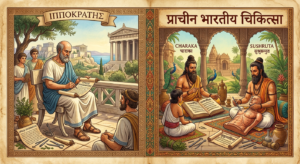
Two and a half thousand years ago, on opposite ends of the known world, two civilizations arrived at almost the same conclusion about the human body without ever comparing notes. In a limestone sanctuary on the Greek island of Kos, a physician named Hippocrates was telling his students that disease was not a curse sent by an angry god, but an imbalance that could be observed, tracked, and treated. Roughly two thousand kilometers east, in the river valleys and forest schools of ancient India, sages compiling what would become the Charaka Samhita were teaching something strikingly similar — that illness followed knowable patterns in the body’s internal balance, and that a good physician’s job was to read those patterns before reaching for a cure. Neither tradition knew the other existed in any detailed way. And yet Greek and Indian Ancient Medicine grew, independently, into two of the most sophisticated systems of healing the ancient world would ever produce.
This is not a story about which tradition was “better” — that’s a question neither history nor medicine can really answer, and pretending otherwise does a disservice to both. It’s a story about two civilizations that looked at the same basic mystery — why do bodies get sick, and what can be done about it — and built two entirely different, remarkably thoughtful answers, each shaped by its own philosophy, religion, and relationship to the natural world.
What Do We Actually Mean by “Greek and Indian Ancient Medicine”?
Before going further, it’s worth being precise about what’s being compared. “Ancient Greek medicine” generally refers to the tradition that emerged from folk healing and temple worship in the Aegean world, crystallized around the physician Hippocrates in the 5th century BC, and was later systematized by the Roman-era Greek physician Galen — a body of thought that would go on to dominate Western medical thinking for well over a thousand years. “Ancient Indian medicine” refers primarily to Ayurveda, a system rooted in the Vedic texts and formalized in two towering compendiums, the Charaka Samhita and the Sushruta Samhita, which together are still consulted by practicing Ayurvedic physicians today — not as historical curiosities, but as living reference texts.
Both traditions share a family resemblance that makes the comparison genuinely useful rather than superficial: both rejected the idea that illness was purely random or purely supernatural, both built theories of balance within the body, both developed extensive pharmacology drawn from plants and minerals, and both trained physicians through long, structured apprenticeships rather than casual trial and error. Where they diverge is just as instructive as where they agree.
Did You Know?
Hippocrates and the compilers of the earliest Ayurvedic texts were likely working within a century or two of each other, yet the fastest realistic way for an idea to travel between Greece and India in that era was overland trade routes that could take the better part of a year one direction. Any genuine exchange of medical theory this early would have been vanishingly rare — which makes the similarities between the two systems even more striking, since they were very probably arrived at independently rather than borrowed.
The Roots: Where Each Tradition Began
India: From Vedic Ritual to a Science of Life
Ayurveda’s earliest roots reach into the Vedic period, where hymns in texts like the Atharvaveda already describe diseases, remedies, and a rudimentary sense of anatomy woven into ritual and religious life. Over centuries, this body of folk and priestly knowledge was gradually formalized into something closer to a coherent medical discipline. According to the tradition recorded within Ayurveda’s own foundational texts, the knowledge was said to descend from divine sources — the god Brahma to Daksha, and eventually to the physician-sage Dhanvantari and his student Divodasa, the king of Kashi — before being passed down through generations of teachers to the human sages who actually wrote it down.
Two names anchor the entire tradition. Charaka, working from an earlier text attributed to a physician named Agnivesha, compiled what became the Charaka Samhita, focused on internal medicine — diagnosis, pharmacology, diet, and the theory of the body’s internal balance. Sushruta, credited as the father of surgery, compiled the Sushruta Samhita, an extraordinarily detailed surgical text describing procedures, instruments, and techniques that wouldn’t be matched in sophistication in most parts of the world for over a thousand years. Together, these two texts — later joined by others, including the Ashtanga Hridaya — form what’s often called the Brihat Trayi, or “great triad,” of classical Ayurveda.
What makes the Indian tradition distinct from the outset is how thoroughly medicine was woven into a broader philosophy of living. Ayurveda literally means “the science of life” (ayus, life, and veda, knowledge), and it was never conceived as a narrow discipline treating isolated symptoms. It was a comprehensive approach to diet, daily routine, mental state, and spiritual practice, with treating disease as only one part of a much larger goal: sustaining a long, balanced, meaningful life.
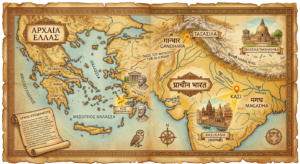
Greece: From the Temples of Asclepius to the Clinic of Hippocrates
Greek medicine began in a very different place — not in sacred texts transmitted from gods to sages, but in temples dedicated to Asclepius, the god of healing, where the sick would travel, sleep within the sanctuary walls, and hope for a dream in which the god revealed a cure. This practice, known as incubation, treated illness as fundamentally a matter for divine intervention, and archaeological remains at sites like Epidaurus show just how seriously that belief was taken — inscriptions there record case after case of visitors claiming miraculous recoveries.
The shift away from purely divine explanations of illness is usually credited to Hippocrates of Kos, active in the 5th century BC, whose name is attached to a large collection of texts known as the Hippocratic Corpus (almost certainly written by multiple authors over decades, not by Hippocrates alone, but unified under his name and general approach). The most radical idea in that corpus wasn’t any specific cure — it was the underlying claim that disease had natural causes that could be observed and reasoned about, rather than supernatural ones that could only be prayed away. A physician’s job, in this view, was to watch the patient closely, track symptoms over time, and intervene based on what the body’s signs actually showed, not on ritual alone.
Roughly six centuries later, the physician Galen, working in Rome, absorbed and systematized Hippocratic theory into an enormously influential framework that would go on to dominate European and Islamic medicine for well over a thousand years, largely unchallenged until the Renaissance began questioning some of its more speculative anatomical claims.
The Core Philosophy: Humors and Doshas
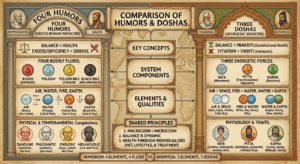
Here is where the comparison between Greek and Indian Ancient Medicine becomes genuinely illuminating, because both traditions independently built their entire medical theory around the same basic idea: health is a state of internal balance between a small number of fundamental substances or forces, and illness is what happens when that balance tips.
In Greek medicine, this took the form of the four humors — blood, phlegm, yellow bile, and black bile — each associated with particular organs, temperaments, and qualities (hot, cold, wet, dry). A physician’s task was to determine which humor was in excess or deficiency and correct it through diet, bloodletting, purging, or other interventions designed to restore equilibrium.
In Ayurveda, the equivalent framework is the tridosha theory: vata (associated with air and movement), pitta (associated with fire and transformation), and kapha (associated with earth, water, and structure). Every person was understood to have a unique natural constitution — a particular balance of the three doshas — and illness arose when that individual balance was disturbed by diet, season, emotion, or environment. Treatment meant identifying which dosha had gone out of balance and using diet, herbs, and lifestyle changes to bring it back.
| Feature | Ancient Greek Medicine (Humoral Theory) | Ancient Indian Medicine (Tridosha / Ayurveda) |
|---|---|---|
| Core elements | Four humors: blood, phlegm, yellow bile, black bile | Three doshas: vata, pitta, kapha |
| Underlying framework | Four qualities: hot, cold, wet, dry | Five elements (Pancha Mahabhuta): earth, water, fire, air, ether |
| Individual variation | Personal temperament shaped by humor balance | Personal constitution (prakriti) unique to each individual |
| Primary foundational texts | Hippocratic Corpus, later Galen’s writings | Charaka Samhita, Sushruta Samhita, Ashtanga Hridaya |
| Key early physicians | Hippocrates, later Galen | Charaka, Sushruta, Vagbhata |
| View of disease cause | Natural imbalance, observable and treatable | Imbalance of doshas, influenced by diet, season, and mind |
| Primary interventions | Diet, bloodletting, purging, rest, herbal remedies | Diet, herbs, oil therapies (Panchakarma), lifestyle regulation |
| Surgical tradition | Present but comparatively limited in scope | Highly developed, especially under Sushruta |
| Relationship to spirituality | Increasingly separated from religion over time | Deeply integrated with broader philosophy of living (dharma) |
It’s worth pausing on how remarkable it is that two civilizations with no meaningful contact both concluded that the body operated on a small set of internal balances rather than being either purely mechanical or purely spiritual. Neither theory holds up under modern biochemistry — humors and doshas aren’t substances a lab can isolate — but both represent a genuine intellectual leap: illness as a pattern that follows rules, rather than a punishment that follows no logic at all.
A Timeline of Greek and Indian Ancient Medicine
| Approximate Date | Indian Medicine (Ayurveda) | Greek Medicine |
|---|---|---|
| c. 1500–1000 BC | Early references to disease and remedies appear in the Atharvaveda | — |
| c. 800–600 BC | Oral medical traditions attributed to Atreya Punarvasu begin circulating among disciples | Temple healing (Asclepion incubation) is the dominant medical practice |
| c. 700–600 BC | Agnivesha compiles an early medical treatise, later revised into the Charaka Samhita | — |
| c. 460–370 BC | — | Hippocrates of Kos is active; the Hippocratic Corpus begins taking shape |
| c. 6th century BC – 1st century AD | Charaka Samhita reaches something close to its current form | — |
| c. 4th century BC | — | Aristotle writes extensively on biology and natural philosophy, influencing later medical thought |
| c. 6th century AD | Sushruta Samhita is further redacted and expanded, including the addition of the Uttara Tantra | — |
| c. 129–216 AD | — | Galen systematizes Hippocratic theory into a dominant medical framework in Rome |
| c. 5th–7th century AD | Vagbhata composes the Ashtanga Hridaya, completing the classical “great triad” of Ayurvedic texts | Galenic medicine spreads through the Byzantine and later Islamic world |
This timeline underlines something easy to miss when the two traditions are discussed separately: Greek and Indian Ancient Medicine weren’t sequential developments, one influencing the other in a tidy chain. They were parallel projects, unfolding across roughly the same many centuries, on different continents, largely in isolation from each other.
The Great Physicians: Different Personalities, Similar Instincts
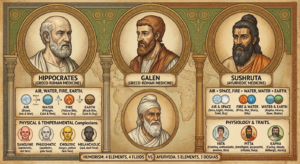
It’s tempting to draw a straight comparison between Hippocrates and Charaka, or between Galen and Sushruta, and there’s real value in doing so — but it’s worth being careful not to flatten four genuinely distinct thinkers into two symmetrical pairs.
Hippocrates is remembered less for any single medical breakthrough than for an attitude: careful observation, honest case notes (including, notably, cases where the patient died — an unusually candid choice for the time), and a professional ethical code that still echoes in the Hippocratic Oath taken by physicians today, even though the oath’s exact origins and authorship remain debated among historians. Charaka, by contrast, built something closer to an entire internal-medicine textbook — covering diagnosis, pharmacology, physiology, and medical ethics with a systematic thoroughness that some historians compare more to Galen’s later, more exhaustive style than to Hippocrates’s case-note approach.
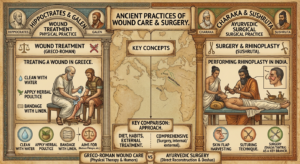
Sushruta’s legacy is more specific and, in some ways, more startling to modern readers. The Sushruta Samhita describes over a hundred surgical instruments and more than 300 surgical procedures, including techniques for cataract removal, cesarean delivery, and — most famously — an early form of reconstructive rhinoplasty, using a flap of skin from the forehead to rebuild a damaged nose, a technique developed partly in response to nose amputation being used as a punishment in some contexts of the period. Versions of this same forehead-flap technique, refined but recognizably related, are still used in modern reconstructive surgery, which is a genuinely rare case of an ancient surgical method surviving in continuous practical relevance rather than only historical interest.
Galen, working centuries after Hippocrates, is a more complicated figure to celebrate uncritically. He was an extraordinarily productive anatomist and a skilled clinician, but much of his anatomical knowledge came from dissecting animals rather than humans, since human dissection was culturally restricted in Rome — an error that would go uncorrected in European medicine for well over a thousand years, in part because Galen’s authority had become almost unquestionable by the time anyone had the tools or the cultural permission to check his work against a human body directly.
Did You Know?
The reconstructive nose surgery described in the Sushruta Samhita is often cited by modern plastic surgeons as one of the earliest detailed descriptions of a technique still recognizable in operating rooms today — nearly two thousand years before “plastic surgery” existed as a named medical specialty anywhere in the world.
Surgery in the Ancient World: A Genuine Point of Divergence
If there’s one area where ancient Greek and Indian medicine genuinely diverged in sophistication rather than simply taking different approaches, it’s surgery. Greek medicine, for all its strengths in observation and diagnosis, treated surgery as a secondary and somewhat lower-status branch of practice, generally reserved for the most straightforward or unavoidable interventions — setting bones, draining abscesses, treating battlefield wounds. Ambitious internal surgery was rare and, given the anatomical knowledge and tools available, frequently fatal.
Indian medicine, through Sushruta’s tradition, pushed considerably further. Beyond the reconstructive techniques already mentioned, the Sushruta Samhita describes methods for cataract couching (displacing the clouded lens to restore partial vision), a detailed classification of wound types, techniques for managing fractures, and even guidance on training surgical skill using practice materials like fruits, leather, and dead animal tissue before ever operating on a living patient — a strikingly modern-sounding approach to surgical education. None of this means Indian surgery was “safe” by modern standards; mortality from any invasive procedure in the ancient world was high across every civilization. But the sheer ambition and specificity of the Sushruta tradition’s surgical catalog has no close parallel in the surviving Greek medical corpus.
Diagnosis and the Physician-Patient Relationship
Both traditions placed enormous weight on the relationship between physician and patient, though they arrived at that emphasis from different directions. Hippocratic medicine encouraged physicians to observe patients over extended periods, tracking pulse, skin color, breath, and the character of bodily discharges, building what amounted to a running case history — a discipline that historians often credit as the ancestor of the modern clinical case study. The Hippocratic tradition also placed unusual emphasis, for its time, on prognosis: predicting how an illness would likely progress, which required close, sustained attention to the individual patient rather than treating every case of a given disease identically.
Ayurvedic diagnosis followed a comparably rigorous, if differently structured, method. Physicians were trained to examine pulse, tongue, skin, urine, and a patient’s overall constitution (prakriti) to determine not just what disease was present, but which dosha imbalance was driving it in that specific individual — meaning two patients with superficially similar symptoms might receive genuinely different treatments depending on their underlying constitutional type. This individualized approach to diagnosis, treating the same surface symptom differently depending on the patient’s makeup, is one of Ayurveda’s most distinctive and enduring features, and it anticipates, in a philosophical rather than biochemical sense, ideas that modern medicine would only formally revisit millennia later under the banner of personalized medicine.
Pharmacology: Nature as Medicine Cabinet
Both Greek and Indian ancient medicine drew heavily on the natural world for treatment, and both built extensive, carefully catalogued bodies of pharmacological knowledge — though the scale and detail again differ.
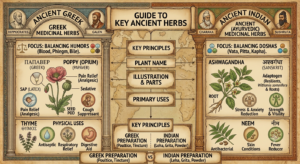
Greek physicians used a range of herbal remedies, many drawn from earlier folk medicine and refined through the Hippocratic tradition — willow bark for pain (a distant ancestor of aspirin’s active compound), various purgatives, and dietary regimens tailored to a patient’s presumed humoral imbalance. Diet, in fact, was treated as a primary medical intervention in its own right, not merely a supporting habit, with entire sections of the Hippocratic Corpus devoted to what foods suited which conditions and constitutions.
Ayurvedic pharmacology went further in scale, cataloguing hundreds of medicinal plants, minerals, and animal-derived substances, organized by their effect on specific doshas and tissues. Beyond herbal treatment, Ayurveda developed an entire category of therapeutic practice known as Panchakarma — a structured sequence of detoxification and purification procedures including therapeutic oil massage, induced sweating, and controlled purging, intended to clear the body of accumulated imbalance before rebuilding it toward health. This procedural, almost ritualized approach to treatment has no precise Greek equivalent, and it reflects Ayurveda’s broader tendency to treat healing as a structured process unfolding over time, rather than a single corrective intervention.
The Philosophy Underneath the Medicine
Neither Greek nor Indian ancient medicine developed in a vacuum, and understanding the philosophical soil each grew from explains a great deal about why the two systems look the way they do.
Greek medicine emerged alongside, and was deeply shaped by, a broader philosophical movement toward naturalistic explanation — the same intellectual climate that produced early Greek natural philosophers questioning what the physical world was fundamentally made of. Hippocratic medicine’s insistence on natural causes over divine punishment mirrors this same cultural shift toward explaining the world through observable cause and effect rather than myth alone, even as temple healing at sites like Epidaurus continued to flourish in parallel for centuries, showing that the naturalistic and the religious approaches to illness coexisted rather than one simply replacing the other.
Ayurveda, by contrast, never separated medicine from its spiritual and philosophical framework in the same way. Health was understood as inseparable from dharma (right living), and the physician’s role extended beyond curing disease into guiding a patient toward a balanced, ethical, and spiritually grounded life. This isn’t a case of Indian medicine being “less scientific” than Greek medicine — Ayurveda’s diagnostic and pharmacological detail rivals or exceeds the Greek tradition in many respects — but rather a case of two civilizations drawing the boundary between “medicine” and “philosophy of living” in fundamentally different places.
Did These Two Traditions Ever Actually Meet?
Given how independently Greek and Indian ancient medicine developed, it’s worth asking whether they ever came into meaningful contact — and the honest answer is: probably only at the edges, and later than either tradition’s formative period.
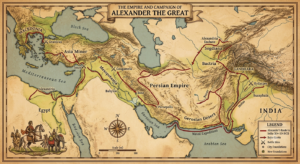
Alexander the Great’s campaigns into northwestern India in the 4th century BC opened a genuine, if limited, channel of contact between Greek and Indian intellectual culture, and the Indo-Greek kingdoms that followed in the region maintained trade and cultural exchange for centuries afterward. Whether this contact produced any direct transfer of medical theory is difficult to establish with confidence — the timing means the core texts of both traditions were already substantially formed by the time meaningful contact began. What’s better documented is a later, indirect connection: Greek medical theory, transmitted and expanded through the Islamic world in the medieval period as Unani medicine, eventually spread into India under Islamic rule centuries after antiquity, where it developed alongside Ayurveda rather than replacing it, and the two systems have coexisted in South Asia in various forms ever since.
So while it’s tempting to imagine ancient Greek and Indian physicians directly comparing notes, the more accurate — and in some ways more remarkable — picture is two civilizations independently discovering strikingly similar core insights about balance, diagnosis, and the natural causes of disease, without ever sitting in the same room to compare them.
Myth vs. Fact
Myth: Ayurveda and Greek humoral medicine are essentially the same system with different names. Fact: While both rest on a theory of internal balance, the underlying frameworks are structurally different — four humors tied to bodily fluids versus three doshas tied to elemental qualities and individual constitution — and they developed independently rather than from a shared source.
Myth: Hippocrates personally wrote the entire Hippocratic Corpus, including the Hippocratic Oath. Fact: Most historians agree the Hippocratic Corpus was written by multiple authors over several decades and later attributed collectively to Hippocrates; the Oath’s precise authorship and even its original wording remain debated.
Myth: Ancient Indian surgery was primitive compared to later Western medicine. Fact: The Sushruta Samhita describes surgical techniques, including reconstructive procedures, of a sophistication that Western surgery would not consistently match for well over a thousand years.
Myth: Galen’s anatomical writings were based on human dissection and therefore highly accurate. Fact: Galen worked primarily from animal dissection due to cultural restrictions on human dissection in Rome, which introduced anatomical errors that persisted in European medicine for centuries.
Myth: Ayurveda has remained completely unchanged since antiquity. Fact: Ayurveda’s foundational texts were themselves redacted, expanded, and updated over centuries — the Charaka Samhita alone was revised by at least one later scholar, Dridhabala — and the tradition has continued evolving through medieval and modern periods.
Why Greek and Indian Ancient Medicine Still Matters
It would be easy to file both of these traditions away as historical curiosities, interesting mainly for how far medicine has come since. That undersells them. Elements of Hippocratic thinking — careful case observation, professional ethics, the idea that a physician’s first obligation is to the patient’s wellbeing — remain embedded in modern clinical training, even where the humoral theory behind them has long been abandoned. Elements of Ayurvedic practice — individualized treatment based on constitution, an emphasis on diet and lifestyle as primary rather than secondary interventions, structured therapeutic protocols — continue to be practiced by millions of people today, and portions of its herbal pharmacology have drawn serious modern scientific interest, even as other claims associated with it remain outside what current evidence supports.
What Greek and Indian ancient medicine share, ultimately, isn’t a common origin or a shared vocabulary. It’s a common instinct: that the human body is not a mystery beyond understanding, that suffering follows patterns a careful observer can learn to read, and that healing is worth studying as seriously as anything else a civilization builds. Two very different cultures, working independently, arrived at that same starting point — and built two of the most enduring medical traditions the ancient world ever produced.

Frequently Asked Questions About Greek and Indian Ancient Medicine
What is the main difference between Greek and Indian ancient medicine? Greek medicine centered on a theory of four bodily humors and developed largely separate from religious explanation over time, while Indian medicine (Ayurveda) centered on three doshas and remained deeply integrated with a broader philosophy of balanced living throughout its history.
Who is considered the father of Greek medicine? Hippocrates of Kos, active in the 5th century BC, is traditionally credited as the father of Greek medicine for shifting the field toward natural explanations of disease and careful clinical observation.
Who is considered the father of Indian surgery? Sushruta, author of the Sushruta Samhita, is traditionally regarded as the father of surgery in ancient Indian medicine, credited with detailed descriptions of surgical instruments and procedures including early reconstructive techniques.
Did ancient Greek and Indian physicians ever influence each other directly? Direct influence during the formative periods of both traditions is not well documented; most historians treat the two systems as having developed independently, with later indirect contact occurring through trade routes and, much later, through the spread of Greek-influenced Unani medicine into South Asia.
Is Ayurveda older than Greek medicine? Ayurveda’s roots in the Vedic texts predate the formal Hippocratic tradition by centuries, though both systems’ core texts were compiled and refined over long periods, making exact “who came first” comparisons difficult to state with precision.
Are the four humors or the three doshas scientifically accurate? Neither framework corresponds to how modern biochemistry describes the body — there is no physical substance called “black bile,” nor are vata, pitta, and kapha measurable biological entities — but both represent early, structured attempts to explain illness through internal balance rather than random chance or pure supernatural punishment.
Important Articel as per History Decoded Hub.
-
Who Was Laozi?
Laozi was an ancient Chinese philosopher and the founder of Taoism (Daoism). He is traditionally credited with writing the Tao Te Ching, a classic work that teaches harmony, simplicity, and living in balance with nature. His philosophy has influenced Chinese culture and spiritual thought for over 2,000 years.
-
Construction of the Pyramids of Giza
The Pyramids of Giza are among the greatest engineering achievements in history. Built around 2580–2510 BCE during Egypt’s Fourth Dynasty, they were constructed using millions of limestone blocks by thousands of skilled workers. These monuments continue to amaze historians and archaeologists with their precision, scale, and enduring legacy.
-
Maya Civilization
The Maya Civilization was one of the most advanced societies of ancient Mesoamerica, flourishing between 2000 BCE and 1500 CE. Renowned for its impressive pyramids, sophisticated calendar, writing system, and achievements in astronomy and mathematics, the Maya left a lasting legacy that continues to fascinate historians and archaeologists.
-
Cai Lun
Cai Lun was a Chinese court official of the Han Dynasty who is traditionally credited with improving the process of papermaking around 105 CE. His innovation made paper more affordable and accessible, transforming education, communication, and the spread of knowledge across the world.