
Battle of Thermopylae: The Untold Story of the 300
Three hundred Spartans did not hold Thermopylae alone. That is the first thing almost every retelling of the Battle of Thermopylae gets wrong, and it is the reason this article exists. Somewhere between Herodotus’s original account and two and a half thousand years of movies, statues, and gym-wall motivational posters, an entire cast of people who bled and died at that pass got quietly erased — the helots who fought as Sparta’s unfree soldiers and whose names no one bothered to record, the seer who could have walked away and chose not to, the four hundred Thebans dragged into a fight they wanted no part of, and the seven hundred men of Thespiae who get one line in most textbooks despite refusing to leave when everyone else did. This is the Battle of Thermopylae with those people put back in.
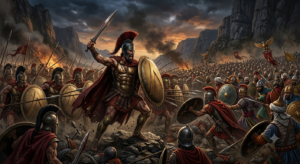
What Was the Battle of Thermopylae, and Why Does It Still Matter?
In August of 480 BC, a coalition of Greek city-states met the invading army of the Persian Empire at a narrow coastal pass called Thermopylae — “the Hot Gates,” named for the sulfur springs steaming out of the rock nearby. For three days, a force that started around seven thousand men and shrank to a rearguard of a few thousand held that pass against a Persian army that Greek sources put in the hundreds of thousands. The Greeks lost. The pass fell. And yet the Battle of Thermopylae is remembered not as a defeat but as the moment a fractured, quarrelsome collection of city-states discovered it might actually be one people worth dying for.
That’s the part that gets flattened into a poster of a Spartan shouting into a pit. The real story is messier, more human, and — once you know who was actually standing in that pass — considerably more moving.
How Do We Actually Know Any of This? The Herodotus Problem
Before going further, it’s worth pausing on something almost no retelling of the Battle of Thermopylae addresses: where this story actually comes from. Nearly everything we know traces back to one man, the historian Herodotus, writing roughly fifty years after the battle, drawing on secondhand accounts, oral tradition, and — by his own admission in other passages — stories he found interesting rather than stories he could fully verify. He wasn’t there. Neither was anyone he interviewed likely to have been an eyewitness to the final hours, since by his own account every Greek at the last stand died.
That matters for how we read details like Xerxes leaping from his throne three times, or the exact wording of Leonidas’s final orders, or the precise Persian casualty figures. These aren’t fabrications, but they’re also not transcripts. Herodotus was working in a tradition that blended history with a kind of moral storytelling, where the “truth” of a story was measured partly by what it revealed about courage, hubris, and fate, not only by what a modern fact-checker could confirm. Later writers — Diodorus Siculus, Plutarch — added their own details centuries afterward, some of which read suspiciously like later embellishment: the famous line about coming to take their weapons appears only in a much later source, written over 500 years after the battle, and is almost certainly a later invention rather than a recorded quote.
None of this means the Battle of Thermopylae didn’t happen roughly as described in its broad strokes — the outnumbered stand, the betrayal, the death of Leonidas are corroborated across multiple ancient sources and align with what we know of Persian and Greek military practice at the time. But the granular, cinematic details — the exact dialogue, the precise emotional beats — are where legend and history blur, and it’s worth knowing that going in.
The Road to Thermopylae: A Decade of Persian Grudges
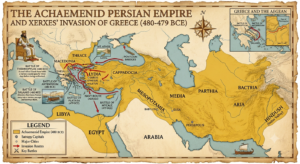
To understand why anyone was standing in that pass at all, you have to go back ten years, to 490 BC, when the Persian king Darius I sent an expeditionary force across the Aegean to punish Athens and Eretria for supporting a revolt among Persia’s Greek subjects in Ionia. That force was beaten at Marathon, a humiliation Darius never got the chance to avenge — he died before he could launch a second invasion, leaving the grudge to his son.
Xerxes I inherited both the throne and the unfinished business. He spent years on preparations that dwarfed anything Darius had attempted: bridging the Hellespont with pontoon boats, cutting a canal through the Athos peninsula so his fleet wouldn’t have to round a headland that had wrecked a previous armada, and stockpiling supply depots along the entire planned route through Thrace and Macedonia. This wasn’t a raid. It was the full weight of the largest empire the world had yet seen, organized to erase an insult a decade old.
Facing that, the Greek world did something it rarely managed: it briefly stopped fighting itself. In 481 BC, delegates from the resisting city-states met at the Isthmus of Corinth and formed what’s usually called the Hellenic League, agreeing to put aside old rivalries — Athens and Sparta included — and coordinate a defense. It didn’t hold everyone. Thebes would later be accused of sympathizing with the Persians, and other states simply sat the war out, submitting rather than risking destruction. But enough cities stayed in to field an army, and that army needed somewhere to make its stand.
The Army Xerxes Actually Brought
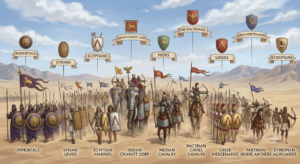
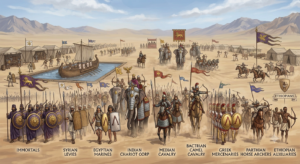
The popular image of the Persian force at Thermopylae is a faceless brown wave, useful mainly as a backdrop for Spartan heroism. The reality was far stranger and, in its own way, more interesting: Xerxes’s army was one of the most ethnically diverse fighting forces the ancient world had ever assembled, drawn from every corner of an empire that stretched from the Indus Valley to Libya. Herodotus catalogs contingents of Medes, Elamites, Assyrians, Bactrians, Indians in cotton armor, Ethiopians carrying stone-tipped arrows, Arabs on camels, and Scythian horse-archers, each unit fighting in its own native style, armed with its own weapons, commanded by its own officers, and speaking languages most of the men around them couldn’t understand. Coordinating that army wasn’t just a matter of numbers; it was a logistical undertaking closer to running an empire on the move than commanding a single force.
Feeding and watering a force of that size was itself a campaign. Modern historians who have tried to model the logistics — water consumption alone, for tens of thousands of men and their pack animals, marching through the dry late-summer terrain of northern Greece — argue this is one of the strongest reasons to doubt Herodotus’s figure of over two million fighting men; an army that size would likely have drained rivers dry and outrun its own supply lines before ever reaching Thermopylae. This is part of why modern estimates land so much lower, and why the Battle of Thermopylae is better understood as an overwhelming numerical mismatch — plausibly ten-to-one or worse — rather than the borderline-mythical hundreds-to-one ratio the ancient sources imply.
It’s also worth remembering that the ordinary soldiers making up this force weren’t fanatics eager to die for Xerxes’s grudge against Athens. Many were levied troops from subject nations with no particular stake in a Greek war, marched enormous distances from home, fighting in a campaign whose failure or success meant relatively little to them personally. The famous Persian discipline that Herodotus describes — officers driving reluctant soldiers forward with whips during the first day’s assault — suggests an army compelled by imperial obligation as much as one united by purpose, a detail that complicates the clean “free Greeks versus despotic horde” framing later centuries liked to draw from the battle.
Spartan Culture and the Making of Men Like Leonidas
To understand why 300 Spartans would walk into a battle they knew was very likely unwinnable, it helps to understand what growing up Spartan actually meant. From around age seven, Spartan boys were removed from their families and placed into the agoge, a state-run education system built almost entirely around military training, physical hardship, and unconditional loyalty to the group over the individual. Deliberate deprivation — inadequate food that encouraged boys to steal (and be punished only if caught), minimal clothing regardless of season, ritualized competition and physical punishment — was designed to produce adults who feared social disgrace far more than they feared death in battle.
That culture produced a specific, almost inverted set of values around the Battle of Thermopylae: a Spartan mother’s most famous recorded instruction to her son heading to war was to return “with his shield or on it” — meaning victorious or dead, but never having thrown the shield away to flee faster, since a dropped shield was the visible mark of a coward in a way a dropped sword or spear wasn’t. Retreat without orders wasn’t merely tactically discouraged, it was one of the few things worse than death in Spartan society. Leonidas, raised inside that system from childhood and having become king relatively unexpectedly after an older brother’s line failed to produce an heir, would have understood a hopeless last stand not as an aberration but as close to the fullest expression of what his entire upbringing had been built to produce.
This doesn’t make the sacrifice less remarkable, but it does make it explicable in a way that “300 heroes chose death” alone doesn’t. Leonidas wasn’t defying his culture at Thermopylae. He was its most complete product.
Why Thermopylae? The Geography Behind the Legend
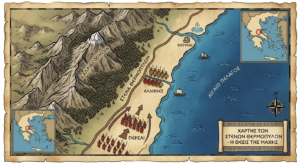
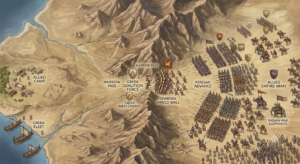
The Greek strategy at Thermopylae wasn’t sentimental, it was mathematical. The pass at the time was a narrow shelf of land squeezed between steep mountains and the sea — in places barely wide enough for a single cart. A Persian army that vastly outnumbered the Greeks in the open field would find that advantage useless in a corridor where only a few hundred men could fight at the front line at any given moment. Numbers stopped mattering the moment the fighting funneled down to that width. It was the ancient equivalent of choosing the doorway instead of the battlefield.
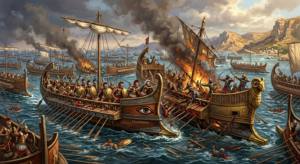
There was a second reason, less discussed: the pass sat near the coast, within supporting distance of the Greek fleet, which was simultaneously engaging the Persian navy in the indecisive battle of Artemisium a short sail away. Thermopylae and Artemisium were not two separate battles that happened to occur at the same time — they were one coordinated defense, land and sea, each protecting the other’s flank. Most retellings of the Battle of Thermopylae drop the naval half entirely, which is a little like telling the story of a bridge while ignoring the fact someone was also holding the riverbank.
The Armies at Thermopylae: Who Was Actually There
Here is where the popular version of the Battle of Thermopylae starts to seriously mislead people. King Leonidas of Sparta did lead roughly 300 Spartan citizen-soldiers to the pass, personally selected men who, per Spartan custom, had already fathered sons to carry on their family lines — a grim detail that tells you Leonidas expected some of them not to come home. But the 300 were never fighting alone, and treating them as the whole story erases most of the people who actually died there.
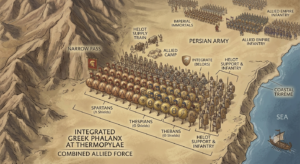
Alongside the Spartans stood roughly 900 helots — the unfree agricultural workers bound to Spartan households, who were brought along as attendants and light troops and who fought and died in numbers historians still argue about, because Spartan sources simply didn’t think their names were worth recording. There were contingents from Tegea, Mantinea, Arcadia, Corinth, Phlius, and Mycenae. There were 700 men from the small city of Thespiae, whose leader Demophilus made the same choice Leonidas did on the final day — to stay — even though nobody was forcing Thespiae’s citizens to die for Sparta’s glory. And there were 400 Thebans, whose loyalty was already suspect and who, according to Herodotus, may have been kept at the pass partly as hostages to Theban good behavior as much as allies.
Add it up and the defenders numbered somewhere around 7,000 at the pass’s peak, against a Persian force that ancient sources inflate to absurd levels — Herodotus claims over two million, a number no modern historian accepts, with serious estimates ranging anywhere from roughly 70,000 to a few hundred thousand fighting troops, still an overwhelming multiple of the Greek force by any measure. Even the low end of that range meant the defenders were outnumbered by ten to one or worse.
Day One: The Pass Holds
When the Persian vanguard arrived and found a few thousand Greeks blocking a pass that should have taken an afternoon to clear, Xerxes reportedly waited four days, assuming they would simply leave once they understood what they were facing. They didn’t. When the assault finally came, Xerxes sent wave after wave of infantry, including regiments specifically chosen for the honor of opening the attack, directly into the narrow front where Greek hoplite armor, long spears, and disciplined phalanx formation turned the fight into a slaughterhouse for the attackers. The Greeks fought in relays, rotating exhausted units to the front and giving fresh men the killing line, a tactic that let a numerically tiny force keep inflicting disproportionate casualties without ever collapsing from fatigue.
By the end of the first day, the elite Persian troops had gained nothing and lost heavily. It must have been a genuinely strange moment for Xerxes — the ruler of the largest army on earth, watching that army fail to move a few thousand men out of a doorway.
Day Two: The Immortals Fail Too
On the second day, Xerxes committed the Immortals — his personal royal guard, ten thousand strong, considered the finest soldiers in the Persian army and reinforced whenever a man fell, so their numbers never visibly dropped. Even they made no better progress than the troops before them. The pass simply didn’t allow their numbers to matter. Two full days of the most powerful military machine in the ancient world had been stopped cold by a force smaller than a modern city’s police department, and Xerxes reportedly leapt from his throne three times in frustration watching it happen.
The Betrayal: Ephialtes and the Path Nobody Was Watching
The Battle of Thermopylae did not end because the Greeks lost the fight in front of them. It ended because of a path behind them. A local Greek named Ephialtes, hoping for a reward, told Xerxes about the Anopaea track — a mountain trail that looped around the pass and would let a Persian column emerge behind the Greek position entirely, unseen. Xerxes sent the Immortals along it that night.
The Phocian troops posted to guard that exact path were caught by surprise at dawn, retreated to higher ground, and — in a decision that has been debated for millennia — did not send word to Leonidas fast enough, or with enough clarity, about how close the Persians actually were. By the time Leonidas understood the trap closing, the choice had already narrowed to almost nothing.
Ephialtes, notably, gained nothing lasting from his betrayal. He fled Greece after the Persian defeat, was later killed over an unrelated matter, and the Greeks placed a bounty on his name that outlived him by generations — a small, bitter footnote most tellings of the Battle of Thermopylae skip past on the way to the more cinematic final stand.
Day Three: The Last Stand, and the Choice to Stay
With the Persians closing in from both directions, Leonidas made the decision that turned a tactical defeat into the story we still tell. He dismissed the bulk of the allied Greek force, sending them south to fight another day rather than die for a position that could no longer be held. What he kept was smaller and more specific than most people realize: his 300 Spartans, the roughly 900 helots who served them, and — crucially — the men of Thespiae, who chose to stay of their own free will, and the Thebans, whose presence at the end is murkier and more disputed, with some ancient accounts suggesting they were kept back rather than volunteering.
This final group, likely under two thousand men against a Persian force closing in from front and rear simultaneously, fought not to win — winning was no longer possible — but to buy time for the retreating army and, arguably, to make a statement the rest of Greece couldn’t ignore. When their spears broke, Herodotus records, they fought with swords, and when the swords broke, with hands and teeth. Leonidas was killed partway through the final fighting, and a vicious struggle broke out over his body, with the Greeks reportedly driving the Persians back four times before finally being overwhelmed. The last defenders were killed by archers firing from a distance once close combat became too costly for the Persians to continue.
The Forgotten Dead: What Almost Nobody Tells You
This is the piece of the Battle of Thermopylae that rarely makes it into the popular version, and it’s the reason this article exists at all.
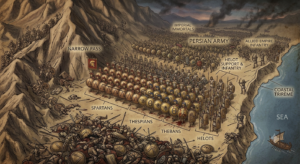
The helots died too, and history didn’t bother naming them. Roughly 900 helots stood and fell alongside the 300 Spartans, doing the same fighting, facing the same Immortals, and dying in the same pass — yet Spartan record-keeping, built around a citizen class that viewed helots as property rather than people, means we don’t have a single one of their names. The “300” of legend were never fighting alone; they were fighting alongside a group nearly three times their size whose sacrifice was written out of the story before it was even finished being told.
The seer who saw his own death and stayed anyway. Among the dead was a diviner named Megistias, who — according to Herodotus — read the omens before the final battle and told Leonidas plainly that death was coming for them that day. Leonidas offered to send him away, since Megistias wasn’t a Spartan and owed no formal duty to stay. He refused, sending only his son to safety, and died with the rest. A separate memorial stone was later raised for him alone, one of the few named individuals from Thermopylae who wasn’t a king or a Spartan.
Thespiae lost more of its citizen body than Sparta did, and gets a fraction of the recognition. Seven hundred Thespians chose, as a body, to remain and die alongside Leonidas — not because Spartan law or custom compelled them, but because their leaders decided the stand was worth making. Proportional to Thespiae’s population, that loss was almost certainly more devastating to the city than Sparta’s loss of 300 professional soldiers was to Sparta. Yet nearly every monument, film, and retelling of the Battle of Thermopylae reduces Thespiae to a footnote, if it mentions them at all.
The Battle Nobody Talks About: Artemisium
While Leonidas held the pass, the Greek fleet — a mixed force led primarily by Athens under Themistocles — was fighting an equally desperate, equally indecisive battle a short distance away at Artemisium, trying to prevent the Persian navy from simply sailing around the land defense and landing troops behind the Greeks entirely. The two battles were fought on the same days, for the same strategic purpose, and news of Thermopylae’s fall reached the fleet at almost the same moment they were considering whether they could hold another day. They withdrew south to Salamis instead, a retreat that turned out to set up the naval battle that would actually decide the war a month later. The Battle of Thermopylae is inseparable from this naval engagement, even though almost nobody puts the two side by side.
Aftermath: Salamis, Plataea, and What the Delay Actually Bought
The immediate military outcome of the Battle of Thermopylae was a Persian victory. The pass fell, the road south lay open, and within weeks Athens itself was evacuated and burned. On paper, three days of fighting changed nothing about the invasion’s trajectory.
Except it did. The delay at Thermopylae gave the rest of Greece critical extra time to organize its defense, evacuate civilian populations, and — most importantly — commit fully to the naval strategy that Themistocles had been arguing for. A month later, the Greek fleet lured the larger Persian navy into the narrow straits of Salamis, where superior numbers again became a liability rather than an advantage, echoing the exact tactical logic of the pass itself, and crushed it. Xerxes, watching his fleet destroyed, withdrew to Persia with much of his army, leaving a reduced force that was finally defeated on land the following year at Plataea. The invasion that had seemed unstoppable in the summer of 480 BC was over within a year, and historians have long argued that the psychological and tactical template set at Thermopylae — hold the narrow ground, make numbers irrelevant — shaped how the Greeks approached Salamis and Plataea both.
The Pass That No Longer Exists
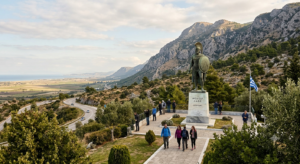
If you visit Thermopylae today expecting to stand in the narrow chokepoint Leonidas defended, you’ll be disappointed — and that disappointment is itself a piece of the story worth telling. The coastline that once ran directly against the mountains at Thermopylae has shifted dramatically over 2,500 years, as sediment from the Spercheios River gradually filled in the Malian Gulf. The sea that once pinned the pass to a width of only a few dozen meters in places has retreated more than a kilometer in some spots. The modern visitor stands on flat farmland, looking at a plaque and a hillside, trying to imagine a chokepoint that geology has since erased.
This is a genuinely useful thing for readers to know, because it explains something that puzzles a lot of people encountering photos of the site for the first time: the battlefield in pictures often looks nothing like the claustrophobic corridor described in every account of the Battle of Thermopylae. It isn’t that the descriptions are exaggerated. It’s that the land itself moved on without the story.
Thermopylae’s Long Afterlife
The Battle of Thermopylae didn’t stay buried in antiquity. The name itself became a kind of shorthand across later centuries for a specific idea — the doomed, defiant defense against impossible odds — reused again and again wherever people wanted to invoke that exact image. In April 1941, when Allied forces briefly tried to hold a defensive line against the German invasion of Greece near the same region, the engagement was deliberately and pointedly nicknamed the “Battle of Thermopylae” by contemporaries who understood exactly which echo they were invoking, even though the tactical situation bore only a loose resemblance to 480 BC.
The epitaph reportedly composed by the poet Simonides for the Spartan dead — commonly rendered as an instruction to tell Sparta that its orders were obeyed to the letter — has been quoted, translated, and inscribed on monuments to fallen soldiers for over two thousand years, appearing everywhere from Victorian war memorials to military academy walls, largely detached from the specific battle that produced it. Few phrases from the ancient world have been repurposed this many times, in this many wars, by this many cultures who had never read a word of Herodotus.
That afterlife is arguably as important to understanding the Battle of Thermopylae as the battle itself. A tactical defeat, in a pass that no longer physically exists, involving perhaps two thousand men at its final stand, became one of the most reused pieces of cultural shorthand in Western history — proof that how a story is remembered can end up mattering more than what actually happened on the ground.
Why the Battle of Thermopylae Still Matters
It would be easy to read the Battle of Thermopylae as a story about heroism and stop there. But the more interesting lesson sits underneath that one: Thermopylae worked, to the extent it worked, because a genuinely diverse coalition — Spartan citizens, unfree helots, Thespian volunteers, and a seer with no obligation to any of them — chose collectively to buy time for people they’d never meet. The individual bravery matters, but it’s the collective, multi-class, multi-city nature of the sacrifice that made the delay possible in the first place. A single Spartan king with 300 soldiers and no one else would have died in an afternoon. It was the presence of everyone history quietly wrote out — the helots, the Thespians, the seer — that made three days possible instead of one.
That’s the version of the Battle of Thermopylae worth remembering: not 300 men standing alone, but a small, unequal, and largely unnamed coalition that understood exactly what it was buying, and for whom.
Important Article as per History Decoded Hub.
-
Discover the Rise and Fall of the Ottoman Empire
The Battle of Thermopylae became a symbol of courage that inspired warriors and empires for centuries. Among those great powers was the Ottoman Empire, one of history’s longest-lasting and most influential empires. From its remarkable rise in the 13th century to the conquest of Constantinople and its eventual collapse after World War I, the Ottoman story reshaped Europe, Asia, and the Middle East. Explore our complete guide to the Rise and Fall of the Ottoman Empire to uncover the empire’s greatest rulers, military campaigns, cultural achievements, and the reasons behind its decline.
Best External Link (Recommended)
- Encyclopaedia Britannica – Battle of Thermopylae