
Introduction
Somewhere around the year 1299, a minor Turkic chieftain named Osman declared independence from a crumbling Seljuk sultanate in a small town called Söğüt, in what’s now northwestern Turkey. He controlled a strip of land you could walk across in an afternoon. Nobody in Constantinople, the great Byzantine capital sitting just across the frontier, would have taken this particular warlord seriously enough to lose sleep over him.
Six hundred and twenty-three years later, in November 1922, the last Ottoman sultan quietly left Istanbul aboard a British warship, and an empire that had once reached the gates of Vienna, ruled over three continents, and controlled some of the most important trade routes on Earth simply ceased to exist.
That’s a genuinely wild gap to sit with. Between those two moments is one of the longest-running, most consequential empires in world history — and one that, in most people’s heads, gets flattened into a handful of stock images: janissaries, harems, Suleiman the Magnificent, maybe the fall of Constantinople if a school lesson stuck. There’s a lot more going on underneath that, and honestly, most of the interesting parts don’t make it into the highlight reel.
Ottoman Empire Timeline: Key Dates at a Glance
Before diving in, here’s the shape of the whole story in one place, so you’ve got something to hold onto as the narrative gets more detailed below:
| Year | Event |
|---|---|
| c. 1299 | Osman I establishes the Ottoman state in northwestern Anatolia |
| 1354 | Ottomans cross the Dardanelles and establish a permanent foothold in Europe |
| 1389 | Battle of Kosovo — Ottoman victory brings most of Serbia under Ottoman influence |
| 1402 | Battle of Ankara — catastrophic defeat by Timur, followed by a decade-long Ottoman civil war |
| 1453 | Mehmed II conquers Constantinople, ending the Byzantine Empire |
| 1520 | Suleiman I becomes sultan, beginning the 46-year Golden Age |
| 1526 | Battle of Mohács — Ottoman forces crush the Hungarian army |
| 1529 | First Siege of Vienna (unsuccessful) |
| 1571 | Battle of Lepanto — major naval defeat against a European Christian coalition |
| 1683 | Second Siege of Vienna fails, marking the start of sustained territorial contraction |
| 1839 | Tanzimat reforms begin under Sultan Abdülmecid I |
| 1908 | Young Turk Revolution restores the constitution |
| 1914 | Ottoman Empire enters World War I on the side of the Central Powers |
| 1922 | The Ottoman sultanate is formally abolished |
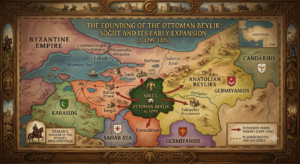
From Nothing: The Founding Myth and the Real Beginning
Here’s an awkward truth historians just have to live with: almost nothing reliable survives about Osman I as an actual person. Every chronicle describing his life was written more than a century after he died, by court historians who had every reason on earth to make the empire’s founder look like he was destined for greatness from birth. The most famous story to survive from this — the “Dream of Osman” — has him falling asleep at the home of a local religious teacher named Edebali and seeing a vision of a tree growing out of his own chest, its branches spreading until they cover the entire world. Edebali reads this as divine confirmation, hands over his daughter in marriage, and, according to legend, more or less blesses an empire that hasn’t been built yet.
Nice story. Almost certainly embellished. Possibly invented outright, start to finish. What we can say with a bit more confidence is duller but more honest: Osman inherited a small frontier territory from his father Ertuğrul, took full advantage of a Seljuk state that was falling apart under Mongol pressure, and spent his reign raiding and absorbing Byzantine border towns — a strategy that worked precisely because the two powers flanking him, Seljuk and Byzantine, were both too weak to do much about it. Osman died around 1323 or 1324, right as his forces finally took the city of Bursa after a long siege. His son Orhan inherited both the throne and the momentum, and it was Orhan who actually turned Bursa into the empire’s first real capital.
So that’s the unglamorous truth behind six centuries of Ottoman rule: not some grand, destined conquest, but a small warband quietly picking off a weakened neighbor’s territory, piece by piece, at exactly the right historical moment. Timing, more than genius, gets this thing off the ground.
Crossing Into Europe and Taking Constantinople
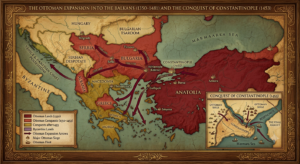
Within a few decades, the Ottomans stopped being merely an Anatolian headache. In 1354 they crossed the Dardanelles and got their first permanent foothold in Europe. By 1369 the capital had already moved to Edirne, deep in the Balkans — which tells you exactly how fast this “small frontier tribe” had turned into something much bigger.
[A historical map showing Ottoman territorial expansion from Osman’s original beylik through the empire’s 17th-century peak would sit well here — it’s genuinely hard to grasp the scale of the growth without seeing it laid out.]
The Ottomans took Serbia after their decisive win at the Battle of Kosovo in 1389, a battle that, even today, still carries enormous symbolic weight in Serbian national memory. By the early 1400s they controlled most of the Balkan peninsula. There was a real hiccup along the way, though — a brutal defeat at the Battle of Ankara in 1402 against Timur (Tamerlane) that plunged the empire into over a decade of civil war between Bayezid I’s sons. For a stretch there, the whole project genuinely looked like it might unravel before it got a real chance to matter. It didn’t. The dynasty pulled itself back together, and within fifty years, Ottoman ambitions turned toward the one prize that had eluded every Islamic power for seven centuries: Constantinople itself.
Sultan Mehmed II — twenty-one years old at the time, which is worth just sitting with for a second — finally took the city in 1453 after a brutal siege, using massive purpose-built cannons to breach walls that had turned back armies for a thousand years. This didn’t just hand the Ottomans a spectacular new capital, renamed Istanbul. It symbolically ended the Byzantine Empire, the last direct continuation of Rome, and announced to the rest of Europe, in no uncertain terms, that a serious new power had arrived. Mehmed earned the epithet “the Conqueror” for exactly this reason, and it’s hard to argue he didn’t earn it.
Why Did the Ottoman Empire Become So Powerful?
Worth pausing here to actually ask the question directly: how does a frontier warband end up ruling three continents? It wasn’t one single trick. It was several advantages, all stacking on top of each other at once.
Start with geography. The empire sat right on the land bridge between Europe and Asia, and once it controlled the Bosphorus after 1453, it could tax, license, or simply block trade between the Mediterranean and the Black Sea however it liked. Very few empires in history have held a chokepoint that valuable for that long.
Then there’s the military structure, which honestly gets underrated. While much of medieval Europe was still leaning on feudal levies — nobles showing up with whatever soldiers they could scrape together, for however long they felt like fighting — the Ottomans built something closer to a standing, salaried, professional core. That’s a genuinely different kind of army, and it shows up in the results.
They were also fast — genuinely fast, for the period — to adopt gunpowder weapons and refine them. The siege guns that finally cracked Constantinople’s walls in 1453 weren’t a fluke; the empire kept investing heavily in artillery and firearms long after that, well past the point where several rivals were still hesitating.
The Janissary corps deserves its own mention here too. As elite standing infantry, salaried and loyal directly to the sultan rather than to some regional lord, they gave Ottoman rulers a dependable core force that didn’t just dissolve the second a campaign season ended — unlike most feudal armies of the era.
Add to that control over major trade routes, not just the Bosphorus but a huge share of the paths connecting Europe, the Middle East, and Asian commerce — real leverage, and real customs revenue, flowing straight into Istanbul.
And then there’s the administration itself, which was smarter than it gets credit for. Rather than trying to forcibly stamp uniform rule on every new territory, the Ottomans frequently let conquered populations keep much of their existing local structure, as long as tribute kept flowing and loyalty wasn’t in question. That’s a much cheaper way to run an empire than rebuilding every province from scratch, and it shows in how quickly the territory kept growing.
Local elites got folded into the system rather than eliminated, too, which cut down on resistance and handed the empire a ready-made administrative layer wherever it expanded next.
And finally — this part doesn’t get discussed nearly enough — the neighbors were weak at exactly the right moment. The Ottomans rose precisely when Byzantium was a shell of its former self and the Seljuks were disintegrating under Mongol pressure. Arrive a century earlier or later, facing stronger neighbors on both sides, and this whole story plays out very differently.
The Golden Age: Suleiman and the Empire at Its Peak
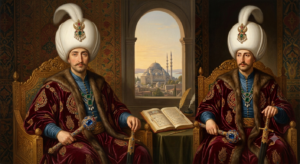
Ask most historians to name a single Ottoman ruler, and the answer is almost always Suleiman I, who reigned from 1520 to 1566 — forty-six years, the longest of any Ottoman sultan. Europeans called him “the Magnificent.” His own people called him “Kanuni,” the Lawgiver, which honestly tells you a lot more about what actually mattered for the empire’s long-term survival.
Suleiman inherited a strong hand already — his father Selim I had spent the previous eight years conquering the Mamluk Sultanate and expanding Ottoman territory by roughly 70%, while also claiming the title of Caliph, spiritual leader of Sunni Islam. Suleiman then spent much of his own reign personally leading military campaigns — thirteen of them by most counts, eating up more than ten years of his life on actual battlefields. He took Belgrade in 1521, captured Rhodes from the Knights Hospitaller in 1522, crushed the Hungarian army at the brutal Battle of Mohács in 1526 — killing the young Hungarian king and roughly 14,000 of his soldiers in a single afternoon — and pushed Ottoman forces all the way to the gates of Vienna in 1529, though the siege ultimately failed and the city held.
But the conquests, dramatic as they were, aren’t really why historians still call this the “Golden Age.” Suleiman put just as much energy into the far less glamorous work of actually running the empire he’d inherited. He overhauled the legal system, blending Islamic religious law (sharia) with a separate body of secular administrative law (kanun) covering taxation, land use, and criminal penalties — a more uniform, less arbitrary framework across territory stretching from Hungary to the Persian Gulf. He was also, by the standards of his era, notably protective of religious minorities. At one point he issued a decree explicitly denouncing blood libel accusations against Jewish communities — at a time when such accusations were routinely tolerated, even encouraged, elsewhere in Europe.
And then there’s the architecture. Suleiman’s chief architect, a genius named Mimar Sinan, designed hundreds of buildings during this period, including the Süleymaniye Mosque, which still dominates Istanbul’s skyline today. Ottoman art, calligraphy, textile work, and manuscript painting all hit new heights under his patronage — a level of cultural investment historians treat as inseparable from the empire’s political power at the time, not just decoration bolted on the side.
By the time Suleiman died in 1566, the empire spanned three continents, ruled over more than 25 million people, and stood as arguably the most powerful state on Earth. Not a bad forty-six years.
How the Ottoman Empire Worked: Structure of Power
Saying the empire “had a bureaucracy” doesn’t tell you much. It’s more useful to actually trace how authority moved from the top down:
Sultan → Grand Vizier → Imperial Council (Divan) → Provincial Governors → Local Administration
At the top sat the sultan, holding absolute authority on paper, though in practice a huge share of the actual day-to-day running of the empire fell to the Grand Vizier — essentially the sultan’s chief minister, who chaired the Imperial Council (the Divan) and oversaw the machinery of state on the sultan’s behalf. Below that sat a layer of specialized officials handling finance, foreign affairs, and religious or legal matters, the latter overseen by the empire’s chief religious authority, the Şeyhülislam.
Out in the provinces, the empire was carved into administrative units run by appointed governors responsible for local order, tax collection, and raising troops on demand. These governors typically had real day-to-day latitude, provided tribute kept flowing to Istanbul and loyalty wasn’t in question — which, again, is a big part of why the empire could expand so fast without having to micromanage every corner of it from the capital.
Underneath the governors sat local administration proper: town councils, religious court judges (qadis) applying sharia and kanun to everyday disputes, and community leaders drawn from the millet system described below. For most ordinary subjects, this was the actual face of imperial authority they dealt with — not some distant sultan in a palace they’d never see.
That’s a big part of why the empire could absorb such staggering cultural and religious diversity without falling apart at the seams every few decades: power was centralized on paper, but genuinely distributed in practice.
The Institutions That Held It Together
The devshirme system. Probably the strangest, and to modern eyes the most unsettling, Ottoman institution was devshirme — a periodic levy in which Christian boys from the Balkans were taken from their families, converted to Islam, and trained for either military or administrative service. The most elite product of this system was the Janissary corps, already mentioned above. Some devshirme recruits who showed real administrative talent rose all the way to grand vizier, the empire’s most powerful official after the sultan himself — a genuinely striking path for a boy taken from a Balkan village as a child, whatever else you make of how he got there.
The millet system. Rather than forcing religious uniformity across an empire packed with huge Christian and Jewish populations, the Ottomans organized non-Muslim communities into self-governing religious blocs called millets, each with its own leadership handling internal legal matters — marriage, inheritance, local disputes — while still answering to the imperial state on taxation and overall loyalty. This wasn’t equality in any modern sense. Non-Muslims paid additional taxes and faced real restrictions. But as a deliberate alternative to forced conversion, it let the empire absorb enormous diversity without constant religious civil war, which is more than a lot of contemporary states could say for themselves.
Life Inside the Ottoman Empire
It’s easy for an article like this one to turn into a parade of sultans and battles and quietly lose the actual people who lived under all of it for six centuries. Worth correcting that before moving on.
Most Ottoman subjects were peasant farmers, and rural land was frequently organized under the timar system — cavalry officers received the right to collect revenue from a piece of land in exchange for military service, broadly similar in spirit to European feudal arrangements, if administered rather differently in practice. Farmers paid their taxes in cash or in kind and, in return, generally kept hereditary rights to their land as long as obligations were met.
Ottoman cities, meanwhile, ran on powerful craft guilds regulating pricing, quality, and training within specific trades — weaving, metalwork, food production, you name it. Istanbul and Bursa, and later Aleppo and Cairo, functioned as genuine hubs of Mediterranean and Asian trade, with merchant communities — including plenty of non-Muslim traders operating under the millet system — playing an outsized role in the empire’s commercial life.
Muslims formed the ruling establishment, but Christian and Jewish populations were substantial minorities, particularly across the Balkans and in major trading cities. Jewish communities expelled from Spain in 1492 were notably welcomed into Ottoman territory, and many went on to become prominent in trade, medicine, and administration — a detail that says something real about how the empire saw its own self-interest.
Formal political and legal power belonged overwhelmingly to men, but that doesn’t mean women had none. Within the imperial court especially, royal women could and did wield real informal influence — Suleiman’s wife Hürrem Sultan is the most famous example, and the later “Sultanate of Women” period saw royal women genuinely shaping succession politics and policy from inside the palace walls. Outside the court, daily life for women varied enormously by region, religion, and class, and it would be a mistake to flatten that into one tidy generalization across six centuries and three continents.
Ottoman cities centered around covered markets, mosque complexes that often folded in schools, libraries, and charitable kitchens, and public baths that functioned as social hubs as much as places to actually get clean. Education for Muslim boys typically ran through mosque-affiliated schools, while millet communities generally ran their own separate religious schools.
And then there was taxation — never anyone’s favorite topic, but genuinely important here. Subjects paid different taxes depending on status, religion, and occupation: land taxes, market and trade duties, and, for non-Muslim men, the jizya tax in exchange for exemption from military conscription. Tax farming, where the right to collect taxes in a given region was auctioned off to the highest bidder, became increasingly common in later centuries. It generated quick cash for the treasury, sure — but it also frequently led to abusive over-collection at the local level, and it eventually became one of the empire’s genuine, ongoing administrative headaches.
Three Centuries of Slow, Uneven Decline
Most short summaries get lazy right about here — they treat everything after Suleiman as one long, inevitable slide into irrelevance. That’s not really accurate, and it’s worth slowing down to get it right.
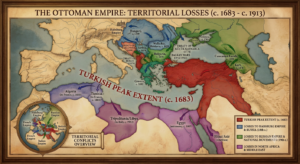
The failed second siege of Vienna in 1683 is usually marked as the real turning point, the moment Ottoman westward expansion definitively stalled and started reversing. But the empire didn’t collapse for another 239 years after that. Two hundred and thirty-nine years is a long time to be “declining.”
Why the Empire Declined: Internal Pressures
Succession itself became a genuine liability. Ottoman practice had at times involved a new sultan executing his own brothers to eliminate rival claimants — brutal, but at least it produced sultans who’d had to fight for the throne. Later practice shifted toward confining potential heirs to a section of the palace known, bluntly, as the “cage.” Less bloodshed, sure, but it also frequently produced sultans with almost no practical governing experience by the time they actually took power.
The Janissary corps, the very institution that had once been the empire’s sharpest edge, became a political problem in its own right. Over generations it drifted from a meritocratic elite fighting force into a hereditary, increasingly conservative interest group that resisted military reforms threatening its own privileges — including, more than once, reforms that might have kept the army genuinely competitive with rapidly modernizing European forces.
And administratively, as tax farming spread and provincial governors gained more effective independence, the central treasury increasingly struggled to collect revenue efficiently or hold consistent control over territory far from Istanbul.
Why the Empire Declined: External Pressures
European states spent the 1600s and 1700s steadily professionalizing their militaries — new tactics, new technology, often faster than the Ottomans could match once that early gunpowder edge eroded.
Russia turned into a persistent, increasingly successful rival, repeatedly pushing into Ottoman territory around the Black Sea and Caucasus across a string of Russo-Turkish wars running from the 1600s well into the 1800s.
Then came 19th-century nationalism, which proved especially corrosive for a multi-ethnic empire built the way this one was. Greece won independence in the 1820s. Serbia, Romania, and Bulgaria followed by the 1870s. Every loss shrank the tax base and territory at once, while quietly encouraging the next nationalist movement waiting in the wings.
And global trade patterns shifted underneath the empire’s feet — as European powers opened new Atlantic and around-Africa routes, some of the overland and Mediterranean trade advantages that had once made Ottoman territory so commercially valuable simply mattered less than they used to.
The 19th-Century Response
Here’s the part that’s genuinely underappreciated: the empire didn’t just sit there and wait to die. The Tanzimat (“Reorganization”) reforms, beginning in 1839, attempted a serious overhaul of legal rights, administrative structure, and tax collection along more centralized, European-influenced lines. Sustained military modernization ran alongside it, and eventually genuine constitutional experiments followed too — the 1876 Ottoman constitution, and the restoration of parliamentary government after the 1908 Young Turk Revolution.
None of it ultimately saved the empire. But it bought real time, produced genuine institutional change, and complicates any lazy narrative treating 1683 to 1922 as one smooth, uninterrupted collapse. A state supposedly “on its deathbed” by the 1850s held together, adapted, and kept functioning for another seventy-plus years. That’s not what unbroken terminal decline actually looks like — it’s closer to a very long, very difficult fight to stay relevant.
The Final Collapse
What finally did end it was World War I. The Ottoman Empire allied with Germany and the Central Powers, and the catastrophic defeat that followed triggered the empire’s dismemberment by the victorious Allied powers. This period also saw the Armenian genocide, in which an estimated 1.5 million Armenians were killed or died during forced deportation — one of the darkest chapters of the empire’s final years, and one that remains a significant point of ongoing historical and political dispute today.
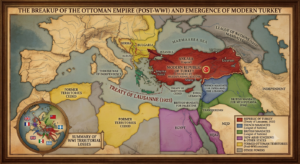
Mustafa Kemal, later known as Atatürk, led a nationalist resistance movement that rejected the harsh postwar Treaty of Sèvres, fought off occupying Allied forces, and ultimately negotiated the more favorable Treaty of Lausanne in 1923. Along the way, the Grand National Assembly formally abolished the Ottoman sultanate on November 1, 1922. The last sultan, Mehmed VI, left the country weeks later. An empire that had run continuously since roughly 1299 was over — not through one dramatic final battle, but through a nationalist movement that simply built a new state on top of the wreckage of the old one.
Ottoman Empire vs. European Powers
A short side-by-side helps put the empire’s structure in context against its contemporaries:
| Area | Ottoman Empire | Contemporary European Powers |
|---|---|---|
| Government | Sultanate with a central bureaucracy (Grand Vizier, Divan) | Various monarchies and, later, republics |
| Military | Standing Janissary corps plus provincial forces | Increasingly professional standing armies from the 1600s onward |
| Religion | Muslim ruling dynasty governing diverse faiths via the millet system | Religious makeup varied significantly by state, generally less formally pluralistic |
| Trade | Controlled key Mediterranean, Black Sea, and overland Asian trade routes | Increasingly focused on expanding Atlantic and colonial trade networks |
| Reform era | Tanzimat reforms (from 1839) | Industrial Revolution-era military and administrative modernization |
Why the Ottoman Empire Still Matters
It’s tempting to file the Ottoman Empire away as a “medieval” story, something that belongs entirely to the past. It doesn’t, not really. Modern Turkey is its direct successor state. Much of the ethnic tension still simmering across the Middle East and Balkans traces back, in real part, to how Ottoman territory got carved up after 1918 — the Kurdish question, various Balkan conflicts, a good chunk of Middle Eastern border disputes all run straight through Ottoman-era administrative decisions and how they got redrawn once the empire was gone.
What actually makes the empire worth studying seriously, rather than just skimming for the highlight reel, is the sheer range of what it managed to hold together for so long: a legal system blending religious and secular law, a governing class partly built from converted child conscripts, a patchwork of self-governing religious communities, and a military and administrative machine flexible enough to absorb enormous cultural diversity without constant internal collapse. It got plenty wrong along the way, and its final years involved real atrocities that deserve to be studied honestly, not glossed over for the sake of a tidier story. But six hundred years is an extraordinarily long run for any political structure — longer than most countries currently on a map have existed at all — and that kind of endurance just doesn’t happen by accident.
Frequently Asked Questions
Who founded the Ottoman Empire? The Ottoman Empire was founded around 1299 by Osman I, a Turkic frontier chieftain in northwestern Anatolia. The empire is named after him.
When did the Ottoman Empire fall? The Ottoman Empire formally ended on November 1, 1922, when the Grand National Assembly of Turkey abolished the sultanate. The last sultan, Mehmed VI, left the country shortly afterward.
Who was the greatest Ottoman sultan? Suleiman I, known as “the Magnificent” in Europe and “Kanuni” (the Lawgiver) among Ottomans, is generally considered the empire’s greatest ruler. His 46-year reign (1520–1566) is regarded as the empire’s Golden Age, marked by territorial expansion, legal reform, and cultural achievement.
When did the Ottomans conquer Constantinople? Sultan Mehmed II captured Constantinople in 1453, ending the Byzantine Empire and establishing the city, later renamed Istanbul, as the Ottoman capital.
Why did the Ottoman Empire become so powerful? The empire’s rise combined strategic control of trade routes and the Bosphorus chokepoint, early adoption of gunpowder weapons, a professional standing military in the Janissary corps, flexible administration that co-opted local elites, and the fortunate timing of expanding into a region where its Byzantine and Seljuk neighbors were both already in decline.
Why was the Ottoman Empire called the “sick man of Europe”? The term was coined by Russia’s Tsar Nicholas I in the mid-19th century to describe the empire’s economic struggles, territorial losses, and political instability. Despite the label, the empire survived for roughly seventy more years before finally collapsing after World War I.
What was the devshirme system? Devshirme was an Ottoman practice of periodically conscripting Christian boys from the Balkans, converting them to Islam, and training them for military or administrative service. It produced the elite Janissary corps and, in some cases, senior officials including grand viziers.
How long did the Ottoman Empire last? The Ottoman Empire lasted approximately 623 years, from its founding around 1299 to its formal abolition
Important Article as per History Decoded Hub.com
Battle of Plassey
The Battle of Plassey (1757) was a turning point in Indian history. The East India Company’s victory over Siraj-ud-Daulah helped it gain political and economic control over Bengal, laying the foundation for British rule in India. Read our detailed article on the Battle of Plassey to learn how this historic battle changed India.
Battle of Thermopylae
The Battle of Thermopylae was one of the most famous conflicts of the Greco-Persian Wars, where King Leonidas and a small Greek force stood against the much larger Persian army. The battle became a lasting symbol of courage, sacrifice, and resistance. Read the full story of the [Battle of Thermopylae] to discover what really happened at the legendary pass.