
Here’s a fact that trips people up every time I mention it: the man widely regarded as India’s greatest emperor couldn’t read. Not “struggled with reading.” Couldn’t do it at all. Akbar sat through nightly religious debates featuring theologians, priests, and monks quoting scripture at each other, and he had to have every single word of it read to him aloud. And yet this same man ended up commissioning some of the finest illustrated manuscripts the medieval world ever produced, and running an empire more sophisticated in its bureaucracy than most of what Europe had going at the time.
It’s one of those details about history that sounds made up. It isn’t.
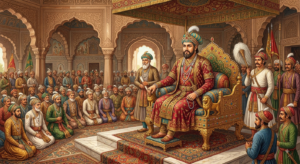
Early Life: A Throne Won Before It Was Truly His
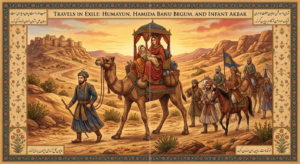
Let’s back up. Akbar was born on October 15, 1542, in Umarkot, a fort in Sindh — and not because his family had any particular fondness for Sindh. His father Humayun had just gotten thrown out of India entirely by an Afghan rival named Sher Shah Suri, and Akbar’s pregnant mother, Hamida Banu Begum, was travelling with a fleeing court that had, by this point, basically nothing left. Local kindness from a Hindu ruler named Rana Prasad is the only reason the birth happened somewhere with a roof over it.
So Akbar’s childhood wasn’t spent in a palace nursery being fussed over. It was spent bouncing between Kabul and Kandahar, frequently apart from his own parents, raised in bits and pieces by uncles while his father tried, and mostly failed, to claw back a kingdom.
Humayun did eventually get the throne back in 1555. Fifteen years of exile, and he lasted maybe six months back in power before he tripped down a staircase in his own library and died from the fall — a genuinely strange way for an emperor to go, and historians have noted the irony that it happened in a library given what his son would later do with knowledge and scholarship.
Akbar was thirteen. He got crowned in a mango orchard in Kalanaur in February 1556 because there wasn’t time to arrange anything more dignified — no palace ceremony, no elaborate ritual, just a boy, a hastily assembled court, and a kingdom that every rival in North India assumed was about to fall apart.
They weren’t being unreasonable. It nearly did.
The Battle That Could Have Ended Everything Before It Started
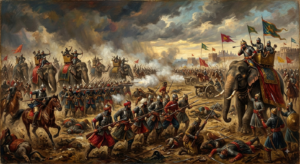
For the first few years, the actual running of things fell to Bairam Khan, Akbar’s regent — a hardened general who’d been loyal to the Mughals through the worst of their bad years. And it’s Bairam Khan who deserves a lot of credit for the moment that decided whether the Mughal Empire would exist at all: the Second Battle of Panipat, November 1556.
The opponent was a man named Hemu, a former general who’d done rather well for himself amid the chaos, seized Delhi and Agra, and declared himself king. By the accounts that survive, his army had the better of it early on — he even had war elephants, which tended to be a decisive advantage in this period. Then an arrow hit him in the eye. His army, suddenly leaderless in the middle of a battle, fell apart.
I won’t pretend this was some brilliant Mughal tactical masterstroke. A lot of it was luck — a single arrow, at a single moment. But luck or not, it saved the empire, and Akbar’s side knew how to capitalize on the chaos it created.
By 1560, Akbar had had enough of being managed. He dismissed Bairam Khan and started ruling in his own right. What came next, over the following four decades, is really two different stories happening at once — one about conquest, and a much more interesting one about what he did after the fighting stopped.
Akbar’s Conquests and Expansion of the Mughal Empire
By the time Akbar died in 1605, Mughal territory stretched from Kabul in the northwest across the Gangetic plain to Bengal in the east, and south into the Gujarat region and the northern reaches of the Deccan plateau. That’s the honest version — you’ll sometimes see claims that his empire reached the Godavari River or covered the entire Deccan, but that overstates it. Akbar’s forces annexed Khandesh, Berar, and only part of Ahmadnagar by 1601; the rest of the Deccan sultanates never fully submitted, and Mughal control there stayed contested and partial right up to his death.
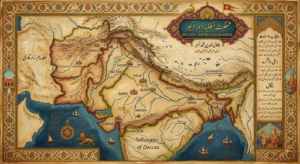
The conquest itself came in phases rather than one continuous sweep:
| Region | Approx. Period | Significance |
|---|---|---|
| Malwa | 1561–62 | First major conquest, opened the route toward central India |
| Rajputana (Rajasthan) | 1560s–70s | Chittor and Ranthambore fell; most Rajput states accepted Mughal suzerainty, though Mewar under Rana Pratap resisted throughout Akbar’s reign |
| Gujarat | 1572–73 | Secured access to major western trade ports |
| Bengal | 1570s–76 | Brought the wealthy eastern territories under Mughal control |
| Kashmir | 1586 | Extended Mughal reach into the northwest |
| Sindh | 1591 | Extended control toward the Indus |
| Kandahar | 1595 | Secured a key Afghan frontier post |
| Khandesh, Berar, part of Ahmadnagar | 1595–1601 | Mughal Empire’s first real foothold in the Deccan, though incomplete — full conquest of the region wasn’t achieved until decades after Akbar’s death |
Worth noting: Mewar, under Rana Pratap and later his son, never formally submitted to Akbar despite repeated campaigns, including the famous Battle of Haldighati in 1576. It’s a detail a lot of shorter articles leave out, but it matters — Akbar’s conquests were extensive, not total.
Akbar’s Administration and the Mansabdari System
Conquering territory is the part every article covers. Holding onto it is the part that actually separates Akbar from most medieval conquerors, and it’s worth slowing down here.
Mansabdari. Every Mughal officer, civil or military, was assigned a numerical rank called a mansab — Arabic for “position” or “rank.” Ranks ran from 10 up to 5,000 for most nobles (occasionally higher for princes), and the number determined both an officer’s status and salary. Akbar refined this system significantly during his reign, formalizing it further in the 1590s.
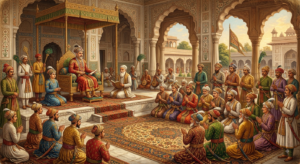
Zat and Sawar. From the mid-1590s onward, a mansabdar’s rank was expressed as two numbers rather than one — zat and sawar. Zat was the personal rank, fixing status and base salary. Sawar indicated how many cavalrymen, horses, and equipment the officer was obligated to maintain and bring to imperial service. A mansabdar with 5,000 zat and 2,000 sawar outranked one with 4,000 zat and 3,000 sawar — status was decided by zat first, cavalry commitment second.
Naqdi and Jagirdari. Mansabdars were paid one of two ways: in straight cash from the treasury (naqdi), or through the right to collect revenue from an assigned tract of land, called a jagir. Officers holding jagirs were called jagirdars, and this arrangement — the jagirdari system — became the more common form of payment as the empire grew, simply because there wasn’t enough cash in the treasury to pay everyone directly. Akbar divided imperial territory broadly into khalisa (crown land, whose revenue went straight to the treasury) and jagir land (assigned out to officers in lieu of salary).
Zabt and the Dahsala system. On the revenue side, Akbar worked with his finance minister Raja Todar Mal to move away from arbitrary, locally set tax demands toward a standardized assessment — the zabt system. This culminated in the dahsala arrangement of 1580: land revenue was calculated using the average yield and average price of crops over the preceding ten years (das = ten, sala = year), giving both the state and the peasantry a predictable, verifiable figure rather than a number pulled from thin air by whichever local official was collecting that season.
Provincial and military structure. The empire was divided into provinces (subas), each headed by a governor (subadar) responsible for administration and defense, with separate officials handling revenue collection and justice at the provincial level — a rough separation of powers that reduced the chance of any single governor accumulating unchecked authority. Mansabdars were also rotated between postings periodically, a deliberate policy to prevent any noble from building a permanent, entrenched regional power base.
Taken together, this is why historians treat Akbar’s reign as a genuine turning point in Indian administrative history rather than just a successful military campaign. The mansabdari-jagirdari framework and the zabt revenue system remained the backbone of Mughal governance for generations after him, even as his successors modified the details.
Akbar’s Religious Policy and the Rajputs
Most write-ups mention Akbar’s religious tolerance in a single vague sentence and move on. That’s a shame, because it’s genuinely the strangest and most interesting part of his reign.
In 1564, he scrapped the jizya — a tax historically imposed on non-Muslims in various Islamic-ruled states — in an empire where the overwhelming majority of the population was Hindu. That’s not a small symbolic gesture; that’s a direct hit to imperial revenue, made deliberately. He also ended a separate tax on Hindu pilgrims and started putting Hindus, including Rajput nobles, into serious positions of power — not token roles, but actual military command.
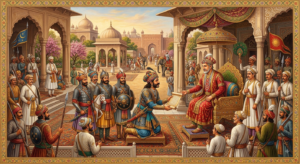
Akbar and the Rajputs
He also married into several Rajput royal families, the Kachwahas of Amber most notably, which meant former rivals became family rather than staying enemies to be watched. Rajput rulers who accepted Mughal overlordship were typically allowed to keep their ancestral territories, provided they paid tribute, supplied troops, and in some cases sealed the arrangement through marriage alliance. Raja Man Singh, born of one such alliance, became one of Akbar’s most trusted generals — which tells you this wasn’t just a marriage for optics. Not every Rajput house accepted these terms, though — Mewar’s resistance under Rana Pratap remained the glaring exception throughout Akbar’s reign.
The Ibadat Khana and Din-i-Ilahi: What Was Akbar’s New Religious Order?
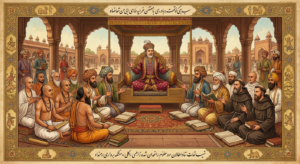
Akbar built the Ibadat Khana — the “House of Worship” — at his new capital, Fatehpur Sikri, specifically to host arguments. Real ones. Muslim theologians, Hindu pandits, Jain monks, Zoroastrian priests, even Jesuit missionaries who’d made the trip from Portuguese Goa, all in the same room, being pushed by Akbar himself to defend the logical gaps in their own beliefs. Contemporary writers describe these sessions as genuinely heated, not staged for show.
Out of all that arguing came something called Din-i-Ilahi around 1582. A lot of popular retellings describe this as Akbar inventing a new state religion and forcing it on everyone — that’s not really what happened. It was a small ethical code followed by a handful of people in his own court, drawing selectively from several traditions. It never spread beyond a tiny circle, and it quietly died with him. What actually matters about it isn’t the content — it’s that an illiterate emperor was personally, obsessively curious about religious ideas that weren’t his own, at a time and in a position where absolutely nobody would have blamed him for not bothering.
Akbar’s Architecture and Fatehpur Sikri
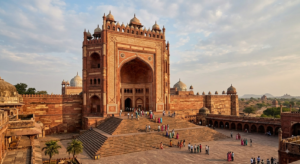
Akbar built an entire new capital, Fatehpur Sikri, near Agra — reportedly out of gratitude to a Sufi saint, Salim Chishti, whose blessing he credited for the birth of his son and long-awaited heir. It’s built almost entirely from red sandstone, mixing Persian, Islamic, and Hindu design in a way that still photographs beautifully even in ruin. It only served as the capital for about fifteen years before water shortages forced the court to abandon it — a bit of an anticlimactic ending for a city that grand.
His court also became famous for a group later called the Navaratnas, or Nine Jewels — though how formal this group actually was, and exactly who belongs on the list, varies depending which historian you ask. The names that come up most consistently:
| Name | Known For |
|---|---|
| Abul Fazl | Court chronicler, wrote the Akbarnama and Ain-i-Akbari |
| Faizi | Poet laureate, Abul Fazl’s brother |
| Birbal | Advisor known for his wit — the subject of countless folk tales even today |
| Raja Man Singh | Rajput general, one of Akbar’s most trusted commanders |
| Raja Todar Mal | Finance minister behind the land revenue reforms |
| Tansen | Court musician, still considered one of the greats of Indian classical music |
| Abdul Rahim Khan-i-Khanan | General, poet, and translator |
The Akbarnama alone is worth mentioning on its own — seven years in the writing, and it’s one of the richest surviving windows into any medieval Indian court, covering everything from military campaigns down to the plants and animals Akbar noticed on his travels, illustrated by some of the best miniature painters working anywhere at the time.
Not a Clean Ending
The last years weren’t peaceful. His son, Prince Salim, got tired of waiting for the throne and rebelled in 1600, going as far as setting up a rival court of his own. Then in 1602, Salim had Akbar’s closest friend and advisor, Abul Fazl, assassinated — apparently seeing him as an obstacle to succession. Contemporary accounts suggest Akbar never really got over that loss. Father and son patched things up before the end, but it’s not the tidy, dignified finish these stories sometimes get flattened into.
Akbar died in Agra in October 1605, likely from dysentery, and was buried at Sikandra in a tomb that — fittingly — mixes architectural styles the same way his reign mixed everything else. His son took the throne as Jahangir.
Why This Still Matters Four Centuries Later
It would be easy to remember Akbar purely as a conqueror, and the map alone would back that up. But that’s not really why historians keep coming back to him. What’s actually rare is a conqueror who treated the empire he’d just seized as something that then had to be built, not just held onto by force until the next rival showed up.
The tax system, the noble-ranking structure, marrying former rivals into the family instead of just subduing them, dragging religious leaders into his own personal cross-examinations — none of that is what you’d expect from someone whose main job description was “win battles.” It’s what you’d expect from someone trying to make sure the thing he built didn’t collapse the moment he was gone.
It’s worth being careful with how far that claim gets stretched, though. The administrative framework Akbar built — mansabdari, jagirdari, the zabt revenue system — did carry the empire forward through the reigns of Jahangir, Shah Jahan, and Aurangzeb, but each of them modified it substantially rather than simply preserving it untouched. Crediting Akbar with a century and a half of stability oversimplifies a much messier story of adaptation, strain, and eventual crisis under his successors. What’s fair to say is that he laid the institutional groundwork later emperors built on, adjusted, and ultimately struggled to sustain — which is still a remarkable legacy for one reign, even without the tidier version of the story.
Frequently Asked Questions
Who was Akbar the Great?
Akbar was the third Mughal emperor of India, ruling from 1556 to 1605. He expanded the Mughal Empire across most of the Indian subcontinent and is remembered for his administrative reforms and policy of religious tolerance toward his non-Muslim subjects.
When was Akbar born and when did he become emperor?
Akbar was born on October 15, 1542, in Umarkot, Sindh. He became emperor on February 14, 1556, at age thirteen, following the sudden death of his father, Humayun.
What was Akbar most famous for?
Akbar is best known for expanding Mughal territory across most of the Indian subcontinent, introducing the mansabdari and zabt administrative systems, and pursuing a policy of religious tolerance that included abolishing the jizya tax on non-Muslims and forming alliances with Rajput rulers.
What was the mansabdari system?
The mansabdari system was Akbar’s method of ranking Mughal officials by assigning each a numerical rank (mansab) that determined their salary and military obligations, expressed through paired zat (personal rank) and sawar (cavalry) numbers.
What was Din-i-Ilahi?
Din-i-Ilahi was an ethical order Akbar introduced around 1582, drawing selectively from Islamic, Hindu, Zoroastrian, and Jain principles. It was followed by only a small number of courtiers and did not survive Akbar’s death; it was not a religion forced upon the wider empire.
Did Akbar conquer the entire Deccan region?
No. Akbar’s forces gained control of Khandesh, Berar, and only part of Ahmadnagar by 1601. The remainder of the Deccan sultanates resisted Mughal authority throughout his reign, and full Mughal control of the region wasn’t achieved until decades after his death.
Who succeeded Akbar as Mughal emperor?
Akbar was succeeded by his son, Prince Salim, who took the throne name Jahangir after Akbar’s death in October 1605.
Was Akbar literate?
No. Despite being unable to read or write, Akbar took a deep personal interest in scholarship, religious debate, and the arts, and built one of the most significant libraries and centers of manuscript production in the medieval world.
Important Article As per History Decoded Hub.
Humayun and Akbar’s Early Life
Humayun, Akbar’s father, lost the Mughal throne to Sher Shah Suri and spent years in exile before reclaiming Delhi in 1555. His sudden death in 1556 left thirteen-year-old Akbar as the next Mughal emperor.
Learn more about Humayun’s life, exile, and return to power in our detailed guide to Humayun.
Battle of Plassey
The Battle of Plassey (1757) was a major turning point in Indian history. Robert Clive’s East India Company forces defeated Nawab Siraj-ud-Daulah, paving the way for British political and economic control in Bengal.
Learn more about the Battle of Plassey and its impact on British rule in India here.
Untold Story of the Mughal Empire
The Mughal Empire was more than a dynasty of powerful rulers. Its rise was shaped by ambitious emperors, military conflicts, political alliances, administrative reforms, and struggles for succession that transformed Indian history.
Discover the untold story of the Mughal Empire and the events that shaped its rise and fall here.
External Source
Use on the first or second mention of Akbar.
Anchor text: Akbar
Akbar — Encyclopaedia Britannica