
Introduction
There are battles in history that are remembered for the scale of their bloodshed, and there are battles remembered for the scale of their consequences. The Battle of Plassey, fought on 23 June 1757 on the banks of the Bhagirathi river near the village of Palashi in present-day West Bengal, belongs unmistakably to the second category. Measured purely in military terms, it was a modest skirmish, lasting only a few hours and claiming relatively few lives. Yet measured by what followed, it stands as one of the most consequential single days in the history of the Indian subcontinent — and arguably in the history of the modern world. It was the moment a commercial trading company, the British East India Company, ceased to be merely a merchant enterprise and began its transformation into a sovereign political power that would eventually rule over hundreds of millions of people for nearly two centuries.
This is the story of how that transformation began — not primarily through superior arms or tactical genius, but through conspiracy, betrayal, and the quiet, corrosive power of money.
Bengal Before the Storm
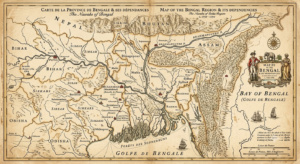
To understand why Plassey mattered so much, one must first understand what Bengal was in the mid-eighteenth century. Far from being a backward or marginal territory, Bengal was the most prosperous province of the Mughal Empire. Its weavers produced textiles and silks famed across the world; its fields yielded abundant harvests; its merchants conducted trade that stretched from the ports of the Indian Ocean to the markets of Europe. It possessed a sophisticated revenue system that had, for generations, made it one of the richest regions on earth. This wealth was not incidental to the story of Plassey — it was, in many ways, the entire reason the story exists at all. A poor province would never have attracted the intense commercial and political rivalry that eventually consumed it.
In 1756, a young man named Siraj ud-Daulah ascended to the position of Nawab of Bengal following the death of his grandfather, Alivardi Khan. He inherited not just a throne but a court riddled with rival factions, ambitious nobles, and powerful banking families whose loyalty could never be entirely taken for granted. It was into this fragile inheritance that the British East India Company’s ambitions, and its grievances, would soon collide.
The Seeds of Conflict
The roots of the conflict were neither sudden nor simple. They grew from a tangle of economic friction, wounded pride, and mutual suspicion that had been accumulating for years.
The East India Company had long enjoyed valuable trading privileges granted under imperial Mughal authority, including exemptions from certain taxes. Over time, however, Company officials and their associates began to exploit these privileges far beyond their intended scope, using them to conduct private trade that deprived Bengal’s treasury of revenue it was rightfully owed. To a Nawab attentive to the finances of his province, this was not a minor irritation but a direct affront to his authority and his exchequer.
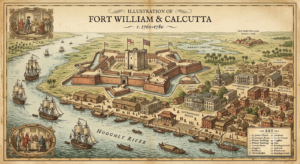
Compounding this was the matter of Calcutta’s defenses. The British, anticipating potential conflict with the French and wary of regional instability, fortified their settlement at Calcutta without first seeking the Nawab’s consent. For a ruler newly come to power and acutely conscious of his own authority, this unilateral military buildup on his own soil could only be read as a challenge — a foreign trading company arming itself as though it were already a state within a state.
There was also the matter of political meddling. The Company had, at various points, extended support to factions and individuals opposed to Siraj ud-Daulah’s interests, entangling itself in the internal politics of Bengal in ways that went well beyond the bounds of a commercial enterprise. These actions did not go unnoticed, and they hardened the young Nawab’s suspicion that the British intended something more than trade.
Matters came to a head in June 1756, when an angered Siraj ud-Daulah marched on Calcutta and seized the city from the British. It was a forceful assertion of sovereign authority, a reminder to the foreign merchants that they operated in Bengal only at the Nawab’s pleasure. The British, however, would not accept this reversal quietly. Robert Clive, a Company officer who had already built a formidable reputation in earlier conflicts on the subcontinent, led the force that recaptured Calcutta soon after.
It was in the aftermath of the city’s fall that one of the most controversial and emotionally charged episodes of the entire saga emerged: the so-called “Black Hole of Calcutta.” According to British accounts of the time, a number of British prisoners were confined overnight in a cramped chamber following the capture of the city, and many reportedly perished from suffocation and heat. This incident became a powerful symbol in British narratives of the period, fueling outrage and providing a moral justification for retaliation. It is worth noting, however, that historians have long debated the precise scale and details of the episode, and that the story, as it circulated in Britain, may have been shaped as much by the needs of propaganda as by strict historical accuracy. Whatever the truth of its particulars, the incident hardened British resolve and added an emotional edge to what was, beneath the surface, primarily a contest over trade, revenue, and power.
A Conspiracy Takes Shape
What makes Plassey so historically distinctive is not the fighting itself but the conspiracy that preceded it. Long before the two armies faced each other across the battlefield, the outcome of the encounter had already been substantially decided in the shadows of intrigue and negotiation.
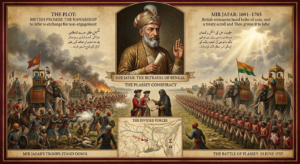
A coalition of dissatisfied figures within Siraj ud-Daulah’s own court began to conspire against him. Among the central figures in this plot was Mir Jafar, a senior military commander whose ambition for the throne made him receptive to British overtures. He was joined by the immensely powerful banking house of Jagat Seth, whose financial influence over Bengal’s economy gave them leverage that few could match, as well as by Rai Durlabh, another influential noble, and Omichand, a merchant who inserted himself into the negotiations as an intermediary. On the British side, Company officials worked to cultivate and consolidate this alliance, recognizing that a battlefield victory over Bengal’s vastly larger army was far from guaranteed, but that a victory secured through betrayal from within was eminently achievable.
The arrangement was straightforward in its essential logic, however elaborate its execution: the British would support Mir Jafar’s claim to the Nawab’s throne, and in exchange, he would ensure that the resistance Siraj ud-Daulah could mount on the battlefield was hollowed out from within. It was less a military alliance than a calculated transaction — the sale of a kingdom, brokered through whispered promises and private assurances. This conspiracy, more than any tactical maneuver on the day of the battle itself, would determine the fate of Bengal.
The Armies Assemble
On paper, the contest at Plassey should never have been close. Robert Clive commanded a relatively modest force of roughly three thousand men, composed of about nine hundred Europeans and around two thousand one hundred Indian sepoys, supported by a mere ten field guns. Ranged against them was the army of Siraj ud-Daulah — an imposing force of approximately fifty thousand infantry and fifteen thousand cavalry, backed by more than forty artillery pieces. Among the Nawab’s senior commanders were Mir Jafar, Rai Durlabh, Yar Lutuf Khan, and Mir Madan, the last of whom remained genuinely loyal to his sovereign even as others around him wavered or actively schemed against him.
In purely numerical terms, the Bengal army dwarfed its opponent many times over. But numbers on a battlefield mean little when the loyalty of those who command them has already been quietly purchased. The Nawab’s forces were not a unified instrument of war; they were a fractured assembly riven by rivalry, ambition, and, in the most critical cases, outright treachery waiting to reveal itself.
The Battle Itself
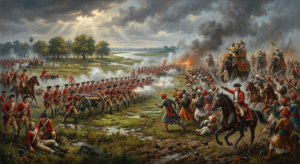
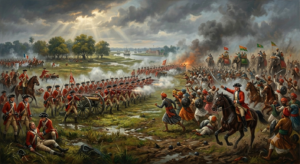
The fighting began in the early hours of 23 June 1757, in the vicinity of a large mango grove near Plassey, with the Nawab’s forces moving to encircle Clive’s smaller contingent. For a time, the sheer weight of numbers threatened to overwhelm the British position, and the outcome remained genuinely uncertain.
Then nature intervened in a way that would prove decisive. A sudden and heavy rainstorm swept across the battlefield. The Bengal army, whether through oversight or simple misfortune, failed to adequately shield its gunpowder stores from the downpour, rendering much of its artillery useless at a critical juncture. The British, by contrast, had taken the precaution of covering their ammunition, allowing their guns to continue firing even as the rain lashed down around them. In an engagement where artillery played such a central role, this single difference in preparedness shifted the tactical balance significantly in Clive’s favor.
The battle’s emotional and strategic turning point, however, came with the death of Mir Madan, one of the few commanders who remained unwaveringly loyal to Siraj ud-Daulah. His fall removed not just a capable officer but a vital pillar of resistance, and it visibly shook the morale of the Nawab’s forces.
It was in this moment of vulnerability that the conspiracy bore its bitter fruit. Mir Jafar, commanding a substantial portion of the Nawab’s army, simply declined to engage. His troops stood by, inert, while their sovereign’s cause crumbled before them. This calculated inaction was, in effect, the betrayal made manifest on the battlefield — not a dramatic defection in the heat of combat, but a cold, deliberate withholding of support at the precise moment it was needed most.
Sensing that the bulk of the opposing army would not fight, Robert Clive ordered his forces forward in a decisive advance. The Bengal army, already destabilized by the loss of Mir Madan and undermined from within by Mir Jafar’s treachery, began to disintegrate and retreat. Siraj ud-Daulah, seeing the battle irretrievably lost, fled the field toward Murshidabad, his capital. By the close of that single day, what had begun as a contest between a vast imperial army and a small commercial force ended in a decisive and almost anticlimactic British victory — a victory won as much in the antechambers of conspiracy as on the open field.
Aftermath and Immediate Consequences
Siraj ud-Daulah’s flight did not bring him safety. He was soon captured by forces loyal to Mir Jafar and was executed on 2 July 1757, bringing a swift and brutal end to his brief reign.
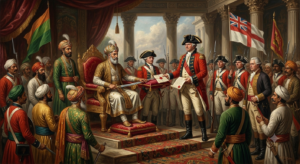
In his place, the British installed Mir Jafar as the new Nawab of Bengal, fulfilling the bargain struck before the battle had even begun. Yet this was sovereignty in name only. Mir Jafar owed his throne entirely to the Company that had placed him upon it, and he remained, from the outset, deeply dependent on British support and goodwill — a ruler whose authority existed largely at the pleasure of his foreign patrons.
The financial windfall for the British East India Company was immediate and staggering. Vast sums of money, valuable gifts, expanded commercial privileges, and control over significant territories flowed into Company hands in the aftermath of the victory. What had been a trading enterprise suddenly found itself in possession of resources and influence that dwarfed anything it had previously controlled. Although Bengal continued to nominally possess its own ruler, genuine political authority increasingly migrated toward the Company’s officials, who now operated as the effective power behind the throne. Flush with new wealth and confidence, the Company began to expand its military reach and its influence across other parts of the subcontinent, setting the stage for further conquests in the years to come.
The Long Shadow of Plassey
If Plassey’s immediate aftermath was significant, its long-term consequences were transformative on an entirely different scale.
Politically, the battle marked the genuine beginning of British rule in India. The East India Company, which had entered Bengal as a commercial entity seeking profit through trade, emerged from Plassey as a political power capable of installing and removing rulers at will. The episode also laid bare the deep divisions that existed among Indian rulers and nobility — divisions that the British would learn to exploit again and again in the decades that followed. The eventual Battle of Buxar in 1764 would further consolidate this emerging dominance, building directly upon the foundation that Plassey had established.
Economically, the consequences were equally profound and, for Bengal, deeply damaging. Enormous quantities of the province’s wealth began flowing outward to Britain, a pattern of extraction that would continue and intensify for generations. The Company steadily tightened its grip over Bengal’s revenue collection system, effectively turning what had been one of the richest agricultural and commercial regions in the world into a source of sustained extraction for a foreign power. Traditional industries, including the textile trades for which Bengal had long been celebrated, came under increasing pressure as British economic policies reshaped trade patterns to favor Company and, later, imperial interests.
Militarily, Plassey set in motion a pattern of expansion that would define the next century of Indian history. The Company’s armed forces grew substantially, British military influence spread across the subcontinent, and the recruitment of Indian soldiers into Company service expanded markedly, creating the foundations of the colonial military apparatus that would later underpin direct British rule.
Why Historians Still Argue About Plassey
Perhaps the most intellectually interesting aspect of Plassey is the persistent debate among historians about what kind of event it actually was. Some scholars argue forcefully that Plassey should not even be classified as a major military battle in any conventional sense, given that only a fraction of Siraj ud-Daulah’s enormous army ever engaged in actual combat. In this reading, Plassey was less a battle than a political coup — a transfer of power achieved primarily through diplomacy, financial inducement, and betrayal, with the brief exchange of arms serving merely as a formality to confirm an outcome already settled in private negotiations.
Other historians, while not necessarily disputing the limited scale of the fighting itself, contend that the sheer magnitude of its consequences earns Plassey its place among the most important battles ever fought on Indian soil. By this measure, the significance of an engagement lies not solely in the violence it produces but in the historical trajectory it sets in motion — and by that standard, few encounters anywhere in world history can claim to have redirected the fate of so many people for so long.
Conclusion
The Battle of Plassey endures in historical memory not because of grand tactics or overwhelming bloodshed, but because of what it set irrevocably into motion. Through a calculated blend of political conspiracy, financial leverage, and a narrow but decisive military action, the British East India Company succeeded in capturing control of one of the wealthiest provinces in the world — and in doing so, planted the seed from which nearly two centuries of colonial rule over India would eventually grow. It stands as a stark reminder that the most consequential turning points in history are not always decided by the clash of swords or the roar of cannon, but sometimes by the quieter, more insidious power of betrayal, ambition, and gold. In the story of Plassey, we find not merely the tale of a single afternoon’s fighting, but the opening chapter of a much larger and more enduring transformation of an entire subcontinent’s destiny.
Important Article as per History decoded Hub
1. The East India Company had long enjoyed valuable trading privileges granted under imperial Mughal authority.
2. Bengal was the most prosperous province of the Mughal Empire, a dynasty whose foundations were strengthened by rulers such as Humayun.
Recommended External Link
Encyclopaedia Britannica – Battle of Plassey
Battle of Plassey – Encyclopaedia Britannica