
A World Before Paper: The Civilization That Struggled to Write
Close your eyes for a moment and try to picture a world without paper.
Not a brief inconvenience — a fundamental restructuring of how civilization works. No books stacked on shelves, no letters folded into envelopes, no maps spread across a table before a battle, no legal codes protecting the rights of ordinary people, no sacred texts carried from village to village. Every idea that a philosopher labored over, every law that a king proclaimed, every account that a merchant kept — all of it either held inside a human memory or inscribed, with enormous effort and cost, onto stone, clay, stretched animal skin, or strips of bamboo so heavy they had to be transported by the cartload.
This was not a hypothetical dark age. This was the actual world of ancient China before one man — a court official of modest origins and extraordinary practical intelligence — sat down in a palace workshop and changed everything.
His name was Cai Lun. And what he made in 105 CE still surrounds us today, in every book, every letter, every classroom, and every corner of the written world.
From Hunan to the Imperial Palace: The Early Life of Cai Lun
The story of Cai Lun begins, as so many world-changing stories do, in circumstances that gave very little hint of what was to come.
He was born around 50 CE in the Guiyang Commandery — a region corresponding to the modern-day Hunan Province in southern China. His family was not powerful. His background was not distinguished. History has not even preserved the name of his mother, which tells us something about how unremarkable his origins must have seemed at the time to those doing the recording.
What history does tell us is that around the age of fourteen or fifteen, Cai Lun entered the imperial palace of the Eastern Han dynasty as a eunuch. Castration and entry into palace service was, in Han China, one of the few pathways through which a boy of modest background could access the inner world of imperial power. The bureaucratic machinery of the Han empire was vast and complex, and eunuchs occupied a peculiar but genuinely significant position within it — trusted with intimacy and access precisely because their physical condition was believed to remove certain ambitions and loyalties that made ordinary men unreliable near emperors.
For a young boy from the provinces, it was a doorway into a world he could never have entered any other way. What he would do once inside that world was entirely up to him.
The Making of a Court Official: Skill, Integrity, and Ambition
The Han imperial court at Luoyang was not a place for the passive or the timid. It was a world of layered ceremony and genuine administrative complexity, of literary culture and political danger, where careers could rise over decades of patient service and collapse overnight through a single miscalculation.
Cai Lun navigated it with remarkable skill.
He moved steadily upward through the ranks of palace service over the years following his entry. By 75 CE, during the reign of Emperor Ming, he had established himself as a figure of real standing. When Emperor He ascended the throne in 88 CE, Cai Lun’s position became genuinely powerful. He was appointed to oversee the manufacture of instruments, tools, and weapons for the imperial palace — a role that placed him in direct, daily contact with craftsmen, workshops, and the physical processes by which raw materials were transformed into useful things.
It is worth pausing here, because this appointment matters enormously to the story of what came next.
Most educated officials in ancient China were men of letters — scholars who had mastered the classical texts and whose world was one of documents, ceremonies, and political relationships. Cai Lun was something rarer and more interesting: an intellectually serious man who also understood how things were actually made. He watched craftsmen work. He asked questions about materials and processes. He thought carefully about why certain techniques produced certain results. He brought to the physical world of making the same quality of attention that scholars brought to the world of texts.
He was also, by the accounts that survive, a man of genuine moral character — known for honest counsel and careful, conscientious work in an environment where both were far from universal.
These qualities, taken together, were precisely what the invention of paper would require.
The Writing Materials of Ancient China: Why Something Had to Change
Before we can fully appreciate what Cai Lun achieved, we need to understand the problem he was solving — and it was a problem serious enough to constrain the functioning of an entire civilization.
Ancient China had been writing for thousands of years before Cai Lun was born. The earliest writing appeared on oracle bones — the shells of turtles and the shoulder blades of oxen, used in divination rituals and carved with questions posed to ancestors and spirits. These are among the oldest written records in human history, and they are extraordinary artifacts. They are not, however, a practical medium for running an empire.
Bronze vessels served another ancient purpose — carrying inscriptions that commemorated royal commands, military victories, and significant events. Permanent, authoritative, and entirely impractical for daily correspondence.
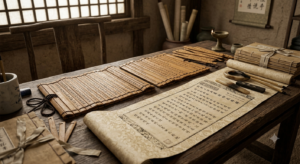
The workhorse of Han administrative life was bamboo and wood. Strips of bamboo were dried, prepared, and written on with a brush, then bound together with cord or leather to form what functioned as books and documents. This system worked — in the sense that it allowed writing to happen — but it imposed brutal practical constraints. A significant administrative document was heavy. A library was a warehouse. Transporting written records across the vast distances of the Han empire required serious logistical effort. A single scholar was said to work through sixty kilograms of bamboo documents in a single day of reading.
Silk existed as a lighter, more elegant alternative, and it was genuinely beautiful to write on. But silk was a luxury material of the highest order — expensive to produce, expensive to purchase, and entirely out of reach for ordinary administrative use across a large empire. The idea of making government documentation on silk was roughly equivalent to printing modern office memos on gold leaf.
The Han empire was, by the first century CE, one of the most administratively sophisticated states the ancient world had ever seen — governing tens of millions of people across an enormous geographic area, generating and requiring enormous quantities of written communication. And it was doing all of this while bent under the physical and economic weight of writing materials that were either too heavy, too expensive, or both.
Something had to change. Cai Lun was the man who changed it.
The Invention of Paper: What Cai Lun Actually Did
The achievement that history credits to Cai Lun, formalized in 105 CE and presented to Emperor He, was not born in a single moment of inspiration. It was the product of sustained, patient, practical experimentation — the kind of work that only someone with genuine hands-on knowledge of materials and manufacturing processes could have pursued.
What Cai Lun understood, with an insight that seems almost obvious in retrospect but was genuinely revolutionary at the time, was that the key ingredient in a writing surface was not any expensive or rare material. It was plant fiber — specifically cellulose, the structural material that gives all plants their form and rigidity. And cellulose was everywhere, in everything, available in unlimited quantities at virtually no cost.
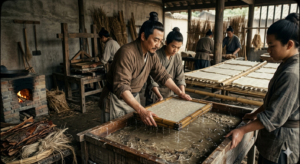
He gathered his raw materials from the margins and waste of everyday life: bark from mulberry trees, hemp fibers stripped from old rope and worn-out cloth, discarded rags, and even old fishnets. None of these cost anything significant. All of them were rich in cellulose fiber.
The process he developed began by soaking and boiling these materials until they broke down completely into a wet, soft, fibrous mass — what we would now call pulp. This pulp was mixed with a large quantity of water to create a thin, evenly distributed slurry. A flat screen or woven mold was then submerged in this slurry and lifted out slowly and carefully, capturing on its surface a thin, uniform layer of intermingled fibers. As the water drained through the screen and the remaining moisture evaporated in the air, something remarkable happened — the cellulose fibers, as they dried, bonded together through natural chemical attraction, forming a single coherent, flexible sheet.
Paper.
Light enough to be carried in a hand. Smooth enough to receive the finest brushwork. Cheap enough to be produced anywhere that trees grew, rags accumulated, or plants could be harvested. Durable enough to preserve writing for centuries. And manufacturable through a process that required no exotic ingredients, no specialized equipment that could not be built from available materials, and no knowledge that could not be taught to a skilled craftsman in a matter of weeks.
When Cai Lun presented this invention to Emperor He, the reception was immediate and enthusiastic. He was praised at court, rewarded generously, and the material quickly became known across China as “the paper of Marquis Cai” — a name that preserved his personal connection to the invention for generations.
Ambition, Loyalty, and the Dangerous Game of Court Politics
To tell the story of Cai Lun honestly, however, is to acknowledge that his life was not simply the story of a great inventor moving serenely from workshop triumph to imperial reward. The court he served was a place of genuine moral complexity, and Cai Lun was not immune to its pressures and temptations.
The Book of the Later Han — the primary historical source for his life, compiled by the scholar Fan Ye in the fifth century CE — records that Cai Lun was involved in the factional politics that surrounded the struggles between imperial consorts for influence over the throne. Specifically, he is associated with schemes that targeted a consort named Song, whose downfall he reportedly helped engineer through false accusations.
The historical record does not allow us to draw a perfectly clear picture of his role — how much was personal initiative and how much was obedience to powerful patrons who could destroy him as easily as elevate him remains genuinely ambiguous. What the record makes clear is that the court of the Later Han was an environment in which moral compromise was not merely tempting but frequently unavoidable for anyone seeking to survive at the highest levels of power.
Cai Lun survived, and more than survived. Under the patronage of Emperor He and the powerful Empress Dowager Deng, he rose to receive the title of Marquis of Longting — a level of formal honor and material reward that a eunuch of provincial origins could not have dreamed of at the beginning of his career. He had become, by any measure, one of the most significant figures at the Han court.
But the court that elevated him would not always protect him.
Disgrace, Dignity, and a Death on His Own Terms
The political landscape that had sustained Cai Lun’s career could not last forever. When Emperor An took the throne in 106 CE and the factional balance at court shifted, the enemies Cai Lun had made across decades of palace life — and the old accusations connected to the intrigues against Consort Song — came back with devastating force.
He was summoned to face public judgment.
What happened next is one of the most quietly remarkable details in the entire story. Cai Lun did not flee. He did not submit a defense. He did not beg for mercy or attempt to bargain his way out of the consequences of a lifetime spent navigating a court where moral compromises had been the price of survival and achievement.
He went home. He bathed with care. He dressed himself in his finest court robes — the garments of the rank and station he had earned across a lifetime of extraordinary service. And then he drank poison.
He died around 121 CE, approximately seventy years old — a man who had traveled from provincial obscurity to the very heights of imperial China and back, and who chose, in the end, to leave the world on his own terms rather than submit to a public degradation that would have erased the dignity of everything he had built.
It is a death that forces us to sit with the full complexity of who he was — not a simple hero, not a simple villain, but a genuinely remarkable human being whose life contained multitudes that resist easy moral summary.
Paper Travels West: How One Invention Crossed the World
Whatever judgment history chooses to render on the man, the thing he made refused to stay still.
For roughly six centuries after Cai Lun’s death, the art of papermaking remained largely within China — guarded, intentionally or otherwise, as a kind of civilizational advantage. The Chinese had understood from very early on that their paper technology was genuinely superior to any writing material available elsewhere in the ancient world, and they did not rush to share the knowledge of how it was made.
The knowledge escaped, as knowledge always eventually does, through the chaos of war.
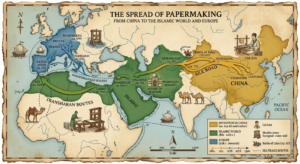
In 751 CE, at the Battle of Talas in Central Asia, Arab forces defeated a Chinese army. Among the prisoners taken in the aftermath were Chinese craftsmen — men who carried the complete technical knowledge of papermaking in their hands and their heads. Under the patronage of the Abbasid Caliphate, papermaking was established first at Samarkand and then spread through the Islamic world with extraordinary speed.
Within decades, Baghdad had operational paper mills. By the tenth century, paper had reached Egypt, where it began displacing papyrus — a writing surface that had served the Mediterranean world for more than three thousand years. By the eleventh and twelfth centuries, paper was firmly established across North Africa, Spain, and the Islamic regions of southern Europe. From there, it moved north and east into the heart of medieval Christendom.
The effects compounded at every stage. Cheaper writing material meant more documents, more books, more letters, more widely distributed knowledge. It meant that the ideas of scholars, scientists, theologians, and poets could circulate across distances and through time in ways that had never been practically possible before. It laid the material foundation for the great flowering of learning in the Islamic Golden Age — for the preservation and transmission of Greek philosophical and scientific texts that would eventually fuel the European Renaissance.
And when Johannes Gutenberg developed his movable-type printing press in the 1440s, it was paper — not parchment, not vellum, not any of the expensive animal-skin materials that European scribes had used for centuries — that made mass printing economically viable. Without cheap, abundant paper, the printing press is an interesting mechanical curiosity. With it, it becomes the engine of the modern world.
The Renaissance. The Reformation. The Scientific Revolution. The Enlightenment. The rise of the free press. The spread of democratic ideas. The modern novel. The universal letter. The school textbook. The scientific journal.
None of it, in the form we know it, without Cai Lun.
The Measure of a Legacy: What History Says About Cai Lun
In 1997, the American historian Michael Hart published a revised edition of his landmark work The 100: A Ranking of the Most Influential Persons in History. When he placed Cai Lun at number seven on that list — above Galileo, above Shakespeare, above the founders of great empires — he was making a claim that might initially seem surprising but that holds up under scrutiny.
The reasoning is not complicated. Paper, and the culture of writing and knowledge it made possible, underlies virtually every other significant human achievement of the past two millennia. Science depends on the recorded accumulation of observations and theories across generations. Democratic governance depends on written law, written rights, and an informed citizenry. Religion spreads through sacred texts. Literature exists through books. Education functions through documents. Commerce is built on recorded contracts and accounts.
Every single one of these things depends on a writing material that is cheap enough, light enough, and available enough to make widespread literacy and knowledge-sharing practically achievable. Before Cai Lun, no such material existed at scale. After him, it was everywhere.
We live so completely inside his invention that we have lost the ability to see it. The paper in every book, the pages of every document, the notebooks on every student’s desk, the archives in every library — all of it descended in a direct and unbroken line from what a court official in the Han dynasty worked out in a palace workshop two thousand years ago.
That is not a minor contribution to human history. It is one of the most consequential acts any individual has ever performed.
A Final Word: The Quiet Revolutionary
Cai Lun never commanded an army. He never founded a religion or wrote a philosophy that carries his name. He held no throne and conquered no territory. He did not seek to change the world through the force of a grand vision or a compelling ideology.
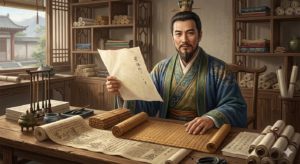
He watched craftsmen work. He asked questions. He experimented with bark and rags and water and fiber. He solved a practical problem with a practical solution, and then he presented that solution to an emperor in 105 CE.
He also lived a life that cannot be reduced to that single shining achievement — a life that included political compromise, factional intrigue, moral ambiguity, the heights of imperial favor, and the depths of public disgrace. He was a man, fully and completely, with all the complexity that implies.
But in those workshops — surrounded by mulberry bark and hemp fiber and the quiet discipline of a craftsman’s attention — he did something that no subsequent disgrace, no political reversal, and no judgment of history could ever undo.
He gave human beings a page to write on.
And on that page, we have been writing the story of civilization ever since.
Keywords: Cai Lun, inventor of paper, history of paper, Han dynasty, ancient Chinese inventions, papermaking history, Cai Lun legacy, Chinese innovation, history of writing materials, four great inventions of China
Related Topics: The Four Great Inventions of China | History of the Printing Press | How Paper Changed the World | Ancient Chinese Technology | The Silk Road and the Spread of Knowledge
Important Article as per History Decoded Hub YOU must Read.
External Link Suggestion
Learn More About Cai Lun and the History of Paper
Encyclopaedia Britannica – Cai Lun
Encyclopaedia Britannica: Cai Lun