
Introduction
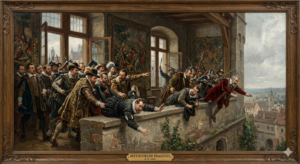
Picture a grey May morning in Prague, 1618.
Inside Hradčany Castle, an argument is getting out of hand. Catholic imperial officials are facing a room full of furious Protestant noblemen. Words are flying. Tempers are completely gone. And then — something snaps.
Three men are grabbed, dragged to a third-floor window, and thrown out.
All three survive. Catholics immediately claimed angels had caught them on the way down. Protestants had a far less poetic explanation — they landed in a pile of manure.
It sounds almost funny. But that one moment — known to history as the Defenestration of Prague — lit a fuse that nobody could put out. What followed was not a quick border dispute or a clean religious showdown with a tidy ending. It was thirty years of war, plague, famine, and betrayal that tore the heart of Europe apart. A conflict so brutal, so constantly shifting, and so impossible to stop that historians still argue about what it truly was.
This is my attempt to make sense of it.
The Ground Was Already Cracking
Before we get to the battles, you need to understand what Europe was standing on — because the ground had been unstable for over a century.
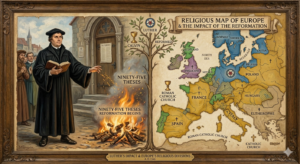
When Martin Luther challenged the Catholic Church back in 1517, he didn’t just spark a theological debate. He cracked the entire foundation of Western Christendom. By 1618, the Holy Roman Empire — that enormous, messy patchwork of German-speaking kingdoms, duchies, and free cities loosely held together under a Catholic emperor — was a place of barely contained religious tension. Catholics and Protestants lived as neighbours, shared city walls, and quietly despised each other. Every political dispute had a religious edge. Every religious argument had political consequences.
The Emperor Ferdinand II was a man of absolute Catholic conviction. He genuinely believed it was his sacred duty to restore Catholic dominance across all his lands. The Protestant nobility of Bohemia, who had been promised religious freedoms by his predecessors, looked at Ferdinand and felt a cold wind approaching.
They were right to feel it.
When Ferdinand moved to take back their rights, the Bohemian lords did not write a polite letter of objection. They revolted, threw his officials out of a window, and crowned themselves a new Protestant king — Frederick V, the young and somewhat overconfident Elector of the Palatinate — and then waited for Protestant Europe to come rushing to their defence.
Protestant Europe did not come rushing.
At the Battle of White Mountain in November 1620, the Bohemian revolt was crushed in under two hours. Frederick fled into exile and was mocked ever after as “the Winter King” — his reign had lasted barely one season. His supporters were publicly executed in Prague. Their estates were seized. Their churches handed back to the Catholics.
The Emperor had won. The rebellion was over.
Except it wasn’t. Not even slightly.
Denmark Steps In — and Quickly Steps Back Out
The Imperial Catholic forces, now riding high on victory, pushed further north. Protestant princes in their path grew nervous. Into that nervousness stepped King Christian IV of Denmark, who saw his chance to be the great Protestant champion of Europe — and, if we are being honest, to extend Danish influence southward while he was at it.
He marched into Germany in 1625 with considerable confidence.
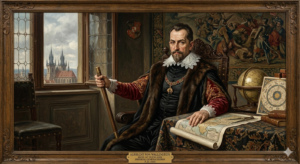
He was met by two men who would define the military character of these early years. The first was Count Tilly — a battle-hardened veteran with an unbroken record and not a shred of mercy in him. The second was Albrecht von Wallenstein, and Wallenstein deserves a proper introduction because he is one of those figures history occasionally produces who seems almost too strange to have actually existed.
Wallenstein was a Bohemian nobleman turned Catholic convert who had made an obscene fortune buying up the confiscated estates of exiled Protestant nobles after White Mountain. He then walked into the Imperial court and made one of the most audacious offers in military history — he would personally raise and finance an army of thirty thousand men, out of his own pocket, in exchange for near-complete independence and the freedom to plunder conquered territories to keep the whole operation running.
The Emperor, who was permanently short of money, said yes immediately.
Wallenstein was brilliant, ruthless, and deeply strange. He consulted astrologers before major military decisions and believed the stars had things to tell him. He was also, as an opponent, absolutely merciless. Denmark stood no chance.
Christian IV signed a humiliating peace in 1629 and retreated northward, his great ambitions in tatters. The Emperor, now at the peak of his power, issued the Edict of Restitution — demanding the return of every piece of church property that Protestants had acquired over the previous seventy-five years. It was the demand of a man who believed God had settled the argument in his favour.
Protestant Europe looked at that edict and understood something clearly: this was nowhere near over.
The Man Who Almost Changed Everything
The Protestant champion Europe had been waiting for came from the north, and he came ready.
Gustav II Adolf of Sweden had been fighting wars since he was a teenager. By 1630 he was thirty-five, razor-sharp, and watching Germany with the focused attention of a man who saw both the religious stakes and the strategic opportunity with equal clarity. Sweden had genuine interests in northern Germany — Baltic trade routes, territorial ambitions — but Gustav also believed in the Protestant cause with real conviction. His soldiers believed it too. That combination of sincere faith and military genius is a rare and dangerous thing.
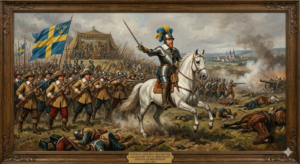
He landed in Germany in the summer of 1630 and immediately made clear that Imperial forces had never faced anything quite like him. His tactics were ahead of his time — faster cavalry, coordinated infantry and artillery, flexible formations that could think and adapt rather than just grind forward. At the Battle of Breitenfeld in September 1631, he dismantled a Catholic Imperial army so completely that Protestant Europe erupted.
Church bells rang across the north. Sermons proclaimed that God had finally sent his answer. People who had spent years living under the threat of Imperial Catholic dominance allowed themselves, cautiously, to feel something like hope.
Then came Lützen.
In November 1632, Gustav Adolf rode into thick fog and cannon smoke to personally rally his troops at a critical moment — and never came back out. He was shot from his horse and killed in the chaos. His body was found later, face down in the mud, stripped by soldiers looking for valuables.
Sweden kept fighting. His generals kept the army moving. But the war had lost its most compelling figure, and everyone could feel the difference.
The Twist That Revealed What the War Was Really About
Here is where the war stops pretending and shows its true face.
France was Catholic. Officially, proudly, elaborately Catholic. And yet Cardinal Richelieu — the cold and brilliant man who effectively governed France on behalf of King Louis XIII — had for years been quietly sending French money to Protestant armies fighting against the Catholic Emperor.
His reasoning had nothing to do with religion whatsoever. It was entirely about power.
France was surrounded by Habsburg territory on multiple sides — the Holy Roman Empire to the east, Spain to the south, Spanish-controlled lands threading through Italy. If the Habsburgs won this war and tightened their grip on Germany, France would spend the next century boxed in on all sides. Richelieu had absolutely no intention of allowing that to happen.
So he funded Sweden. He paid Protestant German princes to keep fighting. He backed anyone willing to bleed the Habsburgs, regardless of what they believed on Sunday. In 1635, when Sweden’s position in Germany grew dangerously weak, France abandoned all pretence and entered the war directly and openly.
A Catholic cardinal spending French money to sustain Protestant armies against a Catholic emperor.
If this war had ever been purely about religion, it plainly was not anymore. It was now a fight over who would shape Europe for the next hundred years. Faith was the flag everyone carried. Ambition was what the flag was waving for.
What the War Did to the People Nobody Wrote Books About
Military histories of this conflict spend a lot of time on battles and political manoeuvres. What they sometimes miss is what those thirty years did to the millions of ordinary people who had no say in any of it.
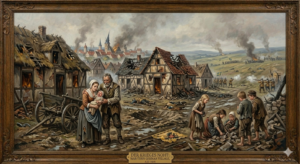
Armies in this era had no proper supply system. They fed themselves off whatever land they happened to be moving through. A village that managed to survive feeding one army on a Wednesday might be stripped completely bare by a different army — possibly fighting for the same side — by the end of the week. Crops were burned during retreats. Animals were taken at sword-point. And trailing behind every army, as reliable as a shadow, came disease. Typhus, plague, and dysentery moved through starving and exhausted populations with horrifying speed.
The sack of Magdeburg in 1631 became the war’s most infamous single atrocity. Imperial forces stormed the Protestant city and killed somewhere around twenty thousand civilians in an orgy of fire and violence so complete that the city’s name entered the language as a byword for total destruction. Even by the brutal standards of this war, Magdeburg shocked people.
But most of the suffering was quieter than Magdeburg. It did not arrive in one catastrophic day. It accumulated slowly — through one bad harvest, then another, through a fever that took the children, through a soldier passing through who took everything that was left.
Some regions of Germany lost a third of their population across these thirty years. Others lost half. The Duchy of Württemberg had perhaps 450,000 people when the war began. By 1648, roughly 100,000 remained.
Sit with that number for a moment.
Children grew up not knowing what peacetime felt like. Old men could barely remember it. Across vast stretches of Central Europe, the war was not an event that had happened and would eventually end. It was simply the world — as permanent and as pitiless as winter itself.
Peace, Eventually. Broken, Imperfect, Desperately Needed Peace.
By the 1640s, exhaustion had become the defining fact of European life. Not ordinary tiredness — the deep, structural exhaustion of a continent that had been consuming itself for a generation. Treasuries were empty. Armies were held together by habit more than purpose. Whole regions that had once been productive and populated were wasteland.
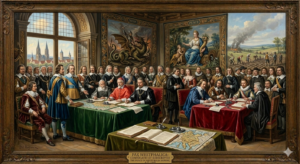
Negotiations began in the Westphalian towns of Osnabrück and Münster in 1644 and dragged on for four years. Nearly every significant power in Europe sent representatives. It was, in ambition and scale, something genuinely new — the first real international peace conference in history, a collective recognition that a war this tangled could not be ended by any simple agreement between two parties.
The Peace of Westphalia, signed in October 1648, satisfied almost nobody completely. Which is, honestly, the surest sign that it was a genuine compromise rather than one side simply dictating terms to the other.
Calvinism was formally recognised as a legitimate Christian faith alongside Lutheranism. The religious map of Germany was largely frozen where it stood. France emerged as the dominant power on the continent, having gained significant territory in Alsace. Sweden secured substantial influence in northern Germany. The Holy Roman Empire survived, but the Emperor’s real authority over his princes was so weakened that Germany would remain politically fragmented for another two centuries.
The Pope declared the entire settlement null, void, and reprobate. History, with quiet patience, ignored him.
The Peace of Westphalia became the foundation of a new international order — one built on the sovereignty of states, on the idea that nations can coexist without demanding their neighbours share their faith. That principle was not born from wisdom or philosophy. It was born from watching what happens when you ignore it.
It was not justice. It was survival. After thirty years, that was the best honest deal on the table.
Why It Still Matters Today
The Thirty Years’ War sits in the comfortable distance of the past — old maps, strange names, weapons in museum cases. But look at it closely enough and it starts to feel uncomfortably familiar.
It shows how a conflict born from genuine, legitimate grievance can spiral so completely beyond anyone’s intentions that the original cause becomes almost beside the point — buried under decades of momentum, revenge, and the terrible logic of sunk costs. The men who threw those officials from the window in Prague were not trying to start a thirty-year catastrophe. They were trying to make a point. Nobody ever plans the disaster. They only plan the first move.
It shows how religion and politics and naked self-interest become impossible to separate over time. Cardinal Richelieu and his Protestant allies each believed, with different degrees of sincerity, that they were fighting for something righteous — while pursuing objectives that were entirely strategic. Most wars contain this same mixture. The Thirty Years’ War just made it impossible to ignore.
And it shows, with the brutal honesty that only catastrophe can produce, who truly pays the price of a long war. Not the emperors in their palaces. Not the cardinals wrapped in their convictions. Not even, in many cases, the generals who died in battle and got their names on monuments.
The people in the village. The ones who needed the harvest to come in. The ones who had no opinion about imperial edicts and no ability to escape whatever was coming down the road.
Three men were thrown from a window on a May morning in 1618. All three walked away.
More than eight million people did not.
The next time someone assures you that a conflict will be quick, controlled, and limited in its consequences — remember Prague. Remember that the men throwing those officials out of the window were also completely certain it would not come to very much.
It took thirty years to show them how wrong they were.
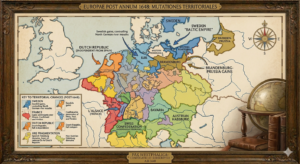
The Thirty Years’ War remains one of the most destructive conflicts in European history — and one of the most consequential. The international order it produced, built on state sovereignty rather than shared faith, is still the one the world operates under today.
Explore More from History Decoded Hub
- Interested in how religion and power shaped empires? Explore our article on The Ottoman Empire: 600 Years of Power and Influence to discover how one of history’s greatest empires transformed Europe, Asia, and Africa.
[Ottoman Empire Blog Link ] - Want to understand another major turning point in European history? Read our guide to The Fall of the Berlin Wall and discover how a divided Europe was reunited after decades of conflict.
[ Berlin Wall Blog Link Here] - Curious about how powerful rulers changed the course of history? Discover the story of Queen Victoria and the British Empire, whose reign reshaped global politics and colonial expansion.
[ Queen Victoria Blog Link Here] - Explore another empire that influenced the world for centuries. Read about The Roman Empire and learn how its political systems, military strategies, and culture continue to impact modern society.
[ Roman Empire Blog Link Here] - Interested in resistance against imperial rule? Discover The Revolt of 1857, the uprising that shook the British Empire and became a landmark moment in Indian history.
[ Revolt of 1857 Blog Link Here]
External Reference
Encyclopaedia Britannica – Thirty Years’ War
Encyclopaedia Britannica: Thirty Years’ War