
Introduction
Imagine leaving home for a religious pilgrimage and not returning for nearly 30 years. Imagine setting out alone, with no maps, no phones, and no guarantee of safety — and ending up crossing three continents, covering 75,000 miles, and witnessing civilizations that most people of your era would never even hear about. This is not fiction. This is the true story of Ibn Battuta, the greatest traveler the medieval world ever produced.
Who Was Ibn Battuta?
Born in 1304 in the coastal city of Tangier, Morocco, Abu Abdullah Muhammad Ibn Abdullah Al-Lawati Al-Tanji Ibn Battuta was a scholar, judge, and explorer whose hunger for the world around him was unlike anything seen before or after in the medieval age.
He was not a soldier seeking conquest. He was not a merchant chasing profit. He was something rarer — a man driven by an insatiable curiosity about people, places, cultures, and ideas. By the time his journey was complete, he had visited territories that today make up around 40 countries, traveled approximately 120,000 kilometers, and produced one of the most important travel records in all of human history.
He passed away around 1368–1369, but the world he left behind in his writings remains very much alive.
The Journey That Wasn’t Supposed to Last 30 Years
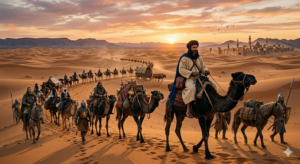
In 1325, at just 21 years old, Ibn Battuta left Morocco with a single, clear purpose — to perform the Hajj, the sacred Islamic pilgrimage to Mecca. It was a journey that thousands of Muslims made every year. Most returned home within months.
Ibn Battuta did not.
What began as a devout religious act slowly transformed into something far larger. With every city he passed through, every scholar he met, every ruler who welcomed him into their court, the world opened up a little wider. He kept moving — eastward, southward, northward — driven by wonder, faith, and an extraordinary willingness to embrace the unknown.
He would not see Morocco again for nearly three decades.
Across Africa and the Middle East
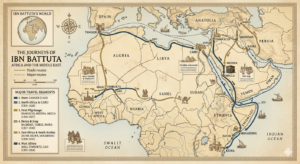
Ibn Battuta’s earliest travels took him through North Africa — across Algeria, Tunisia, and into Egypt, a country whose grandeur clearly impressed him deeply. From Egypt he moved through Palestine and Syria, regions buzzing with trade, scholarship, and political life.
He eventually reached Mecca and completed his Hajj — but rather than turning back for home, he pressed forward. He traveled through Yemen and down the eastern coast of Africa, visiting Somalia, Kenya, and Tanzania. These were not peripheral stops. These were thriving port cities connected by the vast Indian Ocean trade network, and Ibn Battuta documented them with the eye of a man who understood he was witnessing something worth recording.
He then moved through the Middle East — into Iraq, Persia (modern-day Iran), and Afghanistan — before pushing into the vast steppes of Central Asia, passing through Uzbekistan and the territories of the Golden Horde. He performed the Hajj multiple times throughout his life, returning to Mecca on different journeys as his travels looped and expanded across the known world.
Ibn Battuta in India: A Chapter Like No Other
Of all the chapters in his extraordinary life, Ibn Battuta’s time in India stands as one of the most historically significant.
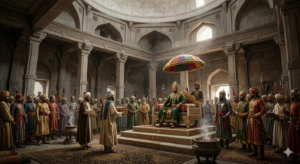
He arrived in the Indian subcontinent around 1333, crossing through Afghanistan and entering the Sultanate of Delhi. He came to the court of Sultan Muhammad bin Tughlaq, one of the most powerful and complex rulers of medieval India — a man simultaneously known for his brilliance and his unpredictability.
Ibn Battuta impressed the Sultan, and was appointed as a Qadi — a judge — in Delhi. He lived in India for several years, receiving honors, wealth, and responsibilities that placed him at the heart of one of the most vibrant courts in the world.
What makes this period so valuable to historians is not just the fact that he was there, but what he chose to record. Ibn Battuta wrote about Delhi’s bustling markets with their enormous variety of goods. He described the roads and trade routes that connected cities across the subcontinent. He observed the workings of government administration under the Sultanate, noted the striking religious diversity of Indian society, and documented local customs, food, clothing, and daily life with a detail that no one else of his era came close to matching.
His writings on medieval India are not a curiosity — they are a primary historical source. Without Ibn Battuta, entire dimensions of 14th-century Indian life would be lost to us.
Adventures, Dangers, and the Reality of the Road
It would be easy to romanticize Ibn Battuta’s journey, but the truth is that his decades on the road were filled with genuine peril. His story is not just one of wonder — it is one of survival.
He was attacked by robbers on more than one occasion, stripped of his belongings and left vulnerable in foreign lands. He endured the brutal hardships of desert crossings, where heat, thirst, and disorientation could kill a traveler as easily as any enemy. He survived dangerous sea voyages across the Indian Ocean and beyond, waters notorious for sudden storms and shipwrecks. He was caught up in political conflicts between rulers, sometimes finding himself on the wrong side of a volatile court. He suffered illnesses that would have ended a lesser man’s journey.
And yet, he kept going.
This resilience is part of what makes him such a compelling figure. Ibn Battuta was not a superhuman. He was a human being who faced very real fear and very real danger, and chose, again and again, to continue.
The Journey to China
After his years in India, Ibn Battuta’s travels took him further east than almost any medieval traveler before him. He moved through Southeast Asia — visiting Malaysia and Indonesia — before eventually reaching China.
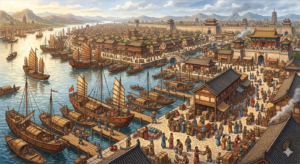
What he found there astonished him. He documented vast, organized cities unlike anything in Europe or Africa. He marveled at China’s advanced trade systems, the sophistication of its ports, and the use of paper money — a concept so foreign to most of the medieval world that it required careful explanation in his writing. He admired Chinese craftsmanship and the sheer scale of commerce that flowed through Chinese ports.
His observations of 14th-century China are among the rarest accounts we have. For historians piecing together what daily life, trade, and governance looked like in that era, Ibn Battuta’s words are invaluable.
The Rihla: Turning Memory Into History
Ibn Battuta finally returned to Morocco in 1354 — nearly 30 years after he had left. He had seen more of the world than almost any person alive. And now came the task of putting it all down.
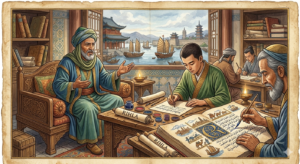
At the instruction of the Sultan of Morocco, Ibn Battuta narrated his experiences to a scholar and writer named Ibn Juzayy. Together, they shaped his decades of memory and observation into a document that would outlast them both.
The account became known as the Rihla — meaning simply, The Journey.
The Rihla is not a dry geographic record. It is a living, breathing account of the medieval world — full of vivid descriptions, personal encounters, political intrigues, and cultural observations that no textbook could replicate. It covers trade and religion, architecture and food, rulers and ordinary people. It is one of the most important travel documents ever written, and it is still studied by historians and scholars today.
Fascinating Facts About Ibn Battuta
For those who like their history in sharp, memorable detail, here are some of the most striking facts about this remarkable man:
He traveled for nearly 30 years before returning home. He covered an estimated 120,000 kilometers — a distance that dwarfed the journeys of Marco Polo, often considered the West’s most celebrated medieval traveler. He visited three continents at a time when most people never left their home province. He served as a judge in India, working within a foreign legal and political system while far from everything familiar. He performed the Hajj multiple times, weaving religious devotion into a life of constant movement. And the book he produced, the Rihla, is still read and studied seven centuries after it was written.
The Legacy of Ibn Battuta
What does it mean to truly understand another culture? To walk its streets, eat its food, speak with its people, sit in judgment in its courts, and then faithfully record what you saw?
Ibn Battuta did all of this across an astonishing breadth of the medieval world. He was not just a traveler — he was a witness. And because he bore witness so carefully and so honestly, historians today can access corners of the 14th century that would otherwise be completely dark.
His writings illuminate medieval trade networks, political systems, religious life, architectural achievements, social customs, and human diversity in ways that no other single source can match. He stands as a bridge between civilizations — between Africa and Asia, between the Islamic world and the courts of India and China, between the 14th century and our own attempts to understand it.
Ibn Battuta is remembered, and rightly so, as one of history’s greatest explorers. Not because he claimed lands or led armies, but because he paid attention — and then told the world what he saw.
The next time you feel the pull of a distant horizon, remember a 21-year-old from Tangier who left for a pilgrimage and came back with the world.
Continue Your Journey Through History with History Decoded Hub.
External Resources
Encyclopaedia Britannica – Ibn Battuta Biography
A reliable and detailed source covering Ibn Battuta’s life, travels, and historical significance.
Ibn Battuta Biography – Encyclopaedia Britannica