
Introduction: The Spark That Ignited a Nation
On a hot summer day in May 1857, the British East India Company appeared stronger than ever. Its officials controlled vast territories across India, collected taxes, commanded armies, and believed their rule was secure.
Yet beneath the surface, resentment had been growing for years.
Farmers struggled under heavy taxation. Traditional rulers lost their kingdoms. Soldiers in the Company’s army felt disrespected and ignored. Ordinary people watched as social, political, and economic changes transformed their lives.
Then, a single spark ignited a fire that would spread across northern and central India.
What began as a military mutiny soon evolved into one of the most significant uprisings in Indian history. Known as the Revolt of 1857, it challenged British authority, united diverse groups against a common enemy, and changed the future of India forever.
More than a rebellion, it was a turning point that exposed the weaknesses of British rule and planted the seeds of the Indian freedom movement.
1. India Before the Revolt of 1857
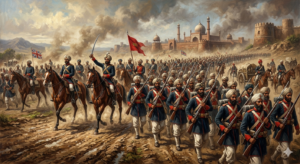
To understand why the revolt happened, we must first look at India in the mid-19th century.
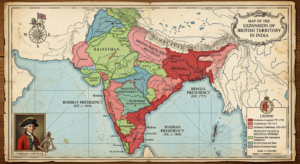
By 1857, the British East India Company had transformed from a trading company into a powerful political force. Through wars, alliances, and diplomacy, it controlled large parts of the Indian subcontinent.
Many Indian rulers had lost their independence. The Company introduced new laws, administrative systems, and taxation policies. While some reforms modernized certain aspects of society, many Indians viewed these changes with suspicion.
The British often failed to understand local customs and traditions. As a result, resentment spread among princes, peasants, artisans, and soldiers alike.
The foundations of rebellion were already being laid long before the first shots were fired.
2. The Growing Causes of Discontent
The Revolt of 1857 was not caused by a single event. It was the result of years of accumulated anger.
Political Causes
One major source of resentment was the Doctrine of Lapse, introduced by Governor-General Lord Dalhousie.
According to this policy, if an Indian ruler died without a biological heir, the British could annex the kingdom.
Several states, including Jhansi, were absorbed into British territory.
Many rulers believed the British were deliberately expanding their control at the expense of Indian sovereignty.
Economic Causes
Heavy taxation placed enormous pressure on farmers.
Traditional industries such as textiles suffered as British manufactured goods flooded Indian markets.
Many artisans lost their livelihoods, while local economies struggled to compete with imported products.
Social and Religious Concerns
Some Indians feared that British reforms were attempts to interfere with their religious and cultural traditions.
Although certain reforms aimed to improve society, mistrust of British intentions continued to grow.
Military Grievances
Indian soldiers, known as sepoys, formed the backbone of the East India Company’s army.
Despite their importance, they often received lower pay and fewer privileges than British soldiers.
Their dissatisfaction would soon become a major factor in the rebellion.
3. The Cartridge Controversy: The Immediate Trigger
The event most commonly associated with the Revolt of 1857 involved the new Enfield rifle.
To load the rifle, soldiers had to bite open cartridges reportedly greased with cow and pig fat.
For Hindu soldiers, the cow was sacred.
For Muslim soldiers, the pig was considered unclean.
Rumors spread rapidly throughout military camps.
Many sepoys believed the British were deliberately insulting their religious beliefs.
Although the British attempted to address these concerns, the damage had already been done.
Trust had been broken.
What followed would change history.
4. Mangal Pandey and the First Signs of Rebellion
Before the revolt erupted across northern India, one soldier became a symbol of resistance.
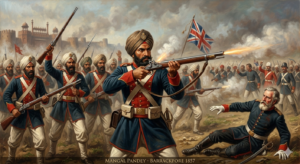
Mangal Pandey, a sepoy stationed at Barrackpore, openly challenged British authority in March 1857.
His actions inspired many soldiers who were already angry about their treatment and the cartridge issue.
Although he was arrested and executed, his name became closely associated with the growing spirit of rebellion.
Today, he is remembered as one of the early figures who stood against British rule.
5. The Revolt of 1857 Begins
The uprising officially began on 10 May 1857 in Meerut.
Indian soldiers rebelled against their British officers and marched toward Delhi.
Their arrival transformed a local military mutiny into a larger political movement.
The rebels proclaimed the aging Mughal emperor Bahadur Shah Zafar as their symbolic leader.
This decision gave the rebellion legitimacy and encouraged others to join.
Within weeks, the revolt spread across numerous regions.
Cities and towns witnessed fierce battles, dramatic confrontations, and shifting alliances.
The British suddenly found themselves facing a challenge unlike anything they had encountered before.
6. Key Leaders Who Shaped the Revolt
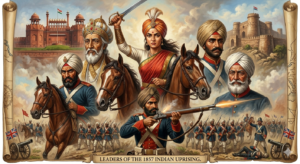
The rebellion was driven by several remarkable individuals.
Rani Lakshmibai of Jhansi
Few figures symbolize courage like Rani Lakshmibai.
Denied recognition of her adopted heir under British policies, she became one of the revolt’s most determined leaders.
Her leadership and battlefield bravery turned her into a legendary figure in Indian history.
Nana Sahib
Nana Sahib emerged as an important leader in Kanpur.
Believing he had been unfairly treated by the British, he joined the rebellion and became a major figure in the uprising.
Tatya Tope
A skilled military commander, Tatya Tope continued resistance even after many rebel strongholds had fallen.
His persistence made him one of the most respected leaders of the revolt.
Begum Hazrat Mahal
In Lucknow, Begum Hazrat Mahal played a crucial role in organizing resistance against British forces.
Her leadership demonstrated the significant role women played during the uprising.
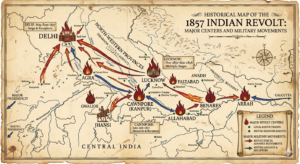
7. Major Centers of the Revolt
The rebellion spread across several important regions:
- Delhi
- Meerut
- Kanpur
- Lucknow
- Jhansi
- Gwalior
Each center had its own local grievances and leaders, but all shared a common objective: challenging British authority.
Some areas witnessed prolonged sieges and intense fighting that lasted for months.
8. Why the Revolt of 1857 Failed
Despite its scale and intensity, the rebellion ultimately failed.
Several factors contributed to its defeat:
Lack of Unity
Not all regions participated.
Many rulers remained neutral or supported the British.
Limited Coordination
Communication between rebel groups was often poor.
Without a unified strategy, it became difficult to sustain the uprising.
Superior British Resources
The British possessed stronger military organization, better logistics, and greater access to reinforcements.
Absence of a Common National Vision
Although many groups opposed British rule, their goals often differed.
This limited the effectiveness of the movement.
9. The Aftermath That Changed India Forever
The consequences of the revolt were enormous.
The British government dissolved the East India Company and transferred control directly to the British Crown.
This marked the beginning of the British Raj.
The administration introduced changes to the army and governance structure to prevent future uprisings.
At the same time, British authorities became more cautious in dealing with Indian traditions and princely states.
The revolt had failed militarily, but its impact would shape the future of India.
10. The Lasting Legacy of the Revolt of 1857
Historians continue to debate whether the uprising was a military mutiny, a popular rebellion, or India’s First War of Independence.
Regardless of interpretation, its significance cannot be ignored.
The revolt inspired future generations of freedom fighters.
It demonstrated that British rule could be challenged.
More importantly, it created a shared memory of resistance that would influence the independence movement for decades.
The spirit of 1857 lived on in later struggles for freedom.
Conclusion: A Rebellion That Echoed Through History
The Revolt of 1857 was more than a clash between soldiers and an empire.
It was the result of years of political frustration, economic hardship, cultural tension, and growing resentment toward foreign rule.
Though the rebellion did not achieve its immediate goals, it transformed India’s relationship with Britain and altered the course of history.
Its heroes, battles, sacrifices, and lessons continue to fascinate historians and readers alike.
More than 150 years later, the Revolt of 1857 remains a powerful reminder that even the mightiest empires can be shaken when ordinary people decide to resist.
Important Blogs You Must Read
-
Explore the Rise of the East India Company
Long before the Revolt of 1857 erupted, the British East India Company had established itself as one of the most powerful forces in India. What began as a trading enterprise gradually transformed into a political and military power that controlled vast regions of the subcontinent. To understand the roots of the rebellion, explore our detailed article on The History of the East India Company in India.
Read About Queen Victoria and the British Raj
The Revolt of 1857 marked a major turning point in Indian history. After the uprising was suppressed, the British government abolished the rule of the East India Company and brought India directly under the British Crown. This new era unfolded during the reign of Queen Victoria, whose rule left a lasting impact on both Britain and India. Discover more in our article on Queen Victoria: The Monarch Who Oversaw an Empire.
Discover the Legacy of Subhas Chandra Bose
Although the Revolt of 1857 did not end British rule, it inspired future generations of freedom fighters. Nearly a century later, leaders such as Subhas Chandra Bose continued the struggle for independence with determination and courage. Learn how his vision and leadership contributed to India’s freedom movement in our article on Subhas Chandra Bose.
Explore Another Defining Moment in Indian History
Indian history is filled with events that shaped the nation’s future. One such event was Operation Blue Star, a military operation that remains one of the most discussed and debated chapters in modern Indian history. Read our in-depth article to understand its causes, events, and consequences.
Learn How the Berlin Wall Changed the World
History is not only about India; it is also about events that transformed the global order. The fall of the Berlin Wall symbolized the end of an era and reshaped international politics. If you enjoy learning about major historical turning points, be sure to read our article on The History of the Berlin Wall.
Further Reading
The Revolt of 1857 was a turning point in Indian history that challenged British authority and influenced future generations of freedom fighters. While this article provides a comprehensive overview of the uprising, readers who wish to explore the topic in greater depth can refer to the following trusted historical resource.
External Resource: Encyclopaedia Britannica – Indian Mutiny (Revolt of 1857)