
Introduction
Imagine a group of merchants arriving on India’s shores with ships full of goods, seeking nothing more than profitable trade. They carried no grand plan to rule millions of people. Yet over the course of two centuries, these traders transformed themselves into rulers, controlled vast territories, collected taxes, commanded armies, and changed the destiny of an entire subcontinent.
The history of the East India Company in India is one of the most fascinating and dramatic chapters in world history. It is a story of ambition, wealth, political intrigue, military power, and the gradual loss of Indian sovereignty. What began as a business venture eventually became one of the most powerful political organizations the world had ever seen.
To understand modern India’s history, it is essential to understand how a trading company managed to establish an empire. The rise and fall of the East India Company offers valuable lessons about power, commerce, and the consequences of unchecked ambition.
The Birth of a Company with Global Ambitions
At the end of the sixteenth century, European nations were competing fiercely for access to the lucrative markets of Asia. Spices, silk, cotton, and precious goods from the East were in high demand across Europe.
On December 31, 1600, Queen Elizabeth I granted a royal charter to a group of English merchants, creating the East India Company. Their objective was straightforward: establish trade relations with Asian markets and generate profits.
At first, the company was merely one among several European trading powers. The Portuguese had already established themselves in India, while the Dutch were expanding their commercial influence. Few could have predicted that this English company would one day dominate the Indian subcontinent.
The First Steps in India
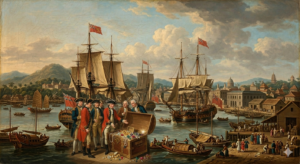
The company’s early representatives arrived in India during the reign of the Mughal Empire. Under Emperor Jahangir, English traders received permission to establish trading posts known as “factories.”
These factories were not manufacturing centers but commercial hubs where goods were stored and exchanged. Over time, important settlements emerged in Surat, Madras, Bombay, and Calcutta.
The East India Company initially depended on the goodwill of Indian rulers. The Mughal Empire was powerful, wealthy, and far stronger than any European trading organization operating in the region.
At this stage, the company sought profit, not political control.
How Trade Turned into Power
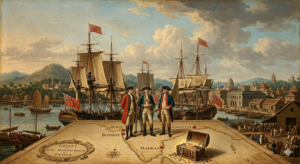
The turning point came during the eighteenth century.
The Mughal Empire, once one of the strongest empires in the world, began to weaken after the death of Emperor Aurangzeb. As central authority declined, regional kingdoms gained greater independence and rivalries intensified.
The East India Company recognized an opportunity.
Rather than remaining neutral traders, company officials began intervening in local politics. They formed alliances, supported rival claimants to thrones, and used military force to protect their commercial interests.
Gradually, commerce and politics became inseparable.
History of the East India Company in India and the Battle of Plassey
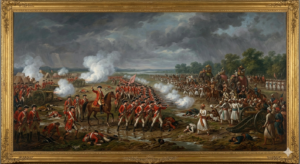
One event changed everything: the Battle of Plassey in 1757.
The Nawab of Bengal, Siraj-ud-Daulah, viewed the growing influence of the company with suspicion. Tensions escalated until open conflict became unavoidable.
Led by Robert Clive, the East India Company’s forces confronted the Nawab’s army. Through military strategy and political manipulation, the company secured a decisive victory.
Although the battle itself was relatively small, its consequences were enormous.
Control over Bengal provided access to immense wealth and resources. The victory marked the beginning of British political dominance in India.
Many historians consider Plassey the moment when a trading company began transforming into a ruling power.
Bengal: The Jewel of the Company Empire
Bengal was among the richest regions in the world during the eighteenth century. Its fertile lands, thriving industries, and bustling trade networks generated enormous wealth.
After gaining influence in Bengal, the East India Company acquired the right to collect revenue from the province. This gave the company direct access to vast financial resources.
The profits from Bengal funded military expansion and further territorial acquisitions.
For the company, Bengal became the foundation upon which its Indian empire was built.
For many Indians, however, the consequences were devastating. Economic policies often prioritized company profits over local welfare, contributing to hardship and instability.
The Expansion Across India
With increasing wealth and military strength, the company expanded rapidly.
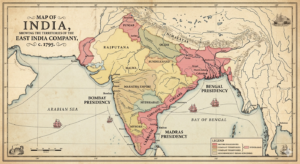
Through wars, treaties, and diplomacy, it extended its influence across large parts of India. Major Indian powers, including the Marathas, Mysore, and the Sikhs, eventually faced the growing power of the company.
Leaders such as Hyder Ali and Tipu Sultan resisted fiercely. Their struggles remain among the most dramatic chapters in Indian history.
Despite determined resistance, the company’s superior resources and strategic alliances often gave it the advantage.
By the early nineteenth century, much of India had come under company control.
Life Under Company Rule
The East India Company was unlike any government that had ruled India before.
Its primary objective was profit.
Taxes were collected efficiently, trade was regulated, and administrative systems were introduced. Railways, telegraph networks, and infrastructure projects would later expand under British rule.
Yet company governance was frequently criticized for placing economic interests above the welfare of ordinary people.
Farmers often faced heavy taxation, traditional industries encountered challenges, and local rulers lost their authority.
The benefits and costs of company rule remain subjects of historical debate even today.
The Great Revolt of 1857
As dissatisfaction grew, tensions eventually exploded.
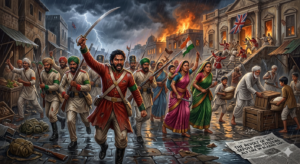
In 1857, Indian soldiers serving in the company’s army launched a rebellion that quickly spread across northern India.
The uprising involved soldiers, local rulers, peasants, and civilians. While the causes were complex, resentment toward company policies played a significant role.
The conflict became one of the most significant events in Indian history.
Although the rebellion was ultimately suppressed, it exposed the weaknesses of company rule and shocked British authorities.
The Fall of the East India Company
The events of 1857 convinced the British government that India was too important to be governed by a private corporation.
In 1858, control of India was transferred directly to the British Crown.
The East India Company, which had once ruled millions of people and commanded one of the world’s largest armies, gradually lost its remaining functions before being dissolved.
Its remarkable journey had come to an end.
A company created to trade spices had become an empire and then disappeared from history.
The Legacy That Still Shapes India
The legacy of the East India Company remains visible even today.
Its actions reshaped India’s political boundaries, economy, legal institutions, and administrative systems. It influenced the course of British imperialism and left a lasting impact on Indian society.
The history of the East India Company in India is not simply a story about colonization. It is a reminder of how economic power can evolve into political power when left unchecked.
It teaches us that history is often shaped not only by kings and emperors but also by merchants, corporations, and the pursuit of profit.
More than 400 years after the company first arrived in India, its story continues to fascinate historians and readers alike because it reveals how a business enterprise changed the destiny of one of the world’s oldest civilizations.
Conclusion
The rise of the East India Company is one of history’s most extraordinary transformations. From humble beginnings as a trading organization, it grew into a political and military force that controlled vast territories and influenced the lives of millions.
Understanding this journey helps us better understand India’s colonial past and the forces that shaped the modern world. The company’s story is a powerful reminder that ambition, wealth, and power can alter the course of nations in ways that few could ever imagine.
Important Internal Links
-
Indus Valley Civilization
Long before the arrival of the East India Company, India was home to one of the world’s earliest urban civilizations. Discover the fascinating achievements, mysteries, and legacy of the Indus Valley Civilization.
-
Bhagat Singh
The struggle against British rule inspired countless freedom fighters, but few became as iconic as Bhagat Singh. Explore the life, sacrifice, and revolutionary ideas of one of India’s greatest heroes.
-
Mahatma Gandhi
As British control over India faced growing resistance, Mahatma Gandhi emerged as the leader of a movement based on non-violence and civil disobedience. Learn how his actions changed the course of Indian history.
-
Why the Dutch Failed in India
The British were not the only Europeans seeking wealth in India. Discover why the Dutch, despite their early success, failed to establish lasting political control over the subcontinent.
-
Operation Blue Star
India’s history did not stop with independence. Decades later, Operation Blue Star became one of the most controversial and significant events in modern Indian history. Discover what happened and why it remains important today.
-
Partition of India 1947
The end of British rule in India came with one of the largest and most tragic migrations in human history. Millions were displaced as India and Pakistan were created overnight. Read more about this turning point in our detailed article on the Partition of India 1947.
-
The Rise and Fall of the Roman Empire
History has seen many powerful empires rise and decline. Just as the East India Company built a vast empire in India, the Roman Empire shaped the ancient world for centuries before its eventual fall.
- Get more information about East India Company as per Wikipedia