
Introdution
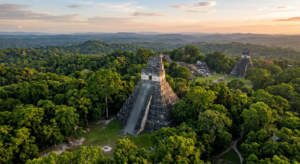
Deep in the jungles of Central America, hidden beneath centuries of vines and soil, lie the remains of cities that once rivaled anything in the ancient world. Towering pyramids pierced the treetops. Astronomers tracked the stars with astonishing precision. Scribes recorded history in one of the most sophisticated writing systems ever developed. And then, in many of these great cities, life simply stopped.
This is the story of the Maya Civilization — a culture so advanced that modern archaeologists are still uncovering its secrets, and so mysterious that its decline remains one of history’s most debated puzzles. To understand the Maya is to understand how a civilization can rise to extraordinary heights of science, art, and power, all without wheels, metal tools, or draft animals like horses and oxen.
Let’s step into the world of the Maya — a world of god-kings, blood sacrifice, mathematical genius, and cities swallowed by the jungle.
Historical Background
The Maya were not a single unified empire like Rome or Persia. Instead, they were a collection of independent city-states that shared a common language family, religion, writing system, and calendar, spread across a region known as Mesoamerica.
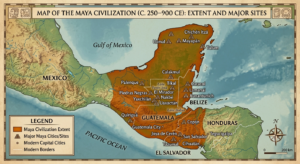
Their civilization occupied territory that today includes:
- Southern Mexico (particularly the Yucatán Peninsula)
- Guatemala
- Belize
- Western Honduras
- Western El Salvador
Unlike a single kingdom with one ruler, the Maya world functioned more like ancient Greece — dozens of powerful city-states, such as Tikal, Calakmul, Copán, and Palenque, that sometimes traded and intermarried, and sometimes went to war with one another.
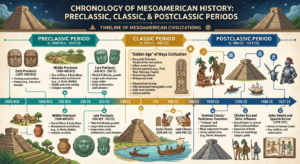
Historians generally divide Maya history into three major periods:
- Preclassic Period (roughly 2000 BCE–250 CE): Early agricultural settlements grow into the first major cities.
- Classic Period (roughly 250–900 CE): The golden age of Maya civilization, marked by monumental architecture, powerful kings, and advanced science.
- Postclassic Period (roughly 900–1500s CE): Many southern cities decline, while northern cities like Chichén Itzá and Mayapán rise to prominence, until Spanish colonization begins in the 1500s.
Timeline of the Maya Civilization
| Period | Approximate Dates | Key Developments |
|---|---|---|
| Preclassic | 2000 BCE – 250 CE | First villages, early pyramids, development of writing |
| Early Classic | 250 – 600 CE | Rise of powerful city-states like Tikal |
| Late Classic | 600 – 900 CE | Peak of Maya civilization; population boom; height of art and architecture |
| Terminal Classic | 800 – 900 CE | Widespread collapse of southern lowland cities |
| Postclassic | 900 – 1500s CE | Rise of northern cities such as Chichén Itzá and Mayapán |
| Spanish Contact | 1500s – 1697 CE | Gradual Spanish conquest; last independent Maya kingdom falls in 1697 |
Geography: Why Location Shaped Everything
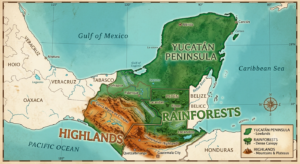
The Maya built their civilization across a strikingly diverse landscape, and this geography shaped nearly every aspect of their society.
In the north, the Yucatán Peninsula is flat, dry, and covered in thin soil, with almost no rivers. Instead, the Maya relied on natural sinkholes called cenotes — freshwater pools formed when limestone collapses — for drinking water and, often, religious rituals.
Farther south, the landscape shifts into dense tropical rainforest, home to cities like Tikal and Calakmul. Here, rainfall was abundant, but managing it required clever engineering, including reservoirs and canals.
Further south still, highland regions in modern Guatemala offered fertile volcanic soil, cooler temperatures, and access to valuable resources like obsidian and jade.
This geographic diversity meant that no two Maya cities faced identical challenges — and it explains why Maya innovation often centered on solving practical problems, from water storage to soil management.
Society: Life Inside a Maya City
Maya society was highly stratified, meaning it was organized into distinct social classes with very different daily experiences.
At the top sat the king, often called the k’uhul ajaw, or “holy lord.” Below him were nobles, priests, and skilled scribes — some of the most respected people in society, since literacy was rare and highly valued.
Merchants and skilled artisans, such as jade carvers and featherworkers, occupied a comfortable middle tier. At the base of society were farmers, who made up the vast majority of the population, and enslaved people, often captured during warfare.
Family life centered around small households, typically built from perishable materials like wood and thatch, clustered around a central plaza. Most Maya were farmers who grew maize, beans, and squash — a nutritional trio so important that many Maya creation stories describe humans as being literally formed from maize dough.
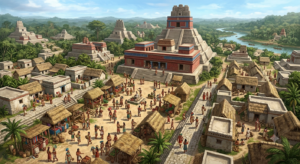
Government: Rule of the God-Kings
Maya political power was deeply tied to religion. Kings were not just political leaders — they were considered intermediaries between the human world and the divine realm.
Rulers were expected to perform bloodletting rituals, communicate with ancestors and gods, and ensure the city’s prosperity through proper religious observance. A king who failed to bring rain, win wars, or maintain order could quickly lose legitimacy.
Because the Maya world was made up of competing city-states rather than one central empire, alliances and rivalries constantly shifted. Powerful cities like Tikal and Calakmul spent centuries locked in a rivalry sometimes compared to a Cold War, complete with proxy wars fought through allied smaller kingdoms.
Economy: Trade Across a Vast Network
Despite lacking wheeled vehicles and pack animals, the Maya built extensive trade networks that stretched across Mesoamerica.
Key traded goods included:
- Obsidian — a volcanic glass used for sharp tools and weapons
- Jade — a highly prized stone associated with royalty and the divine
- Cacao — used to make a bitter, ceremonial chocolate drink, and sometimes even as a form of currency
- Salt — essential for food preservation
- Feathers, particularly from the quetzal bird, used in elaborate royal headdresses
Goods were transported on foot by human porters or by canoe along rivers and coastlines, connecting inland cities to coastal trade routes that stretched as far as central Mexico.
Religion and Beliefs
Maya religion was woven into every part of daily life. They believed in a complex universe made up of multiple layers — an Upper World of gods and celestial bodies, a Middle World where humans lived, and an Underworld called Xibalba, a place of trials and danger ruled by fearsome deities.
The Maya worshipped a vast pantheon of gods, including:
- Itzamna — a creator god associated with wisdom
- Chaac — the rain god, critically important to farming communities
- Kukulkan — a feathered serpent deity, later closely associated with the famous pyramid at Chichén Itzá
Bloodletting rituals, in which nobles and kings offered their own blood, were considered essential to nourishing the gods and maintaining cosmic balance. In some cases, human sacrifice was also practiced, particularly tied to warfare and major religious ceremonies — though its scale and frequency varied significantly between cities and time periods.
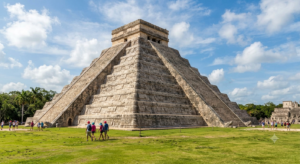
Culture: Art, Writing, and the Maya Calendar
Maya culture produced some of the most sophisticated intellectual achievements in the ancient world.
The Maya Writing System
The Maya developed one of the only fully developed writing systems in the ancient Americas, using a combination of logograms (symbols representing whole words) and syllabic signs. This script, carved into stone monuments and painted on pottery and bark-paper books called codices, allowed the Maya to record history, genealogy, astronomy, and religious ceremony in remarkable detail.
For centuries, scholars couldn’t read this script. It wasn’t until the mid-to-late 20th century that researchers made major breakthroughs in decipherment, finally allowing modern historians to read the words of Maya kings in their own voice.
The Maya Calendar System
The Maya used multiple interlocking calendars, including:
- The Tzolk’in — a 260-day sacred calendar
- The Haab’ — a 365-day solar calendar
- The Long Count — a system for tracking longer spans of time, famously (and mistakenly) linked by some to 2012 doomsday predictions
In reality, the Long Count calendar simply completed a cycle in 2012, much like an odometer rolling over — not an ancient prophecy of the world’s end.
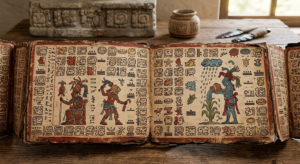
Conclusion
The story of the Maya Civilization is not simply one of rise and collapse—it is a testament to human ingenuity, resilience, and cultural achievement. For more than three thousand years, the Maya built thriving cities, developed one of the world’s most sophisticated writing systems, made remarkable advances in mathematics and astronomy, and created a rich cultural legacy that continues to inspire historians and archaeologists today.
While many of the great Maya cities were abandoned during the Classic Period, modern research suggests that their decline was caused by a combination of prolonged drought, environmental stress, warfare, political instability, and economic disruption rather than a single catastrophic event. Importantly, the Maya people did not disappear. Millions of Maya descendants still live across Mexico, Guatemala, Belize, Honduras, and El Salvador, preserving their languages, traditions, and cultural heritage.
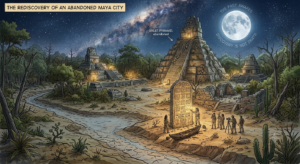
The mystery surrounding the Maya Civilization reminds us that even the most advanced societies can face challenges that reshape their future. At the same time, their remarkable achievements in architecture, science, engineering, and art continue to influence our understanding of the ancient world. As archaeologists uncover new discoveries hidden beneath the forests of Mesoamerica, the story of the Maya continues to evolve, offering fresh insights into one of history’s greatest civilizations.
If you enjoyed learning about the Maya Civilization, explore our other history articles to discover the rise and fall of ancient empires, legendary rulers, and the historical events that shaped the modern world.
Important Article As Per History Decoded Hub.
- While the Maya Civilization was thriving in Mesoamerica, Cleopatra VII was making history in Ancient Egypt. Discover the fascinating story of Egypt’s last pharaoh in our detailed article on Cleopatra: The Last Pharaoh of Egypt.
- The Roman Empire was one of the most influential civilizations in history, shaping politics, law, architecture, and culture for centuries. Discover how this mighty empire rose to power and what ultimately led to its downfall in our detailed guide on The Rise and Fall of the Roman Empire.
- History is filled with powerful civilizations that shaped the world in different ways. If you’re interested in learning about another empire that left a lasting global impact, explore our detailed article on The Ottoman Empire: Rise, Expansion, and Legacy.
External References
For readers who want to explore the topic further, the following authoritative sources provide reliable historical and archaeological information about the Maya civilization:
-
Encyclopaedia Britannica – Maya Civilization