
Introduction
Few events in world history carry the weight and symbolism of American Independence. It marks the moment when thirteen scattered colonies, bound together more by circumstance than unity, chose to reject the authority of the most powerful empire on Earth and forge their own path. The struggle for independence was not the product of a single dramatic day, but the culmination of more than a decade of political friction, economic hardship, and a slow, hard-won transformation in how ordinary colonists saw themselves — not as British subjects, but as Americans.
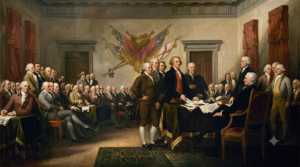
The American Revolutionary War stretched from 1775 to 1783, and it was on July 4, 1776, that the Continental Congress formally adopted the Declaration of Independence, an act that would go on to shape not just the fate of a new nation, but the political imagination of the entire world. Understanding this history means understanding a chain of taxes, protests, battles, and ideas that, together, gave birth to the United States of America.
This guide walks through that entire story — the grievances that sparked rebellion, the war that secured it, the treaty that confirmed it, and the legacy that still echoes through modern democratic thought.
Quick Facts at a Glance
| Topic | Details |
|---|---|
| Independence Day | July 4, 1776 |
| War | American Revolutionary War (1775–1783) |
| Ruled By | Kingdom of Great Britain |
| King of Britain | King George III |
| Declaration Written Mainly By | Thomas Jefferson |
| Final Victory | 1783 |
| Peace Treaty | Treaty of Paris |
| First President | George Washington |
Before Independence: Who Ruled America?
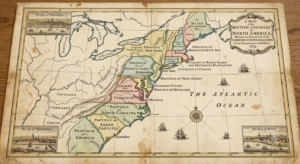
Long before the United States existed as a sovereign nation, the eastern seaboard of North America was home to thirteen British colonies, each operating under the ultimate authority of the British Crown. The reigning monarch at the time of the Revolution was King George III, and under his rule, Britain controlled colonial trade, dictated tax policy, and appointed the governors who oversaw each colony’s affairs.
The thirteen colonies were:
- New Hampshire
- Massachusetts
- Rhode Island
- Connecticut
- New York
- New Jersey
- Pennsylvania
- Delaware
- Maryland
- Virginia
- North Carolina
- South Carolina
- Georgia
While each colony maintained its own local government and handled day-to-day civic matters independently, Britain retained final say over the laws, trade regulations, and military decisions that shaped colonial life. This arrangement worked, more or less, for well over a century — until a series of financial and political pressures pushed the relationship toward its breaking point.
Why Did Americans Want Independence?
The road to revolution wasn’t paved by a single event. It was the result of accumulating frustrations that touched nearly every aspect of colonial life — taxation, representation, military presence, trade, and the basic desire for self-rule.
1. Heavy and Unjust Taxes
Britain’s involvement in the Seven Years’ War left the empire with a massive debt. To recover those costs, Parliament turned to the American colonies, introducing a series of new taxes that colonists had no say in approving. These included:
- The Sugar Act
- The Stamp Act
- The Townshend Acts
- The Tea Act
Colonists were outraged not simply because these taxes cost money, but because they had no elected representatives in the British Parliament to advocate on their behalf. This grievance crystallized into one of the most iconic phrases in American history:
“No Taxation Without Representation.”
2. Lack of Political Representation
Because the colonies had no formal seats in Parliament, colonists felt they were being governed — and taxed — without any meaningful voice in the process. To them, this wasn’t just inconvenient; it was a fundamental violation of their rights as British subjects.
3. British Military Control
Britain stationed soldiers throughout the colonies, ostensibly for defense and enforcement of the law. Many colonists, however, viewed this permanent military presence as an occupying force — a daily reminder that their freedoms were subject to the will of a distant government.
4. Restrictions on Trade
Colonial merchants were required to trade primarily with Britain, a policy that stifled economic growth and limited opportunities for the colonies to build independent commercial relationships. This restriction bred deep resentment among traders and business owners who saw greater potential beyond British control.
5. A Growing Desire for Self-Government
Perhaps the most powerful force driving the Revolution was philosophical rather than financial: an increasing number of Americans believed they were capable of governing themselves. Enlightenment ideas about natural rights, consent of the governed, and individual liberty were spreading through the colonies, and they gave intellectual weight to what had once been simple economic complaints.
Key Events That Led to Independence
1765 — The Stamp Act
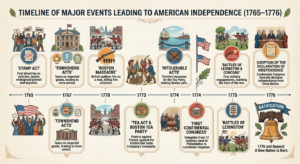
The Stamp Act taxed a wide range of printed materials, including newspapers, legal documents, and licenses. It was one of the first direct taxes imposed on the colonies and triggered widespread protests, boycotts, and the formation of resistance groups such as the Sons of Liberty.
1770 — The Boston Massacre
Tensions between colonists and British troops erupted into violence when British soldiers fired into a crowd of protesters in Boston, killing five civilians. The event was seized upon by colonial leaders as powerful propaganda, illustrating the dangers of British military occupation.
1773 — The Boston Tea Party
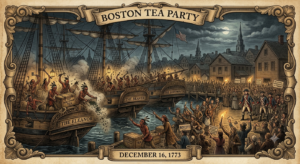
In one of the most symbolic acts of defiance in colonial history, a group of colonists boarded British ships docked in Boston Harbor and dumped hundreds of chests of tea into the water, protesting the Tea Act and the broader principle of taxation without representation. Britain’s response was swift and severe: a set of punitive measures known as the Intolerable Acts, designed to punish Massachusetts and reassert royal authority.
1774 — The First Continental Congress
In response to the Intolerable Acts, representatives from twelve of the thirteen colonies gathered in Philadelphia to coordinate a unified response to British policy. This meeting marked one of the first significant steps toward collective colonial action and laid the groundwork for future cooperation.
April 19, 1775 — The Battles of Lexington and Concord
Often remembered through the phrase “the shot heard around the world,” these battles marked the official beginning of armed conflict between the colonies and Britain, transforming years of political tension into open warfare.
The American Revolutionary War (1775–1783)
The war that followed pitted a well-funded, professionally trained British military against a colonial force built largely from local militias and volunteers. On paper, the odds heavily favored Britain — a global superpower with a dominant navy and vast resources. But the Americans had determination, growing organization, and, eventually, crucial foreign support.
Britain’s Advantages:
- A professional, experienced army
- A powerful and dominant navy
- Immense wealth and access to a global empire
The American Colonists’ Position:
- Local militias with limited training
- Volunteer soldiers driven by ideological commitment
- Eventually organized into a unified fighting force: the Continental Army
Command of the Continental Army fell to George Washington, a decision that would prove pivotal not just militarily, but in unifying the colonies under a single strategic vision.
The Second Continental Congress
In 1775, colonial leaders convened once again in Philadelphia, this time facing a much more urgent set of circumstances. The Second Continental Congress took several decisive actions:
- Formally created the Continental Army
- Appointed George Washington as its commander
- Began the serious work of preparing the colonies for full independence
This gathering represented a turning point — the moment when resistance evolved into organized rebellion with a clear, unified command structure.
The Declaration of Independence (July 4, 1776)
On July 4, 1776, the Second Continental Congress formally adopted the Declaration of Independence, a document that announced the colonies’ intention to separate from British rule entirely.
Who Wrote It?
The Declaration was primarily authored by Thomas Jefferson, though he worked alongside a committee of other influential figures, including:
- John Adams
- Benjamin Franklin
- Roger Sherman
- Robert R. Livingston
What Did the Declaration Actually Say?
The Declaration of Independence articulated a bold and, at the time, radical set of political ideas:
- The thirteen colonies were declaring themselves free and independent states.
- All people are created equal.
- Individuals possess natural, inherent rights — including life, liberty, and the pursuit of happiness.
- Governments derive their legitimate power from the consent of the governed.
- People retain the right to alter or abolish a government that fails to protect their rights.
These principles didn’t just justify separation from Britain — they became foundational ideas that would go on to influence democratic movements around the world for centuries to come.
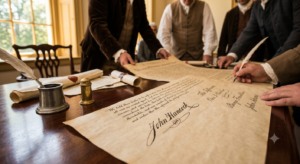
Was America Truly Independent on July 4, 1776?
Legally, the colonies declared their independence that day, but declaring independence and securing it were two very different things. Britain refused to recognize American sovereignty, and the war continued for another seven grueling years. Full, internationally recognized independence would not come until Britain formally acknowledged the United States in the Treaty of Paris in 1783.
Foreign Support: The Role of France and Other Allies
The American colonies could not have won the Revolutionary War alone. Foreign assistance — particularly from France — proved decisive in tipping the balance of power.
France provided:
- Financial support
- Weapons and military supplies
- Soldiers and military expertise
- Naval power, which helped counter Britain’s dominant fleet
Beyond France, both Spain and the Dutch Republic contributed support in various forms, motivated in part by their own rivalries with Britain. This international backing transformed what began as a colonial rebellion into a broader geopolitical conflict, one in which Britain found itself increasingly isolated.
Major Battles of the Revolutionary War
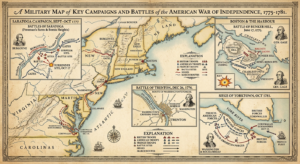
Battle of Bunker Hill (1775)
Though British forces ultimately captured the battlefield, they suffered heavy casualties in the process — a costly reminder that the colonial militias were far more capable than many had assumed.
Battle of Trenton (1776)
In a bold and now-legendary maneuver, George Washington led his troops across the icy Delaware River to launch a surprise attack, securing a critical victory that reinvigorated American morale at a moment when the war effort was flagging.
Battle of Saratoga (1777)
Widely regarded as the turning point of the entire war, the American victory at Saratoga convinced France that the colonies had a genuine chance at winning — and persuaded them to formally enter the war as an American ally.
Battle of Yorktown (1781)
American and French forces successfully surrounded the British army under the command of General Charles Cornwallis. Facing an impossible position, the British surrendered, effectively bringing major combat operations to an end.
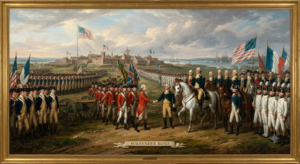
The Treaty of Paris (1783)
The Treaty of Paris formally concluded the Revolutionary War and secured Britain’s official recognition of the United States as an independent nation. Beyond ending the conflict, the treaty also granted the new nation significant territorial gains, extending its borders all the way to the Mississippi River.
This moment represented the true completion of American independence — not merely a declaration of intent, but an internationally recognized reality.
George Washington’s Role in Shaping a Nation
George Washington’s contributions to American independence extended far beyond the battlefield. As commander of the Continental Army, he:
- Led colonial forces through years of grueling warfare
- Secured pivotal military victories that shifted the course of the war
- Played a central role in unifying the colonies around a shared cause
Following the war, Washington’s influence continued to grow, culminating in his election as the first President of the United States in 1789. His leadership during both the Revolution and the early republic cemented his status as one of the most consequential figures in American history.
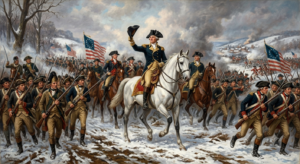
The Founding Fathers
While countless individuals contributed to the American cause, a handful of figures are remembered as the principal architects of the new nation:
- Thomas Jefferson — Principal author of the Declaration of Independence
- George Washington — Commander of the Continental Army and first U.S. President
- Benjamin Franklin — Diplomat, statesman, and key negotiator of foreign support
- John Adams — Advocate for independence and future second President
- James Madison — Later instrumental in drafting the U.S. Constitution
- Alexander Hamilton — Architect of the young nation’s financial system
Together, these leaders shaped not only the outcome of the Revolution but the political framework that would define the United States for generations.
Why July 4th Is Celebrated Today
Every year, Americans mark Independence Day with fireworks, parades, concerts, family gatherings, and patriotic ceremonies. While the celebrations have evolved considerably since 1776, their purpose remains the same: commemorating the day the Declaration of Independence was formally adopted, and with it, the birth of a new nation built on the principles of liberty and self-governance.
The Lasting Effects of American Independence
Political Effects
- The birth of the United States as a sovereign nation
- The establishment of a democratic republic, structured around representative government
- A lasting influence on constitutional governance around the world
Global Effects
The ideals born from the American Revolution didn’t stay confined to North America. They rippled outward, influencing:
- The French Revolution
- Independence movements throughout Latin America
- Broader democratic reforms across the globe
Economic Effects
- Greater control over domestic and international trade
- Expansion of homegrown industries no longer bound by British restrictions
- Accelerated westward settlement and economic growth
The Challenges That Followed Independence
Winning independence did not mean the new nation’s struggles were over. In fact, some of its most difficult challenges were only beginning:
- Significant war debt left over from years of fighting
- A weak central government operating under the Articles of Confederation
- Ongoing economic instability
- Complex and often strained relations with Native American nations
- Continued tension with both Britain and Spain
These mounting difficulties eventually made clear that a stronger, more unified system of government was necessary — a realization that led directly to the drafting of the U.S. Constitution in 1787.
Timeline of American Independence
| Year | Event |
|---|---|
| 1764 | Sugar Act |
| 1765 | Stamp Act |
| 1770 | Boston Massacre |
| 1773 | Boston Tea Party |
| 1774 | First Continental Congress |
| 1775 | Revolutionary War begins |
| July 4, 1776 | Declaration of Independence adopted |
| 1777 | Battle of Saratoga |
| 1781 | Battle of Yorktown |
| 1783 | Treaty of Paris recognizes U.S. independence |
| 1787 | U.S. Constitution drafted |
| 1789 | George Washington becomes first President |
Interesting Facts About American Independence
- The Declaration of Independence was approved on July 4, 1776, but the formal engrossed copy wasn’t signed by many delegates until later.
- The Liberty Bell in Philadelphia remains one of the most enduring symbols of American independence.
- Approximately 56 delegates ultimately signed the Declaration of Independence.
- Not every colonist supported the push for independence — a significant number remained loyal to the British Crown throughout the war.
- French military and naval support is widely regarded as one of the decisive factors behind the American victory.
Frequently Asked Questions
Q: When did America officially become independent? America declared independence on July 4, 1776, but full international recognition of that independence didn’t come until the Treaty of Paris was signed in 1783.
Q: Who wrote the Declaration of Independence? Thomas Jefferson was the principal author, working alongside a committee that included John Adams, Benjamin Franklin, Roger Sherman, and Robert R. Livingston.
Q: What was the turning point of the Revolutionary War? The Battle of Saratoga in 1777 is widely considered the turning point, as it convinced France to formally support the American cause.
Q: Why did the colonies want independence from Britain? The primary causes included heavy taxation without representation, restrictive trade policies, an unwanted British military presence, and a growing desire for self-governance.

Conclusion
American independence was never the product of a single moment — it was the outcome of years of political conflict, economic frustration, and a determined pursuit of self-governance that gradually transformed colonial subjects into a unified nation. While the Declaration of Independence stands as the symbolic birth of the United States, true independence was only secured through years of hard-fought battles and, ultimately, Britain’s formal recognition of American sovereignty in the Treaty of Paris in 1783.
The legacy of this revolution extends far beyond American borders. By proving that a determined people could break from imperial rule and establish a government rooted in representation and individual rights, the American Revolution helped reshape the course of world history — inspiring movements for freedom and democratic governance that continue to resonate today.
Enjoyed this deep dive into American history? Explore more historical analysis and narrative accounts on topics ranging from military campaigns to alternate history scenarios.
Important Article as per history decoded hub
Less than a century after winning independence from Britain, the United States faced one of the greatest challenges in its history: The American Civil War (1861–1865). Fought between the Union and the Confederacy, this devastating conflict claimed hundreds of thousands of lives and reshaped the nation’s future. Explore our detailed guide on The American Civil War (1861–1865) to learn about its causes, major battles, key leaders, the abolition of slavery, and the lasting impact it had on the United States.