
The Battle of Gettysburg: Three Days That Changed America
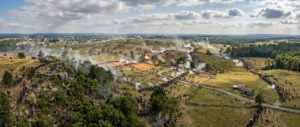
There are moments in history that arrive quietly, almost by accident, and yet end up reshaping the destiny of a nation. The Battle of Gettysburg was exactly that kind of moment. No general planned for it to happen in a small Pennsylvania town. No strategist marked Gettysburg on a map as the place where the Civil War would pivot. And yet, for three blistering days in July 1863, the fields, hills, and orchards surrounding this quiet farming community became the stage for the bloodiest battle ever fought on North American soil — a battle that would determine whether the United States survived as one nation or split forever into two.
To understand why Gettysburg matters so much, we need to step back and look at the summer of 1863, when the Confederacy stood, for a brief and dangerous moment, closer to victory than at almost any other point in the war.
The Road to Pennsylvania
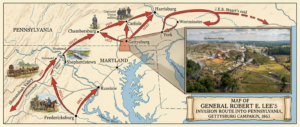
By the summer of 1863, the Confederacy had strung together a series of impressive victories in the Eastern Theater of the war. Riding this wave of momentum, General Robert E. Lee, commander of the Army of Northern Virginia, made a bold decision: he would take the fight north, out of war-ravaged Virginia and into the Union’s own backyard.
Lee’s reasoning was layered and ambitious. An invasion of the North would relieve the pressure on Virginia’s farmland, which had been stripped bare by years of marching armies. It would also allow his soldiers to feed off the rich, untouched farmlands of Pennsylvania — a practical necessity for an army that was perpetually short on supplies. Beyond logistics, Lee hoped a successful campaign on Northern soil might shake the resolve of the Northern public, turning war-weary citizens against President Lincoln’s administration. There was also the tantalizing possibility of foreign recognition — if the Confederacy could prove itself capable of winning battles deep in Union territory, perhaps Britain or France might finally intervene on its behalf. And looming over all of this was the dream of threatening major Northern cities like Harrisburg, Baltimore, Philadelphia, or even Washington, D.C. itself.
So in June 1863, Lee’s army crossed into Pennsylvania, and the Union scrambled to respond. In a moment of high drama, the Union Army of the Potomac received a new commander just days before the coming storm: General George G. Meade. He had almost no time to prepare, no time to fully understand his army, and yet he would soon be tasked with stopping one of the most formidable military forces in American history.
How a Small Town Became a Battlefield
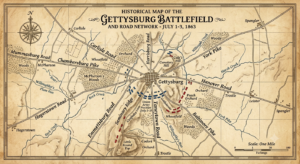
Here’s something that surprises many people: Gettysburg was never chosen as a battlefield. No one selected it for its strategic value or defensible terrain. It became the site of the war’s largest battle almost by coincidence.
The town’s significance came from something deceptively simple — roads. Ten different roads converged at Gettysburg, making it a natural crossroads and transportation hub. As Confederate and Union forces fanned out across the Pennsylvania countryside searching for one another, it was perhaps inevitable that their paths would cross at this convergence point. On July 1, advance units from both armies stumbled into each other near the town, and what began as a chance encounter quickly escalated into a full-scale battle that neither side had fully anticipated.
The Armies That Collided
Before diving into the fighting itself, it’s worth understanding the scale of what was about to happen.
The Union’s Army of the Potomac, under Meade, numbered roughly 93,000 soldiers. Their mission was straightforward but immense: defend Northern territory, halt Lee’s invasion, and above all, protect the capital at Washington, D.C.
Facing them was Lee’s Army of Northern Virginia, a smaller but battle-hardened force of approximately 71,000 to 75,000 men. Lee’s goals were bolder — he wasn’t simply trying to survive this encounter. He wanted a decisive, crushing victory on Northern soil, one significant enough to force political negotiations and possibly secure the international recognition the Confederacy so desperately craved.
Two armies, two very different sets of objectives, about to collide in a town neither had chosen.
Day One: The Battle Begins
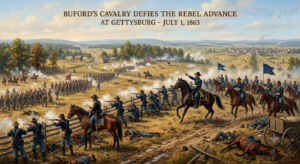
The first day of fighting, July 1, 1863, opened with Confederate troops advancing toward Gettysburg and running directly into Union cavalry commanded by General John Buford.
What Buford did next would prove pivotal. Recognizing the immense tactical value of the high ground south of town, he made the decision to hold his position and delay the Confederate advance for as long as possible, buying precious time for Union infantry reinforcements to arrive. It was a desperate gamble — cavalry against infantry — but it worked long enough to matter.
As the day wore on, Union troops fought with tremendous determination, but they were gradually pushed back through the streets of Gettysburg. By evening, the Confederates had seized control of the town itself. It looked, on the surface, like a Confederate victory.
But something more important had happened beneath that surface. As Confederate forces took the town, Union troops retreated to a series of strong defensive positions on Cemetery Hill, Cemetery Ridge, and Culp’s Hill. Together, these positions formed what historians now call a “fishhook”-shaped defensive line — a formation that would prove almost impossible to break in the days that followed.
This was the critical mistake of Day One. The Confederates had won the fighting, but they failed to seize the high ground before Union forces could fortify it. That single failure would haunt Lee’s army for the remainder of the battle.
Day Two: A Battle on Two Fronts
On July 2, Lee changed his strategy. Rather than attacking the center of the Union line directly, he ordered assaults on both flanks simultaneously, hoping to find a weakness somewhere along that fishhook-shaped defense.
What followed was some of the most brutal, desperate fighting of the entire war, spread across several now-legendary locations.
Little Round Top
On the Union’s left flank stood Little Round Top, a rocky, modest hill that would become the site of one of the most celebrated defensive stands in American military history. Confederate forces launched a determined assault to seize the position, understanding that if they captured it, they could roll up the entire Union line.
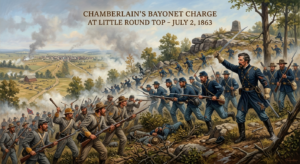
Standing in their way was Union Colonel Joshua Lawrence Chamberlain, leading the 20th Maine Regiment. As Confederate attacks intensified and his men’s ammunition dwindled to almost nothing, Chamberlain made an audacious decision: rather than retreat, he ordered a bayonet charge down the hillside. The surprised Confederate attackers broke and fell back. It was a moment of pure desperation transformed into legend — and it remains one of the most studied and celebrated actions of the entire Civil War.
Devil’s Den
Not far away, soldiers fought among the massive boulders and jagged rock formations of Devil’s Den. The terrain itself became a weapon, offering cover for snipers and creating a maze-like battlefield where men fought at close, brutal range. Although Confederate forces managed to capture portions of this rocky landscape, they could not break through to the Union line beyond it.
The Peach Orchard
At the Peach Orchard, the fighting took a different shape — intense artillery duels combined with infantry combat. Union troops stationed here suffered devastating losses, but their sacrifice succeeded in slowing the Confederate advance, buying time that would prove valuable as the day progressed.
The Wheatfield
Perhaps no location better captures the chaotic, see-saw nature of Day Two than the Wheatfield. This unassuming farm field changed hands repeatedly throughout the day as thousands of soldiers clashed in brutal close combat. Lines advanced, broke, and reformed again and again, leaving the field littered with the human cost of the struggle.
Culp’s Hill
On the opposite end of the Union line, Culp’s Hill faced wave after wave of Confederate attacks. Despite the repeated assaults, Union defenders held firm, refusing to surrender this critical anchor point on the right flank.
By the close of Day Two, despite extraordinary effort and staggering casualties on both sides, the Confederate forces had failed to break the Union defensive line at any point. The fishhook held.
Day Three: Pickett’s Charge
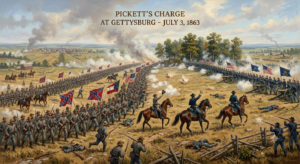
By July 3, Lee had grown convinced that the Union center — having reinforced both flanks over the previous two days — must now be vulnerable. It was a calculated gamble, and Lee decided to stake everything on it. He ordered a massive frontal assault against the center of the Union line, an attack that would become known to history as Pickett’s Charge.
The scale of this assault is almost difficult to comprehend. Approximately 12,500 Confederate soldiers prepared to advance across nearly one mile of completely open ground, directly into the teeth of the Union defense on Cemetery Ridge.
Before the infantry moved, Confederate artillery unleashed a massive bombardment intended to soften the Union position. Union artillery responded in kind, and for a time the air itself seemed to shake with cannon fire. Then, as the smoke began to clear, Confederate infantry stepped out into the open field and began their long, exposed march toward the Union lines.
What followed was catastrophic. The advancing Confederate troops faced an unrelenting storm of heavy artillery fire, rifle volleys, and deadly crossfire from Union positions on higher ground. Men fell by the hundreds with every passing minute. Despite the horror of it, a small contingent of Confederate soldiers managed to briefly break through the Union center at a spot that would later be immortalized as the “High Water Mark of the Confederacy” — the furthest point the Southern cause would ever reach in its bid to win the war on Northern soil.
But the breakthrough could not be sustained. Union reinforcements swarmed the breach, and within moments, the assault collapsed entirely. The survivors of Pickett’s Charge stumbled back across the same open ground they had just crossed, leaving the field behind them scattered with the dead and dying.
The result was unambiguous: massive Confederate losses, a complete failure to break the Union defenses, and effectively the end of Lee’s offensive campaign in the North.
Counting the Cost
The numbers from Gettysburg are staggering, even by the brutal standards of the Civil War. This was, without question, the bloodiest battle ever fought in North America.
| Side | Casualties |
|---|---|
| Union | About 23,000 |
| Confederate | About 28,000 |
| Total | Around 51,000 |
These figures included the killed, the wounded, the missing, and the captured. Entire regiments were effectively wiped out over the course of those three days. It’s a number so large that it becomes difficult to truly grasp — tens of thousands of individual human stories, families, and futures altered or ended within a span of seventy-two hours.
Why the Union Prevailed
Several intertwined factors explain why the Union ultimately emerged victorious from this brutal contest.
First, and perhaps most decisively, was terrain. Union troops occupied the high ground for most of the battle, a tactical advantage that proved enormously difficult for Confederate forces to overcome no matter how determined their assaults.
Second, the Confederate attacks throughout the battle often suffered from poor coordination, with assaults arriving at different times rather than as a unified, simultaneous push. This allowed Union commanders to shift resources and respond to threats one at a time rather than facing overwhelming pressure on every front at once.
Leadership decisions also played a significant role. Lee, normally a master tactician, repeatedly ordered frontal assaults against fortified Union positions — a strategy that, time and again, proved costly against an enemy holding strong defensive ground.
Finally, simple resilience cannot be overlooked. Union soldiers, despite suffering tremendous losses of their own, held their lines through repeated and ferocious attacks. That stubborn refusal to break was, in many ways, the deciding factor of the entire battle.
The Aftermath and Lasting Consequences
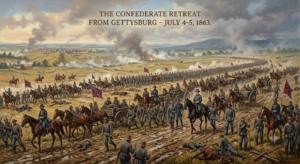
On July 4, 1863, Lee’s battered army began its retreat back to Virginia. He would never again attempt a major invasion of the North. The momentum that had carried the Confederacy through so many earlier victories had been broken, decisively, on the fields of Gettysburg.
This is why historians so often refer to Gettysburg as the turning point of the Civil War. Confederate momentum, which had seemed nearly unstoppable in the months before the battle, came to an abrupt halt. The South lost a staggering number of experienced soldiers and officers — losses that would prove difficult, if not impossible, to replace. Meanwhile, Northern morale, which had been flagging under the weight of earlier defeats, received a desperately needed boost.
In the months that followed, the strategic landscape of the war shifted noticeably. The Confederacy increasingly found itself forced into defensive operations rather than bold offensive campaigns. The path toward eventual Union victory, while still long and bloody, became significantly more likely. And the dream of foreign recognition — that hope of British or French intervention that had partly motivated Lee’s invasion in the first place — grew increasingly distant and improbable.
A Few Words That Outlived the Battle
Several months after the guns fell silent, on November 19, 1863, President Abraham Lincoln traveled to Gettysburg for the dedication of the Soldiers’ National Cemetery, a final resting place for many of the soldiers who had died there. What he delivered that day became known as the Gettysburg Address.
The speech lasted only a few minutes — remarkably brief, especially compared to the lengthy oratory typical of the era. And yet, it became one of the most influential speeches in American history. In just a few hundred words, Lincoln articulated the deeper meaning behind the sacrifice made at Gettysburg, weaving together themes of equality, democracy, national unity, and sacrifice for freedom. It transformed a battlefield into something larger: a symbol of what the nation was fighting to become.
Why Gettysburg Still Matters
More than a century and a half later, the Battle of Gettysburg remains one of the most extensively studied military engagements in history, and for good reason. It halted Confederate expansion into the North at a critical moment in the war. It demonstrated, in vivid and often heartbreaking detail, the importance of terrain, timing, and leadership in deciding the outcome of a battle. It produced casualties on a scale that forced the nation to reckon with the true cost of the conflict it had entered. And ultimately, it influenced the broader trajectory of the American Civil War, helping set the stage for the eventual preservation of the United States as one nation.
The Bigger Picture
The Battle of Gettysburg, fought across three exhausting days in July 1863, stands as the largest and bloodiest battle of the American Civil War. Under the leadership of George G. Meade, the Union Army turned back Robert E. Lee’s invasion of the North through a combination of strong defensive positioning, stubborn resilience, and — in the end — Lee’s own costly tactical decisions. The collapse of Pickett’s Charge and the subsequent Confederate retreat marked a pivotal turning point, one that helped tilt the long, painful arc of the war toward eventual Union victory and the preservation of the United States.
It’s worth remembering that none of this was inevitable. Gettysburg wasn’t chosen; it was stumbled into. The outcome wasn’t guaranteed; it was earned, hill by hill, field by field, at extraordinary human cost. And perhaps that’s exactly why it continues to resonate so deeply — because within those three days lies a story not just of armies and generals, but of ordinary people thrust into extraordinary circumstances, making choices that would echo far beyond their own lifetimes.
Important Article as per History Decoded Hub
- he Battle of Gettysburg is often considered the most significant turning point of the American Civil War, marking the moment when Confederate momentum began to fade. To better understand the broader conflict that led to this decisive battle, read our article on The American Civil War (1861–1865): Real Causes, Turning Points, and Lasting Consequences.
- The consequences of Gettysburg extended far beyond the battlefield, influencing the future direction of the United States. Similar long-term effects can be seen in The Falklands War (1982): The 74-Day Conflict That Changed Britain and Argentina Forever, where a brief conflict significantly altered the political landscape of both Britain and Argentina.
-
External Reference
To explore the battlefield in greater detail and learn about its historical significance, visit the official Gettysburg National Military Park website maintained by the U.S. National Park Service: Gettysburg National Military Park