
Around 89 AD, a Roman emperor named Domitian gave an order that should have silenced a Greek philosopher forever. Every philosopher was to be expelled from Italy. Books were to be burned. Teachers were to be executed if they stayed. Domitian feared philosophers because they refused to flatter him, and one of the men he wanted gone had once been owned as property, his leg broken by his own master.
That man was Epictetus. He did not resist the exile. He simply packed what little he owned — an iron lamp, a straw bed, a stool — and walked away to Greece, where he built something Domitian could never touch: a school that would outlast the empire itself, and a philosophy that a Roman emperor would later carry into battle as his personal handbook.
Nearly two thousand years later, Epictetus is still being read by soldiers, therapists, athletes, and CEOs. Navy pilot James Stockdale credited him with keeping his mind intact through seven years of torture as a prisoner of war in Vietnam. The founder of cognitive behavioral therapy, Aaron Beck, traced the roots of modern psychotherapy directly back to him. And the phrase that anchors nearly every self-help book published today — focus on what you can control — was not invented by a modern psychologist. It was taught in a rented room in Nicopolis by a man who had once been considered property.
This is the story of how a slave became one of history’s most important philosophers, and why his ideas refuse to go out of date.
Introduction: Who Was Epictetus?
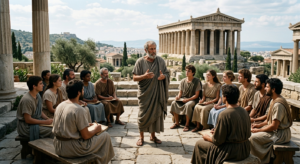
Epictetus was a Greek Stoic philosopher who lived from roughly 50 to 135 AD — born enslaved in the Roman province of Phrygia, freed as an adult, and eventually exiled from Rome for the crime of teaching people how to think. He never held political office, never commanded an army, and never wrote a single book. And yet his name sits comfortably alongside Aristotle, Marcus Aurelius, and Seneca on any serious list of history’s most influential thinkers.
What earns him that place is not the originality of his ideas — Stoicism already existed for three centuries before he arrived — but the brutal authority with which he taught them. When Epictetus said that external circumstances cannot touch a person’s inner freedom, he was not offering comfortable theory from a position of safety. He was a man whose body had been owned by another human being, whose leg may have been deliberately broken, and who had been forcibly exiled from his home for practicing philosophy. He had, in other words, already lost almost everything a person can lose, and he was still standing there arguing that none of it mattered to the one thing that did: his own judgment, freely exercised.
That is also why he remains relevant today in a way many ancient philosophers do not. His central teaching — that we suffer not from events themselves but from our opinions about them — anticipated modern cognitive psychology by nearly two thousand years and now sits at the foundation of cognitive behavioral therapy, one of the most widely used treatments for anxiety and depression in the world. His “dichotomy of control,” the simple distinction between what is up to us and what is not, has become a working framework for professional athletes managing pressure, entrepreneurs managing failure, and soldiers managing fear.
That practicality is precisely why successful people continue to study him centuries later. Roman emperor Marcus Aurelius built his private journal, Meditations, on Epictetus’s teachings. Vietnam prisoner of war James Stockdale credited Epictetus’s philosophy with keeping his mind intact through years of torture. Modern entrepreneurs, coaches, and military leaders return to the same handful of ideas for the same reason ancient students once traveled across the Roman world to sit in his classroom in Nicopolis: Epictetus does not offer comfort. He offers control — real, durable control over the one part of life that was never actually up for negotiation in the first place.
The World Epictetus Was Born Into
To understand Epictetus, you first have to understand the machine he was born inside of.
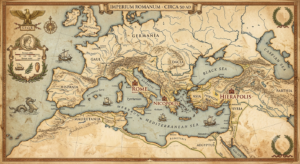
By the middle of the first century AD, Rome controlled the known world. Its empire stretched from Britain to Egypt, held together by roads, legions, and a rigid social order that placed the emperor at the top and enslaved people at the very bottom. Slavery was not a shameful footnote in Roman society; it was the engine that ran it. Historians estimate that slaves made up somewhere between a fifth and a third of the population of Italy. They farmed the fields, raised the children, kept the accounts, and — in households wealthy enough — even taught philosophy to the sons of senators.
Greek culture sat in an odd position within this world. Rome had conquered Greece militarily centuries earlier, yet Greek philosophy, medicine, art, and literature were considered the height of sophistication. Educated Romans learned Greek. Wealthy households often staffed themselves with Greek-speaking slaves precisely because Greek slaves were assumed to be more cultured. This is the paradox Epictetus lived inside: a man with no legal rights, whose intellect made him more valuable — and occasionally more respected — than free men around him.
Stoicism itself was already three centuries old by the time Epictetus arrived. It had been founded in Athens around 300 BC by a merchant named Zeno of Citium, who reportedly discovered philosophy after being shipwrecked and losing everything he owned. By Epictetus’s era, Stoicism had traveled from Greek marketplaces into the halls of Roman power, studied by senators, generals, and eventually an emperor. Epictetus did not invent Stoicism. What he did was strip away its technical, academic language and turn it into something that could be lived by anyone — free or enslaved, rich or poor.
Birth and Early Life: What We Know and What We Don’t
Even Epictetus’s name is not really his own. “Epictetus” comes from the Greek word epiktetos, meaning simply “acquired” or “gained” — a label, not a name given by parents who loved him. His birth name has been lost to history entirely.
Most historians place his birth around 50 AD in Hierapolis, a Greek city in the region of Phrygia, in what is now western Turkey, near the modern town of Pamukkale. Nothing certain is known about his parents, his childhood, or how he ended up enslaved. This is not unusual — the ancient world rarely bothered to record the origins of the people it owned. What we do know is that at some point, likely as a child, he was taken to Rome and sold into the household of Epaphroditus, a powerful and wealthy freedman who served as secretary to the emperor Nero.
Historians are careful to flag how thin this record really is. Everything about Epictetus’s first two decades of life is reconstructed from scattered references in his later teachings and from biographical notes written by other ancient authors, sometimes generations after his death. There is no birth certificate, no family record, no contemporary account of his childhood. What survives is a man who appears fully formed in the historical record only once he begins studying philosophy.
Life as a Slave in the House of Epaphroditus
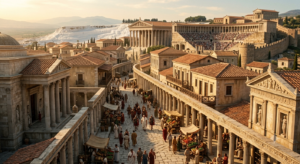
Epaphroditus was no ordinary slaveholder. As Nero’s secretary, he sat close to the center of imperial power — close enough that he would later assist Nero in his suicide in 68 AD, a service for which he was eventually executed under Domitian. Owning a household of educated, capable slaves was part of how a man like Epaphroditus projected status.
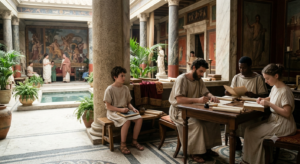
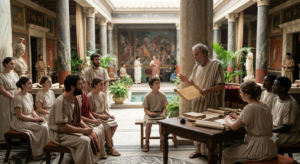
This is the strange hinge on which Epictetus’s whole life turns. Epaphroditus, for reasons no source fully explains, permitted his slave to attend the lectures of Musonius Rufus, one of the most respected Stoic teachers in Rome. It was not entirely unheard of for slaves in wealthy households to receive an education — an educated slave was, after all, a more useful and more valuable one. But philosophy was different from bookkeeping or medicine. It taught a person to question what truly mattered, to separate their inner freedom from their outer circumstances. Handing that tool to an enslaved person was, whether Epaphroditus realized it or not, handing him a way to be free long before the law ever agreed.
The Broken Leg: Fact, Legend, and Uncertainty
No detail of Epictetus’s life has been retold more often than the story of his disability, and few details are less certain.
The most famous version comes from Celsus, a second-century critic of Christianity, whose account survives only because the Christian theologian Origen quoted it while arguing against him. According to this story, Epaphroditus lost his temper one day and began twisting Epictetus’s leg. Epictetus is said to have calmly warned him that it would break — and when it did, he simply remarked, “Did I not tell you that it would break?” He did not cry out. He did not resist. He treated the destruction of his own body as a fact to be observed rather than a catastrophe to be mourned.
It is a magnificent story. It is also, historians caution, probably not something we can verify. A different ancient source, the philosopher Simplicius writing centuries later, claims instead that Epictetus had been lame since childhood, with no mention of abuse at all. Modern scholars point out that the leg-breaking anecdote reads suspiciously like a piece of philosophical theater — a story built to illustrate Stoic principles in action, whether or not it happened exactly that way. Some modern medical historians have even proposed rheumatoid arthritis as a more mundane explanation for a permanent limp.
What can be stated with confidence is only this: Epictetus lived with a physical disability for most or all of his adult life, walking with the aid of a limp so pronounced that ancient writers routinely described him as “lame.” Whether the cause was cruelty or illness, Epictetus himself turned the fact into one of his central teaching examples — a body that could be broken, sitting beside a will that could not be touched.
Musonius Rufus and the Making of a Philosopher
If Epictetus is Stoicism’s most famous practical teacher, Musonius Rufus is the man who made him one. Musonius was a Roman senator and philosopher known for his uncompromising moral seriousness — he reportedly argued that women deserved the same education in philosophy as men, a radical position for his time, and that philosophy was worthless unless it was actually practiced, not just discussed.
Under Musonius, Epictetus would have studied the traditional three branches of ancient philosophy: logic, physics, and ethics. But it was Musonius’s insistence on ethics as lived practice, rather than abstract theory, that shaped Epictetus’s entire teaching style. Years later, Epictetus would repeat this same demand to his own students: stop reciting philosophy like a party trick and start using it to face your actual life.
Freedom, and a New Life as a Teacher
The historical record does not tell us the exact date or circumstances of Epictetus’s manumission — the formal Roman legal process of freeing a slave. What scholars can say is that it happened sometime after Nero’s death in 68 AD, possibly connected to the chaos and change of ownership that followed the collapse of Nero’s regime. Once free, Epictetus did something remarkable for a former slave: he began teaching philosophy in Rome under his own name, building a reputation serious enough that it eventually reached the emperor’s court.
Exile: Domitian and the Banishment of Philosophers
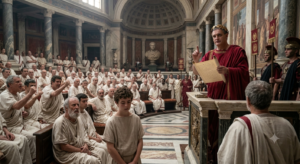
Epictetus’s growing prominence collided with one of Rome’s more paranoid emperors. Domitian, who ruled from 81 to 96 AD, grew increasingly hostile toward philosophers, whom he viewed as a political threat — men whose teachings on virtue and freedom too easily curdled into criticism of tyranny. Around 89 or 93 AD (ancient sources vary), Domitian issued an edict expelling all philosophers from Italy. Some historians note this crackdown coincided with the execution of Epictetus’s former owner, Epaphroditus, whom Domitian ordered killed for his role in Nero’s death decades earlier.
Rather than fight the order or go into hiding, Epictetus left. He crossed the Adriatic to Nicopolis, a city in the Roman province of Epirus in northwestern Greece — and there, in exile, he built the school that would define the rest of his life.
Nicopolis: The School That Outlasted an Empire
Nicopolis was not a backwater. Founded by the emperor Augustus to commemorate his victory at the nearby Battle of Actium, it functioned as a major administrative and communications hub on the Greek coast — a sensible place for a teacher hoping to attract students traveling between Rome and the eastern provinces.
Epictetus’s classroom was built around conversation, not lecture. Students brought him real problems — grief, fear, ambition, anger — and he worked through them out loud, using sharp questioning, blunt humor, and constant repetition of a handful of core ideas rather than an ever-expanding list of doctrines. His curriculum included readings from earlier Stoic philosophers such as Chrysippus, along with training in logic, but his own emphasis fell overwhelmingly on ethics — how to actually live.
He lived, by every surviving account, with almost nothing. His possessions reportedly amounted to little more than a bed, a rug, and an earthenware lamp. When that lamp was stolen, he simply replaced it with a cheaper one, reasoning that he had only lost what he never truly owned in the first place. After his death, an admirer is said to have paid an enormous sum for that same cheap clay lamp — a detail Epictetus himself would likely have found darkly amusing, given everything he taught about attaching value to objects.
His reputation grew large enough that the future emperor Hadrian is recorded as having visited him in Nicopolis, seeking out a former slave for counsel that senators and generals could not offer him.
Personal Life: A Man Who Practiced What He Preached
Epictetus never married and, for most of his life, had no children — a detail that made him an easy target for teasing. One of his own students, the Cynic philosopher Demonax, mocked him for constantly urging his pupils to marry and have children while remaining unmarried himself; when Epictetus pressed the point, Demonax sarcastically offered to marry one of Epictetus’s own daughters, knowing full well he had none.
Late in life, however, Epictetus’s principles were tested directly. A friend could not care for a newborn child who would otherwise have been abandoned to die — a grim but not uncommon practice in the ancient world. Epictetus, then an old man living alone, adopted the child and raised him with the help of a woman, though ancient sources disagree on whether the two were formally married. It is one of the few moments where the philosopher who preached detachment from external attachments chose, without hesitation, to take on the deepest attachment of all.
The Discourses and the Enchiridion: Words He Never Wrote
Here is the strangest fact about one of history’s most quoted philosophers: Epictetus never wrote a single word of what we now read under his name.
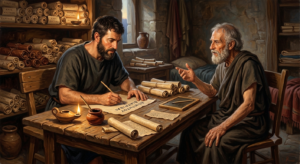
Everything we have comes from a student named Arrian of Nicomedia, who attended Epictetus’s lectures around 108 AD and claimed to have transcribed them as close to word-for-word as he could manage, later publishing them as a record for his own memory rather than as a polished literary work. The result was The Discourses, originally eight books, of which four survive. Arrian later compiled a condensed digest of the core teachings into a short handbook known as the Enchiridion, from a Greek word meaning something you keep close at hand — a manual, not a monument.
Not every scholar accepts Arrian’s framing at face value. A minority of modern historians argue the polish and length of certain passages suggest Epictetus himself may have shaped or even written portions of the text, with Arrian’s claim of pure transcription functioning as a literary convention rather than a literal description. The majority view still credits Arrian as a faithful, if imperfect, recorder rather than the true author. Either way, without Arrian, Epictetus would almost certainly have vanished from history entirely — an irony for a philosopher who insisted that opinions, not books, were what mattered.
The Core of Epictetus’s Philosophy: The Dichotomy of Control
If Epictetus’s entire teaching had to be reduced to a single sentence, it would be the opening line of the Enchiridion: some things are within our power, and some are not.
Within our power, he taught, are our judgments, our impulses, our desires, and our own actions — in short, anything that originates purely from within us. Outside our power is everything else: our bodies, our reputations, our possessions, other people’s opinions of us, even whether we live or die. Suffering, Epictetus argued, comes not from external events themselves but from mistakenly believing we control things we do not, and then feeling betrayed when reality fails to obey us.
This is not a philosophy of passivity. Epictetus was not telling his students to stop caring about outcomes — he was telling them to stop staking their peace of mind on outcomes they could not guarantee. A modern student worrying about a job interview cannot control whether they get the job; they can control how thoroughly they prepare and how honestly they present themselves. An athlete cannot control an opponent’s performance; they can control their own training and effort. This single distinction, applied consistently, is the seed from which nearly every other Stoic exercise grows.
Practical Stoic Exercises Epictetus Taught
Epictetus was allergic to philosophy that stayed theoretical. His school ran on repeated practice, not memorized doctrine.
Daily self-examination meant reviewing one’s judgments and reactions at the end of each day, asking where fear, anger, or desire had been allowed to overrule reason. The discipline of desire trained students to want only what was truly within their control, so that failure to obtain something external would no longer cause despair. The discipline of action focused on carrying out one’s social duties — to family, community, and role — with care, regardless of whether those actions were appreciated. The discipline of assent, arguably the most demanding, trained students to pause before accepting any first impression as objective truth, since Epictetus believed it was not events but our snap judgments about events that caused distress.
He also encouraged a kind of mental rehearsal for hardship — imagining loss, insult, or misfortune in advance, not to induce anxiety, but to drain those possibilities of their shock value before they ever arrived.
Famous Quotes and What They Actually Mean
Epictetus’s teachings survive today largely as short, quotable lines, and a few deserve closer attention than they usually get.
His observation that people are disturbed not by events themselves but by their opinions about those events is often shortened into modern self-help language, but its original context was far more demanding — it was a call to examine every emotional reaction as evidence of a hidden, possibly false, belief.
His teaching that we should not wish for events to happen as we wish, but should wish for events to happen as they do happen, is frequently misunderstood as resignation. In context, it was closer to a definition of genuine freedom: peace comes not from controlling the world, but from no longer needing the world to go a particular way.
His warning that wealth does not consist in having great possessions but in having few wants reflects his own lived example — a man who owned almost nothing and considered himself, by his own account, wealthier than the emperors who ruled him.
Influence: From Marcus Aurelius to Modern Therapy
Epictetus’s most famous student never actually sat in his classroom. Marcus Aurelius, born roughly a decade after Epictetus died, encountered his teachings secondhand through a tutor and through the widely circulated text of the Discourses. Marcus quotes Epictetus directly in his own private journal, later published as Meditations — meaning the most powerful man in the world took moral instruction from a philosophy built by a former slave.
The line runs forward from there in ways Epictetus could never have predicted. Early Christian thinkers were drawn to his emphasis on providence, humility, and inner discipline, and later translations of the Enchiridion circulated widely through medieval and Renaissance Europe. In the twentieth century, psychiatrist Aaron Beck cited Stoic philosophy, and Epictetus specifically, as a direct influence on the founding principles of cognitive behavioral therapy — the now-standard treatment built on the idea that distorted thinking, not raw circumstance, drives most emotional suffering. Psychologist Albert Ellis credited similar Stoic roots for his own influential therapy model. Military history offers its own striking example: Vietnam prisoner of war James Stockdale later said Epictetus’s teachings on physical suffering and inner freedom helped him survive years of captivity and torture, a debt he spoke about publicly for the rest of his life.
Criticism and Academic Debate
Epictetus is not without critics, ancient or modern. Some ancient rivals mocked Stoicism generally for demanding an almost inhuman level of emotional control, doubting that ordinary people could realistically live up to it. Modern critics raise a related concern: taken to an extreme, the dichotomy of control can be misread as an argument for accepting injustice rather than resisting it — if outcomes are not “up to us,” why fight to change them at all? Most contemporary Stoic scholars respond that this misreads Epictetus, who explicitly taught that fulfilling one’s social duties and acting justly were themselves fully within a person’s control, even if the results of that action were not.
Scholars also continue to debate the authorship question raised earlier — how much of the Discourses reflects Epictetus’s actual words versus Arrian’s literary shaping — a genuinely open academic question rather than a settled fact.
Myths vs. Facts
| Claim | Status |
|---|---|
| Epictetus wrote the Discourses and Enchiridion himself | Myth (mainstream view) — they were compiled by his student Arrian, though a minority of scholars argue for greater Epictetan authorship |
| His leg was broken by his master, Epaphroditus | Disputed — reported by Celsus/Origen; contradicted by Simplicius, who says he was lame from childhood |
| Epictetus was Roman by birth | Myth — he was Greek, born in Hierapolis, in modern-day Turkey |
| He taught the emperor Marcus Aurelius directly | Myth — Marcus never met him; he studied Epictetus’s teachings after his death |
| Emperor Hadrian visited him in Nicopolis | Generally accepted by historians as likely true |
| He lived in poverty by choice, not just necessity | Fact — he continued this lifestyle even after gaining a public reputation and wealthy admirers |
A Simple Timeline
- c. 50 AD — Born into slavery in Hierapolis, Phrygia
- Youth — Taken to Rome, enslaved in the household of Epaphroditus
- Youth/early adulthood — Studies Stoic philosophy under Musonius Rufus
- After 68 AD — Gains his freedom following the death of Nero
- 68–89 AD — Teaches philosophy publicly in Rome
- c. 89–93 AD — Banished from Italy under Emperor Domitian’s edict against philosophers
- c. 93 AD onward — Establishes his school in Nicopolis, Greece
- c. 108 AD — His student Arrian records the lectures that become the Discourses
- c. 135 AD — Dies in Nicopolis at an advanced age
Lesser-Known Facts
Epictetus’s original birth name is unknown — even “Epictetus” is essentially the Greek word for “acquired,” a label stamped on him by his own enslavement. His famous clay lamp reportedly sold for an enormous sum after his death, a detail even the satirist Lucian found worth mocking. And despite being one of history’s most quoted moral philosophers, no bust, painting, or physical description of him survives from his own lifetime — every artistic depiction of Epictetus was created centuries after his death, based purely on imagination.
Why Epictetus Still Matters
Strip away the togas and the Latin names, and Epictetus’s core insight is uncomfortably modern: most of our suffering comes not from what happens to us, but from what we tell ourselves about what happens to us. A man who owned nothing, whose body had been broken by another human being, insisted that his mind remained entirely his own — and built an entire philosophical system to prove it.
That is why his ideas outlived an empire that tried to silence him. Domitian could banish philosophers from Italy, but he could not banish an idea that had already taken root in the mind of anyone willing to hear it: you are not what happens to you. You are what you choose to do about it.
Frequently Asked Questions
Was Epictetus really a slave? Yes. He was born into slavery around 50 AD in Hierapolis and was owned by Epaphroditus, a wealthy freedman who served as secretary to Emperor Nero, before gaining his freedom as an adult.
Did Epictetus write the Enchiridion himself? No — mainstream scholarship holds that his student Arrian compiled both the Discourses and the Enchiridion from lecture notes, though a small number of scholars argue Epictetus may have shaped the text more directly than Arrian’s preface suggests.
What is the “dichotomy of control”? It is Epictetus’s foundational teaching that some things are within our power (our judgments, desires, and actions) while everything else (our bodies, reputation, and external events) is not, and that lasting peace comes from focusing only on the former.
How did Epictetus become disabled? It’s genuinely uncertain. One ancient account claims his master broke his leg during an act of cruelty; another ancient source says he was lame from childhood, possibly due to illness such as arthritis. Historians cannot fully resolve which account is accurate.
Why is Epictetus still relevant today? His teachings underpin modern cognitive behavioral therapy, are studied by military leaders and athletes for mental resilience, and remain a foundational text for the modern Stoicism movement embraced by entrepreneurs, coaches, and self-improvement writers worldwide.
What is the difference between the Discourses and the Enchiridion? The Discourses are the longer, more conversational record of Epictetus’s actual classroom teaching — originally eight books, four of which survive. The Enchiridion (Handbook) is a short, condensed digest of the core ideas from the Discourses, compiled by Arrian as a portable, practical summary rather than a full record of his teaching.
Did Epictetus ever meet Marcus Aurelius? No. Epictetus died around 135 AD, when Marcus Aurelius was still a young boy. Marcus encountered Epictetus’s teachings later in life through a tutor and through the widely circulated text of the Discourses, which he quotes directly in his own Meditations.
Why was Epictetus exiled from Rome? Emperor Domitian issued an edict banishing all philosophers from Italy, viewing them as a political threat whose teachings on virtue and freedom too easily became implicit criticism of imperial rule. Epictetus left for Nicopolis, Greece, rather than defy the order.
What did Epictetus teach about happiness? He taught that happiness does not depend on external circumstances — wealth, health, reputation, or possessions — but entirely on the correct use of one’s own judgment, desires, and actions, which he argued were the only things ever truly within a person’s control.
Is Epictetus’s philosophy connected to modern therapy? Yes. Aaron Beck, the psychiatrist who founded cognitive behavioral therapy, and psychologist Albert Ellis, who developed a closely related model, both cited Stoic philosophy — and Epictetus specifically — as a direct influence on the idea that distorted thinking, rather than raw circumstance, drives most emotional suffering.
Further Reading: Epictetus and Stoic Philosophy
To explore Epictetus’s life, Stoic philosophy, teachings, and major works such as the Discourses and Enchiridion, see the Stanford Encyclopedia of Philosophy, a scholarly reference source.
Stanford Encyclopedia of Philosophy — Epictetus
Important Article as per History Decoded Hub.com
-
Marcus Aurelius and Stoic Philosophy
Marcus Aurelius, the Roman emperor and Stoic philosopher, believed that true strength came from self-control, reason, and fulfilling one’s duties. His famous work, Meditations, offers practical reflections on resilience, discipline, and living a virtuous life.
Learn more: Marcus Aurelius: Life, Philosophy, and Legacy
-
Socrates and the Origins of Western Philosophy
Socrates was one of ancient Greece’s most influential philosophers, known for questioning conventional beliefs and encouraging people to examine their lives and ideas. His method of asking probing questions became a foundation of Western philosophy.
Learn more: Socrates: The Philosopher Who Changed the Way We Think
-
Aristotle and the Foundations of Western Thought
Aristotle was one of ancient Greece’s most influential thinkers, contributing to philosophy, science, politics, and ethics. A student of Plato and teacher of Alexander the Great, his ideas shaped Western thought for centuries.
Learn more: Aristotle: The Curious Mind Who Changed the World