
Introduction
For more than 3,400 years, a quiet chamber cut deep into the limestone hills of Egypt’s Western Valley kept a secret. Sealed away from sunlight, sand-scoured winds, and the footsteps of millions of tourists who passed through the more famous corridors of the Valley of the Kings, the tomb of Pharaoh Amenhotep III waited. Its painted walls, its long sloping corridors, its silent chambers meant for a king and his queen — all of it sat frozen in time, protected as much by neglect as by intention.
Now, after more than two decades of closure and one of the most painstaking restoration efforts in modern Egyptian archaeology, that silence has broken. In what is being called one of the most significant moments in recent Egyptian heritage, the Amenhotep III tomb reopening has once again put a forgotten golden age on display. A chapter of history that had been fading into darkness is now visible in full color, and for historians, archaeologists, and travelers alike, this is not simply the unlocking of a door. It is the reawakening of an era.
This is the story of Amenhotep III — the pharaoh who ruled not through the sword, but through splendor — and the remarkable journey his tomb has taken from royal resting place, to robbed ruin, to one of Egypt’s most celebrated conservation triumphs. In the sections below, we’ll walk through who he was, why his tomb was closed for so long, what has changed inside it, and why this restoration matters far beyond the borders of Egypt.
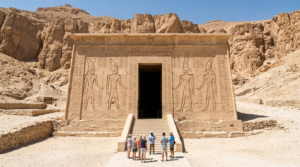
Who Was Amenhotep III?
To understand why this reopening matters, you first have to understand the man at the center of it.
Amenhotep III ascended the throne of Egypt during the 18th Dynasty, reigning from approximately 1390 BC to 1353 BC. In a civilization whose greatest rulers are so often remembered for their conquests — for the armies they led and the enemies they crushed — Amenhotep III stands apart. His nearly four-decade reign is remembered instead as the golden age of the New Kingdom, a period when Egypt achieved a level of peace, prosperity, and cultural brilliance rarely matched before or since.
Rather than expanding his empire through warfare, Amenhotep III built it through diplomacy. He forged marriage alliances and trade agreements with the great powers of his era, including Mitanni, Babylon, and other kingdoms of the ancient Near East. Egyptian gold flowed outward through these relationships, and in return, the kingdom gained something arguably more valuable than territory: stability. It was this stability that allowed Egypt’s economy, art, and architecture to flourish as never before.
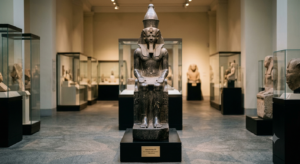
Under his rule, Egypt did not merely survive — it radiated confidence. Monumental temples rose along the Nile. Colossal statues were carved to announce his power to anyone who dared doubt it. Court life became a showcase of luxury, artistry, and religious devotion. By the time Amenhotep III died, he had presided over what many historians consider the political and cultural peak of Ancient Egyptian civilization.
And yet, his legacy did not end with him. His son, the pharaoh who would become known as Akhenaten, would go on to shatter Egyptian religious tradition entirely, ushering in the radical Amarna Period. In many ways, the stability and wealth Amenhotep III built were the very foundation that made his son’s revolutionary — and controversial — reign possible.
Where Is the Tomb Located?
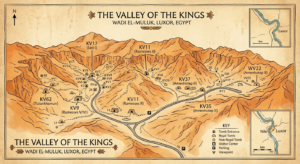
Unlike many of the more famous tombs clustered together in the well-trodden eastern branch of the Valley of the Kings, Amenhotep III chose a different resting place entirely.
His tomb, designated WV22 by archaeologists, lies in the Western Valley, a more remote and secluded offshoot of the greater Valley of the Kings near Luxor. While tourists today flock in the thousands to the eastern valley to see the tomb of Tutankhamun or Ramesses VI, the western branch has always remained quieter, less accessible, and far less visited.
This was almost certainly by design. Scholars believe Amenhotep III selected this more isolated location specifically because it offered greater privacy and a stronger sense of protection compared to the increasingly crowded eastern section, which by his time was already becoming the preferred burial ground for Egypt’s royal family. In choosing solitude over spectacle, the pharaoh who ruled through diplomacy rather than domination made one final quiet statement — even in death, he preferred to stand apart.
Why Was the Tomb Closed for Over Two Decades?
For a monument that had survived more than three thousand years, the modern era brought its own set of dangers — ones far slower and less dramatic than tomb robbery, but no less destructive.
The tomb was closed to public visitation for more than 20 years because its delicate wall paintings and underground chambers had suffered significant deterioration over time. The threats came from multiple directions at once:
- Natural weathering that gradually eroded painted surfaces
- Salt damage, a persistent enemy of Egyptian tombs, caused by mineral deposits crystallizing beneath painted plaster and pushing it apart from within
- Humidity, often introduced ironically by the very visitors who came to admire the art, as human breath and body heat raise moisture levels in enclosed spaces
- Structural cracks that threatened the long-term stability of the corridors and chambers
- Cumulative tourism impact, the slow wear caused by decades of footsteps, touch, and exposure to artificial lighting
Recognizing that the tomb could not withstand continued exposure without intervention, Egyptian authorities made the difficult decision to close it entirely. What followed was a major, multi-phase restoration project led by Egyptian conservation teams with significant support from Japanese archaeological and preservation experts — a collaboration that combined local expertise in Egyptian material culture with international conservation science.
The work was neither quick nor simple. Restorers had to carefully clean centuries of grime and salt buildup from painted surfaces without damaging the pigments beneath. They had to stabilize crumbling structures without erasing the tomb’s ancient character. And they had to improve safety for future visitors — all while treating the site with the reverence owed to a 3,400-year-old royal burial chamber. It was, in every sense, a race between decay and preservation, and after more than two decades, preservation has won.
What Makes This Reopening So Significant?
The reopening of WV22 is far more than the simple unlocking of a historical site. It represents the successful conclusion of one of the most ambitious tomb conservation projects Egypt has undertaken in recent memory — and it arrives at a moment when the country is placing renewed emphasis on its cultural heritage.
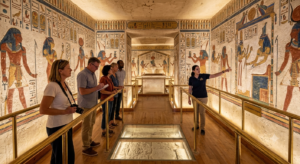
Visitors who step into the tomb today will encounter a markedly different experience than what existed before its closure. Among the most notable improvements are:
- Restored wall paintings, now displaying brighter, more vivid original colors that had long been dulled by grime, salt, and time
- Improved lighting systems, designed to illuminate the artwork clearly while minimizing the heat and humidity that damage ancient pigments
- Safer walkways and staircases, replacing older infrastructure that posed risks to both visitors and the fragile tomb structure itself
- Enhanced environmental protection systems, intended to regulate humidity and airflow to prevent the very deterioration that necessitated the closure in the first place
- A significantly improved visitor experience, balancing public access with the long-term preservation of an irreplaceable monument
Notably, the reopening does not exist in isolation. It coincides with Egypt’s broader campaign to promote cultural tourism ahead of the long-anticipated opening of the Grand Egyptian Museum, a sprawling new institution near the Giza Plateau designed to showcase the country’s ancient treasures on a scale never before attempted. The revival of Amenhotep III’s tomb fits neatly into this larger narrative: Egypt is not simply preserving its past, but actively re-presenting it to the world.
Stepping Inside: What Does the Tomb Actually Look Like?
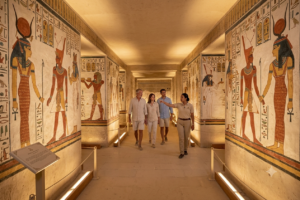
Descending into WV22 is, in many ways, a journey backward through time itself.
The tomb begins with a long, descending entrance corridor that stretches approximately 36 meters (118 feet) into the bedrock before reaching the burial chambers below. Each step downward carries visitors further from the light and heat of the Egyptian sun and deeper into the cool, silent world the ancient Egyptians believed would carry their king into the afterlife.
The overall layout of the tomb reflects both practical and religious considerations, and includes:
- A long, sloping entrance passage designed to lead the deceased pharaoh’s spirit toward the afterlife
- Multiple interior corridors connecting various chambers
- A central burial chamber, the resting place intended for Amenhotep III himself
- Side chambers believed to have been designated for Queen Tiye, his principal wife, and Princess Sitamun, his daughter
- Additional storage and ritual rooms, likely intended to hold funerary goods and objects necessary for the journey into the next world
Interestingly, despite the tomb’s impressive scale and ambitious design, it was never fully decorated in the way some other royal tombs in the Valley of the Kings were. This incompleteness offers its own quiet insight into the realities of ancient royal burial — even a pharaoh as powerful and wealthy as Amenhotep III was bound by the limits of time, resources, and the unpredictable timing of death itself.
The Artistry Within: Restored Wall Paintings
If the architecture of WV22 tells the story of ambition, its wall paintings tell the story of belief.
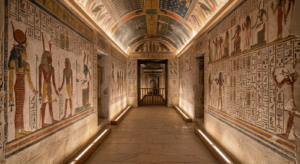
The restored artwork stands among the tomb’s greatest treasures, offering a rare and intimate window into the religious world of the New Kingdom. Thanks to the extensive conservation work, visitors can now see details that had become nearly invisible under layers of salt, grime, and age. The surviving scenes depict:
- Amenhotep III standing in reverence before Egyptian gods, a visual affirmation of his divine right to rule
- Elaborate religious ceremonies conducted in honor of the deities central to Egyptian cosmology
- Offerings presented to the gods, symbolizing the exchange of devotion for protection and favor in the afterlife
- Passages drawn from the Book of the Dead, the collection of spells and texts intended to guide the deceased safely through the dangers of the underworld
- Traditional funerary rituals, meticulously illustrated to ensure the king’s safe passage into eternity
For centuries, much of this artwork had been difficult to appreciate fully, obscured by the slow accumulation of environmental damage. The recent conservation work has changed that entirely, peeling back the layers of time to reveal detail, color, and craftsmanship that had not been clearly visible in generations. For historians, this restoration is not just cosmetic — it offers renewed opportunities to study Egyptian religious iconography and funerary practice with a clarity that had been lost.
A Tomb Disturbed: Was It Ever Robbed?
For all its grandeur, WV22 was not spared the fate that befell nearly every richly furnished tomb in ancient Egypt.
Yes — like the vast majority of royal burials in the Valley of the Kings, Amenhotep III’s tomb was looted in antiquity, likely not long after his burial, when knowledge of the tomb’s location and contents would still have been fresh among those willing to risk everything for royal treasure.
Among the items believed to have been stolen were:
- Precious jewelry crafted for the pharaoh’s eternal adornment
- Gold artifacts, some possibly melted down shortly after the theft
- Funeral equipment intended to serve the king in the afterlife
- Much of the original sarcophagus, the stone coffin meant to house his body for eternity
Today, only fragments of that original sarcophagus remain within the tomb — broken pieces that nonetheless offer archaeologists valuable clues about its original design, craftsmanship, and appearance. In a strange way, these surviving fragments have become just as valuable to modern researchers as an intact sarcophagus might have been, since they allow scholars to reconstruct not only what was lost, but how it was made.
Where Is Amenhotep III’s Mummy Today?
One of the more surprising aspects of this story is that the pharaoh whose tomb has just reopened is not actually resting within it.
Amenhotep III’s mummy does not remain inside his original burial chamber. During ancient times, in response to the growing threat of tomb robbery that plagued the Valley of the Kings, Egyptian priests took the extraordinary step of relocating the mummy to another royal tomb for safekeeping. This practice was not unique to Amenhotep III — many pharaohs’ remains were moved and reburied by priests attempting to protect them from looters during periods of political instability.
Today, Amenhotep III’s mummy is preserved and displayed at Egypt’s National Museum of Egyptian Civilization, alongside the remains of several other New Kingdom royals. For visitors, this creates a uniquely layered historical experience: one can walk through the pharaoh’s empty but magnificently restored tomb in the Western Valley, and separately, come face to face with the preserved remains of the man himself elsewhere in the country — two halves of the same story, split across different locations by the passage of thousands of years.
Why Is Amenhotep III So Famous?
Long before this tomb reopening returned his name to headlines, Amenhotep III had already secured his place as one of Ancient Egypt’s most consequential rulers. His fame rests on a combination of achievements that few pharaohs could match:
- Nearly four decades of prosperous, largely peaceful rule
- Massive temple-building projects that reshaped the religious landscape of Egypt
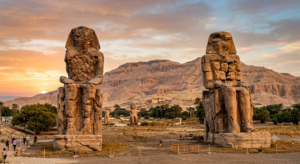
- The construction of the Colossi of Memnon, two enormous stone statues that still stand today as silent guardians of his now-vanished mortuary temple
- Luxurious royal palaces that reflected the wealth and sophistication of his court
- Strong diplomatic relationships with neighboring kingdoms across the ancient Near East
- Generous patronage of art, sculpture, and architecture, much of which came to define the aesthetic high point of the New Kingdom
Perhaps most significantly, his reign laid the essential groundwork for what came next. The stability, wealth, and administrative strength Amenhotep III built over nearly forty years gave his son, Akhenaten, the foundation needed to attempt one of the most radical religious transformations in ancient history — the short-lived but historically fascinating Amarna Period, during which traditional Egyptian polytheism was temporarily set aside in favor of the worship of a single solar deity, the Aten.
In this sense, Amenhotep III’s legacy is dual: he was both the architect of Egypt’s golden age and, indirectly, the father of one of its most disruptive revolutions.
Why the Reopening Matters Beyond Tourism
It would be easy to view the reopening of WV22 simply as a new attraction for Egypt’s tourism industry — another checkbox on a traveler’s itinerary through Luxor. But to view it that way alone would be to miss the deeper significance of what has actually taken place.
This reopening represents the successful conclusion of decades of painstaking, deliberate, and often invisible conservation work. It reflects a broader philosophy taking hold across Egypt’s approach to its own heritage: that ancient monuments are not simply attractions to be exploited for revenue, but fragile, finite resources that must be actively protected if they are to survive for future generations at all.
The restored tomb now allows both casual visitors and serious researchers to engage with the craftsmanship, religious beliefs, and royal traditions of Ancient Egypt in a way that had not been possible for more than twenty years. Every restored brushstroke on the tomb’s walls, every stabilized corridor, and every improved safety measure represents a choice to prioritize long-term preservation over short-term convenience.
As Egypt continues to invest in the preservation and presentation of its extraordinary archaeological heritage — from the Grand Egyptian Museum to ongoing excavation projects across the Valley of the Kings — the reopening of Amenhotep III’s tomb stands as one of the country’s most significant recent achievements in cultural conservation. It is a reminder that history, when cared for properly, does not simply survive. It can be brought back to life.
Frequently Asked Questions
Who was Pharaoh Amenhotep III? Amenhotep III was a pharaoh of Egypt’s 18th Dynasty who ruled from approximately 1390 BC to 1353 BC. His reign is widely regarded as the golden age of the New Kingdom, marked by peace, wealth, diplomacy, and extensive artistic and architectural achievement.
Where is Amenhotep III’s tomb located? The tomb, known as WV22, is located in the Western Valley, a secluded section of the Valley of the Kings near Luxor, Egypt.
Why was the tomb closed for more than 20 years? The tomb was closed due to significant damage from natural weathering, salt buildup, humidity, structural cracks, and the cumulative impact of tourism. Egyptian and Japanese conservation experts undertook an extensive restoration project to stabilize and preserve the site.
Is Amenhotep III’s mummy inside the tomb? No. His mummy was moved by ancient priests to another location for protection from tomb robbers and is now displayed at the National Museum of Egyptian Civilization in Egypt.
Was the tomb robbed in ancient times? Yes. Like most royal tombs in the Valley of the Kings, WV22 was looted in antiquity, with jewelry, gold artifacts, and much of the original sarcophagus stolen. Only fragments of the sarcophagus remain today.
What can visitors see inside the restored tomb? Visitors can explore a long descending entrance corridor, multiple chambers, and beautifully restored wall paintings depicting Amenhotep III before Egyptian gods, religious ceremonies, and texts from the Book of the Dead.
Why is Amenhotep III considered one of Egypt’s greatest pharaohs? He is remembered for nearly four decades of prosperous rule, monumental construction projects including the Colossi of Memnon, strong diplomatic alliances, and a reign that laid the foundation for the Amarna Period under his son, Akhenaten.
Important Article As Per History Decoded Hub.
-
Cleopatra: Egypt’s Last Great Pharaoh
More than a thousand years after Amenhotep III’s reign, Cleopatra became Ancient Egypt’s last active ruler. Explore her fascinating life, political alliances, and lasting legacy in our article on Cleopatra: The Last Pharaoh of Egypt.
-
Rise and Fall of the Roman Empire
Like Ancient Egypt, the Roman Empire rose to immense power before eventually declining. Discover the key events, famous emperors, and reasons behind its collapse in our article on Rise and Fall of the Roman Empire.
-
Construction of the Pyramids of Giza
Long before Amenhotep III ruled Egypt, the Pyramids of Giza stood as remarkable symbols of ancient engineering and royal ambition. Learn how these iconic monuments were built in our article on Construction of the Pyramids of Giza.
External Resources
To learn more about Amenhotep III, the Valley of the Kings, and Ancient Egyptian history, explore these trusted sources:
- UNESCO – Ancient Thebes with its Necropolis: https://whc.unesco.org/en/list/87/