
Introduction: The American Civil War is usually remembered for its battles, leaders, and the fight over unity and freedom. But behind the scenes, a different kind of revolution was unfolding—one driven by technology and innovation. This was not just a war of soldiers and strategy, but a turning point where machines and new systems began to shape the battlefield.
Railroads moved troops faster than ever before, telegraphs carried instant commands across long distances, and ironclad ships changed naval warfare forever. Weapons became more advanced, making combat deadlier and more efficient. These hidden technologies quietly transformed how wars were fought, marking the shift from traditional combat to modern warfare.
“The Silicon & Steel Revolution” explores this lesser-known side of the Civil War—revealing how innovation, not just bravery, played a crucial role in shaping its outcome and the future of warfare.
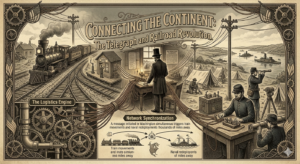
1. The Nervous System of War: The Telegraph
Before 1861, warfare moved at the speed of a galloping horse. Commands were carried by hand, and by the time a general received a report, the situation on the ground had often changed. The introduction of the telegraph changed the “tempo” of human conflict forever.
The Lincoln Connection
President Abraham Lincoln was perhaps the first “high-tech” Commander-in-Chief. He spent more time in the War Department’s telegraph office than almost anywhere else outside the White House. From a small room, he could “ping” his generals in real-time. This allowed for:
-
Centralized Command: The ability to coordinate movements across a 2,000-mile front.
-
The End of the “Lone General”: Commanders could no longer ignore the executive branch; they were now on a digital leash.
Tactical Intelligence
Field telegraphs were deployed with rolling reels of wire that followed the armies. For the first time, a scout five miles away could report an enemy movement to the command tent in seconds. This was the 19th-century equivalent of a satellite feed.
2. Steel Ribbons: The Railroad as a Weapon
If the telegraph was the nervous system, the railroad was the circulatory system. In previous wars, an army’s size was limited by how much food its horses could carry. The railroad shattered those limits.
Logistics as Strategy
The North held a massive advantage here. With over 22,000 miles of track compared to the South’s 9,000, the Union could move an entire army corps from the Eastern Theater to the Western Theater in a matter of days—a feat that would have taken months of marching.
Standardized Gauges
A hidden detail that crippled the South was the lack of “standardized gauges.” Different Southern rail companies used different track widths. This meant that supplies often had to be unloaded from one train and reloaded onto another simply to cross a state line. The North’s unified system allowed for seamless, industrial-scale warfare.
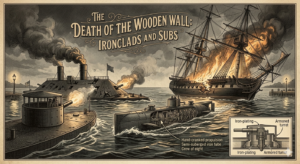
3. The Death of the Wooden Wall: Ironclads and Subs
The naval aspect of the Civil War is often overshadowed by the land battles, but it was on the water that the most radical shifts in technology occurred.
Monitor vs. Virginia
In March 1862, the world watched as two “iron monsters” hammered each other at Hampton Roads. The USS Monitor and the CSS Virginia proved that the age-old tradition of wooden ships and sails was over. Every navy in Europe—including the mighty British Royal Navy—was rendered obsolete in a single afternoon.
The H.L. Hunley
The South, desperate to break the Union blockade, turned to experimental “secret weapons.” The H.L. Hunley became the first submarine to successfully sink an enemy warship. Though the mission was a suicide trek for the crew, it birthed the terrifying reality of underwater warfare that would define the 20th century.
4. The Rifled Musket: A Lethal Miscalculation
Perhaps the most tragic technological “hidden hand” was the transition from smoothbore muskets to rifled barrels using the Minié ball.
-
The Tech: Rifling (spirals inside the barrel) made bullets spin, increasing accuracy from 50 yards to 300+ yards.
-
The Tragedy: Generals on both sides continued to use Napoleonic tactics—lining men up in tight rows and marching them across open fields.
-
The Result: Because the weapons were now far more accurate than the tactics were modern, the casualty rates were catastrophic. This gap between technology and tradition is why the Civil War remains the bloodiest conflict in American history.
5. Shadows and Secrets: The Invisible Spies
While the men fought openly, a hidden war of shadows was waged by those the military often ignored: women, civilians, and the formerly enslaved.
The Black Dispatches
The Union’s “Secret Service” relied heavily on “Black Dispatches”—intelligence provided by enslaved people who overheard the private conversations of Confederate officers. Their contributions were vital to the Union’s understanding of Southern troop movements and morale.
The Women in the Shadows
Spies like Rose O’Neal Greenhow (Confederate) and Elizabeth Van Lew (Union) used their social status to gather high-level secrets. Van Lew even placed a former slave, Mary Bowser, as a servant in the Confederate White House, where she could read Jefferson Davis’s mail while clearing the table.

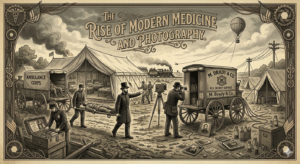
6. The Rise of Modern Medicine and Photography
The Civil War was the first conflict to be “seen” by the public in near-graphic detail.
-
The Camera: Photographers like Mathew Brady brought the “dead of Antietam” into the living rooms of New York and Washington. For the first time, war was not a glorious painting; it was a muddy, gruesome reality.
-
The Ambulance Corps: Before the war, there was no system for evacuating the wounded. By 1864, the Union had developed a professionalized ambulance system that became the blueprint for modern emergency medical service.
7. The Final Conclusion: A Modern Blueprint
By 1865, the American Civil War had ceased to look like a 19th-century conflict and began to look like World War I. Trench warfare around Petersburg, the use of rapid-fire “Gatling” guns, and the systematic destruction of infrastructure (Sherman’s March) showed the world that war was no longer about “chivalry.” It was about industrial capacity and the total mobilization of society.
When we decode the history of the 1860s, we see the birth of the modern world—forged in iron, connected by wire, and fueled by a relentless drive for innovation.
Further Reading & Topics for Investigation:
-
The role of the Gatling Gun in the siege of Petersburg.
-
How the discovery of Special Order 191 changed the Battle of Antietam.
-
The hidden economics of the Southern cotton trade during the blockade.
If you a full and knowledgeable blog on American Civil war which will help you to increase you knowledge in simple English Word than visit to