
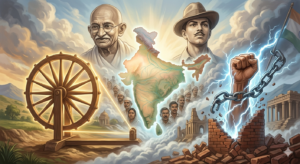
Introduction: “History is often written as a straight line, but the story of India’s independence was a collision of two unstoppable forces. On one side stood the ‘Apostle of Peace,’ Mahatma Gandhi, wielding the quiet power of non-violence and mass civil disobedience. On the other was the ‘Prince of Martyrs,’ Bhagat Singh, whose revolutionary action and defiant sacrifice shook the foundations of the British Raj. But was this a rivalry of enemies, or a partnership of necessity? In this deep dive, we explore the Gandhi vs Bhagat Singh debate—not just as a clash of tactics, but as the dual heartbeat of a nation fighting to be born. Discover how these two different paths to freedom ultimately converged to change the world forever.”
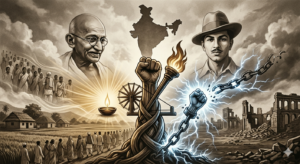
1. Gandhi’s Path: Non-Violence and Mass Movement
Mahatma Gandhi’s strategy was revolutionary in its own right, not for the weapons it used, but for the weapons it discarded. His philosophy of Satyagraha (Truth-Force) was built on the radical idea that the moral weight of an oppressed people could eventually collapse the strongest empire on earth.
-
Ahimsa as a Political Tool: For Gandhi, non-violence was not a sign of weakness but the highest form of bravery. He believed that by refusing to retaliate against British brutality, Indians could expose the “moral bankruptcy” of colonialism to the entire world.
-
The Power of the Common Man: Gandhi’s greatest contribution was the democratization of the freedom struggle. Before his arrival, the movement was largely restricted to the urban elite and the legal profession. Gandhi took the message to the villages. Through movements like the Salt March (1930) and the Quit India Movement (1942), he empowered farmers, weavers, women, and students.
-
Economic Self-Reliance: By promoting Khadi (homespun cloth) and the Charkha (spinning wheel), Gandhi attacked the economic foundation of British rule—the textile industry. He transformed a simple piece of cloth into a symbol of defiance.
To Gandhi, the “Path” was as important as the “Destination.” He famously stated that a freedom won through bloodshed would result in a nation governed by fear and violence.
2. Bhagat Singh’s Path: Revolutionary Action
While Gandhi was mobilizing the masses through patience and penance, a young, brilliant intellectual was crafting a different narrative in the northern heartlands of India. Bhagat Singh, influenced by European revolutionary history and Marxist ideology, believed that the British Empire was a parasitic entity that would never leave voluntarily through “moral appeals.”
-
The Philosophy of the Bomb: Singh clarified that his use of force was not “terrorism.” In his view, “The bomb and the pistol do not make a revolution. The sword of revolution is sharpened on the whetting-stone of ideas.” His actions were strategic strikes meant to shatter the myth of British invincibility.
-
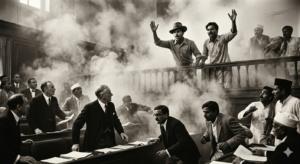
The Assembly Bombing (1929): When Singh and Batukeshwar Dutt threw non-lethal smoke bombs into the Central Legislative Assembly, their goal was to “make the deaf hear.” They didn’t flee; they stayed to be arrested, using the subsequent trial as a platform to spread revolutionary socialist ideas to the Indian youth.
-
A Socialist Vision: Unlike many contemporary leaders, Singh’s vision of Inquilab (Revolution) wasn’t just about removing the British. He wanted to end the exploitation of man by man—whether the exploiter was a British official or an Indian landlord. He sought a radical restructuring of society where the “toilers” (workers and peasants) were the true masters.
3. Did Their Paths Conflict or Complement Each Other?
This is the central question of Indian historiography. On the surface, their paths were in constant friction, but a deeper analysis suggests a powerful, unintended synergy.
The Conflict
Gandhi was vocally critical of revolutionary violence. After the Chauri Chaura incident, he withdrew a national movement because it turned violent, much to the frustration of younger revolutionaries. Conversely, Singh and his comrades in the HSRA (Hindustan Socialist Republican Association) felt that Gandhi’s methods were too slow and allowed the British to consolidate power through hollow “reforms.”
The Complement
Despite their ideological clashes, they functioned as the Hammer and the Anvil:
-
The Threat of the Radical: The British were often more willing to negotiate with the “moderate” Gandhi because they lived in constant fear of the “radical” followers of Bhagat Singh and later Subhash Chandra Bose. The presence of a violent alternative made Gandhi’s non-violence a more attractive option for the British to engage with.
-
The Moral Shield: Gandhi provided a moral legitimacy to the movement that protected it from being dismissed as a mere “terrorist uprising” by the international community. He created the massive, unstoppable tide, while Singh and his comrades provided the sharp, sudden shocks that kept the colonial administration on edge.
4. Impact on India’s Independence
The combined impact of these two paths changed the course of history in 1947.
-
Gandhi’s Legacy of Democracy: Gandhi’s emphasis on mass participation and civil rights laid the groundwork for India’s democratic constitution. It ensured that when independence finally came, the nation had a framework for peaceful governance and a culture of collective protest that persists to this day.
-
Singh’s Legacy of Social Justice: Bhagat Singh remains the ultimate icon for the Indian youth. His sacrifice ignited a fire that ensured the movement never went cold. His focus on socialism heavily influenced the early economic policies of independent India and the push for land reforms and workers’ rights.
-
The Psychological Break: Gandhi proved that the British could be defied; Singh proved that they could be terrified. Together, they broke the psychological spell of the British Raj. By the time the 1940s arrived, the British realized they were fighting a war on two fronts: a massive, non-violent population that refused to obey, and a revolutionary spirit that made their physical presence in India increasingly dangerous.
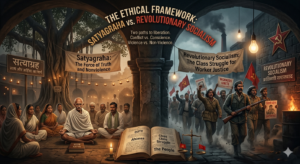
5. The Ethical Framework: Satyagraha vs. Revolutionary Socialism
The fundamental difference between Gandhi and Singh lay in their definition of “power.”
For Mahatma Gandhi, power was a moral force. His philosophy of Satyagraha (Truth-Force) was built on the bedrock of Ahimsa (non-violence). Gandhi argued that the British were not just political occupiers; they were moral captives of their own greed. By refusing to cooperate and by accepting suffering without retaliation, Gandhi believed Indians could “melt the hearts” of their oppressors. To Gandhi, the means were the ends in the making. If India won freedom through violence, he feared the resulting nation would be a “violent India,” merely replacing white tyrants with brown ones.
Bhagat Singh, however, viewed power through the lens of material reality and class struggle. Influenced by the Russian Revolution and Marxist-Leninist thought, Singh believed that the British Empire was a predatory economic machine. You do not ask a predator to “change its heart”; you dismantle the machine. Singh’s brand of revolutionary socialism wasn’t about mindless killing—it was about “propaganda by deed.” His actions, such as the 1929 bombing of the Central Legislative Assembly, were carefully designed to “make the deaf hear.” He threw smokeless bombs and shouted slogans not to kill, but to force the world to acknowledge the illegitimacy of British rule.
6. The Concept of “Swaraj”: What Kind of Freedom?
The word Swaraj (Self-rule) meant different things to these two leaders.
Gandhi’s Swaraj was deeply spiritual and decentralized. He envisioned a “Gram Swaraj”—a nation of self-sufficient villages. He was wary of industrialization and the centralization of power. For Gandhi, freedom meant the liberation of the individual from the vices of modern civilization. It was as much a struggle against internal weaknesses (like untouchability and religious intolerance) as it was against external rule.
Singh’s Swaraj was a radical social and economic overhaul. In his seminal writing, Why I am an Atheist, Singh clarified that his fight was against all forms of exploitation. He didn’t want a “transfer of power” where Indian elites replaced British elites. He dreamed of a socialist republic where the “toiling masses”—the peasants and the workers—held the reins. To Singh, political independence was a hollow victory if the caste system and class exploitation remained intact.
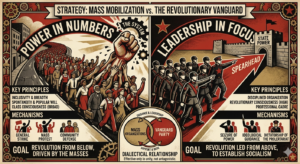
7. Strategy: Mass Mobilization vs. The Revolutionary Vanguard
How do you move a nation of 300 million people? This was the tactical question that separated the two.
The Gandhian Wave
Gandhi’s genius lay in his ability to turn mundane, everyday activities into acts of rebellion. Wearing Khadi (homespun cloth), making salt, or simply refusing to go to work—these were actions that a grandmother, a child, or a farmer could participate in. This converted the independence movement from an elite debate into a mass movement. By involving the common man, Gandhi made it impossible for the British to govern by consent.
The Revolutionary Spark
Bhagat Singh and the Hindustan Socialist Republican Association (HSRA) operated on a different scale. They believed that the masses were ready for revolution but lacked the “spark.” Singh believed that a small group of highly disciplined, fearless revolutionaries (the vanguard) could perform acts of supreme sacrifice that would shatter the myth of British invincibility. His decision to stay in the Assembly after the bombing and face trial was a calculated move to use the British courtroom as a megaphone for his ideas.
8. The 1931 Execution: The Great Historical Friction
The most controversial point of intersection between these two paths occurred in March 1931. Bhagat Singh, Sukhdev, and Rajguru were sentenced to death for the Lahore Conspiracy Case (the killing of Officer Saunders). This coincided with the negotiations for the Gandhi-Irwin Pact.
History remains divided on Gandhi’s role during this period. Critics argue that Gandhi had the political leverage to demand the commutation of Singh’s sentence as a condition for the pact. Supporters of Gandhi point out that he did plead for their lives on umanitarian grounds, but as a proponent of non-violence, he could not make the release of “violent revolutionaries” a non-negotiable term.
Bhagat Singh, for his part, did not want a pardon. He believed his death would do more for the cause than his life ever could. He went to the gallows at the age of 23, chanting Inquilab Zindabad, becoming a martyr whose popularity, at that moment, rivaled even Gandhi’s.
9. Comparing the Methods: A Tactical Analysis
To understand the effectiveness of these different paths, we can look at their impact on the British Raj:
10. The Synthesis: Why Both Were Necessary
It is tempting to choose a side, but the reality of 1947 suggests that India’s freedom was a result of the interplay between these two forces.
Without Gandhi, the movement might have devolved into a fragmented series of violent uprisings that the British could have easily crushed with superior weaponry, as they did in 1857. Gandhi gave the movement a moral shield that made it difficult for the British to use full military force without looking like monsters on the world stage.
Without Bhagat Singh and the revolutionaries who followed (including Subhash Chandra Bose’s INA), the British might have felt they could manage Gandhi’s non-violence indefinitely. The presence of the “revolutionary path” acted as a deadline. The British realized that if they did not negotiate with the “moderate” Gandhi, they would eventually have to face the “radical” followers of Singh.
Conclusion: Two Pillars of One Nation
Mahatma Gandhi and Bhagat Singh represent the two essential halves of the Indian psyche: the patience of the sage and the fire of the rebel.
Gandhi gave India the tools of democracy, civil rights, and collective action. Bhagat Singh gave India the spirit of intellectual inquiry, the courage to challenge the status quo, and a vision of economic equality.
Today, as we navigate the complexities of the 21st century, we don’t have to choose between them. We can admire Gandhi’s commitment to peace while honoring Singh’s refusal to accept injustice. They were the hammer and the anvil—different in nature, but both essential in forging the steel of a free nation. If you want a full blog on Bhagat Singh than visited to
Discussion Point: If Bhagat Singh had lived to see a free India, how do you think his socialist vision would have interacted with the democratic framework established by Gandhi and Nehru?
*If you want a full blog on history of Bhagat Singh, Then visit to my another blog to get knowledge in simple English.
*If you want a full blog on history Mahatma Gandhi than also you can visit to my another blog to get knowledge in simple English.
