
Picture this. It’s 1919. A cool January breeze moves through Amritsar, but the mood in Punjab is anything but calm. In a few months, a garden called Jallianwala Bagh will turn red, and a nation that had spent centuries divided by caste, religion, region, and language will begin — slowly, painfully, powerfully — to imagine itself as one.
This is not just a chapter in your history book. It’s the story of how “India” as an idea was born in the hearts of millions of ordinary people — farmers who had never left their villages, mill workers with blistered hands, women who stepped out of their homes for the first time, and a lawyer named Mohandas Karamchand Gandhi who convinced an entire subcontinent that they could fight an empire without lifting a sword.
This detailed guide follows the exact structure your NCERT chapter uses — the First World War and the rise of Non-Cooperation, the many different strands the movement took in the countryside, the road to Civil Disobedience, and finally how India began to feel like a single nation. Read it once as a story, and you’ll never need to cram it again.
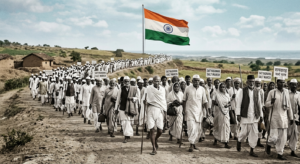
Part 1: The First World War, Khilafat, and Non-Cooperation
Why Did Nationalism Grow After 1919, Not Before?
Before you jump into dates and movements, your first exam-worthy question is: why did the mass movement begin around 1919, and not earlier?
The First World War (1914–1918) had changed everything. India had supplied soldiers, money, and raw materials to Britain’s war effort, expecting that this loyalty would be rewarded with greater self-government once the war ended. Instead, the war years brought something else entirely:
- Massive price rise, especially in food grains, which crushed the household budgets of the poor.
- Forced recruitment of villagers into the army, which created deep resentment in rural India, particularly in Punjab.
- Increased taxes and war loans that the colonial government demanded from Indians to fund a war they had little stake in.
- A devastating influenza epidemic following the war that killed millions, worsening the mood of hardship and loss across the country.
Ordinary people who had sacrificed the most got nothing back. That broken promise is the seed from which the entire chapter grows.
The Idea of Satyagraha
By this point, Gandhi had already returned from South Africa, where he had developed and tested a new form of political struggle — satyagraha, literally “the force of truth.” The principle was simple but revolutionary: if your cause is just and your fight is truthful, you don’t need violence to win it. Suffering, patience, and moral courage could defeat even the most powerful empire, because it would eventually be forced to see the injustice of its own actions.
Gandhi did not simply announce this idea — he proved it worked, one struggle at a time:
- Champaran, Bihar (1917): Gandhi organised a satyagraha to support indigo planters who were being forced by British planters to grow indigo on a fixed portion of their land, at unfair prices.
- Kheda, Gujarat (1917): Gandhi supported peasants demanding relaxation in revenue collection after crop failure and a plague epidemic.
- Ahmedabad (1918): Gandhi organised a satyagraha among cotton mill workers, demanding better working conditions.
Each of these local victories built Gandhi’s credibility as a leader who could actually deliver results for ordinary people — and set the stage for something much bigger: a nationwide movement.
The Rowlatt Act (1919): A Law With No Trial
Imagine a law that lets the government arrest you, hold you without a trial, and give you no right to appeal. That was the Rowlatt Act, hurriedly passed by the Imperial Legislative Council in 1919, despite united opposition from every single Indian member. Gandhi decided this “black law” needed a nationwide response and called for a countrywide hartal (strike) on 6 April 1919, along with satyagraha against the Act.
Quick note: Rowlatt Act = government could arrest and imprison people without trial or appeal → nationwide hartal called by Gandhi, April 1919.
Jallianwala Bagh: The Massacre That Changed the Mood of a Nation
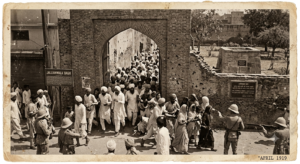
The situation turned tragic in Punjab. Local leaders were picked up and arrested, prompting large-scale protests. On 13 April 1919, thousands gathered at Jallianwala Bagh in Amritsar — many for a peaceful protest against the arrests, and many simply attending the Baisakhi fair, unaware that a ban on public meetings had even been announced. General Dyer sealed the only exit of the enclosed garden and ordered his troops to open fire directly into the unarmed, trapped crowd. Hundreds were killed within minutes, and many more were injured.
The horror of Jallianwala Bagh did something the British hadn’t expected: it stripped away any remaining trust between Indians and the colonial government. News of the massacre spread quickly, and violent protests broke out in many towns. The government responded with brutal repression — martial law was imposed in Punjab, and people were subjected to public floggings and humiliating punishments such as the infamous “crawling order” in a lane in Amritsar. Gandhi, alarmed at the growing violence on both sides, called off the movement — but the anger left behind by Jallianwala Bagh never really faded, and it became a permanent symbol of colonial cruelty in the national memory.
The Khilafat Wave and the Birth of Non-Cooperation
Here’s where the chapter gets genuinely clever, and this is a favourite exam topic: how did a religious issue in Turkey become linked with an Indian freedom movement?
After the war, Indian Muslims were deeply anxious about the future of the Ottoman Khalifa, the spiritual head of the Muslim world, whose authority the British seemed ready to dismantle as part of the post-war peace settlement. Brothers Muhammad Ali and Shaukat Ali, leaders of the Khilafat cause, began looking to build a wider, countrywide agitation, and a Khilafat Committee was formed in Bombay in March 1919.
Gandhi saw an opportunity here that no one else quite grasped: if the Khilafat cause and the wider Indian freedom struggle could be brought under one roof, Hindus and Muslims could march together as a single force against colonial rule. At the Congress session in Calcutta in September 1920, Gandhi convinced the party to adopt a programme of non-cooperation, to be carried out in stages, in support of both the Khilafat cause and Swaraj (self-rule). This was formally endorsed at the Nagpur session of the Congress in December 1920.
Quick note: Khilafat + Non-Cooperation joined together = one of the earliest large-scale Hindu-Muslim unity efforts in the freedom struggle.
What Did Non-Cooperation Actually Ask People to Do?
Gandhi’s idea was radical in its simplicity: British rule in India survived only because Indians cooperated with it — as clerks, soldiers, taxpayers, students, and consumers of British goods. Withdraw that cooperation, Gandhi argued, and the entire structure of colonial administration would collapse on its own within a year.
The movement was designed to unfold in stages, and this sequence is a common exam point:
- Surrender of titles that the British government had awarded to Indians.
- Boycott of civil services, the army, the police, courts, and legislative councils.
- Boycott of schools and colleges run or aided by the government.
- Boycott of foreign goods, especially foreign cloth.
- If the government continued its repression, the final stage would be non-payment of taxes.
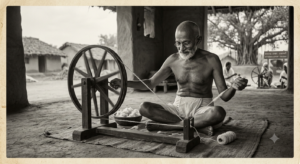
People responded with extraordinary energy. Students left government-run schools and colleges, lawyers such as Motilal Nehru and C.R. Das gave up flourishing legal practices, and foreign cloth was collected and burnt in massive public bonfires. In place of imported cloth, people began wearing khadi, hand-spun and hand-woven cloth, which became a living symbol of self-reliance, simplicity, and national self-respect. Council elections were boycotted in most provinces, and in many places, strikes by workers and shopkeepers brought normal business activity to a halt.
Part 2: Differing Strands Within the Movement
This is one of the most important — and most frequently tested — ideas in the entire chapter: the same movement meant different things to different people. Gandhi’s message of Swaraj travelled across India, but each social group interpreted and reshaped it according to their own local grievances and daily struggles.
Awadh: The Peasant Movement of Baba Ramchandra
In the Awadh region of present-day Uttar Pradesh, the movement against talukdars and landlords was led by a sanyasi named Baba Ramchandra, who had earlier worked as an indentured labourer in Fiji. Peasants here were burdened by extremely high rents and unfair taxes, and they were also forced to perform begar — unpaid labour on the landlord’s farms — without any consent. The Oudh Kisan Sabha was formed in October 1920, and by 1921, this had grown into the Awadh Kisan Sabha, drawing thousands of members. As the Non-Cooperation Movement spread, houses of talukdars and merchants were attacked, bazaars looted, and grain hoards seized in several places, showing how quickly a disciplined city-based movement could take a far more radical shape once it entered the countryside.
The Gudem Hills: Alluri Sitaram Raju’s Forest Satyagraha
In the hill tracts of Andhra Pradesh, colonial forest laws had closed off large forest areas to villagers, denying them the right to graze cattle or collect fuel and fruit that they had freely used for generations. When the government also began forcing tribal people into unpaid labour (begar) for road building, deep anger broke out.
Here, Non-Cooperation was interpreted in a strikingly different way. Rather than adopting the strictly non-violent methods Gandhi favoured elsewhere, hill tribes and peasants under the leadership of Alluri Sitaram Raju launched a militant guerrilla movement, believing India could be liberated only through the use of force. Raju claimed to have mystical powers and presented himself as an incarnation of a god, drawing thousands of followers who attacked police stations and confronted British authorities directly. Raju was eventually captured and executed in 1924, but he became a lasting folk hero of the region.
Assam: The Plantation Workers’ Idea of “Swaraj”
For plantation workers in Assam, freedom meant something very personal and immediate. Under the Inland Emigration Act of 1859, plantation workers were not permitted to leave the tea gardens without official permission — permission that was rarely given. When the news of the Non-Cooperation Movement reached them, thousands of workers simply defied the authorities, left the plantations, and began heading home. For them, “Swaraj” did not mean councils or courts — it meant the basic right to move freely and return to the villages they had left behind. Unfortunately, most of these workers never reached their destinations, as they were stranded by a railway and steamer strike, and were caught and brutally beaten by the police along the way.
Note for your answer: When asked how different social groups interpreted the idea of Swaraj, always mention that peasants, tribal groups, and workers all gave the term a meaning rooted in their own daily hardships — rent, forest access, or personal freedom — rather than the constitutional freedom that city-based Congress leaders imagined.
Why Did Gandhi Withdraw the Movement in 1922?
Movements like these worried the Congress leadership, who feared that local, spontaneous uprisings could turn violent and derail the disciplined, non-violent character Gandhi wanted the national struggle to have. That fear came true on 4 February 1922, when a violent clash occurred at Chauri Chaura in Uttar Pradesh. A large crowd, angered by police behaviour, set fire to a local police station, killing more than twenty policemen trapped inside.
Deeply disturbed that the movement was turning violent, Gandhi called off the Non-Cooperation Movement altogether, believing that people were not yet sufficiently trained in discipline and non-violence for such a large-scale mass struggle. Following this withdrawal, some Congress leaders, including C.R. Das and Motilal Nehru, formed the Swaraj Party in 1922–23 to argue for a return to council politics, while others devoted themselves to social and constructive work in villages.
Exam tip: Always mention Chauri Chaura when asked “why was the Non-Cooperation Movement withdrawn?” It is almost guaranteed to appear in some form every year.
Part 3: Towards Civil Disobedience
After 1922, the movement quietened for a while, but two developments in the late 1920s reignited the fire.
The Simon Commission (1928): “Go Back Simon”
In 1928, the British government sent a commission led by Sir John Simon to India to review the working of the constitutional system and recommend further reforms — but shockingly, the commission had not a single Indian member. It felt like the ultimate insult: decisions about India’s constitutional future were being made entirely without an Indian voice at the table. The Commission was met everywhere with the now-famous slogan “Go back Simon,” and protests turned violent in some cities, including a lathi charge in Lahore during which the veteran leader Lala Lajpat Rai was severely injured and later died.
Purna Swaraj: The Turning Point of 1929
At its Lahore session in December 1929, held under the presidency of a young Jawaharlal Nehru, the Indian National Congress formally declared “Purna Swaraj” — complete independence — as its goal, a significant shift from the earlier demand for dominion status. 26 January 1930 was fixed as Independence Day, when people across the country were asked to take a pledge for full independence — a date India would later choose to celebrate permanently as Republic Day.
Quick note: Purna Swaraj = complete independence (not just dominion status within the British Empire), declared at Lahore, December 1929.
The Salt March: Gandhi’s Masterstroke
If Non-Cooperation was Gandhi’s first great experiment, the Salt March of 1930 was his most brilliant. Salt, something every single Indian household used every single day regardless of caste, religion, or income, was taxed by the British and its production was a strict government monopoly. Gandhi turned this everyday necessity into a searing symbol of colonial injustice, arguing that nothing exposed the cruelty of British rule more clearly than taxing something as basic as salt.
On 12 March 1930, Gandhi set out from his ashram in Sabarmati with 78 trusted followers, walking nearly 240 miles over 24 days to the coastal town of Dandi in Gujarat. Along the route, thousands of people joined the march at every village, and it became a powerful travelling symbol of resistance. On reaching Dandi on 6 April 1930, Gandhi broke the salt law by picking up a handful of natural salt from the seashore. This single, quiet act triggered the Civil Disobedience Movement across the entire country.
Unlike Non-Cooperation, Civil Disobedience went a crucial step further: this time, people were not merely asked to refuse cooperation — they were directly asked to break colonial laws. Across India, people began manufacturing salt illegally, picketing shops selling foreign cloth and liquor, refusing to pay taxes, and in some regions, violating forest laws by taking wood and grazing cattle in reserved forests.
The British government responded harshly, arresting Gandhi and imprisoning over 100,000 people across the country. Yet the movement continued under other leaders, and eventually culminated in the Gandhi-Irwin Pact of March 1931, in which Gandhi agreed to discontinue the Civil Disobedience Movement and participate in a Round Table Conference in London, in exchange for the release of political prisoners. The talks in London, however, proved largely unproductive, and on his return, Gandhi relaunched the Civil Disobedience Movement, which continued with reduced intensity until 1934.
Who Joined the Civil Disobedience Movement — and Why?
Just like Non-Cooperation, this movement was joined by very different groups for very different reasons, and comparing the two movements is a favourite board exam question.
- Rich peasants (Patidars of Gujarat, Jats of Uttar Pradesh): Hit hard by falling agricultural prices during the Great Depression while revenue demands stayed fixed and high, they organised militantly, hoping for a permanent reduction in the revenue burden.
- Poor peasants: Wanted more than a reduction in revenue — many hoped for a complete waiver of unpaid rent to landlords, but the Congress leadership was reluctant to fully support this, since it did not want to alienate the wealthier landholding peasants whose support it also needed.
- Business classes: Indian merchants and industrialists, organised under bodies like the Indian Industries and Trade Federation and the Federation of Indian Chambers of Commerce and Industry (FICCI), supported civil disobedience strongly because they wanted swaraj to bring an end to colonial restrictions and protection against unfair foreign competition — though many businessmen grew more cautious once the movement seemed to threaten prolonged disruption.
- Industrial working class: Participated in some regions, such as the railway workers of the Chotanagpur Tin Fields who wore Gandhi caps, but with a degree of caution overall, since Congress leadership did not want to alienate industrialists by openly raising factory-related demands for better wages and hours.
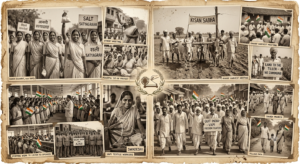
- Women: This is a beautiful and important part of the story — thousands of women stepped out of their homes for the first time to participate, picketing shops selling liquor and foreign cloth, marching in protest processions, and even manufacturing salt on the beaches, even though this participation did not immediately translate into a larger formal political role for them within the Congress organisation itself.
The Limits of Civil Disobedience: Who Stayed Away, and Why?
A truly well-written exam answer always acknowledges the limitations of a movement, not just its achievements.
Dalit participation remained limited throughout Civil Disobedience. Many Dalit leaders, most notably Dr. B.R. Ambedkar, who founded the Depressed Classes Association in 1930, believed that political empowerment for the Dalit community required a direct political solution — reserved seats and separate electorates — rather than simply joining a broader nationalist movement led by upper-caste Congress leaders. Gandhi, on the other hand, strongly opposed separate electorates for Dalits, fearing they would permanently divide Hindu society. This tension came to a head at the Second Round Table Conference and was finally resolved through the Poona Pact of September 1932, in which Ambedkar agreed to give up the demand for separate electorates in exchange for reserved seats for the Depressed Classes in provincial and central legislative councils.
Muslim participation also became noticeably more limited compared to the Non-Cooperation and Khilafat years. As the unusual Hindu-Muslim unity of the Khilafat period began to fray through the 1920s amid a series of local communal riots, many Muslim political organisations grew increasingly wary of joining a Congress-led movement that, in their perception, carried strong Hindu religious imagery, such as the symbol of Bharat Mata and slogans linked to Hindu revivalism. Attempts at political reconciliation, such as the Nehru Report of 1928, which rejected the demand for separate electorates, further widened the gap. Muhammad Ali Jinnah, who had earlier proposed his own Fourteen Points to safeguard Muslim political interests, remained willing to negotiate, but a lasting political agreement between the Congress and the Muslim League could not be reached before independence.
Quick note: Two groups whose limited participation you must mention in any answer on the “limits” of the movement — Dalits (Ambedkar’s demands, Poona Pact 1932) and Muslims (communal tensions, Nehru Report, separate electorate debates).
Part 4: The Sense of Collective Belonging
This final section is the most conceptual — and often the most beautifully asked — part of the chapter: how does a collective identity form among people who speak different languages, follow different faiths, and have never met each other?
Nationalism spreads through a shared sense of belonging, and Indian nationalist leaders, artists, and writers deliberately built this feeling through culture, symbols, and memory, well before and alongside the political movements you have just read about.
The Image of Bharat Mata
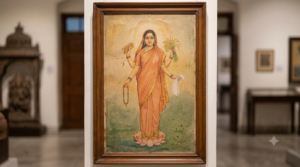
Perhaps the most powerful of these symbols was the image of Bharat Mata — India personified as a mother goddess. The image was first painted by Abanindranath Tagore, giving the abstract, hard-to-grasp idea of “the nation” a human, emotional face that ordinary people could love, worship, and feel compelled to protect. This idea also drew inspiration from Bankim Chandra Chattopadhyay, whose novel Anandamath contained the song “Vande Mataram,” which was sung at nationalist gatherings and became closely tied to the image of the nation as a mother.
Folklore and Traditions
Nationalists across India also worked hard to record and revive folk songs, legends, and traditional tales, seeing them as an authentic reflection of true, unspoiled Indian culture. Figures such as Natesa Sastri compiled large collections of Tamil folk tales, believing that preserving these traditions was essential to counter British colonial claims that Indian traditions were primitive, static, or unsophisticated compared to the modern West.
Icons Like the National Flag
During the Swadeshi movement of the early 1900s and increasingly through the 1920s, a tricolour flag was designed — with red, green, and yellow bands and a spinning wheel at its centre, later refined by Pingali Venkayya around 1921 — and carried by protestors during marches. Carrying the flag, and facing arrest or lathi charges for doing so during “flag satyagrahas,” became a powerful, unifying act of defiance that transcended local identities of caste, language, and religion.
Reinterpreting History
Finally, nationalist writers and thinkers looked back at India’s ancient achievements in art, science, mathematics, and philosophy, using this glorious and ancient past to counter the colonial argument that Indian civilisation had always been backward and needed British rule in order to “progress” and “modernise.” This reinterpretation of history gave Indians a sense of pride and continuity — a reminder that the nation they were fighting to free had a long and rich past worth being proud of.
All these efforts — art, memory, symbols, songs, and reinterpreted history — worked together to build something no army could ever build on its own: a shared imagination of India as a single nation worth fighting, suffering, and sacrificing for.
Timeline: Nationalism in India at a Glance
| Year | Event |
|---|---|
| 1917 | Champaran and Kheda Satyagrahas |
| 1918 | Ahmedabad Mill Workers’ Satyagraha |
| 1919 | Rowlatt Act passed; Jallianwala Bagh massacre |
| 1920 | Non-Cooperation and Khilafat Movement launched (Calcutta and Nagpur sessions) |
| 1922 | Chauri Chaura incident; Non-Cooperation withdrawn; Swaraj Party formed |
| 1928 | Simon Commission arrives in India; death of Lala Lajpat Rai |
| 1929 | Lahore session; Purna Swaraj declared |
| 1930 | Salt March (12 March–6 April); Civil Disobedience Movement begins |
| 1931 | Gandhi-Irwin Pact; Round Table Conference in London |
| 1932 | Poona Pact between Gandhi and Ambedkar |
| 1934 | Civil Disobedience Movement formally called off |
Frequently Asked Questions
Q1. What is the Rowlatt Act? The Rowlatt Act of 1919 allowed the British government to arrest and imprison people without a trial or right of appeal, sparking nationwide protests led by Gandhi.
Q2. Why did Gandhi withdraw the Non-Cooperation Movement? Gandhi withdrew the movement in February 1922 after the violent Chauri Chaura incident, in which a crowd killed several policemen, because it violated his commitment to strict non-violence.
Q3. What was the Salt March? The Salt March was a 240-mile walk led by Gandhi from Sabarmati to Dandi between 12 March and 6 April 1930, where he broke the colonial salt law, launching the Civil Disobedience Movement.
Q4. What was Purna Swaraj? Purna Swaraj, meaning “complete independence,” was declared as the Congress’s official goal at the Lahore session in December 1929, with 26 January 1930 fixed as Independence Day.
Q5. Why was Dalit participation limited in the Civil Disobedience Movement? Many Dalits, led by Dr. B.R. Ambedkar, wanted separate electorates and political safeguards rather than simply joining a Congress-led movement, a disagreement eventually resolved through the Poona Pact of 1932.
Q6. Who painted the image of Bharat Mata? Abanindranath Tagore painted the iconic image of Bharat Mata, which became a powerful symbol of Indian nationalism.
Q7. What was the Khilafat Movement, and why did Gandhi support it? The Khilafat Movement was launched by Indian Muslims, led by Muhammad Ali and Shaukat Ali, to protect the position of the Ottoman Khalifa. Gandhi supported it to build Hindu-Muslim unity for a joint national struggle.
Q8. How did Alluri Sitaram Raju’s movement differ from Gandhi’s approach? Unlike Gandhi’s insistence on strict non-violence, Alluri Sitaram Raju led an armed guerrilla movement in the Gudem Hills, believing colonial rule could only be overthrown through force.
Exam-Ready Summary (Copy This Into Your Notes)
- Post-WWI economic hardship (price rise, forced recruitment, influenza epidemic) plus the Rowlatt Act and Jallianwala Bagh massacre created mass anger against British rule.
- Gandhi’s earlier satyagrahas in Champaran, Kheda, and Ahmedabad built his credibility as a national leader.
- Khilafat plus Non-Cooperation (1920) united Hindus and Muslims under Gandhi’s leadership, launched in stages: surrender of titles, boycott of services/schools/courts/foreign goods, and non-payment of taxes.
- Different social groups gave “Swaraj” their own local meaning: Awadh peasants wanted lower rents and no begar, Gudem hill tribes wanted forest rights and used armed struggle, Assam plantation workers wanted freedom of movement.
- Chauri Chaura (1922) led to the withdrawal of Non-Cooperation; the Swaraj Party was formed afterward.
- The Simon Commission (1928, no Indian members) triggered mass protests, including the death of Lala Lajpat Rai.
- The Lahore Session (1929) declared Purna Swaraj as the goal, with 26 January 1930 as the pledge date.
- The Salt March (1930) launched the Civil Disobedience Movement, which asked people to actively break colonial laws.
- Different groups joined Civil Disobedience for different reasons (rich peasants, poor peasants, business classes, workers, women); Dalits and Muslims had limited or complex participation, resolved partly through the Poona Pact (1932).
- National identity was built through symbols like Bharat Mata, folklore, the national flag, and the reinterpretation of India’s ancient history.
Important Article as per History Decoded Hub which help you to improve your knowledge regarding History.
-
The Emergency in India (1975–1977)
The Emergency in India (1975–1977) was a period when Prime Minister Indira Gandhi declared a national Emergency, suspending civil liberties, censoring the press, and arresting political opponents. It remains one of the most controversial events in Indian history and is remembered as a major test of the country’s democratic institutions.
Read More: The Emergency in India (1975–1977): Causes, Timeline & Impact
-
Battle of Plassey (1757)
The Battle of Plassey, fought on 23 June 1757, marked a turning point in Indian history. The British East India Company, led by Robert Clive, defeated Siraj-ud-Daulah, the Nawab of Bengal, with the support of Mir Jafar. The victory gave the British political and economic control over Bengal and laid the foundation for nearly two centuries of British rule in India.
Read More: Battle of Plassey (1757): Causes, Events, Consequences & Historical Significance
-
Greek and Indian Ancient Medicine
Ancient Greek and Indian medicine laid the foundation for many modern healing practices. Greek medicine, led by Hippocrates, emphasized observation, diagnosis, and the theory of the four humors. In India, Ayurveda, developed by scholars such as Charaka and Sushruta, focused on balancing the body’s energies through diet, herbal remedies, and surgery. Together, these traditions greatly influenced the history of medicine and healthcare.
Read More: Greek and Indian Ancient Medicine: Origins, Principles, Similarities & Legacy