
Introduction
Imagine walking, unarmed, into the middle of a battle-hardened army on the eve of a civil war, and trying to talk the soldiers out of fighting. Not with weapons. Not with rank. With a lecture on the virtue of peace.
That is exactly what Gaius Musonius Rufus did in AD 69, during one of the bloodiest years in Roman history. The soldiers did not thank him for it. Some found him tiring. Others wanted to knock him to the ground and stamp on him. He survived only because cooler heads in the crowd talked the others down.
Most articles about Musonius Rufus never mention this moment. They stop at the safer, more repeatable facts: he was a Stoic philosopher, he was exiled to a barren island, he taught Epictetus, he believed women deserved an education. All of that is true, and all of it matters. But it is also the surface layer of a much stranger and more specific life — a life that included a real courtroom prosecution against a man who betrayed his friend to the executioner, a specific list of 21 lectures with titles blunt enough to make a modern reader blink, and a debate among historians, still unresolved, over whether Rome exiled him twice or three times.
This is the deeper version of his story — the one built from what actually survives in Tacitus, in the fragments preserved by his students, and in the scholarship that has picked over those fragments for two thousand years.
Quick Facts
| Detail | Information |
|---|---|
| Full Name | Gaius Musonius Rufus |
| Born | c. AD 20–30 |
| Birthplace | Volsinii (modern Bolsena), Etruria, Roman Empire |
| Died | Probably after AD 95 (possibly c. AD 100–101) |
| Social Rank | Roman equestrian (knight) |
| School of Thought | Stoicism |
| Called “Roman Socrates” By | The early writer Origen, among others |
| Known For | Practical Stoic ethics, resilience through exile, equality in education |
| Famous Students | Epictetus and Dio Chrysostom |
| Surviving Works | 21 Discourses, 32 Fragments, letters |
| Times Exiled | Twice by most accounts (Nero, then Vespasian); some scholars count three, including his voluntary exile alongside Rubellius Plautus |
A Knight’s Son Who Chose a Harder Path
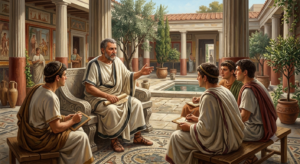
Gaius Musonius Rufus was born into an equestrian family in Volsinii, in Etruria, sometime between roughly AD 20 and 30. The equestrian order sat directly beneath the senatorial elite in Roman society — wealthy, respected, and generally more interested in property and administration than in philosophy. A young man from that background had a well-worn path available to him: manage estates, hold minor magistracies, avoid controversy.
Musonius did not take that path. By the reign of Nero, he had become one of the most sought-after teachers of philosophy in Rome, attracting students from the same aristocratic class he had been born into. What makes this notable is not simply that a wealthy Roman studied philosophy — plenty did, often as a fashionable accessory to a well-rounded education. What makes it notable is that Musonius treated philosophy as something that had to reorganize a person’s actual conduct, not decorate their conversation. That distinction would define, and repeatedly endanger, the rest of his life.
Into Exile With a Friend, Before the Famous Exile
Most popular summaries of Musonius Rufus begin his exile story in AD 65, on the island of Gyaros. But the fuller record, preserved through Tacitus, actually starts five years earlier.
Around AD 60, Musonius was close to Rubellius Plautus, a Roman noble whose descent from the Julio-Claudian line made him a plausible dynastic threat in Nero’s paranoid calculations. When Nero forced Plautus into exile in Asia Minor, Musonius went with him voluntarily, choosing to share his friend’s banishment rather than remain safely in Rome. Plautus was assassinated on Nero’s orders in AD 62, and Musonius returned to Rome afterward, resuming his teaching.
This earlier episode is genuinely useful context that most short biographies skip entirely, and it matters for a specific reason: some historians count it as Musonius’s first exile, which means the commonly repeated claim that he was “exiled twice” is, at minimum, an oversimplification. Depending on how a historian counts it, Musonius endured exile two or three separate times across his life — a detail that changes how relentless the pattern of imperial suspicion around him actually looks.
Gyaros: What “Exile” Actually Meant
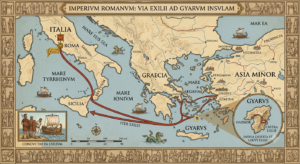
The exile that made Musonius famous came in AD 65, in the aftermath of the Pisonian conspiracy — a failed plot to assassinate Nero that triggered a sweeping purge of Rome’s senatorial and philosophical circles. Musonius had no clear direct role in the plot itself, but his known associations, particularly with the executed senator Barea Soranus, made him an easy target once Nero’s court began settling scores.
He was banished to Gyaros, a small island in the Aegean known even by Roman standards as one of the harsher exile posts — short on fresh water, poor for farming, and cut off from the intellectual and social life that had defined Musonius’s entire career. Modern historians studying the island describe it as barren and largely without established culture at the time, the kind of place chosen specifically because almost nobody survived it with their reputation, let alone their teaching career, intact.
Musonius did both. He is recorded as having gathered a small circle of fellow philosophers around him even on Gyaros, continuing to teach in the same conditions that were designed to erase him. His ninth surviving discourse, “That Exile Is Not an Evil,” draws directly on this experience, and it contains a detail rarely mentioned outside specialist sources: Musonius specifically recommended farming as an ideal occupation for a philosopher in exile, arguing that manual agricultural work suited the philosophical life better than idleness, since it combined self-sufficiency with the discipline he considered essential to virtue. This was not abstract advice. It was a description of how he proposed to actually live on a rock in the Aegean Sea.
The Peace Mission of AD 69
The most dramatic episode in Musonius Rufus’s biography is also the one almost entirely absent from popular retellings, despite being recorded directly by the historian Tacitus.
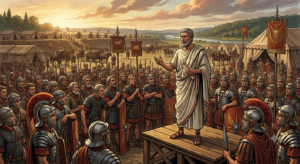
In AD 69 — the chaotic “Year of the Four Emperors,” when Galba, Otho, and Vitellius each briefly held the throne before Vespasian’s forces marched on Rome — Musonius joined a delegation sent to meet the advancing army of Vespasian’s general, Antonius Primus. While the official envoys carried out formal negotiations, Musonius did something no diplomat would have attempted: he walked directly among the armed soldiers themselves and began lecturing them, unprompted, on the virtues of peace and the dangers of war.
The reaction was not admiration. According to Tacitus, many of the soldiers found him tiresome, some laughed outright, and a number were prepared to physically assault him before cooler heads and explicit warnings persuaded him to stop. He survived the encounter, but only barely, and only because he heeded the crowd’s mood before it turned violent.
This is not a minor footnote. It is a direct, contemporaneous, eyewitness-adjacent account of a Stoic philosopher attempting to live out his own teaching about the irrelevance of physical danger to a virtuous life, in the most literal and dangerous circumstance imaginable — unarmed, inside a hostile army, on the edge of a civil war. Few philosophers in any tradition have a documented moment this concrete.
The Trial of Publius Egnatius Celer
A year later, in AD 70, Musonius Rufus stepped into a different kind of confrontation: a Roman courtroom.
Publius Egnatius Celer was a philosopher who had built a reputation as a Stoic teacher, but who had also, under Nero, betrayed his own former patron, the senator Barea Soranus, giving testimony that helped condemn Soranus to death. Soranus had been part of the same circle of Stoic-aligned senators that Musonius himself moved in, which made Celer’s betrayal a matter of personal as well as philosophical significance.
Once political conditions shifted under Vespasian, Musonius personally pursued the case against Celer and secured his conviction. This detail rarely appears in general biographies, but it reveals something important about how Musonius understood the relationship between philosophy and justice. He did not treat virtue as a purely private, contemplative matter. When someone within his own philosophical circle had betrayed a friend for personal advantage, Musonius used the formal machinery of Roman law to hold that person accountable — a reminder that Stoic ethics, in his hands, was not passive.
Spared, Then Exiled Anyway: The Vespasian Years
In AD 71, Emperor Vespasian issued a sweeping expulsion of philosophers from Rome and Italy, a common imperial tactic for reasserting control after a period of political instability. Musonius’s reputation was apparently substantial enough that Vespasian initially made an explicit exception for him, allowing him to remain in Rome while his philosophical peers were forced out.
That exception did not last. Sources differ on the exact timing and reasoning, but Musonius was ultimately banished as well, in what several scholars treat as his third distinct exile — this time reportedly to Syria, making it both the least discussed and, by some accounts, the longest of his banishments. He was eventually permitted to return to Rome under Vespasian’s son and successor, Titus, around AD 79, and appears to have spent his final years teaching in the city that had exiled him three separate times across four decades.
Philosophy as Medicine, Not Entertainment
Running underneath all of these political episodes was a consistent teaching philosophy. Musonius compared philosophy directly to medicine: medicine exists to heal the body, and philosophy exists to heal the soul. A philosopher who could argue brilliantly but had not changed his own conduct was, in Musonius’s view, no more useful than a doctor who understood anatomy perfectly but refused to treat patients.
This was a pointed critique of a real current in Roman intellectual life, where rhetorical skill was often prized independently of a speaker’s actual character. Musonius rejected that model outright, and his own biography — the exiles, the courtroom, the army camp — reads like a direct refusal to let his teaching remain theoretical.
The 21 Discourses: A List Almost No Other Article Reproduces in Full
Perhaps the single most useful thing a reader can take from this article is something most competing content never provides at all: the actual titles of the 21 discourses attributed to Musonius Rufus, preserved through his student Lucius and collected by later scholars such as Cora Lutz and Cynthia King. Seeing the full list in one place says more about the specific, sometimes blunt texture of his thinking than any paraphrase can.
| # | Discourse Title |
|---|---|
| 1 | That There Is No Need of Giving Many Proofs for One Problem |
| 2 | That Man Is Born with an Inclination Toward Virtue |
| 3 | That Women Too Should Study Philosophy |
| 4 | Should Daughters Receive the Same Education as Sons? |
| 5 | Which Is More Effective, Theory or Practice? |
| 6 | On Training |
| 7 | That One Should Disdain Hardships |
| 8 | That Kings Also Should Study Philosophy |
| 9 | That Exile Is Not an Evil |
| 10 | Will the Philosopher Prosecute Anyone for Personal Injury? |
| 11 | What Means of Livelihood Is Appropriate for a Philosopher? |
| 12 | On Sexual Indulgence |
| 13 | What Is the Chief End of Marriage |
| 14 | Is Marriage a Handicap for the Pursuit of Philosophy? |
| 15 | Should Every Child That Is Born Be Raised? |
| 16 | Must One Obey One’s Parents Under All Circumstances? |
| 17 | What Is the Best Viaticum (Provision) for Old Age? |
| 18 | On Food |
| 19 | On Clothing and Shelter |
| 20 | On Furnishings |
| 21 | On Cutting the Hair |
A few things stand out immediately from this list. Discourse 10, on whether a philosopher should prosecute someone for personal injury, reads very differently once a reader knows about the Egnatius Celer trial — it is not an abstract legal puzzle, but a question Musonius had lived through directly. Discourse 15, on whether every child born should be raised, touches on a subject — the Roman practice of exposing unwanted infants — that modern classical scholars, including a well-known 1965 study in the Classical Quarterly, have examined closely enough to debate the precise wording of the surviving Greek text. And discourses 18 through 21, on food, clothing, shelter, furnishings, and even haircuts, show just how far Musonius pushed the idea that philosophy governs literally every daily choice, not just the large moral ones.
Virtue as the Only True Good
At the foundation of everything Musonius taught was the claim that virtue is the only genuinely reliable good, while wealth, fame, power, and physical beauty are all fundamentally unstable. Wealth could be confiscated, fame could turn to mockery, power could evaporate the moment an emperor grew suspicious — as Musonius’s own repeated exiles proved with almost mathematical precision — and beauty faded with age. Virtue alone depended entirely on the choices of the person who held it, immune to confiscation by any emperor.
Equality of Women in Philosophy
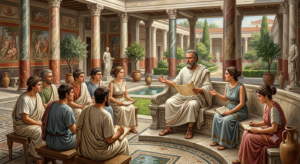
Among Musonius’s teachings, none has aged into more obvious relevance than his argument, laid out directly in Discourses 3 and 4, that women possess the same capacity for virtue as men and therefore deserve the same philosophical education. His reasoning followed straightforward Stoic logic: if reason and virtue are not distributed differently by sex, then access to the education that cultivates them should not be either.
This was a genuinely unusual position in a Roman society where formal education for women was inconsistent and philosophy was treated as a largely male pursuit. Musonius did not frame it as social reform for its own sake — he framed it as the direct, almost unavoidable conclusion of taking his own first principles seriously.
Simple Living, Diet, and the Discipline of Small Choices
Musonius recommended plain food, simple clothing, and honest physical labor over luxury, and Discourses 18 through 21 apply this principle down to remarkably specific territory — what to eat, what to wear, what furniture to own, even how short to keep one’s hair. He is recorded as favoring simple, largely plant-based meals, not out of anything resembling modern nutritional science, but because eating for pleasure rather than necessity indulged appetite at the expense of self-control. For Musonius, moderation at the dinner table and moderation in a haircut were training for the same underlying discipline.
Marriage, Family, and the Question of Children
Discourses 13 through 16 form a connected block on domestic life. Musonius argued that marriage should rest on mutual respect and shared responsibility between husband and wife, that raising children was an important social duty rather than a private inconvenience, and that fidelity within marriage was a direct expression of the self-control central to his entire philosophy. His discourse on whether every child born should be raised engages directly with a real and often brutal Roman practice — the exposure of unwanted infants, particularly daughters — and its survival has made it a genuine subject of modern classical scholarship, not just popular Stoic commentary.
Beyond Epictetus: Dio Chrysostom, the Overlooked Second Student
Nearly every article about Musonius Rufus mentions Epictetus. Far fewer mention that Epictetus was not his only significant student. Dio Chrysostom — literally “Dio the Golden-Mouthed,” one of the most celebrated orators of the Roman world — also studied under Musonius and carried forward elements of his ethical seriousness into his own public speaking career, which spanned exile, imperial favor, and a reputation as one of antiquity’s great moralist-orators.
This matters because it reframes Musonius’s influence as broader than a single philosophical lineage running through Epictetus to Marcus Aurelius. He shaped at least two very different kinds of public figures: a former slave who became one of history’s most quoted philosophers, and a celebrated orator who used rhetoric, not classroom lecture, to carry ethical argument into Roman public life.
Why “Roman Socrates” Is More Than a Nickname
The comparison to Socrates did not originate as a vague modern compliment. The early Christian writer Origen specifically applied the title to Musonius, and the comparison holds up on close inspection, not just in spirit but in specific parallels: both men prioritized ethical conduct over abstract theorizing, both taught primarily through spoken interaction rather than written treatises, both attracted devoted students who preserved their teaching only after the fact, and both paid a direct personal cost — Socrates his life, Musonius his freedom and his home — for refusing to soften their principles under political pressure.
What Survives, and Why the Textual History Matters
Musonius wrote little or nothing in his own hand, or nothing that survived independently. What exists today comes through his student Lucius’s notes on the lectures, supplemented by another student sometimes identified as Pollio, and preserved in fragments through later anthologists, especially the compiler Stobaeus. Modern readers typically encounter this material through Cora Lutz’s mid-20th-century scholarly edition or Cynthia King’s more accessible English translation.
This textual history is not just academic trivia. It explains why some of Musonius’s ideas survive as full discourses while others exist only as short, sometimes ambiguous fragments — and it is precisely this ambiguity that has generated genuine scholarly debate, such as the 1965 Classical Quarterly study examining a disputed passage in his discourse on child-rearing closely enough to propose a specific textual correction. Few ancient philosophers outside the most famous names generate that level of close scholarly attention on a single fragment, which is itself a quiet indicator of how seriously classicists take him.
Timeline of Gaius Musonius Rufus
| Year | Event |
|---|---|
| c. AD 20–30 | Born in Volsinii, Etruria |
| Reign of Nero | Establishes himself as a respected philosophy teacher in Rome |
| c. AD 60 | Voluntarily accompanies the exiled noble Rubellius Plautus into banishment in Asia Minor |
| AD 62 | Plautus is killed on Nero’s orders; Musonius returns to Rome |
| AD 65 | Exiled by Nero to the island of Gyaros following the Pisonian conspiracy |
| AD 68 | Returns to Rome after Nero’s death, under Emperor Galba |
| AD 69 | Attempts to preach peace to Vespasian’s advancing soldiers during the civil war; narrowly avoids violence |
| AD 70 | Prosecutes and secures the conviction of Publius Egnatius Celer for betraying Barea Soranus |
| AD 71 | Initially spared, then ultimately exiled a further time when Vespasian expels philosophers from Rome |
| c. AD 79 | Returns to Rome under Emperor Titus |
| After AD 95 | Last known historical references to him |
| c. AD 100–101 | Probable date of death |
How These Teachings Apply Today
Musonius’s insistence that character outweighs status speaks directly to a culture still preoccupied with wealth and public image. His argument, developed on Gyaros itself, that hardship can be reframed as training rather than pure misfortune anticipates much of what modern psychology now studies as resilience. His discourse-length attention to food, clothing, and furnishings anticipates modern conversations about minimalism and intentional living, though he arrived at those conclusions through Stoic discipline rather than lifestyle branding. And his willingness to use a Roman courtroom against a fellow philosopher who had betrayed a friend is a useful corrective to any reading of Stoicism as passive acceptance — for Musonius, equanimity in the face of personal danger was never the same thing as indifference to injustice done to others.
Conclusion
Go back to that army camp in AD 69. A philosopher in his forties or fifties, already once exiled to a rock in the Aegean, walks unarmed among soldiers who have every reason to ignore him and several who are ready to hurt him — and he lectures them on peace anyway. That single scene tells you almost everything you need to know about Gaius Musonius Rufus. He did not treat Stoicism as a set of comforting lines to repeat in safety. He tested it, over and over, in exactly the circumstances where it would have been easiest to abandon: on a barren island with no fresh water, in front of a hostile army, and in a Roman courtroom facing down a man who had betrayed a friend to save himself.
That is also, ultimately, why he deserves more attention than he usually gets. Seneca had eloquence and access to power. Epictetus had the moral authority of a former slave who built a philosophy from nothing. Marcus Aurelius had an empire and a private journal that made him a household name two thousand years later. Musonius Rufus had none of that visibility, only fragments, a handful of lecture titles, and a historian’s brief, almost incidental account of a man nearly beaten for preaching peace to soldiers. But strip away the fame of his successors, and what remains is arguably the most tested version of Roman Stoicism on record — a philosophy that was not merely written down, but lived through exile, confrontation, and courtroom risk, by the man who first taught it to Epictetus. Read in full, his surviving discourses read less like ancient trivia and more like a working manual for character under pressure, written by someone who had no choice but to use it himself.
Frequently Asked Questions
Who was Gaius Musonius Rufus? Gaius Musonius Rufus was a Roman Stoic philosopher of the 1st century AD, known as the “Roman Socrates” for insisting that philosophy must be lived, not merely discussed. He is best known as the teacher of Epictetus and the orator Dio Chrysostom.
How many times was Musonius Rufus exiled? By the most common count, twice — once by Nero to Gyaros in AD 65, and once under Vespasian around AD 71. Some scholars count a third exile, since he voluntarily accompanied his friend Rubellius Plautus into banishment around AD 60.
What are the 21 Discourses of Musonius Rufus? They are a set of lectures preserved by his students, covering topics from virtue and education to marriage, food, clothing, and old age, including “That Women Too Should Study Philosophy” and “That Exile Is Not an Evil.”
Did Musonius Rufus really confront Roman soldiers during a civil war? Yes. In AD 69, according to the historian Tacitus, he walked among Vespasian’s advancing troops attempting to persuade them to choose peace over battle, and narrowly avoided being physically attacked before he stopped.
What did Musonius Rufus teach about women? He argued, across two dedicated discourses, that women possess the same capacity for virtue as men and therefore deserve the same philosophical education, a notably progressive position in Roman society.
Who besides Epictetus studied under Musonius Rufus? The celebrated orator Dio Chrysostom, known as “Dio the Golden-Mouthed,” also studied under Musonius and carried his ethical seriousness into a prominent public speaking career.
Do any of Musonius Rufus’s own writings survive? He appears to have written little himself, or none of it survived independently. What remains — 21 Discourses and 32 Fragments — comes from student notes, primarily by his student Lucius, later preserved by ancient anthologists such as Stobaeus.
Important Article as per History Decoded Hub.
Who Was Socrates?
Socrates was an ancient Greek philosopher and one of the most influential thinkers in history. Known as the Father of Western Philosophy, he transformed the way people approached knowledge, ethics, and critical thinking through the famous Socratic Method. His teachings inspired Plato, who later mentored Aristotle, shaping the foundation of Western philosophy. Explore the life, philosophy, and lasting legacy of Socrates to understand why his ideas remain relevant even today.
Who Was Plato?
Plato was one of the greatest philosophers in history and a student of Socrates. He founded the Academy in Athens, the first institution of higher learning in the Western world, where Aristotle later studied. Through influential works like The Republic, Plato explored justice, politics, ethics, and the nature of reality. Discover Plato’s life, philosophy, and lasting legacy to understand how his ideas continue to shape education, government, and Western philosophy today.
Who Was Aristotle?
Aristotle was one of history’s greatest philosophers, a student of Plato, and the teacher of Alexander the Great. His groundbreaking ideas on philosophy, science, politics, ethics, and logic laid the foundation for Western thought and influenced generations of scholars. From works like Nicomachean Ethics to his studies of nature and government, Aristotle’s legacy continues to shape modern education and critical thinking. Discover his life, teachings, and lasting impact on civilization.
Who Was Epictetus?
Epictetus was a Greek Stoic philosopher who rose from slavery to become one of the greatest teachers of Stoicism. A student of Gaius Musonius Rufus, he taught that true freedom comes from controlling our thoughts, actions, and responses rather than external events. His teachings, preserved in The Enchiridion and the Discourses, continue to inspire millions seeking wisdom, resilience, and inner peace. Discover the life, philosophy, and enduring legacy of Epictetus and why his ideas remain relevant in the modern world.
External Resources
- Encyclopaedia Britannica – Gaius Musonius Rufus
https://www.britannica.com/biography/Gaius-Musonius-Rufusj