
Introduction
Long before modern schools and political systems existed, Plato was asking questions that still challenge humanity today. From the streets of ancient Athens to the creation of one of history’s first academies, Plato changed the way people think about truth, justice, leadership, and knowledge. In this blog, explore the fascinating story of Plato’s life, his connection with Socrates, and the powerful ideas that continue to influence the modern world.
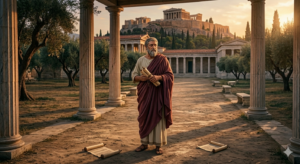
1. The Early Life of Plato in Ancient Greece
Imagine walking through the busy streets of ancient Athens, where politicians shouted in public squares and philosophers questioned everything around them. Among the crowd stood a young man whose ideas would influence the world for thousands of years — Plato. Long before modern schools, universities, or political systems existed, a young boy walked through the crowded streets of ancient Athens with curiosity in his eyes. That boy was Plato.
Born around 428 BCE, Plato came from a wealthy and respected family. His relatives were connected to politics, and many expected him to become an important political leader one day.
But history had something very different planned for him.
Athens during Plato’s childhood was not peaceful. Wars, political conflicts, and power struggles shaped everyday life. People argued constantly about leadership, justice, and freedom.
Growing up in such an environment forced Plato to observe society carefully. He began noticing how quickly power could corrupt people and how easily crowds could be influenced.
These experiences later became the foundation of Plato philosophy.
2. How Plato Met Socrates and Changed Forever
Every great story has a turning point.
For Plato, that turning point was meeting Socrates.
Socrates was not rich or powerful. He walked barefoot through Athens, speaking with ordinary citizens and asking difficult questions.
He would ask:
- What is truth?
- What makes a person good?
- Why do people follow leaders blindly?
- Can wisdom create a better society?
Most people avoided such questions.
Plato, however, became fascinated.
Instead of chasing political power, he started following Socrates and listening to his conversations. The young student admired how fearlessly Socrates challenged powerful individuals.
For the first time, Plato realized that ideas could change society more deeply than weapons or wealth.
This moment shaped the future of Western philosophy.

3. The Death of Socrates and Plato’s Greatest Shock
Plato never imagined that the man who inspired him most would soon face a tragic fate. The people of Athens admired democracy, but democracy also had a darker side.
As political tensions increased, many leaders saw Socrates as dangerous. His questions made people uncomfortable. Some believed he was influencing the youth against traditional beliefs.
Eventually, Socrates was arrested and put on trial.
Plato watched helplessly as his teacher stood before the court.
Instead of apologizing, Socrates defended the importance of truth and independent thinking. The judges sentenced him to death.
He was forced to drink poison.
For Plato, this was heartbreaking.
The execution deeply affected his understanding of politics and society. He began wondering whether ordinary people were truly wise enough to make important decisions.
This tragedy became one of the biggest influences on Plato philosophy and political theory.
4. Plato’s Journey Beyond Athens
After the death of Socrates, Plato left Athens.
He traveled across regions like Egypt and Italy, searching for knowledge and understanding.
During these travels, Plato studied:
- Mathematics
- Astronomy
- Religion
- Politics
- Science
He met scholars, priests, and thinkers from different cultures. Every journey expanded his mind.
Unlike many people of his time, Plato did not believe wisdom came from one single place. He believed learning required observation, discussion, and experience.
Traveling also helped him understand how governments rise and collapse. He saw corruption, greed, and poor leadership destroy societies.
These observations later appeared throughout Plato’s writings.
5. How Plato Built One of History’s First Universities
When Plato returned to Athens, he decided to create something extraordinary.
He founded the Academy.
This institution became one of the world’s earliest centers of higher education. Students gathered there to study philosophy, science, mathematics, and logic.
The Academy was not just a school.
It was a place where people learned to question ideas instead of blindly accepting them.
Plato believed education should shape character, not just provide information.
One of the Academy’s most famous students was Aristotle, who later became one of history’s greatest thinkers himself.
Through the Academy, Plato influenced generations far beyond ancient Greece.

6. Plato Philosophy and the Search for Truth
One of the most important parts of Plato philosophy was the belief that reality is deeper than appearances.
According to Plato, humans often mistake temporary things for permanent truth.
He argued that the physical world constantly changes:
- Buildings collapse
- Kingdoms disappear
- People grow old
- Wealth comes and goes
Because everything changes, Plato believed true perfection could not exist in the material world.
This idea led him to develop the Theory of Forms.
7. The Strange Plato Theory That Changed Philosophy Forever
The Theory of Forms became one of Plato’s most famous philosophical ideas.
Plato believed perfect versions of concepts exist beyond the physical world.
For example:
- Perfect justice exists
- Perfect beauty exists
- Perfect goodness exists
Humans only experience imperfect copies of these ideals.
Imagine drawing a circle on paper. No matter how carefully you draw it, it will never be perfectly round. But the idea of a perfect circle still exists in your mind.
That, according to Plato philosophy, is the difference between reality and ideal truth.
This theory influenced religion, ethics, politics, and later philosophical traditions for centuries.
8. The Allegory of the Cave in Plato Philosophy
Perhaps no story from Plato philosophy remains more powerful than the Allegory of the Cave.
Plato described prisoners chained inside a dark cave since childhood. They can only see shadows on a wall.
Because they have never experienced the outside world, they believe those shadows are reality.
One prisoner eventually escapes.
For the first time, he sees sunlight, trees, rivers, and the real world. When he returns to free the others, they refuse to believe him.
Some even become angry.
Through this story, Plato explained how humans often resist uncomfortable truths.
Even today, the allegory feels relevant.
Social media misinformation, political propaganda, and blind group thinking all reflect Plato’s warning about illusion and ignorance.

9. Plato’s Ideas About Education and Knowledge
Plato strongly believed education could transform society.
But he did not support memorization alone.
He believed true education teaches people how to think critically.
According to Plato philosophy, knowledge should help individuals:
- Understand morality
- Develop discipline
- Seek wisdom
- Control selfish desires
Plato feared societies would collapse if leaders lacked education and ethics.
That is why he placed so much importance on intellectual development.
Modern education systems still reflect many ideas first discussed by Plato thousands of years ago.
10. Why Plato Believed Most Leaders Should Not Rule
Politics was one of Plato’s deepest interests.
After witnessing corruption and the execution of Socrates, Plato lost trust in emotional public decision-making.
In his famous work The Republic, Plato described his vision of an ideal society.
He argued that rulers should not govern for personal wealth or fame. Instead, leaders should be wise, disciplined, and educated.
This idea gave birth to the concept of the “philosopher-king.”
According to Plato philosophy, the best leaders are those who understand justice and truth rather than popularity.
While many people criticize some of Plato’s political ideas today, his work started important conversations about leadership and ethics that continue even now.
11. Why Plato Distrusted Excessive Wealth and Power
Plato noticed something about human behavior that still feels true today.
People often become corrupted when they gain too much power.
He saw leaders manipulate citizens through fear, emotion, and promises. Wealthy individuals frequently placed personal gain above public good.
Because of this, Plato believed rulers should live disciplined lives.
He feared greed could destroy justice.
This concern appears repeatedly throughout Plato philosophy and political writings.
Even in modern times, debates about corruption and ethical leadership reflect many of Plato’s concerns.
12. Plato’s Writing Style Made Philosophy Interesting
Many ancient texts feel difficult to read today.
Plato’s writings were different.
Instead of writing long lectures, he used dialogues. His books often feel like real conversations between intelligent people debating important questions.
This style made philosophy more engaging and human.
Readers could follow arguments naturally instead of feeling overwhelmed by technical explanations.
Plato understood that storytelling makes ideas memorable.
That is one reason his works survived for over two thousand years.
13. Plato’s Influence on Religion and Science
The influence of Plato philosophy spread far beyond Greece.
Later Roman thinkers studied his work carefully. Medieval scholars used his ideas while discussing religion and morality.
Even early scientists were inspired by Plato’s belief that reason and logic could help humans understand reality.
His influence can be found in:
- Christian philosophy
- Islamic scholarship
- Renaissance thought
- Political theory
- Ethics
- Modern education
Very few thinkers in history have shaped civilization as deeply as Plato.
14. Plato and Aristotle: Teacher and Student
One of the most fascinating relationships in philosophy was between Plato and Aristotle.
Aristotle studied at Plato’s Academy for nearly twenty years.
Although Aristotle admired his teacher, he did not agree with every idea.
Plato focused heavily on abstract ideals, while Aristotle preferred observation and practical reasoning.
Their disagreements later created two different traditions of philosophical thinking.
Yet without Plato, Aristotle’s journey may never have begun.
Together, they shaped the intellectual foundation of the Western world.
15. What Modern Society Can Learn From Plato
Even after thousands of years, Plato philosophy still feels surprisingly modern.
Today people continue debating:
- What makes a good leader?
- Can democracy fail?
- Does education shape society?
- Why do humans fear truth?
- Can justice ever be perfect?
Plato reminds people not to accept everything blindly.
He encouraged questioning, discussion, and self-reflection.
In a world filled with distractions and misinformation, those lessons remain incredibly valuable.
16. The Last Years of Plato’s Life
Plato spent most of his final years teaching and writing in Athens.
He continued improving his ideas and guiding students at the Academy.
By the time he died around 348 BCE, his influence had already spread across the Greek world.
But Plato’s story did not end with his death.
His books survived wars, collapsing empires, and changing civilizations.
Centuries later, students still study his ideas in schools and universities around the world.
That alone shows the extraordinary power of his thinking.
17. Why Plato Still Matters in the Modern World
Many ancient figures are remembered only in history books.
Plato is different.
His questions remain alive because human nature has not changed as much as people think.
Humans still struggle with:
- Greed
- Fear
- Ignorance
- Power
- Justice
- Truth
Plato philosophy continues challenging people to think beyond surface appearances.
He believed wisdom begins when humans admit they do not know everything.
That idea may be more important today than ever before.
Conclusion: The Lasting Legacy of Plato Philosophy
Plato was not merely a philosopher writing abstract theories.
He was a man deeply affected by political chaos, injustice, and the search for truth.
From the death of Socrates to the creation of the Academy, every stage of Plato’s life shaped ideas that still influence the modern world.
His writings explored politics, morality, education, leadership, and human behavior with remarkable depth.
More importantly, Plato taught humanity to question reality instead of blindly accepting it.
That is why, after more than two thousand years, people still read, discuss, and debate Plato philosophy.
His voice continues to echo across history — reminding humanity that wisdom begins with curiosity.

To fully understand Plato, you must first understand the life and teachings of Socrates, the philosopher who shaped his thinking forever. Tap Here for read
One of Plato’s greatest students was Aristotle, whose ideas later transformed science, logic, and philosophy across the world. Tap Here for read