
Apsara Reactor: The Remarkable Story of India’s First Nuclear Reactor (1956)
On the evening of 4 August 1956, a modest brick-and-concrete building at Trombay, on the northern edge of Bombay, held a secret that would soon change how the world looked at India. Inside, a young team of Indian scientists and engineers stood watching a set of instruments, waiting for a needle to cross a line on a dial. When it did, the room did not erupt into applause the way a movie might have it. People exhaled. Some smiled quietly. Somewhere in that quiet exhale was the sound of a country stepping, for the first time, into the nuclear age.
That machine was the Apsara reactor — India’s first nuclear reactor, and Asia’s first research reactor of any kind. It is easy, seven decades later, to reduce the Apsara reactor to a line in a textbook: “commissioned 4 August 1956, at Trombay, under Homi Bhabha.” But that sentence hides an extraordinary story about a newly independent nation, barely nine years free of colonial rule, deciding it would not simply buy its way into the modern scientific world — it would build its way in.
This article is not just about dates and technical specifications, though we’ll cover those too. It’s about why a swimming-pool-shaped reactor named after a mythological celestial dancer became the single most important starting point for everything India would later achieve in nuclear medicine, nuclear power, and — eventually — nuclear deterrence.
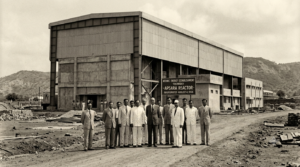
What Made the Apsara Reactor India’s Most Important Scientific Gamble
To understand why the Apsara reactor mattered, you have to remember what India looked like in 1956. Independence had arrived in 1947 accompanied by Partition, mass displacement, and an economy that was still overwhelmingly agrarian. Steel plants, dams, and universities were only beginning to take shape under the first Five-Year Plans. Against that backdrop, committing scarce national resources to something as abstract and expensive as nuclear physics research seems, at first glance, like an odd priority.
But Jawaharlal Nehru and Homi Jehangir Bhabha did not see it that way. Bhabha, a Cambridge-trained physicist who had returned to India during the Second World War, had already persuaded the Tata Trust in 1945 to fund the Tata Institute of Fundamental Research (TIFR) in Bombay — a full two years before independence. His argument was simple and, in hindsight, prophetic: nations that master the atom early will define the next century of science, medicine, and energy. Nations that wait will spend that century buying technology from others.
Nehru agreed, and in 1954 the Department of Atomic Energy was established with Bhabha at its head, answering directly to the Prime Minister. Trombay, a rocky, then-undeveloped stretch of land near Bombay, was chosen as the site for what would become the Atomic Energy Establishment, Trombay (AEET) — later renamed the Bhabha Atomic Research Centre (BARC) in his honour after his death in 1966.
The Apsara reactor was the first building block of that vision. And the choice to build a reactor — rather than simply import nuclear technology wholesale — was itself a statement of intent.
Inside the Apsara Reactor: Design and Technical Specifications
The Apsara reactor belonged to a category of reactors called “swimming pool-type” research reactors, and the name is refreshingly literal. The reactor core sat submerged at the bottom of a deep pool of ordinary light water, visible through the water as a faint blue glow — a phenomenon called Cherenkov radiation, caused by particles moving through water faster than light does in that medium. Visitors who were later allowed to view the reactor often describe that blue glow as almost otherworldly, which perhaps explains why a name evoking celestial beauty (“Apsara” refers to a divine nymph in Hindu mythology) felt fitting.
Here’s a quick technical snapshot of the Apsara reactor:
| Feature | Details |
|---|---|
| Name | Apsara |
| Commissioned | 4 August 1956 |
| Location | Trombay, Bombay (now Mumbai), Maharashtra |
| Reactor Type | Swimming pool-type research reactor |
| Thermal Power | 1 MW |
| Fuel | Highly Enriched Uranium (HEU) |
| Moderator & Coolant | Light water |
| Chief Designer | Indian scientists under Dr. Homi J. Bhabha |
| Operating Body | Atomic Energy Establishment, Trombay (later BARC) |
A 1-megawatt thermal output sounds tiny compared to the gigawatt-scale power reactors that light up cities today — and it was tiny, deliberately so. The Apsara reactor was never meant to generate electricity. Research reactors like this one are built to produce a steady, controllable stream of neutrons, which scientists then use for experiments, irradiation, and isotope production. Think of the Apsara reactor less like a power plant and more like a specialized scientific instrument — one that happened to be the size of a building.
One detail rarely emphasized enough: the enriched uranium fuel for the Apsara reactor was supplied by the United Kingdom under a lease arrangement, while the reactor’s design, construction, and — critically — its operation were entirely Indian. This distinction mattered enormously. India was not simply hosting foreign technology; Indian engineers had designed the reactor pool, its control systems, and its safety architecture themselves, at a time when only a handful of countries anywhere possessed that expertise.
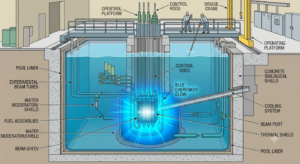
Why the Apsara Reactor Was a First for All of Asia
It’s worth pausing on a fact that often gets glossed over: the Apsara reactor wasn’t just India’s first — it was Asia’s first research reactor, period. Not China’s, not Japan’s, not any other Asian nation’s. In 1956, Japan was still rebuilding from wartime devastation and hadn’t yet embarked on civilian nuclear research at this scale. China’s own nuclear programme was several years behind. South Korea’s first reactor, TRIGA Mark II, wouldn’t achieve criticality until 1962.
That timing matters because it reframes the standard narrative. India is often discussed today primarily in terms of its 1974 and 1998 nuclear weapons tests — moments that dominate popular memory of “India and nuclear technology.” But the Apsara reactor predates both by nearly two decades, and its purpose was pointedly peaceful: medicine, agriculture, materials science, and training. Long before India became a nuclear-armed state, it had already established itself as a serious nuclear-research nation, arguably the most capable one in Asia at the time.
This is the part of the story that tends to get lost. The Apsara reactor wasn’t built to threaten anyone. It was built to heal people, feed people, and teach a generation of scientists things no Indian university could yet teach.
How the Apsara Reactor Changed Indian Medicine and Agriculture
Reactors like Apsara generate something enormously useful and often underappreciated: radioisotopes. These are radioactive versions of ordinary elements, and when produced and handled carefully, they become powerful tools far beyond a physics lab.
Within a few years of the Apsara reactor going critical, India had a domestic source of radioisotopes for:
- Cancer diagnosis and treatment — certain isotopes are used in imaging tumours or, in controlled doses, in radiotherapy.
- Agricultural research — isotopes helped scientists track how plants absorb nutrients and water, and supported the development of improved, higher-yield crop varieties through induced mutation studies.
- Industrial testing — checking for flaws in metal welds, pipelines, and machinery without having to dismantle them.
- Archaeology and forensic science — techniques like radiocarbon-adjacent dating and trace analysis benefited from the neutron activation methods the Apsara reactor made possible.
Before the Apsara reactor existed, an Indian hospital or research institute wanting these materials would have had to import them from abroad — expensive, slow, and dependent on the goodwill of other nations. Afterward, India could produce many of its own. That shift, quiet and unglamorous as it sounds, likely mattered more to ordinary Indian lives in the following decades than any headline-grabbing nuclear test ever would.
The Apsara Reactor as India’s First Nuclear Classroom
Perhaps the most understated legacy of the Apsara reactor is the sheer number of careers it launched. Operating and studying a live nuclear reactor requires an entirely different kind of expertise than reading about one in a textbook — reactor physics, radiation safety, instrumentation, neutron behaviour, materials under irradiation. In the mid-1950s, almost no Indian institution could teach these subjects hands-on, because there was no reactor to teach them on.
The Apsara reactor changed that overnight. It became a living laboratory where physicists, chemists, and engineers trained by literally working alongside a functioning reactor. Many of the scientists who would go on to lead India’s subsequent nuclear projects — the CIRUS reactor (commissioned in 1960, built with Canadian assistance and American heavy water), and later Dhruva (India’s first fully indigenous large research reactor, commissioned in 1985) — cut their teeth on Apsara.
In that sense, the Apsara reactor functioned less like a single achievement and more like a seed. Everything that followed in India’s nuclear story — power reactors, isotope production centres, and yes, eventually weapons capability — traces a direct institutional and human lineage back to that swimming pool of water at Trombay and the people who first learned to work with it. Readers interested in how this same era of nation-building unfolded elsewhere may enjoy our article on India’s independence movement for broader context.
From the Apsara Reactor to Apsara-U: A Legacy Renewed
After more than five decades of near-continuous operation, the original Apsara reactor was permanently shut down in 2009. Fifty-three years is an extraordinarily long working life for a piece of experimental nuclear infrastructure, a testament to how carefully the original design and its Indian operators had maintained it.
Rather than simply retire the legacy, India chose to renew it. On 10 September 2018, Apsara-U (Apsara-Upgraded) began operation on the very same site — this time designed and built entirely indigenously, and running on Low Enriched Uranium (LEU) fuel instead of the highly enriched uranium the original Apsara reactor used. This shift to LEU reflects a broader global trend in nuclear research: reducing reliance on highly enriched uranium for non-proliferation reasons, while still achieving strong scientific performance.
Apsara-U also delivers a notably higher neutron flux than its predecessor, which translates directly into more efficient radioisotope production — meaning more medical isotopes for cancer care and diagnostics, produced faster and in greater volume, at a time when India’s healthcare demands have grown enormously since the 1950s.
There’s something quietly poetic about that continuity. The same patch of land at Trombay that hosted the original Apsara reactor in 1956 is, today, still producing the medical isotopes that treat Indian cancer patients — just with sixty years of accumulated expertise behind it.
Why the Apsara Reactor Still Matters Today
It would be easy to file the Apsara reactor away as a historical footnote — the answer to a trivia question about “India’s first nuclear reactor.” But its real significance lies in what it represented: a deliberate choice, made by a young and economically constrained nation, to invest in fundamental scientific capability rather than wait to purchase it later.
That choice paid dividends far beyond the nuclear sector itself. The institutional culture Bhabha built at Trombay — rigorous, self-reliant, focused on training local talent — became the template for other major Indian scientific institutions in space research, defence technology, and beyond. When India’s space programme, under Vikram Sarabhai, began taking shape in the 1960s, it drew directly on lessons learned from how Bhabha had built India’s atomic energy establishment around the Apsara reactor a decade earlier.
The Apsara reactor also complicates a simplistic view of nuclear history that focuses only on weapons and geopolitics. Its story is fundamentally about capacity-building: training scientists, treating patients, improving crops, and proving — to Indians and to the world — that a newly independent, resource-constrained nation could master one of the most demanding fields of twentieth-century science on its own terms. For more on how India navigated pivotal turning points in this period, see our coverage of the Battle of Plassey and its long shadow over colonial and post-colonial India.
Frequently Asked Questions About the Apsara Reactor
What was the Apsara reactor, and why is it important? The Apsara reactor was India’s first nuclear reactor and the first research reactor in Asia, achieving criticality on 4 August 1956 at Trombay. It marked the beginning of India’s nuclear programme and trained the country’s first generation of nuclear scientists.
Who designed and built the Apsara reactor? The Apsara reactor was designed and built by Indian scientists and engineers under the leadership of Dr. Homi Jehangir Bhabha, widely regarded as the father of India’s nuclear programme.
What type of reactor was Apsara? The Apsara reactor was a swimming pool-type research reactor with a thermal power of 1 MW, using highly enriched uranium (HEU) fuel and light water as both moderator and coolant.
Where did the Apsara reactor’s fuel come from? The enriched uranium fuel for the Apsara reactor was supplied by the United Kingdom under a lease agreement, while the reactor’s design, construction, and operation were entirely carried out by Indian scientists and engineers.
What was the Apsara reactor used for? The Apsara reactor produced medical radioisotopes for cancer diagnosis and treatment, supported neutron activation analysis, enabled nuclear physics and materials research, and trained India’s early reactor scientists and operators. It also supported research in agriculture, biology, archaeology, and forensic science.
When was the Apsara reactor shut down, and what replaced it? The original Apsara reactor was permanently shut down in 2009 after more than 50 years of operation. It was replaced by Apsara-U (Apsara-Upgraded) on 10 September 2018, an indigenously developed reactor using Low Enriched Uranium (LEU) fuel with a higher neutron flux for improved radioisotope production.
Was the Apsara reactor related to India’s nuclear weapons programme? The Apsara reactor itself was a peaceful research reactor focused on science, medicine, and training. However, the expertise and infrastructure it helped build at Trombay laid the institutional foundation for India’s later nuclear reactors, including CIRUS and Dhruva, which were connected to India’s broader nuclear capabilities.
Why is the Apsara reactor called “Asia’s first” research reactor? When the Apsara reactor achieved criticality in 1956, no other Asian nation — including Japan, China, or South Korea — had yet built and operated a nuclear research reactor, making India the first in the continent to do so.
Important Article as per History Decoded Hub.