
Introduction: A Story That Deserves to Be Remembered
When people think about India’s great empires, names such as the Mughals, Mauryas, and Guptas often come to mind.
Yet hidden between the pages of history lies a remarkable story of courage, determination, and leadership—the story of the Maratha Empire.
It was an empire that rose from the rugged hills of western India and challenged some of the most powerful rulers of its time. At its peak, Maratha influence stretched across much of the Indian subcontinent. Their armies marched thousands of kilometers, their leaders inspired millions, and their vision reshaped Indian politics.
Despite these achievements, many people know surprisingly little about them today.
The forgotten story of the Maratha Empire is not merely about battles and kings. It is a story about ambition, resistance, administration, and the dream of self-rule.
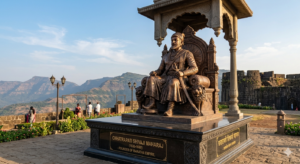
Table of Contents
- The World Before the Rise of the Maratha Empire
- A Young Leader Named Shivaji
- The Birth of the Maratha Empire
- The Forts That Built a Kingdom
- How the Marathas Challenged the Mughal Empire
- The Coronation That Changed Indian History
- The Expansion of the Maratha Empire
- The Third Battle of Panipat
- Governance, Economy, and Military Innovations
- Legendary Leaders Beyond Shivaji
- Why the Maratha Empire Began to Decline
- The Legacy of the Maratha Empire
- Conclusion
1. The World Before the Rise of the Maratha Empire
The seventeenth century was a period of major political change in India.
The Mughal Empire dominated much of the subcontinent. Its rulers controlled vast territories and possessed enormous wealth.
Yet beneath the surface, many regional powers sought greater independence.
In the rugged landscape of the Deccan, local communities faced political uncertainty and constant power struggles.
Few could have imagined that this region would soon produce one of India’s most influential empires.
The stage was set for a remarkable transformation.
2. A Young Leader Named Shivaji
Every great empire begins with a dream.
For the Marathas, that dream was carried by a young man named Shivaji.
Born in 1630, Shivaji grew up hearing stories of bravery, justice, and self-rule. His mother Jijabai played a crucial role in shaping his character and vision.
From an early age, Shivaji understood the strategic importance of forts, local alliances, and public support.
Unlike many rulers of his time, he believed that leadership required more than military strength.
It required trust.
As he entered adulthood, he began capturing key forts and building a loyal network of supporters.
These early victories marked the beginning of something extraordinary.
3. The Birth of the Maratha Empire
The rise of the Maratha Empire was not sudden.
It was built step by step.
Fort by fort.
Victory by victory.
Shivaji carefully expanded his influence across western India. His forces used speed, intelligence gathering, and deep knowledge of local terrain to overcome larger armies.
This approach allowed the Marathas to achieve success against opponents who often possessed superior resources.
As their power grew, so did their reputation.
People began to see Shivaji not simply as a military commander but as a leader capable of creating a new political order.
The foundation of the Maratha Empire had been laid.
4. The Forts That Built a Kingdom
Few empires relied on fortifications as effectively as the Marathas.
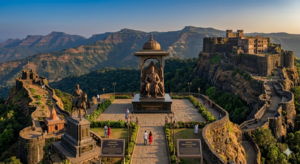
The mountains of western India were filled with strategically placed forts.
These strongholds served as military bases, administrative centers, and symbols of authority.
Famous forts such as Raigad, Pratapgad, and Sinhagad played a vital role in protecting Maratha territory.
Each fort told a story of planning, engineering, and determination.
Together, they formed a defensive network that allowed the Marathas to survive against powerful enemies.
Without these forts, the empire’s rise might never have been possible.
5. How the Marathas Challenged the Mughal Empire
One of the most fascinating chapters in Indian history is the conflict between the Marathas and the Mughals.
At the time, the Mughal Empire was among the strongest political powers in the world.
Yet the Marathas repeatedly challenged its authority.
Rather than engaging in direct confrontation whenever possible, Maratha commanders relied on mobility and surprise.
Their ability to adapt gave them a significant advantage.
Even when facing enormous pressure from Emperor Aurangzeb, the Marathas refused to surrender.
Their resistance gradually weakened Mughal influence in the Deccan.
This struggle would ultimately reshape the balance of power in India.
6. Maratha Empire and the Historic Coronation of Shivaji
In 1674, a momentous event took place.
Shivaji was formally crowned as Chhatrapati at Raigad Fort.
The coronation was more than a ceremonial occasion.
It represented the recognition of a sovereign Maratha state.
For many people, it symbolized hope, stability, and self-governance.
The event also strengthened the legitimacy of the growing empire.
From that point onward, the Marathas were no longer viewed as a regional force alone.
They had become a major political power.
7. The Expansion of the Maratha Empire Across India
After Shivaji’s death in 1680, many believed the empire would collapse.
Instead, it expanded.
Successive leaders carried forward his vision and extended Maratha influence across vast territories.
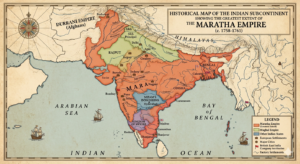
Their armies reached northern India, central India, and parts of eastern India.
At its height, the Maratha Empire became one of the largest powers on the subcontinent.
Its influence stretched from the Arabian Sea toward the Bay of Bengal.
This remarkable expansion demonstrated the resilience of the institutions Shivaji had built.
8. The Third Battle of Panipat: A Turning Point
History often turns on a single day.
For the Marathas, that day arrived in 1761.
The Third Battle of Panipat remains one of the largest and most significant battles in Indian history.
The Marathas faced the forces of Ahmad Shah Durrani in a conflict that would determine the future of northern India.
The battle was fierce and devastating.
Despite their courage, the Marathas suffered a major defeat.
The loss shocked the empire and weakened its position.
However, contrary to popular belief, the Maratha Empire did not disappear after Panipat.
It recovered and continued to play a major role in Indian politics for decades.
9. Governance, Economy, and Military Innovations
Many discussions focus only on Maratha military achievements.
Yet their administrative contributions were equally important.
The empire developed systems for taxation, revenue collection, and local governance.
Officials were appointed to oversee different regions.
Trade routes were protected, helping economic activity flourish.
The Marathas also encouraged efficient communication across their territories.
These administrative foundations allowed the empire to manage vast areas despite constant challenges.
Their success was not built solely on warfare.
It was supported by effective governance.
10. Legendary Leaders Beyond Shivaji
While Shivaji remains the most celebrated figure, many other leaders contributed to the empire’s success.
The Peshwas played a critical role in expanding Maratha influence.
Baji Rao I, in particular, became one of India’s greatest military commanders.
His campaigns demonstrated extraordinary speed and strategic brilliance.
Leaders such as Madhavrao I also helped stabilize and strengthen the empire during difficult periods.
Their achievements ensured that the Maratha story continued long after Shivaji’s lifetime.
11. Why the Maratha Empire Began to Decline
No empire remains powerful forever.
As the Marathas expanded, new challenges emerged.
Internal rivalries weakened unity.
Regional interests sometimes conflicted with central authority.
At the same time, European powers were becoming increasingly influential in India.
The British East India Company gradually expanded its reach through diplomacy, trade, and military force.
A series of conflicts eventually reduced Maratha power.
By the early nineteenth century, British dominance had largely replaced Maratha authority across much of India.
The decline was gradual rather than sudden.
It was the result of multiple political, military, and economic factors.
12. The Legacy of the Maratha Empire
Although the empire eventually declined, its legacy remains significant.
The Marathas challenged powerful opponents and demonstrated the importance of strategic leadership.
They promoted systems of governance that influenced later administrations.
Their military innovations changed the nature of warfare in India.
Most importantly, they inspired future generations with the idea that determined leadership could reshape history.
The story of the Maratha Empire is not merely about territorial expansion.
It is about resilience.
It is about vision.
It is about the ability of a regional power to transform itself into one of the most influential forces in Indian history.
Conclusion: Why the Maratha Empire Still Matters Today
The forgotten story of the Maratha Empire deserves greater attention.
It is a story filled with courage, ambition, sacrifice, and achievement.
From the leadership of Shivaji to the vast expansion of Maratha influence across India, the empire played a central role in shaping the country’s history.
Its leaders proved that determination and strategy could overcome seemingly impossible challenges.
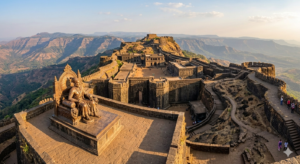
Today, the forts still stand.
The legends still survive.
And the lessons remain relevant.
The Maratha Empire may belong to the past, but its impact continues to be felt in the present.
Important Internal Link
-
Discover How the East India Company Changed India
The decline of the Maratha Empire marked the beginning of a new chapter in Indian history. As Maratha power weakened, the East India Company steadily expanded its influence across the subcontinent. Through trade, diplomacy, and military campaigns, it transformed India’s political landscape. Read our detailed article on The History of the East India Company in India to discover how a trading company became one of the most powerful forces in Indian history.
-
Read the Inspiring Story of Subhas Chandra Bose
The Marathas left behind a legacy of courage, leadership, and resistance against powerful opponents. Centuries later, these qualities could be seen in the life of Subhas Chandra Bose, one of India’s most remarkable freedom fighters. Explore our article on Subhas Chandra Bose to discover how his determination and vision inspired millions during India’s struggle for independence.
-
Explore the Rise and Fall of Another Great Empire
History shows that even the most powerful empires eventually face challenges. The Maratha Empire was no exception. A similar story can be found in the rise and fall of the Roman Empire, which once ruled vast territories before experiencing decline. Read our article on The Rise and Fall of the Roman Empire to discover fascinating lessons about leadership, expansion, and the factors that shape the destiny of great civilizations.
Discover More About the Maratha Empire
To learn more about the rise, expansion, and legacy of the Maratha Empire, explore this detailed historical resource:
Encyclopaedia Britannica – Maratha Confederacy (Maratha Empire)