
Introduction: When India Was the Knowledge Capital of the World
Imagine a time when students traveled thousands of miles across mountains, deserts, and seas—not for trade, not for war, but for education.
Centuries before Oxford, Cambridge, or Harvard existed, India was home to some of the world’s greatest centers of learning. These institutions attracted scholars from China, Tibet, Korea, Persia, and Southeast Asia. Their classrooms echoed with debates on philosophy, medicine, mathematics, astronomy, politics, and literature.
Among these remarkable centers, Nalanda and Takshashila stood above all others. They were not merely schools; they were thriving intellectual cities where knowledge was treasured above wealth.
Today, however, only ruins remain.
What happened to these magnificent institutions? Why did they disappear? And what did humanity lose when they fell?
The story of Ancient Indian Universities is one of brilliance, ambition, cultural exchange, and ultimately, tragedy.
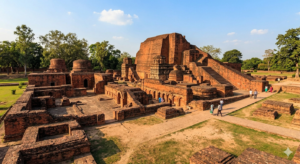
Table of Contents
- Ancient Indian Universities: When India Led the World in Education
- The Rise of Takshashila
- Life Inside the World’s Earliest Learning Center
- Nalanda University and Its Golden Age
- Why Scholars Traveled Across Asia to Study in India
- The Great Libraries of Ancient India
- Why Ancient Indian Universities Became Global Centers of Knowledge
- The Political Changes That Weakened These Institutions
- Why Ancient Indian Universities Were Destroyed
- The Destruction of Nalanda
- What the World Lost
- Lessons for Modern Education
- Conclusion
Ancient Indian Universities: When India Led the World in Education
In the modern world, universities are often measured by rankings, research papers, and infrastructure.
Ancient India had its own version of world-class education centuries ago.
The concept of organized higher learning flourished across the Indian subcontinent. Students were encouraged to question, debate, and seek truth. Education was not limited to a single field. Scholars studied religion, medicine, mathematics, architecture, military strategy, economics, and philosophy.
The reputation of Ancient Indian Universities spread far beyond India’s borders. Foreign travelers wrote about their excellence, and rulers proudly supported these institutions.
At a time when much of the world struggled with limited access to education, India had already built thriving academic communities.
The Rise of Takshashila
Long before Nalanda gained fame, Takshashila had already become a center of learning.
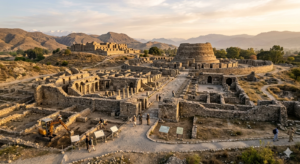
Located in present-day Pakistan, Takshashila emerged around the first millennium BCE and became one of the earliest known educational hubs in human history.
Unlike modern universities, Takshashila did not have a single campus. Instead, renowned teachers taught specialized subjects, and students chose whom they wished to study under.
Young learners arrived from different kingdoms seeking wisdom and practical skills.
Some studied medicine.
Others focused on politics, military science, grammar, law, or philosophy.
The city became a meeting place for diverse cultures and ideas, creating an environment where innovation thrived.
Life Inside the World’s Earliest Learning Center
Imagine waking up before sunrise.
Students would begin their day with study, discussion, and reflection. Lessons often involved intense debates rather than memorization.
Teachers encouraged students to challenge ideas respectfully.
Education at Takshashila emphasized understanding rather than simply repeating information.
Among its most famous scholars was Chanakya, the brilliant strategist who later guided Chandragupta Maurya and helped establish the Mauryan Empire.
His work on governance and economics continues to influence political thought even today.
The success of Takshashila demonstrated that education could shape not only individuals but entire civilizations.
Nalanda University and Its Golden Age
If Takshashila was the pioneer, Nalanda was the masterpiece.
Founded during the Gupta period, Nalanda grew into one of the greatest educational institutions in history.
Its campus covered a vast area filled with monasteries, lecture halls, temples, gardens, and residential buildings.
Thousands of students lived and studied there.
Admission was highly competitive.
Historical accounts suggest that many applicants failed the entrance examinations conducted by senior scholars.
Those who succeeded gained access to an extraordinary intellectual environment.
Teachers and students engaged in discussions that often lasted for hours.
Knowledge was not confined to religion. Subjects included astronomy, mathematics, medicine, grammar, logic, literature, and philosophy.
Nalanda became a symbol of intellectual excellence across Asia.
Why Scholars Traveled Across Asia to Study in India
The fame of Nalanda spread far beyond the Indian subcontinent.
Travelers crossed dangerous mountain passes and difficult trade routes to reach its gates.
One of the most famous visitors was the Chinese scholar Xuanzang.
He spent years studying at Nalanda and later documented its academic culture in detail.
His writings reveal an institution filled with brilliant minds and rigorous scholarship.
Students from different regions lived together, exchanged ideas, and developed friendships that crossed cultural boundaries.
In many ways, Nalanda functioned like an international university centuries before globalization became a reality.
The Great Libraries of Ancient India
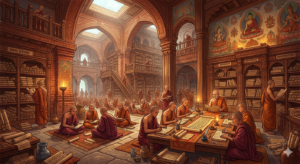
The heart of Nalanda was its legendary library.
Historical accounts describe an enormous collection of manuscripts covering countless subjects.
These texts preserved centuries of accumulated knowledge.
Scholars spent years copying, translating, and expanding upon earlier works.
The library was more than a building.
It represented humanity’s collective effort to understand the world.
Knowledge that had been developed over generations was carefully preserved for future learners.
For many visitors, the library symbolized the true strength of Ancient Indian Universities.
Why Ancient Indian Universities Became Global Centers of Knowledge
Several factors contributed to their success.
First, they welcomed students from different backgrounds.
Second, they encouraged intellectual freedom and debate.
Third, rulers and patrons provided support without restricting scholarly inquiry.
Most importantly, these institutions valued curiosity.
Students were not merely taught what to think.
They were taught how to think.
This approach allowed knowledge to grow continuously.
It transformed universities into living centers of innovation and discovery.
The Political Changes That Weakened These Institutions
No institution exists in isolation.
Universities depend on stable political and economic conditions.
Over time, shifts in power affected educational centers across the region.
Changing dynasties altered patterns of patronage.
Trade routes evolved.
Political instability increased in some areas.
As support declined, maintaining large institutions became increasingly difficult.
These challenges weakened the foundations that had sustained higher learning for centuries.
Why Ancient Indian Universities Were Destroyed
The decline of these institutions did not occur overnight.
It was the result of multiple factors, including political instability, economic changes, and military conflicts.
However, invasions played a significant role in the final destruction of several major centers of learning.
Buildings could be rebuilt.
But the loss of scholars, manuscripts, and intellectual traditions proved far more devastating.
The destruction of educational institutions represented more than physical damage.
It disrupted entire networks of knowledge transmission.
The Destruction of Nalanda
One of the most tragic chapters in Indian history concerns the destruction of Nalanda.
Historical records describe how invading forces attacked the university, causing immense damage.
Its priceless manuscripts were lost.
Its scholars were dispersed.
Its classrooms fell silent.
For centuries, Nalanda had served as a beacon of knowledge.
Its destruction marked the end of an era.
The loss was not only India’s.
It belonged to all humanity.
What the World Lost
When great libraries disappear, knowledge disappears with them.
Countless manuscripts vanished forever.
Scientific observations, philosophical discussions, medical knowledge, and literary works may have been lost beyond recovery.
Future generations were deprived of insights that might have shaped intellectual history in different ways.
The destruction of these institutions reminds us how fragile knowledge can be.
Civilizations rise and fall, but preserving learning remains one of humanity’s most important responsibilities.
Lessons for Modern Education
The story of Ancient Indian Universities offers valuable lessons today.
Education flourishes when curiosity is encouraged.
Knowledge grows when cultures exchange ideas.
Universities succeed when they remain open to diverse perspectives.
Modern institutions can learn from the spirit of Nalanda and Takshashila—a spirit built on inquiry, debate, and the pursuit of wisdom.
Conclusion: The Legacy of Ancient Indian Universities
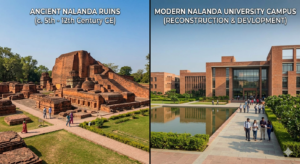
Although Nalanda and Takshashila no longer exist in their original form, their legacy survives.
They demonstrated that education has the power to unite people across borders, cultures, and languages.
The story of Ancient Indian Universities is not merely about destruction.
It is also about achievement, innovation, and the enduring human desire to learn.
Their ruins may stand silent today, but the ideas they inspired continue to echo through history.
And perhaps that is their greatest victory.
Important Internal link
-
Internal Link: Indus Valley Civilization
Long before Nalanda and Takshashila became famous centers of learning, the Indian subcontinent was home to the remarkable Indus Valley Civilization. Its advanced cities, trade networks, and urban planning laid the foundation for centuries of intellectual and cultural development. Read more in our detailed article on the Indus Valley Civilization.
-
Internal Link: The History of the East India Company in India
The decline of ancient centers of learning reminds us how political changes can reshape a civilization. Centuries later, India experienced another major transformation with the arrival of the East India Company, whose influence changed the country’s economy, administration, and education. Learn more in our article on The History of the East India Company in India.
-
Internal Link: Subhas Chandra Bose
India’s tradition of knowledge, leadership, and innovation continued long after the fall of Nalanda and Takshashila. One of the most inspiring figures of modern Indian history was Subhas Chandra Bose, whose vision and determination left a lasting impact on the freedom movement. Discover his extraordinary journey in our article on Subhas Chandra Bose.
-
For readers interested in exploring the historical significance and archaeological remains of Nalanda, visit the official UNESCO World Heritage page on Nalanda Mahavihara: