
Introduction: The Queen History Never Forgot
More than 2,000 years ago, along the fertile banks of the Nile River, a woman rose to power in one of the world’s most famous civilizations. Her name was Cleopatra. Even today, she remains one of the most fascinating figures in history.
Many people know Cleopatra as a beautiful queen who captured the hearts of powerful Roman leaders. However, her real story is far more remarkable. She was an intelligent ruler, a skilled diplomat, a gifted linguist, and a determined leader who fought to protect her kingdom during one of the most turbulent periods in ancient history.
Cleopatra’s life was filled with political intrigue, family betrayals, military conflicts, romance, and tragedy. Her story marked the end of Ancient Egypt as an independent kingdom and the beginning of Roman domination.
Let us travel back in time and discover the extraordinary story of Egypt’s last powerful queen.
The World Cleopatra Was Born Into
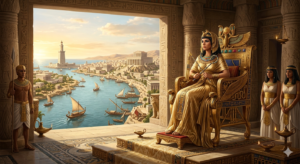
Cleopatra VII Philopator was born in 69 BCE in Alexandria, the magnificent capital of Egypt.
At the time, Egypt was ruled by the Ptolemaic Dynasty, a family of Greek origin established by Ptolemy I, one of Alexander the Great’s generals. Although the dynasty ruled Egypt for nearly three centuries, its leaders often faced political instability and internal conflicts.
By Cleopatra’s birth, the kingdom was weakening. Rome had become the most powerful force in the Mediterranean world, and Egypt increasingly depended on Roman support.
Cleopatra grew up in a royal palace surrounded by wealth, knowledge, and political intrigue. Unlike many rulers of her dynasty, she was highly educated and deeply interested in governance.

Cleopatra’s Education and Intelligence
One reason Cleopatra stands out in history is her exceptional intelligence.
Ancient sources suggest she could speak multiple languages, including Egyptian, Greek, and several others. Most rulers of the Ptolemaic Dynasty spoke Greek and rarely learned the language of ordinary Egyptians. Cleopatra was different.
She studied:
- Mathematics
- Astronomy
- Philosophy
- Medicine
- Diplomacy
- Literature
- Political strategy
Her education prepared her for leadership at a young age.
The famous Library of Alexandria, one of the greatest centers of learning in the ancient world, likely influenced her intellectual development. Surrounded by scholars and philosophers, Cleopatra learned how knowledge could be used as a tool of power.
Becoming Queen of Egypt
In 51 BCE, Cleopatra’s father, Ptolemy XII, died.
According to tradition, Cleopatra was expected to rule jointly with her younger brother, Ptolemy XIII. This arrangement was common within the Ptolemaic Dynasty.
However, sharing power was easier in theory than in practice.
Soon after taking the throne, tensions emerged between Cleopatra and her brother’s advisors. Political rivals sought to remove her from power.
Eventually, Cleopatra was forced to flee Alexandria and seek support elsewhere.
Most rulers would have accepted defeat.
Cleopatra chose to fight for her throne.
The Famous Meeting with Julius Caesar
At the same time, Rome was experiencing its own political struggles.
One of Rome’s most powerful leaders, Julius Caesar, arrived in Egypt in 48 BCE while pursuing his rival Pompey.
Cleopatra realized that Caesar’s support could help her regain power.
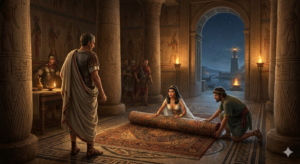
According to ancient accounts, she arranged a dramatic meeting with Caesar by secretly entering the royal palace wrapped inside a carpet or linen sack. Whether the story is entirely true or partly legendary, it has become one of history’s most famous moments.
Caesar was impressed by Cleopatra’s intelligence, confidence, and political skill.
With Roman support, Cleopatra defeated her rivals and reclaimed her position as queen.
The alliance transformed Egypt’s future.
Cleopatra and Julius Caesar
Cleopatra and Julius Caesar developed both a political partnership and a personal relationship.
In 47 BCE, Cleopatra gave birth to a son named Caesarion, whom she claimed was Caesar’s child.
The birth strengthened her position and increased her influence.
For a time, Egypt enjoyed greater stability under Cleopatra’s leadership.
She accompanied Caesar to Rome, where she became a prominent figure. Her presence attracted admiration and controversy.
Many Romans viewed her as a powerful foreign queen with significant influence over Caesar.
When Julius Caesar was assassinated in 44 BCE, Cleopatra’s future became uncertain once again.
Without Caesar’s protection, she needed a new strategy to safeguard Egypt.
Egypt After Caesar’s Death
The assassination of Caesar plunged Rome into chaos.
Several powerful leaders competed for control of the Roman world.
Among them was Mark Antony, one of Caesar’s closest allies and a highly respected military commander.
Cleopatra understood that Egypt’s survival depended on maintaining strong relations with Rome.
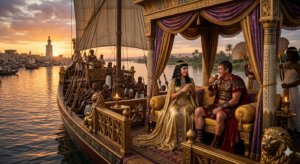
When Antony summoned her to meet him in 41 BCE, she arrived in spectacular fashion.
Ancient historians describe her sailing on a magnificent ship decorated with gold, purple sails, and luxurious furnishings.
The display was carefully planned.
Cleopatra knew that appearances could influence politics.
Her arrival left a lasting impression on Antony.
Cleopatra and Mark Antony
The relationship between Cleopatra and Mark Antony became one of the most famous romances in history.
However, it was much more than a love story.
Their alliance was based on mutual political interests.
Antony needed Egypt’s wealth and resources to support his military campaigns.
Cleopatra needed Roman protection to preserve her kingdom.
Together, they formed a powerful partnership.
The couple had three children and governed large territories in the eastern Mediterranean.
Under Cleopatra’s rule, Egypt remained prosperous despite growing pressure from Rome.
She invested in trade, strengthened the economy, and maintained diplomatic relationships with neighboring regions.
Cleopatra’s Leadership and Achievements
Popular culture often focuses on Cleopatra’s beauty, but her true strength was her leadership.
Some of her major achievements included:
Strengthening Egypt’s Economy
Cleopatra improved trade networks and managed Egypt’s valuable grain exports.
Egypt’s fertile lands produced enormous quantities of food, making the kingdom economically important throughout the Mediterranean.
Political Diplomacy
She successfully negotiated with powerful Roman leaders and foreign rulers.
Her diplomatic abilities allowed Egypt to remain independent longer than many expected.
Supporting Culture and Learning
Cleopatra promoted education, scholarship, and religious traditions.
She worked to connect herself with ancient Egyptian customs and presented herself as the living embodiment of the goddess Isis.
Maintaining Stability
Despite constant political threats, Cleopatra managed to keep Egypt relatively stable during a period of major international conflict.
The Rise of Octavian
While Cleopatra and Antony expanded their influence, another Roman leader was rising to power.
His name was Octavian, the adopted heir of Julius Caesar.
Octavian viewed Antony and Cleopatra as threats.
A fierce political struggle emerged between the two sides.
Roman propaganda portrayed Cleopatra as a dangerous foreign queen attempting to control Rome through Antony.
These accusations damaged Antony’s reputation among many Romans.
The conflict eventually led to war.
The Battle of Actium
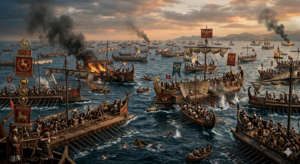
The decisive moment came in 31 BCE during the Battle of Actium.
This naval battle took place off the western coast of Greece.
Octavian’s forces confronted the combined fleets of Antony and Cleopatra.
The battle ended in a major victory for Octavian.
Antony and Cleopatra retreated to Egypt.
The defeat marked the beginning of the end for their alliance and for Egypt’s independence.
The Final Days of Cleopatra
In 30 BCE, Octavian invaded Egypt.
Antony’s military position collapsed.
Believing that Cleopatra had died, Antony reportedly took his own life.
Soon afterward, Cleopatra found herself facing an impossible situation.
She knew that Octavian planned to take her to Rome as a captive and display her in a victory parade.
For a queen who had spent her life protecting her dignity and sovereignty, such humiliation was unacceptable.
Rather than surrender, Cleopatra chose death.
According to tradition, she died from the bite of an asp, a venomous snake. Modern historians continue to debate the exact circumstances of her death.
She was only 39 years old.
With her death, an era ended.
The End of Ancient Egypt
Cleopatra’s death marked the conclusion of the Ptolemaic Dynasty.
Egypt was annexed by Rome and became one of its richest provinces.
For the first time in centuries, Egypt was no longer ruled by its own monarch.
Octavian later became Augustus, the first Roman Emperor.
His victory transformed Rome into an empire and reshaped world history.
Cleopatra’s fall symbolized the end of the ancient Egyptian age that had begun thousands of years earlier with the construction of the pyramids and the rise of the pharaohs.
Myths and Misconceptions About Cleopatra
Over the centuries, many myths have surrounded Cleopatra.
Was Cleopatra the Most Beautiful Woman in History?
Ancient coins suggest Cleopatra may not have matched modern beauty standards.
Her influence likely came from her intelligence, charisma, confidence, and political skill rather than physical appearance alone.
Was She Egyptian?
Although she ruled Egypt and embraced Egyptian culture, Cleopatra was actually of Greek Macedonian descent.
Was She Only Famous Because of Romance?
No.
Her political achievements, leadership abilities, and diplomatic skills were extraordinary and deserve equal recognition.
Cleopatra’s Legacy
More than two millennia after her death, Cleopatra remains one of history’s most studied and celebrated figures.
She has inspired:
- Books
- Paintings
- Films
- Television series
- Historical research
Her story continues to captivate people because it combines ambition, intelligence, power, love, and tragedy.
Cleopatra lived during a period when few women held significant political authority. Yet she managed to influence some of the most powerful men and events of her era.
Her determination to protect Egypt against overwhelming odds transformed her into a symbol of resilience and leadership.
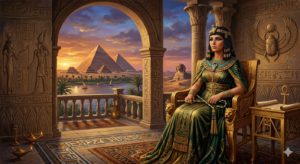
Conclusion: The Queen Who Refused to Be Forgotten
Cleopatra was far more than a legendary beauty or a romantic figure from the ancient world.
She was a brilliant ruler who navigated one of history’s most dangerous political landscapes. She spoke multiple languages, mastered diplomacy, strengthened her kingdom, and fought tirelessly to preserve Egypt’s independence.
Although she ultimately lost her battle against Rome, her legacy survived long after her kingdom disappeared.
Today, Cleopatra stands as a reminder that intelligence, courage, and determination can leave a mark on history that lasts for thousands of years.
The story of Egypt’s last powerful queen is not simply a tale of romance and tragedy—it is the story of a remarkable leader whose influence continues to fascinate the world.
Important Blog You Must Read
-
Discover the Rise and Fall of the Roman Empire
Cleopatra’s story is closely connected to Rome’s expansion. To understand how Roman power grew and eventually absorbed Egypt, discover our detailed guide on the Roman Empire and the reasons behind its historic decline.
Read About Louis XVI and the Fall of Monarchies
Like Cleopatra, Louis XVI faced political turmoil that ultimately ended a royal dynasty. Read our article on Louis XVI to explore how leadership decisions can shape the destiny of entire nations.
Explore the Power and Influence of the Ottoman Empire
Empires have risen and fallen throughout history. Explore our in-depth article on the Ottoman Empire and discover how it dominated three continents for over six centuries.
Discover the Story of the East India Company
Political influence and economic power often go hand in hand. Discover how the East India Company transformed from a trading corporation into one of history’s most powerful ruling forces.
Read About the Maratha Empire
The struggle to preserve independence was not unique to Cleopatra. Read about the Maratha Empire and discover how its warriors challenged some of the greatest powers of their time.
Explore the Legacy of Queen Victoria
History is filled with influential rulers whose decisions changed the world. Explore the life and legacy of Queen Victoria, one of the most powerful monarchs of the modern era.
Learn More About Cleopatra
For readers who want to explore Cleopatra’s life in greater detail, visit the official encyclopedia entry from Encyclopaedia Britannica – Cleopatra.