
Introduction
Imagine a king so powerful that his armies marched to the sacred Ganges River in the far north — and his warships sailed thousands of miles across open ocean to dominate the trade routes of Southeast Asia. A ruler whose temples, built nearly a thousand years ago, still stand today as living places of worship. A civilization so advanced that it invented models of local self-governance that historians marvel at even now.
This was the Chola Empire — one of the longest-ruling, most remarkable dynasties in all of human history.
If you’ve never heard their full story, you’re about to discover why the Cholas deserve to be spoken of in the same breath as Rome, the Mongols, and the Ottomans.
Who Were the Cholas? The Ancient Roots of a Dynasty
Long before they became an empire, the Cholas were already legends.
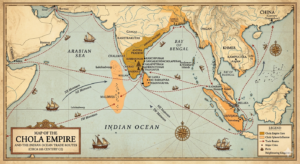
Their name appears in ancient Tamil Sangam literature — poetry and prose composed over two thousand years ago — as a powerful clan of the fertile Kaveri River valley in present-day Tamil Nadu. Their earliest capital, Uraiyur, sat at the heart of this lush, river-fed land, a natural cradle of civilization.
Among the earliest figures celebrated in Tamil tradition is Karikala Chola, a warrior-king whose name echoed through generations. He is credited with military victories and, remarkably, with massive irrigation works along the Kaveri River — proof that even in its earliest days, Chola power was built not just on conquest, but on the ability to make the land flourish.
But the true imperial chapter — the one that would shake the world — had not yet begun.
The Spark That Lit an Empire: Vijayalaya Chola (850 CE)
Around 850 CE, a man named Vijayalaya Chola changed everything.
At the time, the Tamil region was a fractured landscape of competing powers. The Pallavas and the Pandyas jostled for dominance, and the Cholas were just one piece on a complex political chessboard. Vijayalaya saw an opening — and he took it.
He captured Thanjavur, the city that would become the beating heart of the Chola world. One by one, rival powers weakened. A strong territorial kingdom emerged. And from that foundation, Vijayalaya laid the stones upon which his successors would build something extraordinary.
This moment — 850 CE — marks the beginning of what historians call the Imperial Chola period. From this point forward, the Cholas would never look back.
Rajaraja Chola I: The Man Who Built an Empire from a Kingdom
If Vijayalaya lit the spark, Rajaraja Chola I (985–1014 CE) was the fire.
When Rajaraja came to the throne, he inherited a strong kingdom. When he left it, he had forged one of medieval Asia’s greatest empires. Historians often describe him simply as the architect of the Chola golden age — and it is easy to see why.
Conquest and Expansion
Rajaraja’s armies swept across South India like a monsoon. He pushed into Kerala, crushed the Pandya territories, extended Chola authority deep into Sri Lanka, and — most crucially — built a powerful navy that would become the empire’s most fearsome weapon. No longer was the Chola Empire a land power alone. It was becoming something the Indian subcontinent had rarely seen: a maritime superpower.
The Administrator King
But Rajaraja was not merely a conqueror. He was a visionary administrator. He introduced sweeping land surveys, reformed the revenue system, improved record keeping, and strengthened local administration across his vast domains.
These were not the actions of a king who simply wanted to win wars. These were the actions of a man who wanted to build something that would last.
The Temple That Defied Time
And then there is Brihadeeswarar Temple.
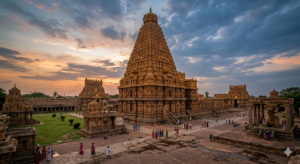
Built between 1003 and 1010 CE in Thanjavur, this temple is arguably the single most breathtaking monument the Chola Empire produced. Dedicated to Lord Shiva, constructed almost entirely from granite, it rises with a colossal tower — the vimana — that would have dominated the skyline for miles.
Its walls are covered in rich inscriptions that read like royal archives, documenting Chola administration, military victories, and religious gifts in extraordinary detail. UNESCO has described it as one of the greatest achievements of Chola architecture. Today, over a millennium after its construction, the Brihadeeswarar Temple is both a UNESCO World Heritage Site and a living temple where devotees still worship every single day.
It is, in every sense, Rajaraja’s stone letter to the future.
Rajendra Chola I: The Emperor Who Touched the Ganges and Crossed the Ocean
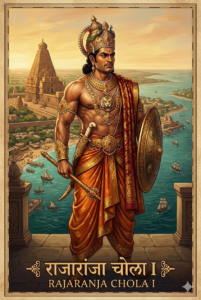
If Rajaraja built the empire, his son Rajendra Chola I (1014–1044 CE) stretched it beyond imagination.
The March to the Ganges
In a campaign that stunned the medieval world, Rajendra sent his armies marching northward across the entire Indian subcontinent — all the way to the banks of the sacred Ganges River.
This was not just military conquest. It was a statement. A message to every kingdom in India that the Cholas were a force without equal.
To commemorate this triumph, Rajendra founded a magnificent new capital: Gangaikondacholapuram — “the city of the Chola who conquered the Ganges.” He built a grand temple there that rivaled even Brihadeeswarar in ambition. And he adopted the resounding title: “Gangaikonda Chola.”
The Naval Campaigns That Stunned Southeast Asia
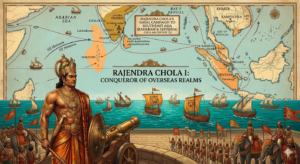
But Rajendra’s most audacious move was not on land — it was at sea.
He launched sweeping naval expeditions across the Indian Ocean, targeting the powerful maritime empire of Srivijaya, the Malay Peninsula, and the critical trade routes of Southeast Asia. These were not mere raids. They were calculated military campaigns designed to control the flow of international commerce.
The message was unmistakable: the Indian Ocean was a Chola sea.
The Chola Navy: India’s Greatest Maritime Force
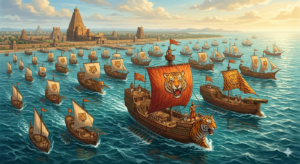
In the long sweep of Indian history, no dynasty built naval power quite like the Cholas.
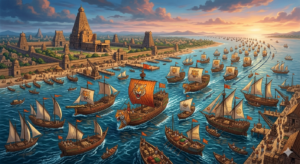
Their navy was not simply a defensive force — it was an instrument of projection, empire, and culture. Chola warships protected merchant vessels traveling dangerous sea lanes, secured vital trade routes, and carried the military power of the empire to shores thousands of miles from Thanjavur.
But perhaps more remarkable than the military dimension was the cultural one. Everywhere Chola influence reached — Sri Lanka, the Maldives, Southeast Asia — Indian art, architecture, religion, and language followed. The spread of Hinduism and Buddhism across maritime Asia owes a significant debt to the Chola navy’s reach.
Few powers in world history — medieval or otherwise — can claim to have projected both military force and cultural influence so effectively across an ocean.
Wealth Without Borders: The Chola Trade Network
Behind every great empire is an economy that feeds it — and the Cholas were masters of commerce.
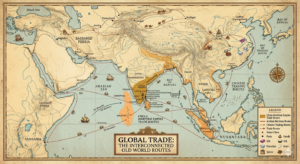
Their trading partners stretched across the known world: China to the east, Sri Lanka and Southeast Asia across the seas, Arab merchants from the west. Chola ports hummed with activity as ships loaded with textiles, spices, precious gems, and metal goods set sail for distant markets.
Powering this commercial machine were the merchant guilds — powerful, organized bodies of traders who drove Chola commerce deep into the Indian Ocean world. These guilds were not just business organizations; they were cultural ambassadors, carrying Tamil language, art, and religion alongside their goods.
The result was a prosperity that funded the Chola’s extraordinary temples, armies, and administrative machinery — a virtuous cycle of wealth and power that sustained the empire for centuries.
Governing a Civilization: The Chola Model of Administration
One of the most quietly revolutionary aspects of Chola history is how they governed.
In an age when most empires ruled through centralized, often brutal, top-down control, the Cholas developed a sophisticated system of local self-governance that many historians consider centuries ahead of its time.
At the heart of this system were village assemblies — bodies of local citizens who managed their own affairs, collected taxes, oversaw irrigation, and maintained communal records. The empire provided the framework; the villages ran themselves.
Combined with rigorous land surveys, detailed inscriptions serving as official records, and a carefully managed tax collection system, the Chola administration was one of the most efficient and transparent of the medieval world.
This was not just good governance — it was a philosophy of power: the idea that a great empire is built from the ground up, village by village, field by field.
Art, Bronze, and Beauty: The Cultural Legacy of the Cholas
Power and administration are one thing. But civilizations are ultimately remembered by what they create — and here, the Cholas produced some of the most sublime art in human history.
The Bronze Sculptures
Walk into any major museum of Indian art and you will almost certainly encounter a Chola bronze. Cast using the ancient lost-wax technique, these sculptures achieved a fluidity of movement and spiritual expressiveness that remains unmatched.
The most iconic of all is the Nataraja — Shiva as the cosmic dancer, one leg raised, arms extended, encircled by a ring of flame. In this single image, the Chola artists captured the entire philosophy of Hindu cosmology: creation, preservation, and destruction, all spinning in one eternal dance.
These are not merely religious objects. They are among the greatest works of sculpture the world has ever seen.
The Great Living Chola Temples
UNESCO has designated three Chola temples as World Heritage Sites under the collective name “The Great Living Chola Temples”:
Brihadeeswarar Temple — Thanjavur Gangaikondacholisvaram Temple — Gangaikondacholapuram Airavatesvara Temple — Darasuram
The word “living” is key. These are not ruins or museums. They are active temples where worship has continued, unbroken, for nearly a thousand years. In the entire world, there are few monuments where ancient history and living faith coexist so seamlessly.
The Long Decline: Why Did the Chola Empire Fall?
No empire lasts forever — and after more than four centuries of dominance, the Cholas too began to fade.
The causes were multiple and interlocking. Succession disputes weakened central authority. Endless warfare on multiple fronts drained resources. The Pandya dynasty — old rivals — grew in power and began reclaiming territories. The Hoysala Empire pressed from the northwest. And slowly, the vast Chola domains began to fragment as regional powers asserted their independence.
The dynasty that Vijayalaya founded in 850 CE finally disappeared in 1279 CE, absorbed by the very rivals it had once dominated.
The Legacy That Never Faded
But here is what is truly remarkable about the Chola Empire: it never really ended.
Its temples still stand. Its bronzes still awe. Its administrative ideas still inspire. Its trade routes shaped the cultural DNA of an entire ocean world. The Tamil language and culture it championed remain vibrantly alive today, spoken by tens of millions across India, Sri Lanka, and diaspora communities worldwide.
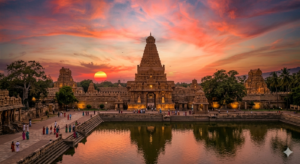
More than 1,200 years after Vijayalaya captured Thanjavur, pilgrims still climb the steps of Brihadeeswarar Temple, still light lamps before the Nataraja, still hear the ancient Sanskrit hymns echoing off walls of granite that have stood through wars, monsoons, and centuries.
The Chola Empire is gone. Its civilization is not.
Conclusion: Why the History of the Chola Empire Still Matters
The history of the Chola Empire is not merely the story of kings and battles. It is the story of what human civilization is capable of at its finest — when artistic genius, military power, economic vision, and administrative wisdom align in a single moment of history.
It is the story of temples that touched the sky. Of ships that crossed the ocean. Of bronze gods that danced for eternity. Of villages that governed themselves. Of a civilization that looked at the world and said: we will leave our mark on it.
And they did.
Quick Reference: The Chola Empire at a Glance
| Detail | Information |
|---|---|
| Empire | Chola Empire |
| Period | 850–1279 CE |
| Region | South India, Sri Lanka, Maldives, Southeast Asia |
| Capitals | Uraiyur, Thanjavur, Gangaikondacholapuram |
| Golden Age | 985–1150 CE |
| Greatest Rulers | Rajaraja Chola I, Rajendra Chola I |
| Known For | Naval power, temple architecture, trade, administration |
Important Blog You Must Read
-
Discover the Rise of the Maratha Empire
The Chola Empire was not the only Indian power to challenge mighty rivals and build a lasting legacy. Centuries later, the Marathas would emerge as one of India’s most influential forces under the leadership of Chhatrapati Shivaji Maharaj. Discover how the Maratha Empire rose from a regional kingdom to become a major power that challenged the Mughal Empire and reshaped Indian history.
-
Explore the History of the East India Company
The Cholas dominated Indian Ocean trade routes during the medieval period, but centuries later another power would arrive by sea and transform India’s destiny. Read our detailed guide on the East India Company to discover how a trading corporation gradually became one of the most powerful political forces in the Indian subcontinent.
-
Discover More About the Great Living Chola Temples
The architectural achievements of the Chola Empire continue to inspire historians, architects, and travelers around the world. To explore the magnificent temples built during the Chola period, including the famous Brihadeeswarar Temple, visit UNESCO’s official page on the Great Living Chola Temples. Discover how these masterpieces of Dravidian architecture became symbols of Chola power and remain active places of worship even today.
External Resource:
UNESCO – Great Living Chola Temples