
Introduction
In 1819, a baby girl was born inside Kensington Palace in London. Nobody at the time knew that she would one day become one of the most powerful monarchs in world history. That child was Queen Victoria.
Her reign lasted more than 63 years and transformed Britain into the center of a massive empire that stretched across continents. During her time on the throne, the British Empire expanded rapidly, industries grew, railways spread across cities, and Britain became one of the strongest nations in the world.
But Queen Victoria’s story is more than politics and empire. It is also a story of loneliness, love, grief, power, and responsibility. Behind the crown was a woman who faced enormous challenges from a young age.
The Victorian Era still influences the modern world today. From technology and education to politics and global trade, many major changes happened during her reign.
This is the remarkable story of the queen born in 1819 who ruled over an empire so large that people said, “The sun never sets on the British Empire.”
1. The Birth of Queen Victoria
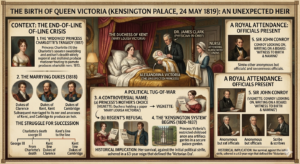
Queen Victoria was born on May 24, 1819, at Kensington Palace in London. Her full name was Alexandrina Victoria.
She was the daughter of Prince Edward, Duke of Kent, who was the fourth son of King George III. At the time of her birth, Victoria was not expected to become queen because several royal family members stood ahead of her in the line of succession.
Her early life seemed ordinary by royal standards. However, destiny slowly changed her future.
When Victoria was only eight months old, her father died. His death created financial and emotional difficulties for the family.
Nobody knew that the little princess would one day rule the largest empire in the world.
2. Queen Victoria’s Lonely Childhood
Victoria’s childhood was strict and heavily controlled.
Her mother and royal advisers created a system called the “Kensington System.” It was designed to keep young Victoria dependent on adults at all times.
She was rarely allowed to play with children her age. She could not walk downstairs alone and was constantly watched by servants and family members.
This lonely upbringing made Victoria emotionally strong but also stubborn and independent.
Despite the restrictions, she received an excellent education. She studied languages, history, music, politics, and art.
As she grew older, Victoria understood that she might someday become queen. She reportedly promised herself:
“I will be good.”
Those simple words reflected her strong sense of duty.
3. Becoming Queen at the Age of 18
Everything changed in 1837.
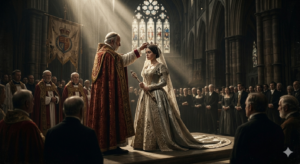
King William IV died on June 20, and because he had no surviving children, Victoria became Queen of Britain at only 18 years old.
Early in the morning, royal officials arrived to inform her about the king’s death. Suddenly, the shy teenager became ruler of one of the world’s most powerful nations.
Many politicians doubted whether such a young queen could handle the responsibility.
However, Victoria quickly surprised everyone with her maturity and confidence.
She worked hard to understand government matters and regularly met political leaders. The public admired her discipline and seriousness.
Britain had found a new queen.
4. The Love Story of Queen Victoria and Prince Albert
One of the most famous parts of Queen Victoria’s life was her relationship with Prince Albert.
Victoria fell deeply in love with him after meeting him again in 1839. She described him as intelligent, handsome, and kind.
Because she was the ruling monarch, Victoria herself had to propose marriage to Albert.
The couple married in 1840.
Unlike many royal marriages during that time, their relationship was based on genuine love and trust. Albert soon became Victoria’s closest adviser and emotional support.
Together they had nine children.
Their marriage also improved the public image of the monarchy. People admired the royal family because they appeared loving and relatable.
5. Prince Albert and the Modernization of Britain
Prince Albert strongly supported science, education, and industrial progress.
One of his greatest achievements was helping organize the Great Exhibition of 1851 in London.
The event showcased inventions, machines, and technology from around the world. It was held inside the famous Crystal Palace, a giant glass building created specially for the exhibition.
Millions of people visited the exhibition.
The event demonstrated Britain’s industrial strength and global influence during the Victorian Era.
Albert’s ideas helped modernize the monarchy and made the royal family appear more connected to the future.
Victoria trusted him deeply in both personal and political matters.
6. The Industrial Revolution During Queen Victoria’s Reign
The Industrial Revolution transformed Britain during Queen Victoria’s rule.
Factories expanded rapidly across cities like Manchester and Birmingham. Steam-powered machines increased production, while railways connected distant parts of the country.
Travel became faster than ever before.
Steamships improved global trade, and telegraph systems changed communication forever.
Britain became one of the richest and most powerful nations in the world.
However, the Industrial Revolution also created serious social problems.
Factory workers often faced dangerous conditions and extremely long working hours. Child labor was common, and poor families lived in overcrowded slums.
The Victorian Era was a time of both progress and hardship.
7. The Massive Expansion of the British Empire
During Queen Victoria’s reign, the British Empire expanded across the globe.
Britain controlled territories in Asia, Africa, Australia, Canada, and the Caribbean. The empire became the largest in world history.
Trade routes connected distant colonies to Britain. Raw materials from colonies supported British industries and helped the economy grow.
Many British citizens believed the empire represented power and progress.
However, colonial rule also caused suffering in many regions. Local populations often faced exploitation, political control, and economic inequality.
The legacy of the British Empire remains controversial even today.
8. India Becomes the “Jewel in the Crown”
India played a major role in Queen Victoria’s empire.
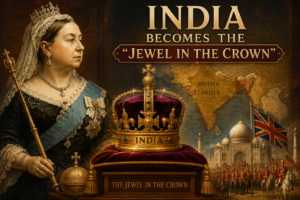
Originally, much of India was controlled by the East India Company. But after the Indian Rebellion of 1857, the British government took direct control of the region.
The rebellion shocked Britain and changed imperial policy forever.
In 1876, Queen Victoria officially became Empress of India.
India was often called the “Jewel in the Crown” because of its economic and strategic importance.
Railways and administrative systems expanded during British rule, but many Indians also suffered under colonial policies and economic exploitation.
The history of British India remains one of the most debated parts of Victoria’s reign.
9. The Death of Prince Albert
In 1861, Queen Victoria faced the greatest tragedy of her life.
Prince Albert died unexpectedly at the age of 42.
His death devastated Victoria emotionally. She entered a deep period of mourning and withdrew from public life for many years.
Victoria wore black clothes almost constantly after Albert’s death.
She kept his rooms exactly as they had been during his lifetime and never fully recovered from losing him.
Many people criticized the queen for staying away from public duties, but her grief was genuine.
This tragic moment revealed the human side of the monarchy.
10. The Victorian Era and Social Change
Queen Victoria’s reign became so influential that historians named the entire period after her.
The Victorian Era became known for discipline, morality, and strong family values.
At the same time, the period saw major intellectual and scientific developments.
Scientists like Charles Darwin introduced revolutionary ideas about evolution. Writers like Charles Dickens described the struggles of poor families during industrialization.
Technology, literature, and education expanded rapidly.
Victorian Britain became one of the most influential societies in the world.
11. Queen Victoria Becomes a Global Symbol
As the years passed, Queen Victoria became more than just a ruler.
She became a symbol of Britain itself.
Her Golden Jubilee in 1887 and Diamond Jubilee in 1897 celebrated her long reign. Massive celebrations took place across the British Empire.
Millions of people around the world had spent their entire lives under Victoria’s rule.
Her image appeared on coins, statues, newspapers, and stamps.
To many people, she represented stability, strength, and national pride.
12. The Final Years of Queen Victoria
In her later years, Queen Victoria’s health slowly weakened.
She spent much of her time at Balmoral Castle in Scotland and Osborne House on the Isle of Wight.
Even in old age, she continued performing royal duties whenever possible.
On January 22, 1901, Queen Victoria died at the age of 81.
Her death shocked Britain and many parts of the world.
After ruling for more than six decades, she had become one of the most recognized figures on Earth.
Her son Edward VII succeeded her as king, and Britain entered a new century.
13. The Legacy of Queen Victoria
Queen Victoria remains one of the most important monarchs in modern history.
Her reign transformed Britain into a global superpower. The British Empire influenced politics, language, education, law, and culture across many countries.
At the same time, the empire also left behind painful memories of colonialism and exploitation.
This complex legacy makes Queen Victoria a fascinating historical figure.
She symbolized both the achievements and contradictions of the Victorian age.
Conclusion
Queen Victoria’s life was extraordinary in every way.
Born in 1819 as a lonely princess, she eventually became ruler of the largest empire in the world. Her reign witnessed industrial revolutions, scientific discoveries, imperial expansion, and major social change.
But behind the royal image was also a deeply human story filled with love, heartbreak, responsibility, and determination.
The Victorian Era officially ended with her death in 1901, yet its influence can still be seen across the modern world today.
That is why Queen Victoria continues to fascinate historians and readers even after more than a century.
She was not simply a queen.
She was the face of an entire era.
Important Internal link
-
Explore the Rise and Fall of the Roman Empire
The British Empire under Queen Victoria became one of the largest empires in history, but it was not the first global power to leave a lasting mark on the world. Explore the fascinating story of the Roman Empire, from its legendary rise to its dramatic fall, and discover how its influence continues to shape modern civilization.
-
Discover How the East India Company Conquered a Nation
Before Queen Victoria was crowned Empress of India, the East India Company had already established British control over large parts of the subcontinent. Discover how a simple trading company transformed into a powerful political force and laid the foundations for the British Raj.
-
Read Why the Dutch Failed in India: The “Businessmen Only” Mistake
While the British built an empire in India, the Dutch followed a very different path. Read why the Dutch focused mainly on trade rather than territorial expansion and discover how this crucial decision allowed the British to emerge as the dominant European power in India.
-
Discover the Fall of the Berlin Wall and the End of an Era
History is filled with events that changed the world forever. Discover the dramatic story of the Berlin Wall’s fall in 1989, a moment that symbolized the collapse of the Cold War divide and marked the beginning of a new chapter in global history.
Discover More About Queen Victoria’s Remarkable Life
Queen Victoria’s reign transformed Britain into a global superpower and left a legacy that shaped the modern world. From her early years on the throne to becoming Empress of India, her story is filled with political change, personal triumphs, and historic milestones. If you would like to explore her life in greater detail, read this comprehensive biography by Britannica.
External Link:
Queen Victoria Biography – Encyclopaedia Britannica