
In July 2026, archaeologists working outside Vienna uncovered something that stopped historians cold: a mass grave holding the remains of more than a hundred young men, buried in haste, some of them dumped headfirst into wells. DNA testing showed they came from across the empire — Italy, the Rhineland, the eastern Mediterranean. The site sat on the edge of ancient Vindobona, the Roman frontier camp where, in the year 180, an emperor lay dying of plague while his soldiers fought a war he never wanted.
That emperor was Marcus Aurelius. For eighteen centuries, he has been remembered as the calmest man who ever wore a crown — the philosopher-king who wrote Meditations, a private notebook of Stoic self-discipline that modern readers still turn to for comfort. But the freshly excavated dead at Vindobona tell a different side of his story: a reign that was, for almost its entire length, a brutal, unrelenting fight for survival. Marcus Aurelius did not rule during Rome’s golden afternoon. He ruled while it was catching fire, and he spent his final years trying, with only partial success, to put the flames out.
This is the fuller story — not just the marble bust and the famous quotations, but the wars, the plague, the family tragedy, and the one decision that undid almost everything he built.
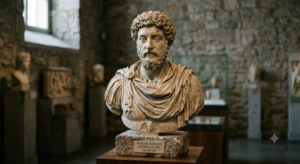
Who Was Marcus Aurelius?
Marcus Aurelius was Roman emperor from 161 to 180 CE, and history remembers him as the last of the “Five Good Emperors” — a run of five consecutive rulers (Nerva, Trajan, Hadrian, Antoninus Pius, and Marcus Aurelius) who governed by adopting their most capable successor rather than relying on blood alone. He is equally famous today as a Stoic philosopher, the author of Meditations, a collection of private reflections he never intended anyone else to read.
He was born Marcus Annius Verus in Rome on April 26, 121 CE, into a wealthy, politically connected family with roots in Roman Spain. He lost his father before he turned three, and it was his grandfather and, later, the emperor Hadrian himself who took an interest in the boy’s upbringing. Hadrian reportedly nicknamed him “Verissimus” — “the truest one” — a small pun on his family name and a nod to a seriousness of character that struck the adults around him as unusual for a child.
That seriousness would define the rest of his life. While other Roman aristocrats chased political glory, hunting, and public spectacle, young Marcus gravitated toward philosophy, law, and a famously austere personal routine — he reportedly slept on bare boards and wore a rough philosopher’s cloak until his mother convinced him a bed might be wise.
The Making of a Philosopher-King
In 138 CE, Hadrian arranged an unusual chain of succession. He adopted Antoninus Pius as his heir on one condition: that Antoninus, in turn, adopt both the 17-year-old Marcus and a boy named Lucius Verus as his own successors. It was a calculated, multi-generational plan to secure the empire’s future, and Marcus — still a teenager — suddenly found himself groomed to eventually rule the largest empire the Western world had ever seen.
For the next 23 years, Marcus served an extraordinarily long political apprenticeship under Antoninus Pius, holding public offices, learning imperial administration, and quietly absorbing the discipline of Stoicism from a rotating cast of tutors. Among the influences that shaped him most was the philosophy of Epictetus, a former slave whose Stoic teachings — recorded by a student as the Discourses — taught that human beings cannot control external events, only their own judgments and reactions to them. That single idea would become the backbone of everything Marcus Aurelius later wrote in Meditations.
By the time Antoninus Pius died in 161 CE, Marcus was 40 years old, extensively trained, and — by every account — deeply reluctant to actually take the throne.
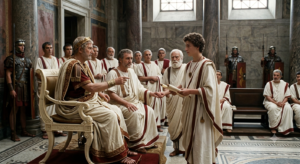
The Path to Power: Rome’s First Co-Emperors
When the Senate offered Marcus sole rule, he made an unusual request: that his adoptive brother, Lucius Verus, be elevated as full co-emperor beside him. It was the first time in Roman history that the empire had two emperors ruling simultaneously with equal legal authority. Marcus handled administration, law, and the Senate; Lucius, ten years younger and by temperament far less austere, took command of Rome’s response to a growing crisis on the eastern frontier.
The arrangement worked better than anyone expected — for a while. The two emperors raised military pay, expanded support for the poor, and were, by contemporary accounts, genuinely popular in the early years of joint rule. Then the empire’s problems arrived all at once, and never really stopped.
Marcus Aurelius and the Marcomannic Wars
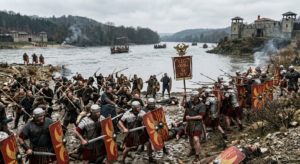
Nothing shatters the “peaceful philosopher” image of Marcus Aurelius faster than a look at how he actually spent his eighteen years in power. Almost the entire second half of his reign was consumed by the Marcomannic Wars (166–180 CE), a grinding, multi-front conflict against Germanic and Sarmatian tribes — the Marcomanni, the Quadi, the Iazyges — who pushed across the Danube frontier in numbers Rome hadn’t faced in generations.
For the first time in nearly 300 years, a foreign enemy threatened to break through into the Italian peninsula itself. Marcus, who had spent his life studying philosophy rather than warfare, was forced to become a battlefield commander in his fifties. He spent years at a stretch away from Rome, commanding operations from frontier camps along the Danube — including long stretches based at Carnuntum and Vindobona, sites in modern Austria and Slovakia.
The July 2026 discovery near Vindobona adds a grim, tangible layer to this chapter. The mass grave — over a hundred men, many showing sword and blunt-force trauma, some with wounds concentrated around the groin consistent with a chaotic, close-quarters battle — sat in an area with no previously known record of fighting. Researchers believe the dead were soldiers from Marcus Aurelius’s campaigns, hastily buried after a battle so violent, and so poorly documented, that it had been completely lost to written history until archaeology exhumed it. It’s a rare, physical reminder that the “golden age” associated with Marcus Aurelius was, on the ground, a story of exhausted legions and unmarked graves.
Rome eventually gained the upper hand. Roman forces pushed deep into Marcomannic and Quadi territory, and in the winter of 179–180 CE, part of the army even camped near modern Trenčín, Slovakia — carving a commemorative inscription into rock that still exists today, more than 1,800 kilometers from the traditional Roman frontier. Marcus may have been preparing to formally annex the conquered territory as new Roman provinces. He never got the chance.
The Antonine Plague: An Empire Under Siege From Within
War wasn’t Marcus Aurelius’s only enemy. Around 165 CE, soldiers returning from campaigns in the East brought back a devastating pandemic, now known as the Antonine Plague, likely smallpox or measles. It tore through the Roman world for over a decade, killing an estimated several million people — including, in 169 CE, Marcus’s own co-emperor and adoptive brother, Lucius Verus.
The plague gutted the Roman army at the exact moment it needed soldiers most, forced the state to recruit slaves and gladiators into the legions out of sheer desperation, and crippled the imperial economy. Marcus Aurelius spent the back half of his reign simultaneously fighting a war he couldn’t fully staff and governing an empire that was, quite literally, dying around him. Modern historians increasingly believe that Marcus Aurelius himself died of this same plague, in March 180 CE, in the very frontier camp — Vindobona — where he had spent so much of the previous decade.
Meditations: Inside the Mind of Marcus Aurelius
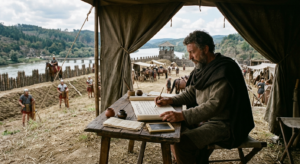
It was in the middle of this — war, plague, administrative crisis — that Marcus Aurelius wrote the book that made him immortal. Meditations was composed in Greek, in fragments, during his years on campaign along the Danube. He almost certainly never meant it for publication; the original title translates roughly to “To Himself.” It reads less like a philosophical treatise and more like a exhausted, disciplined man talking himself through his own worst days.
The core of his Stoicism, absorbed largely from Epictetus, is deceptively simple: you cannot control what happens to you — wars, plagues, betrayal, death — but you have complete control over your own judgments, reactions, and character. Marcus returns to this idea constantly, reminding himself not to be shaken by injustice, not to resent the people who wrong him, and to treat each day as though it might be his last without becoming either reckless or self-pitying about it. One of his most famous formulations, paraphrased across centuries of translation, is the idea that our life is what our thoughts make it — a line that has echoed through everything from Renaissance humanism to modern cognitive therapy.
What makes Meditations remarkable isn’t polished philosophy — it’s the visible effort of a man trying, and often struggling, to live up to his own principles while running an empire that kept handing him reasons to abandon them. Generations of readers, from the Renaissance scholar to Bill Clinton, have found something startlingly modern in that struggle.
Marcus Aurelius and the Christians: A Complicated Legacy
Not every part of Marcus Aurelius’s record fits the “wise and gentle” reputation. Christian communities suffered notable persecutions during his reign, including well-documented executions at Lyon in 177 CE. For centuries, this was read as evidence that the philosopher-emperor was, in practice, a persecutor.
Modern scholarship has complicated that picture considerably. There is no surviving evidence that Marcus personally issued new laws targeting Christians; existing Roman statutes against “illegal associations” and refusal to honor state gods were already on the books, and local governors — not the emperor directly — usually initiated these prosecutions. Marcus’s own writings show a Stoic who valued reasoned inquiry over blind mob justice, but who also, like nearly every Roman elite of his era, viewed Christian communities with suspicion as a destabilizing, secretive sect. It’s a reminder that “philosopher-king” was an ideal Marcus Aurelius aspired to, not a flawless description of how he actually governed.
The Fatal Flaw: Commodus and the End of a Golden Age
Marcus Aurelius and his wife, Faustina the Younger, had at least thirteen children together, though only a handful survived to adulthood — a devastating personal toll that his own writings only obliquely acknowledge. One of the survivors was his son, Commodus.
Every emperor before Marcus in the “Five Good Emperors” sequence had broken with heredity and adopted the most capable successor available, regardless of blood. Marcus Aurelius, despite a lifetime of Stoic training in duty over sentiment, broke that pattern. He elevated Commodus to co-emperor in 177 CE and left him the throne outright upon his death in 180.
It is, by near-universal historical consensus, the single worst decision of his reign. Commodus abandoned his father’s unfinished frontier campaigns within months, retreated to Rome, and descended into a self-indulgent, erratic rule that historians — ancient and modern alike — treat as the moment the Pax Romana effectively ended. Edward Gibbon, writing centuries later, would mark the death of Marcus Aurelius as the hinge point where Rome tipped from its greatest age into slow decline. The philosopher who spent his life writing about self-discipline could not, in the end, discipline his own succession plan.
The Statue That Time Forgot
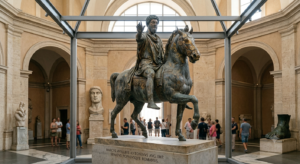
Almost everything from Marcus Aurelius’s era should have vanished. Of the roughly 22 grand equestrian statues that once stood in ancient Rome honoring various emperors, exactly one survives today: his. Every other bronze rider was melted down for raw metal during the chaos of the Middle Ages.
The reason his statue escaped the furnace is almost accidental. By the 10th century, Rome had largely forgotten who the bronze figure on horseback actually depicted, and it became known popularly as the “Horse of Constantine” — mistaken for Constantine the Great, the first Christian emperor. Because Constantine was a revered figure to the medieval Christian church, his “statue” was protected rather than destroyed. Marcus Aurelius, ironically an emperor whose government had persecuted Christians, survived the centuries only because people thought he was someone else entirely.
The statue eventually made its way to the Capitoline Hill, where Michelangelo himself designed its base in the 16th century. It became the template that an enormous share of later European equestrian monuments — kings, generals, generations of statues in city squares around the world — would consciously imitate. A case of mistaken identity in the Dark Ages ended up shaping the visual language of power for the next 500 years.
Marcus Aurelius’s Legacy: Why He Still Matters
| Roman Emperor | Reign | Best Known For |
|---|---|---|
| Nerva | 96–98 CE | Restoring stability after Domitian’s assassination |
| Trajan | 98–117 CE | Rome’s greatest territorial expansion |
| Hadrian | 117–138 CE | Hadrian’s Wall; consolidating the empire’s borders |
| Antoninus Pius | 138–161 CE | Peaceful, largely uneventful “golden” reign |
| Marcus Aurelius | 161–180 CE | Meditations; the Marcomannic Wars; the Antonine Plague |
Marcus Aurelius’s reputation has outlived his empire by nearly two millennia, and it keeps resurfacing in unexpected places — from Ryan Holiday’s modern Stoicism movement to Richard Harris’s portrayal of him in Gladiator (a film that compresses and dramatizes his final campaign, including a fictional death at another emperor’s hand rather than by plague). What keeps drawing people back isn’t that he was a perfect ruler; the historical record shows he wasn’t. It’s that he was demonstrably ordinary in his suffering — grieving children, exhausted by war, worried about money, frightened of disease — and left behind, almost by accident, an unflinchingly honest record of trying to meet all of it with discipline instead of despair.
That combination of imperial power and private vulnerability is rare in the historical record. Most emperors left monuments built to impress us. Marcus Aurelius left a notebook that was never meant to be read by anyone, and that accident of history is precisely why it still is.
Frequently Asked Questions About Marcus Aurelius
Who was Marcus Aurelius? Marcus Aurelius was Roman emperor from 161 to 180 CE, the last of the “Five Good Emperors,” and a Stoic philosopher best known for writing Meditations, a private collection of reflections composed during his military campaigns.
What is Marcus Aurelius most famous for? He is best known for two things: his book Meditations, one of history’s most widely read texts on Stoic philosophy, and his 18-year reign, which was dominated by the Marcomannic Wars and the Antonine Plague.
How did Marcus Aurelius die? Marcus Aurelius died on March 17, 180 CE, in the Roman military camp of Vindobona (modern Vienna), most likely from the same plague that had been devastating the empire for over a decade. He was 58 years old.
Did Marcus Aurelius persecute Christians? Christian communities were persecuted during his reign, including notable executions at Lyon in 177 CE, but there is no direct evidence he personally created new anti-Christian laws. Prosecutions were generally carried out by local governors under existing Roman statutes.
Why did Marcus Aurelius choose his son Commodus as successor? Breaking with the adoptive succession used by his four predecessors, Marcus elevated his biological son Commodus to co-emperor in 177 CE. Historians widely regard this decision as a critical error, since Commodus’s erratic rule is traditionally seen as marking the beginning of Rome’s long decline.
Why is Marcus Aurelius’s statue the only one of its kind to survive? Of roughly 22 grand equestrian statues in ancient Rome, only his bronze statue survived the Middle Ages — because it was mistakenly believed to depict Constantine the Great, Christianity’s first imperial patron, and was therefore spared from being melted down.
Is the movie Gladiator historically accurate about Marcus Aurelius? Only loosely. Gladiator correctly places Marcus Aurelius at the Roman frontier camp of Vindobona during his final campaign, but it invents his murder by Commodus; historically, Marcus almost certainly died of plague, and Commodus was never suspected of killing him.
Further Reading: Marcus Aurelius and Stoic Philosophy
To explore Marcus Aurelius’s philosophy in greater depth, especially his Stoic beliefs and Meditations, you can refer to the Stanford Encyclopedia of Philosophy, a respected academic source:
Stanford Encyclopedia of Philosophy — Marcus Aurelius
Important Article as per History Decoded Hub.com