
Confucius: The Failed Politician Who Quietly Rewired Chinese Civilization
A seventy-two-year-old man sits in a small house in the state of Lu, dying, convinced he has failed. He never won the position he wanted. He never persuaded a single ruler to fully adopt his vision of government. His most ambitious political dream — a China governed by moral example rather than fear — collapsed every time he brought it to a royal court. By the measure he judged himself, his life reads like a long string of rejections.
Two thousand five hundred years later, his face is carved into temples from Seoul to Hanoi. His sayings are quoted in parliament debates, business school lectures, and civil service exams that still, in some form, echo the very examination system his ideas eventually built. The man who thought he’d failed became one of the small handful of individuals whose personal convictions reshaped how entire civilizations define a good life.
That gap — between how Confucius saw his own life and how history has judged it — is the real story here. Most accounts of Confucius flatten him into a wall poster of calm wisdom. The actual man was sharper, more frustrated, more politically ambitious, and considerably more interesting than that.
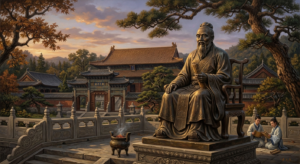
Historical Background: The World That Made Confucius Necessary
To understand why Confucius mattered, you have to understand the china he was born into, because his entire philosophy is a direct response to it.
By 551 BCE, the year of his birth, the Zhou dynasty’s authority had been crumbling for generations. What had once been a unified kingdom under a single royal house had splintered into dozens of competing states, each ruled by its own lord, each pursuing its own territorial ambitions. Historians call this era the Spring and Autumn Period, named after the chronicle that records it, and it was defined by exactly the kind of instability that makes ordinary people desperate for answers: shifting alliances, assassinations, broken treaties, and near-constant low-grade warfare between neighboring states.
This wasn’t background noise to Confucius’s philosophy — it was the problem his philosophy was built to solve. He grew up watching what happens when political authority loses its moral center, and that observation became the engine of everything he later taught. He wasn’t a philosopher working in the abstract, sketching ideal societies on paper. He was a man trying to figure out, in real time, what had gone wrong with his own world and what might fix it.
The state of Lu itself, where he was born, carried extra weight in this story. Lu had a reputation as a keeper of older Zhou ritual traditions — a place where the ceremonial forms of a more ordered past had survived even as that order collapsed elsewhere. Growing up surrounded by those preserved rituals almost certainly shaped Confucius’s later conviction that li, or proper ceremonial conduct, wasn’t empty formality. It was memory made physical — a way a society could keep hold of the values it was otherwise losing.
His own family’s story mirrored the era’s instability in miniature. The Kong family had once held minor noble standing, but that status had eroded well before Confucius was born, and his father died while he was still a young child. He grew up in real material hardship, without the tutors or connections that would normally accompany his family’s earlier rank. What he knew, he taught himself — a fact that would later drive one of his most consequential decisions as a teacher.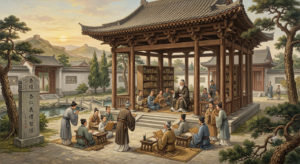
Why Confucius Changed History
Most influential figures change history through conquest, invention, or revolution. Confucius changed it through something far slower and, in some ways, far more durable: he changed who was allowed to be educated, and what rulers were expected to be judged by.
Before Confucius, formal education in history, ritual, music, and statecraft functioned largely as aristocratic property, passed down within noble households. Confucius opened his teaching to students based on sincerity and effort rather than birth. That single decision — treat capability as more meaningful than bloodline — was a genuinely disruptive idea in a hereditary, status-bound society, and it planted the seed for something that would eventually reshape Chinese government at a structural level.
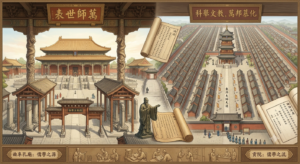
That seed took thirteen centuries to fully bloom, but it did. During the Han dynasty, Confucian texts became the foundation of the imperial civil service examination system — the grueling, merit-based testing process that determined who could rise into government office in China for roughly a thousand years, well into the early twentieth century. Suddenly, a farmer’s son who mastered the classics had a plausible, if difficult, path into the highest levels of imperial administration. That’s an extraordinary outcome for an idea first floated by an unemployed teacher in a minor eastern state.
The second reason Confucius changed history is subtler but arguably more consequential: he shifted the standard by which good governance was judged. Where rival schools of the era, particularly the Legalists, argued that order came from strict law and harsh punishment, Confucius argued that a ruler’s own moral character was the true source of social stability. A ruler who governed through visible integrity, he argued, would earn voluntary loyalty; a ruler who governed only through fear would eventually face rebellion. That idea — that legitimacy flows from moral example, not raw coercion — became embedded in Chinese political theory for the rest of imperial history, and versions of it still surface in modern discussions of leadership and public trust.
Lesser-Known Facts Most Articles Skip
He was unusually tall for his era. Some early Chinese sources describe Confucius as standing nearly two meters — remarkable for the period, and likely part of why later artistic depictions gave him a commanding physical presence rather than the frail, elderly image most people picture.
He worked ordinary jobs before becoming a teacher. Early in life, before his teaching reputation grew, Confucius reportedly held modest administrative roles, including overseeing grain storage and livestock accounts for the state of Lu. He wasn’t born into scholarly leisure — he built his authority from unglamorous clerical work upward.
He may never have called himself a “Confucian.” The label “Confucianism” is largely a Western construction, built around the Latinized name “Confucius” (a Jesuit missionary rendering of Kong Fuzi, “Master Kong”). Confucius himself would have understood his teaching as a continuation and restoration of earlier Zhou dynasty wisdom, not as the founding of a brand-new system bearing his own name.
His descendants are still traceable today. The Kong family lineage is considered one of the longest continuously documented family genealogies in the world, with descendants recorded across dozens of generations into the present day.
He was reportedly a serious music student. Several early accounts describe him studying music intensely enough to temporarily lose his appetite for food while absorbed in learning a particular piece — a detail that complicates the image of Confucius as a purely austere moralist.
Common Myths vs. Reality
Myth: Confucius founded a religion. Reality: Confucianism is best understood as an ethical and philosophical framework centered on moral self-cultivation and social relationships, not a theology built around worship of a deity. Later Chinese tradition did develop temple rites honoring Confucius, but this was closer to ancestral veneration and civic reverence than religious worship in the Abrahamic sense.
Myth: Confucius demanded blind obedience to authority. Reality: This is one of the more persistent misreadings of his thought. Confucius did emphasize respect for hierarchy and elders, but his teachings also repeatedly stress that a ruler who behaves unjustly forfeits the right to be followed, and that a good subordinate has a responsibility to speak honestly to a superior rather than simply comply. Obedience, in his framework, was conditional on the legitimacy of the person being obeyed.
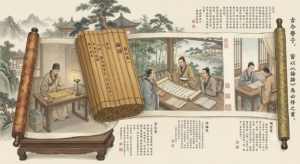
Myth: Confucius wrote the Analects himself. Reality: He didn’t. The Analects is a compilation of his sayings and conversations, assembled by his students and their successors after his death. Confucius left no single authored philosophical treatise in his own hand.
Myth: Confucius was purely a quiet, contemplative sage. Reality: Historical accounts describe a man capable of sharp criticism, occasional public frustration with rulers he considered unjust, and real political ambition. He actively sought government office for years and was, by several accounts, disappointed rather than serene about his repeated political failures.
Historical Debate Among Scholars
Not everything about Confucius is settled fact, and honest historical writing should say so.
One long-running debate concerns how much of the traditional biography of Confucius — assembled centuries later, most notably in the historian Sima Qian’s Han-dynasty account — reflects verified fact versus later embellishment designed to elevate his stature once Confucianism became state orthodoxy. Some modern scholars argue that later Confucian tradition retroactively inflated his political importance during his lifetime, when in reality he may have been a relatively minor and somewhat marginal figure in Lu’s court politics.
Another debate concerns the Analects itself. Textual scholars generally agree the book wasn’t compiled all at once, but assembled in layers over a period of decades or longer, meaning some passages may reflect later additions or interpretations rather than Confucius’s own words verbatim. This matters because it means readers are often encountering a filtered, edited Confucius — shaped by generations of disciples — rather than a direct transcript.
A third area of scholarly disagreement involves how “authoritarian” or “progressive” Confucian thought really is. Twentieth-century reformers in China at times blamed Confucianism for reinforcing rigid hierarchy and resistance to change, while other scholars argue this reading conflates Confucius’s original teachings with later, more rigid state interpretations imposed for political convenience during the imperial era. The philosophy and its later political use, in other words, aren’t necessarily the same thing.
Comparison With Similar Historical Figures
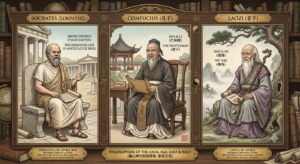
Confucius is frequently placed alongside Socrates, who was born roughly eighty years later in Athens. Both men taught primarily through spoken dialogue rather than written treatises, both left their most famous ideas to be recorded by students, and both were centrally concerned with how to live a virtuous life. But their methods diverged sharply: Socrates built his philosophy around relentless questioning designed to expose contradictions in a listener’s assumptions, while Confucius taught primarily through instruction, example, and the cultivation of proper conduct rather than adversarial debate.
A closer comparison within Chinese thought itself is with Laozi, the semi-legendary founder of Daoism, who is traditionally described as an older contemporary of Confucius. Where Confucius argued that social order comes from cultivated virtue, ritual, and active civic participation, Daoist thought leaned toward simplicity, withdrawal from rigid social structure, and alignment with a natural, effortless order rather than deliberate moral striving. Chinese intellectual history spent the next two millennia in productive tension between these two impulses — one urging engagement and structure, the other urging restraint and naturalness.
Timeline
- c. 551 BCE — Born in Qufu, State of Lu, into a family of declining noble status.
- c. 549 BCE — His father dies, leaving the family in financial hardship.
- c. 530 BCE — Begins building his reputation as a teacher, accepting students regardless of social background.
- c. 501 BCE — Enters government service in Lu, eventually reaching a senior administrative role.
- 497 BCE — Leaves Lu amid political disputes and begins roughly fourteen years traveling among neighboring states, seeking a ruler willing to adopt his vision of governance.
- 484 BCE — Returns to Lu in his later years, shifting focus to teaching and refining his philosophy.
- 479 BCE — Dies in Qufu at approximately seventy-two years old.
- Han Dynasty, 206 BCE–220 CE — Confucianism is adopted as the official philosophy of the Chinese imperial state, and Confucian texts become the foundation of the civil service examination system.
Impact on the Modern World
Confucian influence didn’t stay locked inside imperial China. As Chinese administrative and cultural systems spread across East Asia, so did Confucian values, taking root and adapting locally in Korea, Japan, Vietnam, and later in overseas Chinese communities across Taiwan and Singapore.
That influence shows up today in ways people don’t always recognize as Confucian. The strong cultural emphasis on educational achievement across much of East Asia has roots directly traceable to Confucius’s conviction that self-cultivation through study was the primary path to both personal and civic worth. Corporate governance structures in parts of East Asia still reflect Confucian assumptions about hierarchy paired with reciprocal obligation — the idea that authority carries responsibility toward subordinates, not just power over them. Even contemporary debates about work-life balance, elder care policy, and family obligation across the region regularly trace back, explicitly or implicitly, to the value Confucius placed on xiao, filial duty.
Outside East Asia, Confucian ethics have increasingly entered global conversations about leadership theory and organizational psychology, particularly the argument that leaders who model integrity generate more durable trust and cooperation than leaders who rely purely on authority or incentive structures. Business schools that would never use the word “Confucian” are, in practice, teaching a version of the same argument he was making twenty-five centuries ago.
Leadership Lessons From Confucius
Confucius’s political theory wasn’t abstract idealism — it was, at its core, a practical argument about what makes people willing to follow someone.
He argued that authority earned through demonstrated integrity outlasts authority enforced through fear, because fear-based compliance evaporates the moment the threat disappears, while respect earned through consistent moral conduct tends to persist even under pressure. He argued that a leader’s private character and public conduct couldn’t be separated — that someone incapable of honoring basic obligations at home had little credibility governing obligations at a larger scale. And he argued, repeatedly, that a good leader needed the humility to recognize the limits of his own knowledge, since a leader who couldn’t admit ignorance would eventually make catastrophic decisions rather than ask for the right counsel.
None of this required a classical Chinese education to apply. It’s the same argument, in different language, that modern leadership research keeps rediscovering: that trust, not control, is the more durable foundation for authority.
What Students Usually Get Wrong
Students studying Confucius for exams frequently make three specific errors worth flagging directly.
First, they confuse Confucianism with a rigid, unchanging system, when in reality Confucian thought was reinterpreted, debated, and revised by different schools across different dynasties for over two thousand years. Treating it as a single fixed doctrine misses centuries of internal disagreement and evolution.
Second, they assume Confucius achieved his influence during his own lifetime, when in fact his teachings gained their enormous institutional power largely after his death, through the Han dynasty’s adoption of Confucianism as state philosophy — several centuries after he died believing he’d been politically unsuccessful.
Third, students often treat the Five Virtues — ren, yi, li, zhi, and xin — as a simple checklist to memorize rather than an integrated system, missing that Confucius treated them as mutually reinforcing qualities of a single cultivated character, not independent boxes to tick.
Myths About Confucius That Refuse to Die
Myth: Confucius founded a religion. He didn’t, not in the way most people mean it. Confucianism is an ethical and philosophical framework built around moral self-cultivation and how people should treat each other — not a theology centered on worshipping a god. Later Chinese tradition did build temples and formal rites in his honor, but that was closer to ancestral veneration and civic respect than religious worship in the Western sense.
Myth: Confucius demanded blind obedience. This might be the most persistent misreading of the man. Yes, he emphasized respect for hierarchy and elders. But his teachings also insist, repeatedly, that a ruler who behaves unjustly forfeits the right to be followed, and that a subordinate has a duty to speak honestly to a superior rather than just nod along. Obedience, in his framework, was earned, not automatic.
Myth: Confucius wrote the Analects. He didn’t write a single line of it. The Analects is a collection of his sayings and conversations, stitched together by his students and their successors after he died. Confucius left behind no personal philosophical manuscript in his own hand.
Myth: Confucius was a quiet, contemplative sage who floated above conflict. The historical record says otherwise. He was capable of sharp criticism, visible frustration with rulers he thought were failing their people, and real, unapologetic political ambition. He chased government office for years, and by several accounts, he was disappointed — not serene — about how often he lost.
Frequently Asked Questions
What did Confucius actually believe about government? He believed a ruler’s legitimacy came primarily from moral example rather than legal coercion, and that a state governed by leaders with genuine integrity would produce voluntary social order more effectively than one governed through strict law and punishment alone.
Was Confucius a religious figure? Not in the conventional sense. Confucianism centers on ethics, ritual, and self-cultivation rather than worship of a deity, though later Chinese tradition did develop formal rites honoring him at dedicated temples.
Why did Confucius fail to gain political power during his lifetime? Court politics, rival factions, and rulers unwilling to fully adopt his reform proposals repeatedly blocked his path to sustained influence, both during his time in Lu’s government and during his fourteen years advising other states. His major institutional influence came only after his death, once Confucianism was adopted as Han-dynasty state philosophy.
How reliable are the traditional biographical accounts of Confucius? Some scholars treat parts of the traditional biography, particularly the account compiled centuries later by the historian Sima Qian, with caution, since later Confucian tradition had strong institutional incentives to elevate his historical stature once his teachings became state orthodoxy.
What’s the difference between Confucianism and Daoism? Confucianism emphasizes structured social roles, ritual conduct, and active civic engagement as the path to a well-ordered life, while Daoism emphasizes simplicity, restraint, and alignment with a natural, less deliberately structured order. The two traditions developed in productive tension throughout Chinese intellectual history rather than as strict enemies.
Did Confucius support education for everyone, including the poor? Yes, and this is considered one of his more genuinely disruptive contributions. He accepted students based on sincerity and effort rather than aristocratic birth, at a time when formal education was largely restricted to noble households.
Why is the civil service examination system connected to Confucius? Once Confucianism became Han-dynasty state philosophy, Confucian classics became the core curriculum tested in China’s imperial civil service examinations, a system that determined access to government office for roughly a thousand years and gave his ideas about merit and moral cultivation direct institutional power.
Why This Still Matters Today
Confucius spent his life arguing that character isn’t fixed, that it can be built through deliberate practice, and that the people we choose to follow should be judged by the integrity of their conduct rather than the volume of their authority. None of that argument requires ancient Chinese context to feel current. It’s the same conversation happening right now in debates over what makes a leader trustworthy, whether institutions can teach ethics at all, and what a society owes its most vulnerable members.
He died believing his life’s central project had failed. The verdict of the next two and a half thousand years suggests otherwise — not because he won the political power he wanted, but because he correctly identified something about human beings that outlasted every dynasty, empire, and political system that came after him: that people follow character more durably than they follow force.
Important Article as per History Decoded Hub.
-
Socrates: The Father of Western Philosophy
While Confucius shaped Eastern philosophy through moral values and ethical leadership, Socrates transformed Western philosophy by encouraging people to question beliefs and seek truth through reason. Discover how his revolutionary ideas changed the course of history in our detailed guide on Who Was Socrates?
-
Laozi: The Founder of Daoism
While Confucius emphasized moral discipline and social order, Laozi taught that true harmony comes from living in balance with nature and following the Dao (The Way). Explore the life, philosophy, and lasting influence of Laozi in our complete guide on Who Was Laozi?
-
Aristotle: The Philosopher Who Shaped Western Thought
A student of Plato and the teacher of Alexander the Great, Aristotle made groundbreaking contributions to philosophy, science, politics, and ethics. Discover how his ideas laid the foundation for Western civilization in our detailed guide on Who Was Aristotle?
-
Epictetus: The Stoic Philosopher of Inner Strength
Born into slavery, Epictetus became one of history’s most influential Stoic philosophers by teaching that true freedom comes from controlling our thoughts rather than external events. Discover his life, philosophy, and timeless lessons in our detailed guide on Who Was Epictetus?
-
Gaius Musonius Rufus: The Roman Stoic Who Inspired Epictetus
Known as the Roman Socrates, Gaius Musonius Rufus believed that philosophy should guide everyday life through virtue, self-discipline, and moral character. Discover how his teachings shaped Stoicism and inspired future philosophers in our detailed guide on Who Was Gaius Musonius Rufus?