
Immanuel Kant: The Man Who Never Left Home But Changed How the World Thinks
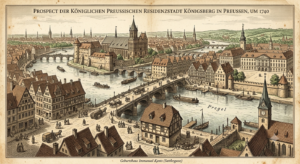
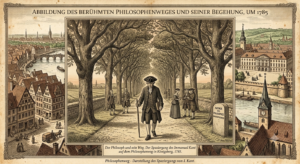
There is a particular kind of quiet that falls over a small Prussian town in the 1780s — smoke curling from chimneys, cart wheels grinding over frozen cobblestone, church bells marking the hours. And in Königsberg, there was one more sound the townspeople set their lives by: footsteps. Every afternoon, at almost the exact same minute, a small, slight man in a grey coat stepped out of his house and walked the same tree-lined avenue, at the same pace, for the same distance. Neighbors reportedly adjusted their clocks by him. They called the path he wore into the ground “the Philosopher’s Walk.”
He never married. He never fathered children. He rarely traveled more than a few miles from the town where he was born, lived, taught, and eventually died. And yet this same man — punctual to the point of legend, physically frail, almost comically predictable — quietly detonated a bomb under nearly everything Western philosophy thought it knew about knowledge, morality, and the human mind.
His name was Immanuel Kant. And to understand why philosophers still argue about him more than two centuries after his death, you have to understand what he was up against, what he broke, and what he built in its place.
Introduction: Who Was Immanuel Kant, Really?
Strip away the textbook portrait — stern face, powdered wig, unreadable prose — and what’s left is a genuinely strange life story. Kant was a man who spent almost his entire existence within walking distance of where he was born, who published his most important ideas only in his late fifties, and who somehow became one of the two or three most important philosophers who ever lived without ever seeing the sea, the mountains, or a foreign capital.
That contrast matters, because it tells you something about where his ideas actually came from. They weren’t the product of a well-traveled cosmopolitan mind gathering experience across continents. They were the product of one extraordinarily disciplined mind, sitting in one place, thinking the same hard questions over and over until something genuinely new broke loose — ideas about knowledge, morality, and even international peace that are still being argued over today.
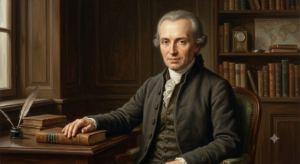
Quick Facts
| Born | April 22, 1724, Königsberg, Prussia |
| Died | February 12, 1804, Königsberg, Prussia |
| Occupation | Philosopher, university professor |
| School of Thought | German Idealism / Enlightenment philosophy |
| Famous For | Transcendental idealism, the Categorical Imperative |
| Major Work | Critique of Pure Reason (1781) |
A Childhood Built on Discipline and Doubt
Kant was born in 1724 in Königsberg, then part of the Kingdom of Prussia, into a family of modest means — his father a harness-maker, his mother a woman of deep religious devotion. The household followed Pietism, a strict Lutheran movement that prized moral seriousness, self-examination, and hard discipline over ceremony or spectacle. It was not a home of luxury. It was a home of rules.
That upbringing left fingerprints on everything Kant later became. The obsession with order that would define his adult routine — waking at the same hour, writing at the same desk, walking at the same time — had roots in a childhood where discipline was inseparable from virtue. But so did something else, something easy to miss: a deep respect for individual conscience, for the idea that morality is something a person works out through their own reason, not something simply handed down by authority. You can draw a fairly straight line from a Pietist childhood in a harness-maker’s house to a grown man’s insistence, decades later, that every human being carries an inner moral law worth taking seriously — and worth working out for themselves.
He studied at the Collegium Fridericianum, a school built around religious rigor, before moving on to the University of Königsberg — the same city, always the same city — where he encountered Newtonian physics, Leibnizian philosophy, and the first real cracks in his religious certainty. He was, by most accounts, a curious and somewhat sickly young man, more drawn to books than to society, more interested in the mechanics of the solar system than in small talk.
Money was tight. For years after finishing his studies, Kant worked as a private tutor for wealthy families — a common fallback for bright but poor young intellectuals of the era. It would take him until his mid-forties to finally land a full professorship at his own university, a slow, unglamorous climb for a man who would eventually be ranked alongside Plato and Aristotle.
A Life Measured in Minutes: Kant’s Daily Routine
By the time Kant reached his professorship, he had built a daily schedule so precise it became local folklore. He woke at five each morning, roused by a servant under strict standing orders not to let him sleep in under any circumstances. He drank weak tea, smoked a single pipe, and prepared his lectures. He taught. He wrote. And every afternoon, without fail, he took his walk — always the same route, always the same pace, rain or shine.
The story, likely exaggerated but too good not to mention, is that Königsberg residents used his afternoon walk to check the time. Only once, it’s said, did he break the routine — so absorbed in reading Rousseau’s Emile that he lost track of the hour entirely.
It would be easy to read this as mere eccentricity. But there’s a more generous reading, and probably a truer one: Kant was physically frail for much of his life, narrow-chested and prone to illness, and his rigid discipline may have been less about rigidity for its own sake and more about a fragile man carefully rationing just enough energy to do the work that mattered to him. Seen that way, the routine wasn’t the opposite of passion. It was the container that made the passion possible.
The Argument Kant Walked Into
To understand why Kant mattered, you first have to understand the argument he was born into — one that had been quietly tearing philosophy apart for a century before he arrived.
On one side sat the rationalists, thinkers like Descartes and Leibniz, who believed the mind could arrive at deep truths about reality purely through reason — through pure thought, sitting in a chair, without ever looking out the window. On the other side sat the empiricists, Locke and Hume chief among them, who insisted the opposite: that all knowledge comes from experience, from what we see, touch, and observe, and that reason alone, cut loose from the senses, drifts into fantasy.
Then came David Hume, and he made things worse — deliciously, productively worse. Hume argued that even our most basic assumptions about cause and effect were things we could never actually prove. We never truly see one event causing another; we only ever see one thing followed by another, over and over, until habit convinces us they’re connected. Certainty about the physical world, Hume suggested, might be an illusion built on repetition, not proof.
Kant later said, with a kind of grudging admiration, that reading Hume woke him from his “dogmatic slumber.” It’s a striking image — a man in his forties, already deep into a comfortable academic life, suddenly realizing the ground beneath his entire discipline might not be solid at all.
He could have simply picked a side. Instead, he did something far more interesting: he asked whether the entire framing of the argument was wrong.
The Copernican Revolution Nobody Saw Coming
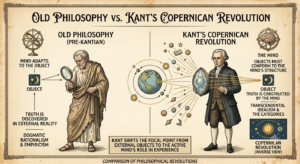
Here is Kant’s idea, stripped down to its bones: philosophers had always assumed that the mind is passive — that it simply receives the world as it is, like a camera capturing a photograph. Kant flipped that assumption on its head. He argued that the mind is not a passive recorder of reality; it’s an active participant in constructing the reality we experience.
Space, time, cause and effect — Kant argued these aren’t things we discover “out there” in the world. They’re the built-in scaffolding the human mind uses to organize any experience at all, the way a pair of tinted glasses would shape everything you see through them, whether or not you were aware you were wearing them.
He called this his “Copernican Revolution” in philosophy — a deliberate echo of the moment Copernicus proposed that the Earth moves around the Sun, rather than the other way around. Just as Copernicus flipped astronomy’s assumption about what orbits what, Kant flipped philosophy’s assumption about what shapes what: it isn’t the mind that conforms to the world, he argued — it’s the world of experience that conforms to the structure of the mind.
This became the foundation of his masterwork, Critique of Pure Reason (1781), a book so dense and so demanding that even Kant’s admirers initially struggled through it — and one that quietly rewired the terms of philosophical debate for the next two hundred years.
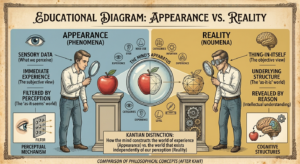
Phenomena and Noumena: The World We See vs. the World That Is
Kant’s revolution led him to one of his most famous — and most misunderstood — distinctions: the difference between phenomena and noumena.
Phenomena are things as we experience them — the world filtered through our senses and mental categories. Noumena are things as they are in themselves, entirely independent of how any mind perceives them. Kant argued we can never actually reach this second layer of reality directly. We are, in a sense, permanently on the inside of our own perception, unable to step fully outside it to check our experience against “reality raw.”
It sounds abstract until you make it personal. Think of color. A red apple isn’t “red” in some pure, mind-independent sense — redness is what happens when a particular wavelength of light meets a human eye and brain built to interpret it that way. Change the eye, and the red disappears, even though something about the apple remains constant. Kant’s argument was that this is true of far more than color — that time, space, and even causality itself might be something our minds contribute to experience, not something we simply find lying around in the world, waiting to be picked up.
Why this still matters: Modern cognitive science, in its own language, keeps circling back to a very Kantian idea — that the brain doesn’t passively record the world but actively constructs a model of it. Kant got there two centuries before an MRI machine existed.
A Law Written Not on Stone, But on Reason
If the Critique of Pure Reason was Kant asking “what can we know?”, his later work turned to a question that mattered just as much to him, maybe more: “what ought we to do?”
His answer became one of the most famous — and most demanding — ideas in the history of ethics: the Categorical Imperative.
Most moral thinking, Kant noticed, is conditional. We tell the truth because it protects our reputation. We help others because we want to feel good, or be liked, or avoid guilt. Kant found this deeply unsatisfying. He believed real morality couldn’t be a matter of convenient outcomes or personal benefit — it had to hold regardless of consequences, universally, unconditionally. Hence “categorical”: not “if you want X, do Y,” but simply “do Y.”
The First Formulation: The Universal Law Test
Act only according to a rule that you could, without contradiction, will to become a universal law for everyone. Thinking about lying to get out of a difficult situation? Ask what would happen if lying became a universal law — if everyone, everywhere, lied whenever it was convenient. Trust would collapse instantly, and the very idea of a “lie” would become meaningless, because no one would believe anyone anyway. The rule defeats itself the moment you try to universalize it. For Kant, that self-defeat was the signal that the act was wrong — not because of who got hurt, but because the underlying principle couldn’t survive being applied to everyone equally.
The Second Formulation: Never Merely a Means
Treat humanity — in yourself and in others — always as an end, never merely as a means. Don’t use people as tools for your own goals. Recognize that every human being carries an inherent dignity that can’t be traded away for someone else’s convenience, profit, or comfort.
It’s not hard to see why this idea has outlived its author by two centuries. It shows up, often uncredited, in modern human rights language, in debates about the ethics of exploitation and consent, and in arguments against treating any group of people as mere instruments for someone else’s benefit. Every time someone argues that a person’s dignity shouldn’t be up for negotiation, they’re standing, whether they know it or not, on ground Kant cleared.
Where the Idea Struggles
Critics have pushed back hard, and fairly. What happens when two universal duties collide — when telling the truth might get an innocent person killed? Kant’s framework, taken rigidly, has struggled with exactly this kind of case, and philosophers ever since have argued about how much flexibility his system can bear without breaking. But even his fiercest critics rarely dismiss him outright. They argue with him, which is its own kind of tribute.
The Quiet Radical: Kant on Peace and Politics
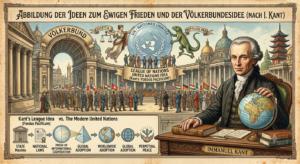
Given how disciplined and cautious Kant was in his own daily life, his political writing can feel almost startlingly ambitious. In his 1795 essay Perpetual Peace, written when Europe was a patchwork of monarchies constantly at war with one another, Kant sketched out a vision for lasting peace between nations — built on republican governments, international law, and a kind of federation of free states.
It reads, at points, like an early blueprint for institutions that wouldn’t exist for another century and a half. Historians and political theorists have long noted the resemblance between Kant’s proposals and the later architecture of the League of Nations and the United Nations — an idea about collective security and international cooperation, drafted by a man who almost never left one small German town, decades before anything like it existed in practice.
The Man Behind the Method
It would be easy to imagine Kant as a cold, mechanical thinker — a man so devoted to reason that he had no room left for feeling. The truth is messier and more human. Colleagues described him as a genuinely engaging conversationalist and a popular dinner host, someone who could discuss geography, astronomy, or gossip about the wider world with real warmth, despite rarely having traveled to see any of it himself.
He published relatively little in his younger years and didn’t produce his major works until his fifties and sixties — a genuinely late bloomer by the standards of his era, and a quiet reminder that intellectual legacies aren’t always built on early brilliance. Sometimes they’re built on decades of patient, unglamorous groundwork that only pays off near the end.
He died in 1804, in the same city where he’d been born eighty years earlier, having barely left its borders. His last words are said to have been simply, “It is good” — a strangely fitting close for a man who spent his life asking what “good” actually meant, and insisting the answer mattered enough to work out properly.
Conclusion: Why Kant Still Matters Today
Take a step back from the details, and Kant’s life tells a fairly improbable story: a sickly boy from a harness-maker’s household, raised on strict Pietist discipline, who barely traveled beyond one small Prussian town — and who nonetheless produced ideas so foundational that modern philosophy is still built on top of them, whether it agrees with him or not.
He gave us a new way to think about the mind itself, arguing that we don’t simply observe reality so much as help construct the experience of it. He gave us a moral framework demanding enough to still be argued over in ethics classrooms and courtrooms today, built on the radical idea that every person carries a dignity that can never be used as a mere means to someone else’s ends. And decades before anyone had reason to expect it, he sketched a vision of international cooperation that would echo, unmistakably, in the founding of the League of Nations and the United Nations.
Every time a philosopher argues about whether AI systems should be treated as mere tools or owed some form of consideration, Kant’s language about ends and means is quietly in the room. Every time a court or a constitution appeals to inherent human dignity as something that can’t be bargained away, it’s speaking in a vocabulary Kant helped invent.
Kant never wanted followers who simply repeated his conclusions. His own motto, borrowed from the Enlightenment he helped define, was Sapere aude — dare to know, dare to think for yourself. That, more than any single doctrine, may be his real inheritance: not a fixed answer, but a standing challenge to keep asking the hard questions honestly, and to trust your own reason enough to follow them wherever they lead.
Key Takeaways
- Kant argued the mind actively shapes experience, rather than passively recording it — his “Copernican Revolution” in philosophy.
- His phenomena/noumena distinction says we can know the world as it appears to us, but never the world exactly as it is in itself.
- The Categorical Imperative asks whether a moral rule could be universalized without contradiction, and insists people must always be treated as ends, not merely as means.
- His 1795 essay Perpetual Peace anticipated ideas later echoed in the League of Nations and the United Nations.
- Kant published his most important work late in life, after decades of quiet, disciplined groundwork.
Frequently Asked Questions
Who was Immanuel Kant? Immanuel Kant (1724–1804) was a German philosopher from Königsberg, widely regarded as one of the most influential thinkers in Western philosophy, known for his work on knowledge, ethics, and politics.
What is Kant most famous for? Kant is best known for his theory of transcendental idealism, his distinction between phenomena and noumena, and his ethical theory centered on the Categorical Imperative.
What is the Categorical Imperative in simple terms? It’s the idea that you should only act according to rules you’d be willing to see applied universally to everyone, and that people should always be treated as valuable in themselves, never merely used as tools for someone else’s goals.
What is the difference between phenomena and noumena? Phenomena are things as we experience them through our senses and mental categories; noumena are things as they exist independently of any observer, which Kant argued we can never directly access.
Did Kant believe in free will? Kant believed free will was something reason could not prove or disprove through pure logic, but that it had to be assumed as a practical necessity for morality to make any sense at all.
Was Kant religious? Kant was raised in a devout Pietist household and continued to engage seriously with questions of God and faith throughout his life, though his mature philosophy argued that religious belief should be grounded in moral reason rather than dogma alone.
How did Kant influence modern philosophy? Kant’s ideas shaped later thinkers including Hegel, Schopenhauer, and Nietzsche, and continue to influence contemporary debates in ethics, political theory, human rights, and even discussions about artificial intelligence.
Important Articel as per History Decoded Hub.
-
Plato’s Influence on Kant
Long before Immanuel Kant transformed modern philosophy, the Greek philosopher Plato explored enduring questions about knowledge, reality, and ethics. While Kant rejected several aspects of Plato’s Theory of Forms, he admired Plato’s pursuit of universal truths through reason. Discover more about Plato’s life, philosophy, and lasting influence in our detailed guide.
-
Aristotle’s Influence on Kant
The ideas of Aristotle laid an important foundation for Western philosophy centuries before Immanuel Kant. Aristotle’s emphasis on logic, ethics, and human reason influenced generations of thinkers, although Kant developed his own revolutionary approach to knowledge and morality. Explore our detailed guide on Aristotle to understand how his philosophy shaped the course of intellectual history
-
- Encyclopaedia Britannica – Immanuel Kant