
Introduction
Picture the desert at dawn, somewhere around 2580 BC. The sun has not yet cleared the horizon, but thousands of men are already awake, gathering rope, checking sledges, and lining up before a mountain of limestone that does not yet exist. By the time this generation of workers grows old and dies, that mountain will rise from the sand — precise to the fraction of a degree, aligned with the compass points of the earth itself, and destined to outlast every other structure human hands have built for the next 3,800 years.
That mountain is the Great Pyramid of Giza. And the story of how it came to be is not a story of aliens, lost civilizations, or impossible magic — it is a story of ambition, mathematics, organization, and roughly twenty to thirty thousand ordinary people who accomplished something extraordinary with nothing but copper, wood, rope, and their own hands.
Built over 4,500 years ago on the Giza Plateau near modern Cairo, the pyramids remain one of the most studied, most mythologized, and most misunderstood monuments on Earth. The real mystery was never who built them. Archaeology settled that question long ago. The real mystery — the one that still keeps engineers up at night — is how. How did a Bronze Age society, without iron tools, without the wheel in any meaningful load-bearing sense, and without a single crane, move millions of multi-ton stone blocks and stack them into a structure so precise that modern surveyors still marvel at it?
This is that story.

Where the Pyramids Stand
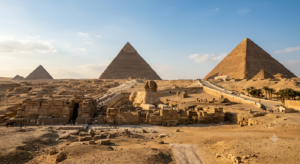
The pyramids sit on the Giza Plateau, about 15 kilometers southwest of Cairo, on a stretch of high desert bedrock that ancient builders chose deliberately for its stability. The plateau is not just home to the three great pyramids most people picture when they hear the word “Egypt.” It is an entire necropolis — a city built for the dead.
Walk the plateau today and you will find the Great Pyramid of Khufu rising above everything else, flanked by the slightly smaller Pyramid of Khafre and the noticeably more modest Pyramid of Menkaure. Nearby crouches the Great Sphinx, its lion’s body and human face staring eastward toward the rising sun. Scattered around these giants are the smaller Queen’s Pyramids, built for royal wives, along with temples, long stone causeways connecting the monuments to the Nile, and vast cemeteries where the pharaohs’ officials and workers were laid to rest.
It is, even now, one of the most visited archaeological sites on the planet — a place where visitors from every continent stand in the same dust that Egyptian laborers once packed beneath their feet.
Who Built the Pyramids, and When
The three major pyramids at Giza all belong to Egypt’s Fourth Dynasty, a golden age of pyramid building that produced some of the most ambitious architecture the ancient world would ever see.
| Pharaoh | Pyramid | Approximate Date |
|---|---|---|
| Khufu | Great Pyramid | 2580–2560 BC |
| Khafre | Second Pyramid | 2558–2532 BC |
| Menkaure | Third Pyramid | 2532–2503 BC |
The largest of the three, the Great Pyramid, was built as the tomb of Pharaoh Khufu — a monument meant not just to hold his body, but to launch his soul into eternity.
Why Build a Mountain of Stone for One Man?
To modern eyes, the scale of the pyramids can seem almost irrational. Why pour the labor of an entire generation into a tomb? The answer lies in how the ancient Egyptians understood death, kingship, and the structure of the cosmos itself.
The Egyptians believed that a pharaoh did not simply die — he transformed into a god. The pyramid was the machine that made that transformation possible. Its shape symbolized the rays of the sun streaming down to earth, forming a physical ramp that connected the king to Ra, the sun god, and allowed him to ascend into the heavens. The structure also served a more practical spiritual purpose: it protected the pharaoh’s body, which needed to remain intact for his soul to survive in the afterlife, and it housed everything he would need on the other side — food, treasure, servants in the form of statues, and inscriptions to guide him through the underworld.
In other words, the pyramid was never just a tomb. It was a resurrection engine, built in stone.
Two Decades in the Desert: How Long Construction Took
Most historians estimate that the Great Pyramid took somewhere between 20 and 27 years to complete, with construction beginning around 2580 BC and finishing near 2560 BC. That means an entire generation of Egyptian workers — men who started as young laborers — may have spent the better part of their working lives on a single project, watching it grow year after year from a flat patch of bedrock into the tallest structure human beings had ever made.
The Scale of the Great Pyramid
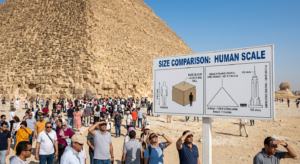
Numbers alone can only hint at what it must have felt like to stand at the base of the Great Pyramid while it was under construction. Originally, it stood 146.6 meters tall — about 481 feet. Erosion and the removal of its outer casing stones over the centuries have brought its current height down to 138.8 meters, still a staggering figure for a structure built without modern machinery.
Each side of its square base measures roughly 230.4 meters, and the entire monument is estimated to weigh around 6 million tons. It was assembled from approximately 2.3 million individual stone blocks. Most of those blocks weighed between 2 and 3 tons — heavy, but manageable for a well-organized team using sledges and ramps. The largest granite blocks, however, tell a very different story: some weighed as much as 70 to 80 tons, roughly the weight of a modern airliner, and had to be moved hundreds of kilometers before they ever reached the construction site.
A Supply Chain Carved from Stone
Long before a single block was set in place, Egyptian planners had to solve a logistics problem on a scale the world had never seen. Different parts of the pyramid required different stone, and each type came from its own distant source.
The bulk of the pyramid’s core was built from ordinary limestone, quarried less than a kilometer away — close enough that workers could move blocks efficiently without a lengthy journey. But the pyramid’s original outer surface was something far more refined: gleaming white casing stones cut from fine limestone quarried at Tura, on the opposite bank of the Nile, roughly 15 kilometers away. These polished blocks were fitted with such precision that ancient visitors described the pyramid as almost seamless, a single continuous surface of white stone blazing in the sun.
The most demanding material of all was granite, used to line the King’s Chamber deep inside the pyramid’s core. That granite came from Aswan, nearly 800 kilometers to the south. Moving multi-ton granite blocks across that distance, using nothing but human labor, river transport, and timber, ranks among the most impressive supply-chain achievements of the ancient world.
Moving Mountains: How the Stones Traveled
For decades, the transport of the pyramid’s stones seemed almost as mysterious as their placement. Recent archaeological discoveries, however, have filled in much of the picture, revealing a system that was as clever as it was labor-intensive.
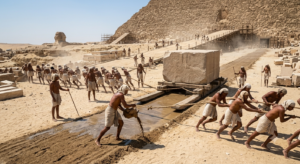
Wooden sledges formed the backbone of stone transport on land. Tomb paintings from the period show long lines of workers hauling massive stone blocks lashed to wooden sledges, dragging them across the desert in coordinated teams.
Wet sand turned out to be one of the ancient Egyptians’ most elegant engineering tricks. Researchers studying the physics of sledge transport discovered that wetting the sand in front of a sledge reduced friction by almost 50 percent, transforming an exhausting task into something dramatically more manageable. A single depiction from an Egyptian tomb even shows a worker pouring water directly in the sledge’s path — evidence that the builders understood this principle firsthand, even without the language of modern physics to describe it.
The Nile River served as the great highway of the operation. During the annual flood season, when water levels rose and simplified river navigation, large stones — including the giant granite blocks from Aswan — were loaded onto boats and floated toward Giza. Ancient papyri uncovered at Wadi al-Jarf describe exactly this kind of delivery, offering rare, firsthand documentation of the logistics behind the pyramid’s construction.
Ramps handled the final and most difficult stage: getting stone blocks up the pyramid itself as it grew taller. Most archaeologists agree that ramps were essential to the process, though the exact design remains one of the enduring debates in Egyptology. Proposed designs include long straight ramps rising directly from the ground, zig-zag ramps that switched back across a single face, spiral ramps that wound around the entire structure as it rose, and internal ramps built into the body of the pyramid itself and later sealed inside. No single theory has been proven beyond doubt, and it is entirely possible that Egyptian engineers used a combination of methods, adapting their approach as the pyramid grew taller and the physics of the problem changed.
Lifting Stone Without a Crane
The question of transport is only half the puzzle. Once a block reached the base of the pyramid, workers still had to lift it — sometimes hundreds of feet — into its precise final position. Three competing theories attempt to explain how.
The first proposes large, straight earthen ramps that increased in length and height as the pyramid rose, allowing teams to drag blocks up a gradual incline. The second suggests spiral ramps wrapping around the exterior of the pyramid, coiling upward like a staircase carved from packed earth and rubble. The third points to internal ramps, hidden within the pyramid’s own structure, which would explain why so little trace of an external ramp system has ever been found at the site.
Each theory has persuasive evidence behind it, and each has unresolved problems. What is clear is that no single explanation has been conclusively proven — and that uncertainty is part of what keeps modern engineers and archaeologists returning to Giza generation after generation, still trying to reverse-engineer a 4,500-year-old solution.
Who Actually Built the Pyramids?
For centuries, popular imagination clung to a dramatic and deeply misleading idea: that the pyramids were built by hundreds of thousands of enslaved people, driven by the whip under a merciless sun. Modern archaeology tells a very different, far more human story.
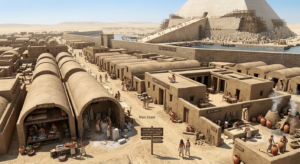
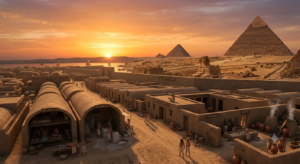
Excavations near the Giza Plateau have uncovered entire workers’ villages, complete with bakeries capable of feeding thousands, on-site hospitals for treating injuries, dedicated sleeping quarters, and cemeteries where laborers were buried with the same care and ritual respect given to Egypt’s elite. These are not the burial patterns of a slave workforce. They are the signatures of a paid, organized, and in some ways honored labor force.
The best current estimates place the workforce at somewhere between 20,000 and 30,000 workers, made up of skilled craftsmen who worked year-round and seasonal laborers who joined the project during the Nile’s flood months, when farming was impossible and the river itself made stone transport easier. Far from an army of anonymous slaves, the builders of the pyramids appear to have taken genuine pride in their work — pride etched permanently into the walls of their own tombs.
The Toolkit of a Bronze Age Superpower
What makes the achievement even more remarkable is the simplicity of the tools involved. Egyptian workers had no iron, no steel, and no wheeled cranes. Instead, they relied on copper chisels for cutting and shaping stone, dolerite hammer stones for rougher work on the hardest granite, wooden sledges for transport, thick rope woven for hauling, wooden levers for prying and adjusting blocks into position, measuring rods for consistent proportions, and plumb bobs for keeping walls and edges perfectly vertical.
With this modest toolkit, and nothing resembling modern machinery, they built a monument accurate enough to embarrass some construction projects built with twenty-first-century equipment.
An Accuracy That Still Humbles Engineers
Perhaps nothing about the Great Pyramid is more astonishing than its precision. Its four faces align almost perfectly with true north, south, east, and west, with an error of less than a fraction of a degree — a level of accuracy that implies sophisticated astronomical observation and surveying techniques. Its base is nearly perfectly level across its entire 230-meter span, and its corners align with a consistency that modern engineers still study and admire.
To achieve this without satellites, lasers, or electronic instruments required an intimate understanding of geometry, astronomy, and the physical behavior of stone and shadow — knowledge passed down and refined by generations of Egyptian architects and priest-scholars.
What Lies Inside
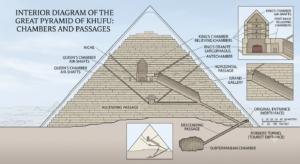
Beneath its precise exterior, the Great Pyramid hides a complex internal architecture built to protect its royal occupant and guide his journey into the afterlife. Inside are the King’s Chamber, lined with granite hauled from Aswan; the Queen’s Chamber; the dramatic, high-ceilinged Grand Gallery; and a network of descending and ascending passages that lead down into a Subterranean Chamber cut directly into the bedrock beneath the structure.
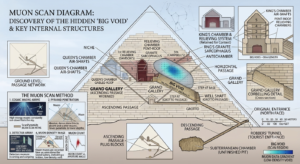
Modern scanning technology has revealed that this is likely not the full picture. Using non-invasive imaging methods, researchers continue to detect hidden voids and spaces within the pyramid’s mass — chambers whose purpose, and whose secrets, remain unknown even today.
What Modern Science Keeps Discovering
The pyramids may be ancient, but our understanding of them is still evolving. In 2017, an international team of scientists using muon scanning — a technique that detects subatomic particles passing through solid stone — identified a large hidden void deep inside the Great Pyramid. Its function remains a mystery, and it stands as a reminder that even after more than a century of serious archaeological study, Giza has not finished revealing itself.
Separately, the discovery of ancient papyri at Wadi al-Jarf added an entirely new layer of firsthand evidence to the story. These documents describe, in the words of the people who lived it, the transportation of limestone by boat for Khufu’s pyramid — turning what was once pure speculation into documented historical fact.
Separating Myth from Fact
No monument on Earth attracts more myths than the pyramids, and it is worth addressing the most persistent ones directly.
Myth: Aliens built the pyramids. Fact: there is no credible archaeological evidence supporting extraterrestrial involvement of any kind. Every piece of physical evidence — quarry marks, workers’ tools, unfinished blocks, construction ramps, worker villages — points to human builders using human methods.
Myth: Millions of slaves were whipped into building the pyramids. Fact: the archaeological record points instead to organized teams of skilled and seasonal workers who were housed, fed, and buried with dignity near the monuments they built.
Myth: The pyramids were physically impossible to build with ancient technology. Fact: modern experiments in experimental archaeology have repeatedly shown that ancient tools and techniques — sledges, wet sand, ramps, levers, and organized labor — could realistically accomplish this work over the course of decades, given a large and well-managed workforce.
Facts Worth Remembering
A handful of facts capture just how extraordinary the Great Pyramid’s legacy really is. It held the title of tallest human-made structure on Earth for nearly 3,800 years, a record unmatched by almost any other building in history. It is the oldest of the Seven Wonders of the Ancient World — and remarkably, the only one still standing today. In its original form, it was not the bare, weathered stone visitors see now, but a smooth, gleaming monument sheathed in polished white limestone that would have reflected sunlight across the desert for miles. Many of those original casing stones were later stripped away and reused in medieval construction projects around Cairo, which is part of why the pyramid looks rougher today than it did in antiquity.
Why the Pyramids Are Still Standing
Four and a half thousand years is an almost incomprehensible span of time for any human structure to survive, let alone remain largely intact. The Great Pyramid’s endurance comes down to a combination of factors working together: massive limestone blocks that resist erosion, a stable bedrock foundation chosen deliberately by ancient surveyors, precise engineering that distributes weight evenly across the structure, a dry desert climate that slows decay, and careful, deliberate weight distribution built into the pyramid’s very design.
Why This Story Still Matters
The Pyramids of Giza are more than an ancient tourist attraction or a backdrop for photographs. They are physical proof of what organized human effort, mathematical knowledge, and sheer determination could achieve nearly five millennia ago — long before the wheelbarrow, the pulley system, or written engineering theory as we know it existed.
They demonstrate the advanced organization, mathematics, and craftsmanship of a civilization that modern historians are still working to fully understand. Every new scan, every newly translated papyrus, every re-examined tomb painting adds another piece to a puzzle that has occupied scholars for well over a century and shows no sign of being fully solved.
That, in the end, is why the pyramids continue to draw people back — not because they hide some fantastical secret, but because their very real secrets are still, after 4,500 years, not entirely told.
FAQ: The Construction of the Pyramids of Giza
1. Who built the Pyramids of Giza?
The Pyramids of Giza were built by skilled Egyptian workers, craftsmen, and seasonal laborers during the Fourth Dynasty of Ancient Egypt. Archaeological evidence shows they were not built by slaves.
2. When were the Pyramids of Giza built?
The pyramids were built between approximately 2580 BC and 2500 BC, over 4,500 years ago.
3. Why were the pyramids built?
The pyramids were built as royal tombs for pharaohs. Ancient Egyptians believed the structures would help their rulers reach the afterlife and become one with the gods.
4. How long did it take to build the Great Pyramid?
Most historians estimate that the Great Pyramid of Khufu took between 20 and 27 years to complete.
5. How many stone blocks were used in the Great Pyramid?
The Great Pyramid contains about 2.3 million stone blocks, with most weighing between 2 and 3 tons.
6. How did the Egyptians move such heavy stones?
Ancient Egyptians used wooden sledges, wet sand to reduce friction, river transport on the Nile, and large ramp systems to move massive stone blocks.
7. What is the largest pyramid at Giza?
The Great Pyramid of Khufu is the largest pyramid at Giza and was originally about 146.6 meters (481 feet) tall.
8. Were the Pyramids of Giza built by aliens?
No. There is no credible archaeological evidence supporting the theory that aliens built the pyramids. Evidence clearly points to ancient Egyptian builders and engineering techniques.
9. What is inside the Great Pyramid?
The Great Pyramid contains the King’s Chamber, Queen’s Chamber, Grand Gallery, passageways, and other hidden spaces that researchers continue to study.
10. Why are the Pyramids of Giza still standing today?
The pyramids have survived for thousands of years because of their strong limestone construction, stable foundation, precise engineering, and Egypt’s dry desert climate.
11. What is the hidden void discovered inside the Great Pyramid?
In 2017, scientists using muon scanning technology discovered a large hidden void inside the Great Pyramid. Its purpose remains unknown.
12. Why are the Pyramids of Giza important today?
The pyramids are one of the greatest achievements of ancient engineering and provide valuable insights into the mathematics, architecture, and culture of Ancient Egypt.
Conclusion
The construction of the Pyramids of Giza remains one of the greatest engineering achievements in human history. More than 4,500 years after they were built, these magnificent monuments continue to inspire historians, archaeologists, engineers, and millions of visitors from around the world. Their remarkable precision, massive scale, and enduring strength demonstrate the extraordinary knowledge and organization of Ancient Egyptian civilization.
While many myths and theories still surround the pyramids, archaeological discoveries have revealed that they were built by skilled workers using innovative techniques, careful planning, and decades of dedicated effort. Every new discovery—from ancient papyri to advanced scanning technology—helps us better understand how this incredible feat was accomplished.
The Pyramids of Giza are more than ancient tombs; they are timeless symbols of human ambition, creativity, and perseverance. Their story reminds us that with determination, teamwork, and ingenuity, civilizations can create achievements that stand the test of time and continue to captivate the world for thousands
Important Article As Per History Decoded Hub.
Although the Pyramids of Giza were built more than 2,000 years before Cleopatra’s reign, they remained one of Egypt’s most iconic landmarks during her lifetime. Cleopatra VII, the last active ruler of ancient Egypt, lived in the shadow of these magnificent monuments and proudly represented a civilization whose architectural achievements had already amazed the world for centuries. To learn more about her fascinating life and legacy, read our detailed article on Cleopatra: The Last Queen of Ancient Egypt.
The Pyramids of Giza continued to stand long after the fall of many of the world’s greatest civilizations, including the mighty Roman Empire. While empires rose and collapsed over the centuries, these ancient monuments remained a lasting symbol of human ingenuity and endurance. If you’re interested in learning how one of history’s most powerful empires expanded, flourished, and eventually declined, explore our detailed article on The Rise and Fall of the Roman Empire.
Throughout history, Egypt came under the rule of several powerful empires, including the Ottoman Empire, which controlled the region for centuries after conquering it in 1517. Despite changing rulers and political transformations, the Pyramids of Giza remained untouched as enduring symbols of Ancient Egypt’s remarkable achievements. To learn how the Ottoman Empire rose to become one of the world’s most influential empires and what led to its eventual decline, explore our detailed article on The Rise and Fall of the Ottoman Empire.
Recommended External Links
-
UNESCO – Memphis and its Necropolis (Official)