
Introduction
“The Partition of India 1947 remains one of the most tragic events in modern history.” In August 1947, the world witnessed one of the most dramatic and painful events of the twentieth century — the Partition of India. What should have been remembered only as the celebration of freedom from British colonial rule instead became a story of separation, migration, violence, and heartbreak.
The Partition divided British India into two independent nations: India and Pakistan. Borders were drawn in haste, communities were torn apart overnight, and millions of people suddenly found themselves strangers in the land they had always called home.
For many, Partition was not just a political decision. It was the loss of neighbors, homes, memories, and identity. Even decades later, the scars of 1947 continue to shape the relationship between India and Pakistan and remain deeply embedded in the memories of families across South Asia.
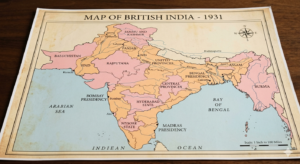
1. British Rule and Growing Tensions
To understand Partition, it is important to understand the condition of India under British rule.
The British East India Company first established influence in India during the eighteenth century, and after the Revolt of 1857, the British Crown took direct control of the subcontinent. Over time, Britain ruled India through a system that often deepened divisions among communities.
India was home to people of many religions, languages, and cultures. Hindus formed the majority population, while Muslims made up a large minority. For centuries, communities had lived together, traded together, and shared cultural traditions. However, political competition and colonial policies slowly increased mistrust.
The British often used a strategy known as “divide and rule,” encouraging separate political representation for different religious groups. Over time, this created stronger religious identities in politics.
By the early twentieth century, two major political organizations had become dominant:
- The Indian National Congress
- The All-India Muslim League
The Congress largely pushed for a united independent India, while many Muslim leaders feared that Muslims would become politically marginalized in a Hindu-majority nation.
2. The Rise of the Demand for Pakistan
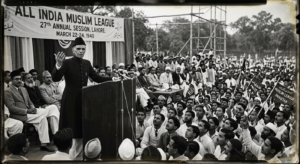
The idea of a separate Muslim homeland gained momentum under the leadership of Muhammad Ali Jinnah, the leader of the Muslim League.
Jinnah initially supported Hindu-Muslim unity. However, political disagreements and growing communal tensions changed his position over time. By the 1940s, he argued that Muslims and Hindus were “two nations” with different cultures, histories, and political interests.
In 1940, the Muslim League passed the Lahore Resolution, demanding separate states for Muslims in northwestern and eastern regions of India.
Meanwhile, leaders like Mahatma Gandhi and Jawaharlal Nehru continued to advocate for a united India. Gandhi especially believed that Hindus and Muslims could coexist peacefully.
Despite these efforts, mistrust between political groups continued to rise.
3. The End of British Rule
After World War II, Britain was financially weakened and politically exhausted. The British government realized that it could no longer maintain control over India.
At the same time, independence movements had become impossible to suppress. Protests, civil disobedience campaigns, and political negotiations intensified pressure on Britain to leave.
In 1947, Lord Louis Mountbatten was appointed as the last Viceroy of India. His task was to transfer power quickly.
Originally, British withdrawal was planned for June 1948. However, worsening communal violence convinced Mountbatten to accelerate the process. The date of independence was moved to August 1947.
The decision left very little time to prepare for the division of one of the largest regions in the world.
4. Drawing the Border
One of the most controversial aspects of Partition was the drawing of borders.
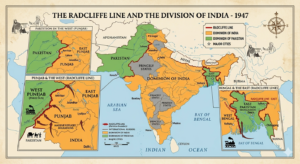
A British lawyer named Sir Cyril Radcliffe, who had never visited India before, was given the responsibility of dividing the provinces of Punjab and Bengal between India and Pakistan.
Radcliffe had only a few weeks to complete the task.
The borders were drawn based on religious demographics, but the reality on the ground was far more complicated. Villages, farms, rivers, railways, and communities were deeply interconnected.
When the Radcliffe Line was finally announced, millions of people suddenly discovered that they were living in the “wrong” country.
Families that had lived in the same towns for generations faced impossible choices:
- Stay and risk violence
- Or leave everything behind and migrate
5. The Largest Mass Migration in History
Partition triggered one of the largest human migrations ever recorded.
Around 10 to 15 million people crossed borders between India and Pakistan within a short period. Muslims moved toward Pakistan, while Hindus and Sikhs migrated toward India.
The migration was chaotic and terrifying.
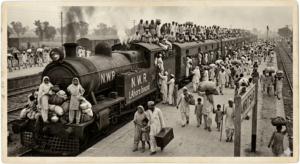
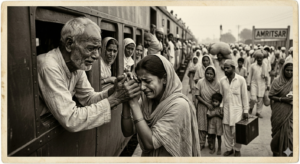
Refugees traveled on foot, in overcrowded trains, bullock carts, and military convoys. Many carried only a few belongings. Some believed they would return home within weeks. Most never did.
Entire villages emptied overnight.
Trains filled with refugees became symbols of both hope and horror. Some trains arrived safely. Others arrived filled only with the dead after communal attacks during the journey.
Roads became crowded with endless lines of displaced people stretching for miles.
The human cost was catastrophic.
Historians estimate that between several hundred thousand and two million people were killed in communal violence. Women faced abductions, assaults, and forced conversions on a massive scale.
Children were separated from families, and countless people disappeared without a trace.
6. Stories of Loss and Survival
Behind the political speeches and official documents were ordinary people whose lives changed forever.
A farmer in Punjab abandoned ancestral land cultivated for generations. A mother carried her children across dangerous borders without knowing where they would sleep. Friends who once celebrated festivals together suddenly found themselves divided by fear and suspicion.
Many survivors rarely spoke about what they experienced.
Some remembered the kindness of strangers who protected families from violence. Others remembered smoke rising from burning villages and the silence left behind after neighbors disappeared.
Partition created memories that were passed down through generations.
Even today, families in India, Pakistan, and Bangladesh preserve old photographs, letters, and stories connected to homes they can no longer visit.
7. Independence and Division
India became independent on 15 August 1947.
Pakistan had officially gained independence one day earlier, on 14 August 1947.
For millions, independence was a moment of pride and celebration. After nearly two centuries of British domination, colonial rule had finally ended.
But alongside celebration came grief.
Cities burned while flags were raised. Refugee camps expanded while leaders delivered speeches about freedom.
The joy of independence and the tragedy of Partition became inseparable parts of the same historical moment.
8. Kashmir and Continuing Conflict
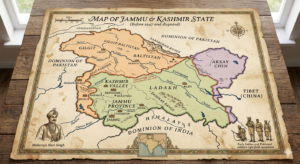
Partition also created unresolved territorial disputes, especially over Kashmir.
The princely state of Jammu and Kashmir had a Muslim-majority population but a Hindu ruler. When tribal fighters from Pakistan entered Kashmir in 1947, the ruler sought military assistance from India and agreed to join India.
This led to the first Indo-Pakistani war.
Kashmir remains one of the most sensitive and disputed regions in the world today. Multiple wars and military confrontations between India and Pakistan have roots connected to the events of Partition.
9. The Creation of Bangladesh
Partition originally created Pakistan in two separate regions:
- West Pakistan
- East Pakistan
These territories were separated by more than 1,000 miles of Indian territory.
Cultural, linguistic, and political differences eventually caused tensions between the two regions. In 1971, East Pakistan fought for independence and became Bangladesh.
This further reshaped the political map of South Asia.
10. The Legacy of Partition
The legacy of Partition extends far beyond borders.
It changed demographics, politics, literature, cinema, and collective memory across South Asia. Writers, poets, and filmmakers have continued to explore themes of displacement, identity, and trauma linked to 1947.
Partition also transformed cities such as Delhi, Lahore, Karachi, and Kolkata as refugees rebuilt lives in unfamiliar places.
At the same time, it left unresolved emotional wounds.
Many families still speak about ancestral homes across the border. Some elderly survivors continue to remember streets, schools, and childhood friends they lost during migration.
For historians, Partition remains one of the most complex events in modern history — a story of freedom achieved alongside immense human suffering.
11. The Human Cost of the Partition of India 1947
The Partition of India 1947 was not just a political event; it was a human tragedy that changed millions of lives forever. As borders divided India and Pakistan, families were forced to leave their homes with little more than hope and fear. Around 10 to 15 million people migrated across the new borders, making it one of the largest mass migrations in history.
Violence spread rapidly across cities and villages. Thousands lost their lives in communal riots, while countless families were separated during the chaos. Refugee trains arrived filled with injured survivors, and many people never returned to the homes they once loved.
For those who lived through Partition, the memories of loss, migration, and separation remained painful for generations. Even today, the human cost of the Partition of India 1947 continues to be remembered through stories passed down within families across South Asia.
Conclusion
The Partition of India in 1947 was not simply the division of territory. It was the division of memories, communities, and millions of lives.
It marked the end of British colonial rule but also began a period of violence and displacement that affected generations. The borders drawn in haste reshaped South Asia forever.
Today, Partition is remembered not only through political history but through personal stories passed from one generation to another. It remains a reminder of how political decisions can deeply affect ordinary people.
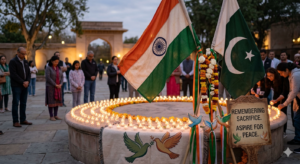
More than seventy years later, the echoes of 1947 can still be heard in the relationship between India and Pakistan, in the memories of survivors, and in the shared history of an entire region.
To understand how Mahatma Gandhi inspired India’s freedom struggle through non-violence, read our detailed article on how Gandhi won freedom without violence. Tap Here for reading.
Read more about how Bhagat Singh became one of India’s most fearless revolutionaries in our detailed blog on Bhagat Singh’s fight for freedom. Tap Here
Read detailed historical records about the Partition of India here.