

Samuel Johnson: What a Sick, Broke Failure Teaches Us About Genius
Most articles about Samuel Johnson will tell you the same three facts in the same order: he wrote a famous dictionary, he was friends with a man named Boswell, and he said some clever things at dinner parties. You will finish reading them knowing what Johnson did. You will not come away knowing why his life is actually useful to you, two hundred and fifty years later, sitting wherever you’re sitting right now. That’s the gap this article is trying to close. Because underneath the dictionary and the quotations is a much stranger, more instructive story — about a man who by every conventional measure of his era should have disappeared into obscurity, and who instead became so central to the English language that we still, without realizing it, think and write partly on his terms.
We like origin stories where struggle is a brief obstacle before destiny kicks in. Johnson’s story resists that shape. His struggle wasn’t a chapter — it was most of the book. Born in 1709 in Lichfield to a bookseller father who was perpetually in debt, Johnson contracted scrofula as an infant, a tubercular infection that left him scarred, partially blind in one eye, and partially deaf. Historians studying accounts of his behavior — the tics, the compulsive movements, the involuntary vocal sounds — now believe he likely had Tourette syndrome, though nobody in the eighteenth century had a name for it. To his contemporaries, he simply looked strange, and society treated him accordingly: with stares, whispers, and exclusion. Here’s the part worth sitting with: Johnson entered Pembroke College, Oxford in 1728 with real academic promise, and left roughly a year later without a degree, because his family ran out of money. Not because he failed. Because he was poor. He then failed to make a living as a schoolteacher. He then opened his own school, which attracted almost no students and collapsed. By his late twenties, Johnson had a chronic illness, a disfigured face, a hearing impairment, no degree, no reliable income, and a string of failed ventures behind him. If you met that résumé today, you would not predict “future definer of the English language.” That’s exactly the point. The value in Johnson’s story isn’t “brilliant man succeeds” — it’s “a man with almost every disadvantage his century could hand him still built something that outlasted empires.” That’s a very different, much more useful story.

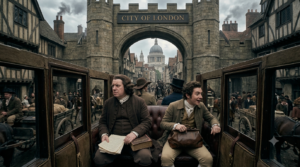
In 1737, with almost nothing to his name, Johnson made the decision that would define the rest of his life: he moved to London with a former pupil, a young man named David Garrick, who would go on to become the most celebrated actor of his generation. Two unknown men from the provinces, arriving in the largest city in the world, each hoping to make something of themselves through talent alone. London was not kind to struggling writers, and Johnson survived on whatever essays, translations, and magazine articles an editor would pay for — the freelance hustle of the eighteenth century, without any of the safety nets we might imagine today. Slowly, word by word, essay by essay, he began to build a reputation as one of the sharpest minds in the city.
Every article about Johnson repeats the same statistic: he defined over 40,000 words in nine years. It’s an impressive number, but numbers alone don’t explain why his dictionary became the standard for 150 years, while other dictionaries attempted before and after his did not. The real innovation was quieter than the word count, and it’s the part most retellings skip entirely: Johnson didn’t just define words — he proved what they meant by quoting them in action. For nearly every entry, he pulled a real sentence from a real writer — Shakespeare, Milton, Dryden — showing the word alive in use, not just pinned down like a specimen. Over 100,000 of these illustrative quotations run through the dictionary. This matters because it reveals how Johnson actually thought about language: not as a fixed set of rules imposed from above, but as something that lives inside literature, shaped by how great writers actually used it. A dictionary built that way isn’t just a reference book. It’s an argument — that meaning comes from usage, not decree. That single design choice is arguably why his dictionary felt authoritative rather than arbitrary, and it quietly anticipated an idea modern linguists now take for granted: language is described, not legislated. There’s also a detail almost nobody highlights, and it’s the most human part of the whole story. Johnson did this work while battling depression severe enough that some biographers believe he feared, at points, for his own sanity. He wrote once of dreading being left alone with his own thoughts. The dictionary wasn’t produced by an untroubled, methodical scholar working calmly at a desk. It was clawed into existence by a man who, by his own private admission, was frequently fighting his own mind just to keep working at all. That reframes the achievement entirely — it’s not just a triumph of intellect, it’s a triumph of showing up.

Most summaries say Johnson “praised Shakespeare but also pointed out his flaws,” as if that’s the whole insight. It isn’t. The deeper lesson is how he did it. Johnson refused a trap that critics still fall into today: the idea that you must either worship a genius uncritically or dismiss them entirely. He held both things at once — Shakespeare was, in his view, the writer who best understood human nature of anyone in the English language, and Shakespeare was sometimes careless, indulgent, and morally sloppy in his plotting. Johnson didn’t see these as contradictions. He saw them as simply what it looks like to evaluate a real, whole human achievement rather than a myth. This is a genuinely useful mental model, and it applies far beyond literature. Whether you’re evaluating a mentor, a public figure, or your own past work, Johnson’s method offers a better path than the two extremes we usually default to — hero-worship or cancellation. Admire the strength. Name the flaw. Don’t let either one erase the other.
If you strip away the eighteenth-century setting, his 1759 novella Rasselas is essentially a story about a young man who has everything — comfort, safety, status — and still feels something is missing, so he leaves to go find “the right way to live.” Sound familiar? It’s the same premise driving half the memoirs and self-improvement content published this year. What makes Johnson’s version worth reading isn’t the plot — it’s the conclusion, which is quietly more mature than most modern versions of the same story. Rasselas doesn’t find one perfect life philosophy to adopt. He finds that the search itself was based on a flawed premise: that there exists some final, complete state of happiness waiting to be discovered, after which all restlessness stops. Johnson’s answer is closer to something like: contentment isn’t a destination you arrive at by choosing correctly. It’s a discipline you practice inside an imperfect life, indefinitely, without ever fully “solving” it. There’s a biographical detail that deepens this. Johnson wrote Rasselas quickly, in the evenings of a single week, specifically to earn enough money to pay for his mother’s funeral. A book about the search for lasting happiness was written by a grieving son under financial pressure, in a hurry, to bury his mother. That context doesn’t undercut the book’s wisdom — it explains where the wisdom came from.

In 1762, Johnson received a government pension that finally freed him from the constant financial anxiety that had shadowed his entire adult life. It’s usually mentioned as a footnote. It shouldn’t be. Consider the timeline: the dictionary — his most famous, labor-intensive achievement — was completed in 1755, seven years before any financial security arrived. Everything people associate with “Dr. Johnson, celebrated man of letters” — the pension, the fame, the dinners at his club with figures like Edmund Burke and Joshua Reynolds, the friendship with Boswell that would immortalize him — came after the hardest, least glamorous work was already done, produced under exactly the kind of scarcity and pressure we usually assume kills great work rather than producing it. This complicates a comfortable modern myth: that people do their best work once conditions are ideal. Johnson’s most enduring achievement happened before any of that arrived, not because scarcity is good for creativity, but because Johnson simply refused to wait for permission or comfort before starting. The stability came as a reward for work already finished, not as a precondition for it.
James Boswell’s Life of Samuel Johnson, published in 1791, is routinely called one of the greatest biographies in the English language, but the reason is usually stated vaguely. The more precise reason is this: before Boswell, biographies of great men were mostly monuments — flattering, distant, curated to preserve reputation. Boswell did something almost nobody had done at that scale: he recorded Johnson’s contradictions on purpose. His stubbornness. His fear of death. His occasional cruelty in argument. His tenderness toward his cat, Hodge, for whom he personally went out to buy oysters so the servants wouldn’t resent the extra chore. That combination — genuine reverence alongside genuine honesty — created something new in English letters: a biography of a real, flawed, fully dimensional human being, rather than a statue in prose. It’s part of why Johnson still feels knowable today in a way most historical figures from his era don’t.
Strip away the eighteenth-century wig and the Latin quotations, and Johnson’s life offers a small set of genuinely transferable lessons. Credentials are not the same as capability — he never finished his degree, yet became the most authoritative voice on the English language in his century by building proof of his ability directly, rather than waiting for an institution to certify it first. Start the big work before conditions are ideal — his most important achievement was completed under financial strain, not after it ended, and waiting for stability before beginning meaningful work is often just a more comfortable form of procrastination. You can respect something and critique it in the same breath — his treatment of Shakespeare shows that honest evaluation is more valuable, and more respectful, than uncritical praise. The search for a “final” answer to happiness may be the wrong search — Rasselas suggests contentment is a practice, not a prize you win once and keep forever. And being fully seen, flaws included, is what makes someone endure — Johnson is remembered so vividly not despite Boswell’s honesty about his contradictions, but because of it.
Johnson’s friends described someone who could be intimidating in argument, quick to correct, unwilling to let sloppy thinking pass unchallenged. But the same man went out of his way to feed stray cats, quietly supported the poor from his own thin purse long before the pension arrived, and gave shelter in his own home to a rotating cast of struggling, often difficult people simply because they had nowhere else to go. Strength and tenderness, in Johnson, weren’t in tension. They were the same instinct pointed in different directions. He died on 13 December 1784, and was buried in Westminster Abbey — a resting place reserved for a small number of Britain’s most significant figures. It’s a striking bookend for a man who, fifty-five years earlier, had walked out of Oxford with no degree and no plan. Every time you open a dictionary, argue that a great work can still be flawed, or feel the particular exhaustion of chasing a happiness that keeps moving the moment you reach it, you are, in some small way, standing on ground Johnson mapped out first. His real legacy isn’t a book from 1755. It’s a way of thinking — rigorous, honest, unwilling to accept comfortable illusions — that quietly outlived him and is still, whether we credit him or not, shaping how we think today.

Frequently Asked Questions
Who was Samuel Johnson? Samuel Johnson was an 18th-century English writer, poet, essayist, and literary critic best known for compiling A Dictionary of the English Language (1755), one of the most influential dictionaries in history, largely completed by him alone over nine years.
Why is Samuel Johnson called “Dr. Johnson”? Oxford University awarded him an honorary Doctor of Laws degree in 1755, decades after he had been forced to leave Oxford early without a degree due to lack of money. The honorary title is the origin of “Dr. Johnson.”
What made Johnson’s dictionary different from earlier dictionaries? Unlike earlier dictionaries, Johnson illustrated word meanings with more than 100,000 real quotations from major English authors such as Shakespeare and Milton, showing how words functioned in actual literature rather than offering isolated, abstract definitions.
Did Samuel Johnson struggle with mental health? Biographers and historians believe Johnson experienced significant depression and anxiety throughout his life, including periods he described as fearing being alone with his own thoughts, even while producing some of his most demanding work.
Who was James Boswell to Samuel Johnson? James Boswell was Johnson’s close friend and later his biographer. His 1791 book, The Life of Samuel Johnson, is considered one of the greatest biographies in the English language for its unusually honest, detailed portrait of Johnson’s personality and daily life.
What is Rasselas about, and why does it still matter? Rasselas (1759) follows a prince searching for the secret to lasting happiness. Its enduring relevance lies in its conclusion: that happiness isn’t a final destination to be discovered once, but an ongoing practice within an imperfect life.
Did Samuel Johnson finish his degree at Oxford? No. He attended Pembroke College, Oxford, starting in 1728 but left after about a year because his family could no longer afford the tuition, and he never completed a formal degree there.
What are Samuel Johnson’s most important works? His major works include A Dictionary of the English Language (1755), The Rambler essays (1750–1752), Rasselas (1759), The Vanity of Human Wishes (1749), and Lives of the Most Eminent English Poets (1779–1781).