
Introduction: A Shepherd, a Herd of Goats, and a War Nobody Saw Coming
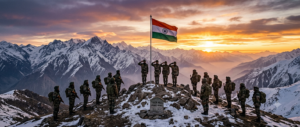
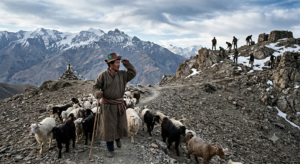
In the first week of May 1999, a Ladakhi shepherd named Tashi Namgyal was doing what he did every spring — climbing after a stray goat into the barren, wind-scoured slopes above the village of Garkhon, near Batalik. He wasn’t looking for history. He was looking for livestock.
What he found instead were armed men in the wrong uniforms, dug into bunkers on terrain that belonged to India, watching the Srinagar-Leh highway through binoculars from a height that let them see everything and be seen by no one.
Namgyal didn’t know it yet, but he had just stumbled onto the opening move of a war that would rewrite the rules of India’s military doctrine, produce some of the most extraordinary stories of individual courage in modern combat history, and end — eleven weeks later, on 26 July 1999 — in a victory so complete that India built a national holiday around the date.
That holiday is Kargil Vijay Diwas. And the story behind it is far stranger, far more human, and far more consequential than the two-line summary most people carry around in their heads: “India fought Pakistan in the mountains and won.” This article tells the fuller story — the miscalculations, the terrain that nearly defeated modern warfare itself, the diplomacy that ran alongside the gunfire, and the men whose names are now etched into India’s collective memory.
What Is Kargil Vijay Diwas and Why Is It Observed on July 26?
Kargil Vijay Diwas — literally “Kargil Victory Day” — is commemorated every year on 26 July, the date in 1999 when the Indian Army announced the successful conclusion of Operation Vijay, the military campaign that evicted Pakistani soldiers and infiltrators from the mountain heights they had illegally occupied on the Indian side of the Line of Control (LoC) in the Kargil sector of Jammu and Kashmir.
The day is marked with wreath-laying ceremonies at the Kargil War Memorial in Dras and at the National War Memorial in New Delhi, moments of silence, military parades, and a nationwide wave of tributes to the soldiers who fought — and the 527 who did not return.
But to understand why this date carries the emotional weight it does, you have to go back further than May 1999. You have to go back to a peace agreement that was supposed to prevent exactly this kind of war.
The Irony Before the War — A Handshake in Lahore
Barely three months before Indian and Pakistani soldiers began exchanging artillery fire on the Kargil heights, the two countries’ prime ministers were shaking hands in Lahore.
In February 1999, Atal Bihari Vajpayee traveled to Pakistan by bus — a symbolic, almost theatrical gesture of peace — and signed the Lahore Declaration with Prime Minister Nawaz Sharif, committing both nations to resolving the Kashmir dispute through dialogue and reducing the risk of accidental nuclear conflict, just months after both countries had conducted nuclear tests in 1998.
What Vajpayee did not know — and what, according to later accounts, even Sharif’s own government was only partially aware of — was that the Pakistan Army, under the command of General Pervez Musharraf, had already begun planning a covert military operation across the LoC. The peace bus and the infiltration plan were, almost unbelievably, running on parallel tracks at the same time.
This is one of the most under-discussed facts of the Kargil story: the war was launched not out of a diplomatic vacuum, but in direct defiance of an active peace process. It is part of why India’s sense of betrayal in 1999 ran so deep, and why the “Kargil misadventure,” as it came to be called even within sections of Pakistan’s own commentary, is remembered as much for its treachery as for its military failure.
Operation Badr — The Plan Behind the Infiltration
The operation Pakistan launched was internally codenamed Operation Badr. Its objective was audacious: infiltrate the unguarded, high-altitude gaps in the Kargil-Dras-Batalik-Mushkoh sector during the harsh winter months — when Indian troops traditionally vacated the highest posts due to extreme cold — and occupy the peaks before the spring thaw.
The strategic logic was threefold:
- Cut the lifeline. The Srinagar-Leh highway (National Highway 1D) runs directly beneath many of these peaks. Controlling the heights meant controlling the only major road link to Ladakh and the Siachen Glacier, effectively strangling Indian logistics to the region.
- Internationalize Kashmir. By creating a fresh military flashpoint, Pakistan’s planners hoped to draw global attention — and pressure — back onto the Kashmir dispute, especially in the newly nuclearized context of South Asia.
- Exploit a seasonal gap. Indian forces typically evacuated the highest outposts each winter and reoccupied them in spring. Pakistani forces — including regular army troops disguised as mujahideen alongside armed infiltrators — moved in during that window, occupying positions before Indian units returned.
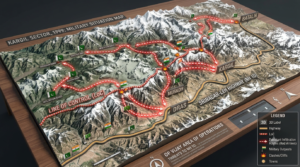
By the time Tashi Namgyal reported what he’d seen, the infiltrators had already dug in across an estimated 130 to 200 square kilometers of ridgeline, at altitudes ranging from roughly 16,000 to over 18,000 feet.
The Terrain That Fought on Both Sides
If there is one factor that separates the Kargil War from almost every other conflict of the modern era, it is the battlefield itself.
Soldiers were fighting at altitudes where the air holds roughly 40% less oxygen than at sea level, temperatures could plunge dozens of degrees below freezing even in July nights, and the “battlefield” was often a near-vertical rock face with no cover, no vegetation, and no room for tanks, armored vehicles, or the kind of mechanized warfare Indian doctrine was built around.
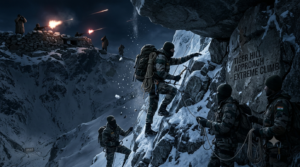
Pakistani troops held the high ground — a decisive advantage in any war, and doubly so here. From their bunkers on the peaks, they could see Indian movements for miles and rain down artillery and small-arms fire on anyone attempting to climb toward them. Indian soldiers, by contrast, often had to scale near-sheer cliffs at night, in sub-zero conditions, carrying rifles, ammunition, and rations up gradients that professional mountaineers would consider extreme — all while under direct enemy observation.
Military analysts have since called Kargil one of the most difficult tactical environments any army has fought in during the 20th century. It was not a war of maneuver; it was a war of vertical assault, where every ridge had to be taken by infantry, on foot, one grueling step at a time.
Operation Vijay — India’s Response Takes Shape
Once the scale of the intrusion became clear, India’s response was named Operation Vijay (“Victory”). It would eventually involve close to 200,000 Indian troops mobilized in and around the conflict zone, though the actual combat force engaged directly in the high-altitude assaults was a fraction of that number — the rest supporting logistics, reserves, and the broader defense posture along the LoC.
Two things made this operation unusual compared to earlier India-Pakistan conflicts.
First, India made a deliberate strategic decision not to cross the Line of Control. Despite immense provocation, Indian forces fought entirely within Indian territory, retaking only what had been illegally occupied. This restraint became a critical diplomatic asset — it meant India could occupy the moral high ground internationally while Pakistan struggled to explain a foreign military presence deep inside territory the world recognized as India’s.
Second, this was the first time India deployed its air force in direct offensive combat operations since the 1971 war, under the codename Operation Safed Sagar. Fighter jets and helicopters conducted precision strikes on infiltrator positions at altitudes that pushed aircraft performance to their limits — engines lose thrust in thin mountain air, and pilots had almost no margin for error navigating narrow valleys under fire, including the loss of aircraft to shoulder-fired missiles early in the operation.
The Battles That Defined the War
The Battle of Tololing
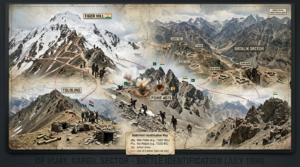
Tololing, a peak rising over 16,000 feet, was one of the first major objectives — and one of the fiercest. Indian infantry, supported by artillery, fought a grinding three-week assault to dislodge entrenched Pakistani positions. Its recapture in mid-June 1999 was the first significant turning point of the war, proving that the seemingly impregnable heights could, in fact, be retaken — at extraordinary human cost.
The Battle of Tiger Hill
Perhaps the single most iconic engagement of the war, the assault on Tiger Hill (over 16,500 feet) became a symbol of the entire campaign. Indian troops scaled a near-vertical rock face under sustained machine-gun and artillery fire to reach the summit, in an operation coordinated with heavy air and artillery support. Its recapture in early July was broadcast into Indian living rooms — a moment that, more than any other, cemented Kargil as a shared national experience rather than a distant military affair.
Point 4875 and the Death of Captain Vikram Batra
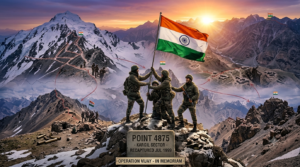
At Point 4875 in the Mushkoh Valley, Captain Vikram Batra of 13 JAK Rifles led the assault that would make his name permanently associated with the Kargil War. His radio call sign and battle cry — “Yeh Dil Maange More” (“This heart wants more”) — became a phrase that outlived the war itself. Batra was killed in action while trying to save a fellow officer during the final push, and was posthumously awarded the Param Vir Chakra, India’s highest wartime gallantry award.
The Battalik Sector
Often overshadowed in popular memory by Tololing and Tiger Hill, the fighting in the Batalik sector — where the infiltration was first detected — was some of the longest and bloodiest of the entire war, involving sustained combat across multiple peaks over several weeks.
The Heroes Behind the Headlines
Kargil produced four Param Vir Chakra recipients, each representing a different face of the extraordinary courage the war demanded:
- Captain Vikram Batra (13 JAK Rifles) — led multiple successful assaults including Point 5140 and Point 4875, and was killed rescuing a wounded comrade.
- Captain Manoj Kumar Pandey (1/11 Gorkha Rifles) — led his platoon in a series of night assaults on Batalik-sector peaks, continuing to fight and inspire his men after being critically wounded, and succumbed to his injuries.
- Grenadier Yogendra Singh Yadav (18 Grenadiers) — as part of the assault on Tiger Hill, scaled a cliff under fire, was hit multiple times, and continued to neutralize enemy bunkers, enabling his company’s advance. He survived and remains one of the youngest Param Vir Chakra recipients in Indian military history.
- Rifleman Sanjay Kumar (13 JAK Rifles) — charged an enemy bunker single-handedly despite being shot, and continued fighting to help capture the position.
These four names are widely taught and remembered, but the war’s true scale is better captured by a harder number: 527 Indian soldiers lost their lives, and well over a thousand were wounded, across eleven weeks of combat that most of the world barely watched unfold in real time.
Hidden Facts and Deeper Analysis of the Kargil War
Beyond the battle names most textbooks cover, several less-discussed dimensions shaped both the war and its legacy:
It was India’s first “television war.” Kargil coincided with the boom of private 24-hour news television in India. For the first time, a war was covered almost live — reporters filed from forward areas, and footage of the Tiger Hill assault reached homes within days. This transformed Kargil from a remote military event into a shared national experience in a way the 1965 and 1971 wars never were, and it fundamentally changed how future Indian governments would have to manage wartime information.
Diplomacy was fought as hard as the mountains. While soldiers climbed under fire, Indian diplomats worked to ensure the world understood one basic fact: the infiltration had occurred entirely on India’s side of an internationally acknowledged Line of Control, drawn under the 1972 Simla Agreement. This framing was decisive. Major powers, including the United States, publicly pressed Pakistan to withdraw — a striking outcome given the usual complexities of the region’s diplomacy, and one that isolated Islamabad even among some of its traditional allies.
Washington played a quiet but pivotal role. On 4 July 1999 — American Independence Day — Prime Minister Nawaz Sharif met President Bill Clinton in Washington. Clinton reportedly pressed Sharif hard to withdraw Pakistani forces unconditionally, warning of the risks of continued conflict between two newly nuclear-armed states. The meeting is widely seen as a turning point that accelerated Pakistan’s decision to pull back.
Musharraf’s calculation misjudged India’s political resolve. Some post-war analyses suggest the operation’s architects believed India, freshly emerging from domestic political instability, would hesitate to respond forcefully, or might seek a negotiated settlement rather than a military one. That assumption collapsed almost immediately once the scale of intrusion became clear and India committed fully to Operation Vijay.
The war reshaped India’s defense establishment. In its aftermath, the Indian government constituted the Kargil Review Committee, whose findings led directly to sweeping reforms — the creation of new intelligence coordination mechanisms, restructuring of higher defense management, and eventually influenced the long-running debate that led to the creation of the Chief of Defence Staff position two decades later. Few wars in Indian history have left such a direct institutional fingerprint.
The infiltrators’ identity was initially disputed — and that dispute mattered strategically. Pakistan initially described the intruders purely as Kashmiri militants or “mujahideen,” distancing its regular army from direct involvement. Indian forces recovered documents, equipment, and identification from Pakistani Northern Light Infantry soldiers among the dead and captured, which India used to demonstrate regular Pakistani army involvement — a claim later corroborated by international reporting and, years afterward, acknowledged in parts of Pakistan’s own domestic discourse.
July 26, 1999 — The Day Victory Was Declared
By mid-July, Indian forces had recaptured the last of the major dominating peaks. On 26 July 1999, the Indian Army officially declared Operation Vijay complete — the infiltrators had been evicted, and Indian territory was fully back under Indian control. The war, which had lasted roughly ten to eleven weeks since the intrusion was first detected in early May, was over.
The date was chosen to mark not just a ceasefire or a withdrawal, but a definitive, on-the-ground military victory — every peak the enemy had occupied had been physically retaken by Indian soldiers, not negotiated back at a table.
The Cost of Victory — By the Numbers
| Metric | Figure |
|---|---|
| Duration of conflict | Roughly May–July 1999 (about 60–75 days) |
| Indian soldiers killed | 527 |
| Indian troops deployed (mobilized in theater) | Close to 200,000 |
| Altitude range of combat | ~16,000–18,000+ feet |
| Key peaks recaptured | Tololing, Tiger Hill, Point 4875, Point 5140, and others across Dras, Batalik, Mushkoh |
| Param Vir Chakra awarded | 4 |
| War officially declared over | 26 July 1999 |
These numbers are worth sitting with. Kargil is sometimes described in shorthand as a “limited war,” and in scope it was — confined to a specific sector, with India deliberately avoiding escalation across the LoC. But for the soldiers who fought at 18,000 feet with no cover and thinning oxygen, there was nothing limited about it at all.
The Legacy of Kargil — Memorials, Reform, and Memory
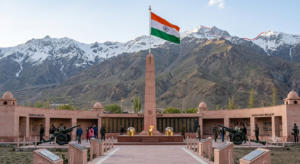
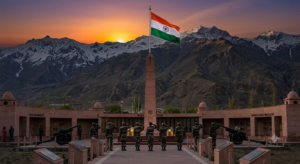
The Kargil War Memorial in Dras, built in 2000 and renovated in 2014, stands at the foot of Tololing and Tiger Hill, inscribed with the names of the fallen beneath the motto “Yeh Dil Maange More” — Vikram Batra’s own words, now belonging to the nation. The National War Memorial in New Delhi, inaugurated in 2019, extends that tribute to soldiers lost across every major conflict in independent India’s history, from 1947 to Kargil and beyond.
Institutionally, Kargil forced a hard look at India’s preparedness. The Kargil Review Committee’s recommendations reshaped intelligence-sharing between agencies, prompted investment in high-altitude warfare equipment and training, and fed into a broader, decades-long conversation about modernizing India’s higher defense organization — a conversation whose effects are still visible in reforms made well into the 2000s and 2010s.
Why Kargil Vijay Diwas Still Matters Today
More than two decades on, Kargil Vijay Diwas endures not just as a military commemoration but as a cultural touchstone — a day that produced war memorials, feature films, television specials, school lessons, and an entire vocabulary of phrases (“Yeh Dil Maange More” chief among them) that have entered everyday Indian usage.
It matters because it is a rare instance in modern history of a war fought almost entirely in full view of the watching public, where individual acts of courage — a captain’s final radio call, a grenadier scaling a cliff under fire — became part of how an entire nation understood sacrifice. And it matters because the terrain and circumstances were so extreme that Kargil is still studied, more than twenty years later, as one of the defining case studies in high-altitude warfare anywhere in the world.
Frequently Asked Questions About Kargil Vijay Diwas
Q1. What is Kargil Vijay Diwas and when is it celebrated? Kargil Vijay Diwas is observed every year on 26 July to commemorate India’s victory over Pakistani infiltrators in the Kargil War of 1999, marking the successful conclusion of Operation Vijay.
Q2. How did the Kargil War start? The war began after Pakistani soldiers and armed infiltrators secretly crossed the Line of Control during the winter of 1998–99 and occupied strategic peaks in the Kargil, Dras, Batalik, and Mushkoh sectors, in an operation codenamed Operation Badr.
Q3. How long did the Kargil War last? The conflict lasted roughly ten to eleven weeks, from the discovery of the intrusion in early May 1999 to India’s declared victory on 26 July 1999.
Q4. How many Indian soldiers died in the Kargil War? India lost 527 soldiers during the Kargil War, with many more wounded in the high-altitude combat.
Q5. Who were the major heroes of the Kargil War? The four Param Vir Chakra recipients were Captain Vikram Batra, Captain Manoj Kumar Pandey, Grenadier Yogendra Singh Yadav, and Rifleman Sanjay Kumar.
Q6. What was Operation Vijay? Operation Vijay was the codename for India’s military campaign to evict Pakistani infiltrators from Indian territory in the Kargil sector, conducted entirely within the Indian side of the Line of Control.
Q7. Why didn’t India cross the Line of Control during the war? India made a deliberate strategic and diplomatic decision to confine operations to its own side of the LoC, which helped it retain international support and cast Pakistan as the clear aggressor.
Q8. Where is the Kargil War Memorial located? The Kargil War Memorial is located in Dras, in the Kargil district of Jammu and Kashmir, at the foot of the Tololing and Tiger Hill peaks.
Conclusion: A Story Written on the Roof of the World
Kargil Vijay Diwas is often reduced, in casual conversation, to a single sentence — India defeated Pakistan’s infiltration in 1999. But underneath that sentence is a story of a shepherd chasing a stray goat into history, a peace bus that crossed paths with a secret war plan, soldiers climbing sheer rock faces in the thin, punishing air above 16,000 feet, and a generation of Indians watching, for the first time, a war unfold on their television screens in something close to real time.
Every 26 July, the flags at Dras and at India Gate are not simply marking a battlefield victory. They are marking the outer edge of what soldiers were willing to endure for a strip of frozen, near-uninhabitable ridgeline — because that ridgeline was, and is, home soil. That is the story Kargil Vijay Diwas asks India to remember every single year.
Imporatant Article as per History Decoded Hub.
- The Kargil War reshaped India’s military and defense strategy, while the Emergency (1975–1977) transformed its political and constitutional landscape. Both events remain defining moments in modern Indian history. To learn more, read our detailed guide on The Emergency in India (1975–1977): Causes, Timeline, Impact, and Legacy.
- Another defining event in India’s modern history was Operation Blue Star (1984), a military operation carried out by the Indian Army to remove armed militants from the Golden Temple complex in Amritsar. The operation had far-reaching political, social, and security consequences that continue to influence India today. Explore the complete story in our detailed article: Operation Blue Star (1984): Causes, Timeline, Events, Impact, and Legacy.
- The Partition of India (1947) was one of the most significant and tragic events in South Asian history, leading to the creation of India and Pakistan. It triggered one of the largest mass migrations in human history and left a lasting impact on politics, society, and India–Pakistan relations. Learn more in our detailed guide: Partition of India (1947): Causes, Timeline, Impact, and Legacy.
- The Revolt of 1857 was India’s first large-scale uprising against British rule, involving soldiers, local rulers, and civilians across northern and central India. Although the rebellion was eventually suppressed, it marked a turning point in India’s freedom struggle and led to major changes in British administration. Explore the complete story in our detailed article: The Revolt of 1857: Causes, Timeline, Major Events, Leaders, Impact, and Legacy.
Official Resources and Further Reading
- Ministry of Defence, Government of India – Official information and commemorations related to Kargil Vijay Diwas and Operation Vijay.
https://www.mod.gov.in/