
Introduction
On a cold October morning in 1066, two armies climbed opposite sides of a narrow hill in the English countryside, neither man in either line fully aware that by sunset, the entire course of English history would be rewritten. One army stood shoulder to shoulder behind locked shields, exhausted from weeks of marching. The other prepared cavalry, archers, and a young duke with everything to prove. Before the day ended, a king would be dead, a crown would change hands, and the English language itself would begin absorbing thousands of foreign words that still sit inside it today.
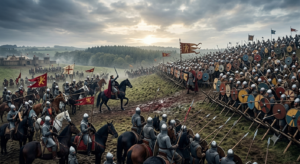
This is the story of the Battle of Hastings — arguably the single most consequential day in English history.
Quick Facts at a Glance
| Fact | Information |
|---|---|
| Date | 14 October 1066 |
| Location | Near Hastings, East Sussex, England |
| Result | Norman Victory |
| Main Commanders | William the Conqueror vs. Harold Godwinson |
| Duration | One day |
| Estimated Soldiers | 12,000–15,000 combined |
| Historical Importance | Ended Anglo-Saxon rule and began Norman England |
Why the Battle of Hastings Still Matters
It’s easy to look at a medieval battle nearly a thousand years old and wonder why it deserves attention today. But the Battle of Hastings isn’t just a story about swords and shields — it’s the hinge point on which English identity turned. The language you’re reading this sentence in exists in its current form partly because of what happened on that hillside. The legal traditions, the class structure, even the architecture of English towns, all trace a line back to 14 October 1066.
Few single days in European history can claim that kind of reach. That’s what makes this battle worth understanding properly, not just as a list of facts, but as a sequence of decisions, accidents, and consequences that still echo forward.
The Throne Sits Empty: How the Crisis Began
Every great conflict needs a spark, and this one began with a death rather than a declaration of war.
The Death of Edward the Confessor
On 5 January 1066, King Edward the Confessor died without an heir. He left behind no son, no clear successor, and — depending on who you believed — possibly three separate promises about who should inherit the throne. In an age where royal succession was rarely a clean, agreed-upon process, this kind of ambiguity was an invitation to conflict.
Within a day, the most powerful noble in England had already been crowned. But he was far from the only man who believed the crown belonged to him.
Three Men, One Crown
Harold Godwinson was the Earl of Wessex and the most powerful English nobleman of his time. He had the backing of the English nobility, control over the country’s military resources, and — crucially — he was already in England when Edward died. He was crowned King Harold II almost immediately, a decision that many historians view as pragmatic as much as it was legitimate.
William, Duke of Normandy told a very different story. William claimed that years earlier, Edward had personally promised him the throne. He went further, insisting that Harold himself had once sworn an oath supporting William’s claim — an oath Harold had, in William’s telling, now broken. Whether this account was entirely accurate or convenient propaganda is something historians still debate, but at the time, it gave William something valuable: a moral justification for invasion, one strong enough to earn him support from Norman nobles and even the Pope.
Harald Hardrada, the King of Norway, added a third claim to the mix. He believed he had inherited rights to the English throne through older agreements between earlier Scandinavian and English rulers. Hardrada wasn’t interested in legal argument — he simply gathered a fleet and sailed for England.
Three ambitious men, three competing claims, and one throne. It’s the kind of succession crisis that medieval Europe produced more often than most people realize, but rarely with consequences this large.
Two Invasions in Three Weeks
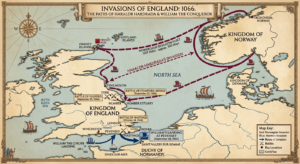
What makes 1066 such a remarkable year isn’t just that England was invaded — it’s that England was invaded twice, by two completely different armies, within the space of about three weeks. Harold Godwinson had to fight both.
The Norwegians Strike First
Harald Hardrada landed in northern England, and Harold Godwinson responded immediately, marching his army nearly 300 kilometers north in a punishing forced march. The two forces met at the Battle of Stamford Bridge on 25 September 1066, and Harold’s army won decisively, effectively ending the Norwegian threat to the throne.
It should have been a triumphant moment. Instead, it became the first half of an exhausting ordeal, because while Harold was celebrating in the north, a second invasion fleet was already crossing the English Channel.
William Lands in the South
Just three days after Stamford Bridge, on 28 September 1066, William landed his forces at Pevensey on the southern coast of England. William had spent months preparing for this moment — securing the backing of Norman nobles, gaining papal support for his claim, assembling a fleet historians estimate at around 700 ships, and waiting patiently for favorable winds to carry his army across the Channel.
Harold now faced an impossible situation. His army, still recovering from the march north and the battle against the Norwegians, had to turn around and march roughly 400 kilometers south to meet a second, fully rested invading force. Fatigue would prove to be one of the quiet, often overlooked factors that shaped what happened next.
The Battlefield: A Hill That Decided a Kingdom
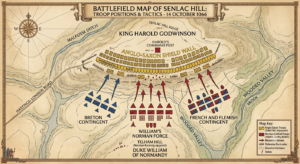
The armies met at Senlac Hill, near the modern town of Battle in East Sussex — a name the settlement carries specifically because of what unfolded there. The terrain itself created two very different tactical pictures for the two commanders.
Harold’s army held the high ground, a natural defensive advantage that let his infantry form a tightly packed shield wall along the ridge. William’s army approached from below, forcing his troops to attack uphill against a well-organized defensive line — a position no experienced commander would choose voluntarily, but one William had little alternative but to accept.
The Two Armies: Contrasting Styles of War
The Anglo-Saxon Army
Harold’s forces were built around housecarls, elite professional soldiers who formed the backbone of English royal military power, supported by the fyrd, a levy of local militia armed with heavy infantry weapons, large shields, and formidable battle-axes.
The Anglo-Saxon shield wall was a genuinely effective defensive formation, capable of absorbing sustained attacks when it held its discipline. But it had one significant weakness: Harold’s army had almost no cavalry and virtually no archers, which meant it was built almost entirely for defense rather than for the kind of flexible, adaptive tactics a battle can demand.
The Norman Army
William’s forces were structured very differently. He brought knights, archers, a limited number of crossbowmen, infantry, and — most importantly — heavily armored cavalry trained for repeated mounted charges. This combination gave William something Harold’s army simply didn’t have: tactical flexibility. He could probe the English lines with archers, test them with infantry, and commit cavalry where weaknesses appeared.
How the Battle Unfolded, Phase by Phase
Phase 1: The Opening Volley
The battle began with Norman archers launching waves of arrows toward the English lines. But because Harold’s men held the high ground behind a dense wall of shields, the arrows did comparatively little damage. It was an inconclusive opening, and both sides likely understood that the real fighting was still ahead.
Phase 2: The Infantry Advance
Norman infantry pushed forward next, climbing the hill to engage the shield wall directly. The English line held firm. For a force that had just completed an exhausting forced march from the north, this discipline under pressure says a great deal about the training and resolve of Harold’s housecarls.
Phase 3: The Cavalry Charges
William then committed his most valuable asset — mounted knights — in repeated charges against the English position. Time and again, the shield wall absorbed the impact and refused to break. For a while, it must have looked to Norman commanders like the hill simply could not be taken by force.
Phase 4: The Feigned Retreat
This is the moment historians return to again and again, because it may be the single decision that determined the outcome of the entire battle. At some point during the fighting, portions of the Norman army appeared to break and retreat down the hill. Seeing what looked like a collapsing enemy, sections of the English line broke formation and pursued them into open ground.
That was the opening William needed. His forces turned and counterattacked the pursuing English soldiers, who were now exposed, disorganized, and cut off from the safety of the shield wall.
Whether this retreat was a deliberate, pre-planned tactic or a genuine retreat that William’s commanders cleverly exploited in the moment is still debated among historians. Either way, it worked, and it began tilting the battle decisively in Norman favor.
Phase 5: The Death of Harold
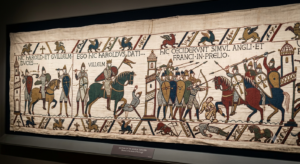
As the day wore on and the shield wall thinned, King Harold was killed. The most famous version of this moment — immortalized in the Bayeux Tapestry — shows Harold struck in the eye by an arrow before being cut down. Historians continue to debate how literally accurate this depiction is, since the Tapestry was commissioned from a Norman perspective and may carry symbolic as well as literal meaning.
What isn’t in dispute is the effect of Harold’s death. Without their king, English resistance collapsed. Leadership in medieval warfare wasn’t just symbolic — it was often the glue holding a formation together, and once that glue was gone, so was any realistic chance of an English victory.
Why William Won
Several factors combined to hand William his victory, and it’s worth separating them out rather than treating the outcome as inevitable:
- Superior tactical flexibility — Norman cavalry and archers gave William options that Harold’s largely defensive force lacked
- Effective exploitation of the feigned retreat — a moment of apparent chaos that Norman commanders turned into a decisive advantage
- Harold’s exhausted army — worn down by the forced march north to Stamford Bridge and back south again in a matter of weeks
- Loss of leadership — Harold’s death at a critical moment broke the cohesion of the English line
- Meticulous Norman preparation — months of assembling ships, securing political backing, and waiting for the right conditions to cross the Channel
None of these factors alone would likely have decided the battle. Together, they produced a result that reshaped a nation.
What Happened Immediately After
William’s victory didn’t end with the battlefield — it triggered a rapid and thorough reorganization of English society. He was crowned King of England on Christmas Day 1066 in Westminster Abbey, earning the title by which history remembers him: William the Conqueror.
In the years that followed, Norman rule replaced the Anglo-Saxon monarchy at every level. Norman nobles were granted vast English landholdings, often at the direct expense of the Anglo-Saxon aristocracy who had held them before. Castles — particularly motte-and-bailey castles — began appearing across the English landscape as a means of securing Norman control over a conquered population. French became the language spoken at the royal court and among the elite, while English, spoken by the majority of ordinary people, began absorbing thousands of French words into its vocabulary — a linguistic shift still visible in modern English today. A new feudal system also took hold, tightening royal control over land, taxation, and loyalty in ways Anglo-Saxon England had never quite achieved.
The Long Shadow: Why the Consequences Lasted for Centuries
Political Centralization
Norman rule brought a far more centralized style of governance than Anglo-Saxon England had known, laying groundwork for the more consolidated monarchy that would follow in subsequent centuries.
A Transformed Language
Modern English carries the fingerprints of this conquest in an enormous share of its vocabulary. Words tied to law, government, art, and cuisine often trace back to Norman French origins, sitting alongside older Anglo-Saxon words in a linguistic layering that’s unique to English among major world languages.
A New Architectural Landscape
Stone castles and Romanesque cathedrals began transforming the English landscape, replacing the wooden structures that had been more common under Anglo-Saxon rule. Many of England’s most recognizable medieval landmarks trace their origins to this Norman building boom.
Law and Governance
Norman administrative practices reshaped how England collected taxes, organized land ownership, and governed at both the local and national level, influencing systems that would evolve over the following centuries.
Closer Ties to Continental Europe
Perhaps most significantly, England’s political and cultural orientation shifted firmly toward continental Europe — and Normandy in particular — a realignment that would shape English foreign relations, land claims, and conflicts on the continent for generations.
The Bayeux Tapestry: A Window Into the Battle
Much of what we know — or think we know — about the visual details of the Battle of Hastings comes from the Bayeux Tapestry, an embroidered narrative nearly 70 meters (about 230 feet) long that illustrates the events leading up to and including the Norman Conquest.
It’s an extraordinary historical resource, but it comes with an important caveat: the Tapestry reflects a Norman perspective on the events it depicts. Historians generally treat it as a valuable but not entirely neutral source, best understood alongside other historical accounts rather than as a literal, unbiased record.
Interesting Facts About the Battle of Hastings
- The battle lasted most of a full day — unusually long by the standards of medieval warfare, which often produced decisive results in far less time
- William reportedly had three horses killed beneath him during the fighting, underscoring how personally exposed even commanders were in medieval combat
- Harold’s body was reportedly difficult to identify after the battle, adding to the enduring uncertainty around the exact circumstances of his death
- The battlefield later became the site of Battle Abbey, reportedly founded by William, in part as an act of penance for the bloodshed
- The Norman Conquest remains the last successful foreign conquest of England — no invading force has taken the English throne by military force since 1066
Timeline of Events
| Date | Event |
|---|---|
| 5 January 1066 | Edward the Confessor dies |
| 6 January 1066 | Harold Godwinson crowned king |
| 25 September 1066 | Battle of Stamford Bridge |
| 28 September 1066 | William lands at Pevensey |
| 14 October 1066 | Battle of Hastings |
| 25 December 1066 | William crowned King of England |
Why Historians Consider Hastings a Turning Point
The Battle of Hastings was never just a single day of fighting — it was the beginning of an entirely new chapter for England. It marked the end of Anglo-Saxon rule and the start of Norman England, a shift that reshaped government, language, architecture, land ownership, and international relations for generations that followed. Few military engagements in European history can claim to have redirected an entire nation’s trajectory as decisively as this one did.
Understanding Hastings isn’t just about memorizing dates and commanders. It’s about recognizing how a single day of decisions, exhaustion, and battlefield tactics rippled forward into the language we speak and the institutions that still shape modern England.
Frequently Asked Questions
When did the Battle of Hastings take place? The Battle of Hastings was fought on 14 October 1066, near the town of Hastings in East Sussex, England.
Who fought in the Battle of Hastings? The battle was fought between King Harold II (Harold Godwinson) of England and William, Duke of Normandy, who later became known as William the Conqueror.
Who won the Battle of Hastings? William, Duke of Normandy, won a decisive victory. He was crowned King of England on Christmas Day 1066, ending Anglo-Saxon rule and beginning the Norman era of English history.
Why is the Battle of Hastings important? The battle marked the end of Anglo-Saxon England and the beginning of Norman rule, which transformed English language, law, architecture, land ownership, and its relationship with continental Europe for centuries afterward.
How did King Harold II die? According to the Bayeux Tapestry, Harold was struck in the eye by an arrow before being killed. However, historians debate whether this depiction is literally accurate, since the Tapestry reflects a Norman perspective on events.
What was the “feigned retreat” at the Battle of Hastings? The feigned retreat was a moment when Norman forces appeared to retreat down the hill, drawing pursuing English soldiers out of their defensive formation. Norman troops then turned and counterattacked the exposed pursuers, a maneuver that significantly weakened the English shield wall. Historians still debate whether this was a planned tactic or an exploited accident.
Why did Harold’s army lose despite holding the high ground? Several factors contributed, including Harold’s exhausted troops (who had just marched to and from the Battle of Stamford Bridge), a lack of cavalry and archers in the English army, the effectiveness of the Norman feigned retreat, and the collapse of English morale following Harold’s death.
What happened to England after the Battle of Hastings? Norman rule replaced the Anglo-Saxon monarchy, Norman nobles received English lands, castles spread across the country, French became the language of the royal court, and a new feudal system tightened royal control over English governance.
What is the Bayeux Tapestry and why is it important to this battle? The Bayeux Tapestry is an embroidered artwork nearly 70 meters long that depicts the events of the Norman Conquest, including the Battle of Hastings. It’s one of the most valuable visual sources historians have for the battle, though it reflects a Norman point of view.
Is the Battle of Hastings the last time England was invaded successfully? Yes. The Norman Conquest remains the last successful foreign military conquest of England, making 1066 one of the most significant dates in English history.