
Introduction
There are wars that last decades and leave only slow, grinding scars on history. And then there are wars like the Falklands — brief, sharp, and so consequential that their political aftershocks outlasted the fighting by generations. From 2 April to 14 June 1982, Argentina and the United Kingdom fought a conflict that lasted just 74 days over a small, windswept archipelago in the South Atlantic Ocean. Yet in those 74 days, the fates of two governments were decided, the careers of political leaders were made and broken, and the world was reminded of a truth that diplomats often prefer to forget: territorial disputes, left unresolved long enough, have a way of becoming wars.
The Falklands War was not an accident. It was the collision of two very different kinds of desperation — an Argentine military junta fighting for its political survival, and a British prime minister fighting to prove that her nation still had the will and the capability to defend what it believed was its own. That collision, played out across 13,000 kilometers of ocean, produced one of the most studied military and political events of the late twentieth century.
This is the story of how it happened, what was fought over, and why it still matters.
Where in the World Are the Falkland Islands?
Before anything else, it helps to understand just how remote and unlikely a stage the Falkland Islands were for a major international conflict.
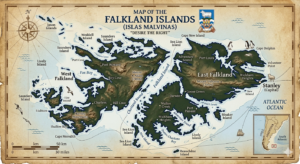
The Falklands are an archipelago of roughly 200 islands located approximately 500 kilometers — about 310 miles — east of the southern tip of Argentina in the South Atlantic Ocean. They are cold, windswept, and sparsely populated. At the time of the war, around 1,800 people lived there, mostly sheep farmers and their families, overwhelmingly of British descent. The two main islands — East Falkland and West Falkland — are separated by Falkland Sound, a strait of choppy, unpredictable water. The capital, Stanley, sits on the eastern coast of East Falkland and is still today a small town of just a few thousand people.

Britain has administered the islands since 1833. Argentina — which refers to them as the Islas Malvinas — has disputed British sovereignty almost from that very year, arguing that the islands are a natural geographic extension of Argentine territory and that British control is a colonial legacy that must be corrected.
For nearly 150 years, that dispute lived mostly in diplomatic channels — in protests, in UN resolutions, in bilateral talks that occasionally raised hopes and then dashed them. By 1982, patience on the Argentine side had run out entirely. But the method chosen to resolve the dispute was not diplomacy. It was an invasion.
The Road to War: Argentina’s Desperate Gamble
To understand why Argentina chose to invade in April 1982, you have to understand the state Argentina was in at the time.
By the early 1980s, the country was governed by a military junta — a ruling council of generals and admirals who had seized power in a coup in 1976. In the years that followed, the junta had presided over one of the darkest periods in Argentine history: the so-called “Dirty War,” in which thousands of political opponents, dissidents, and ordinary citizens were disappeared, tortured, and killed by state security forces. The human cost was catastrophic, and by the early 1980s, the full weight of what had happened was beginning to press down on the regime.
At the same time, the economy was unraveling. Inflation was soaring. Unemployment was rising. Public anger was building to a point where even the tools of repression that the junta had relied upon seemed insufficient. The generals needed something to change the conversation — something that could rally the Argentine people around the government rather than against it.
The Falkland Islands seemed to offer exactly that. The claim to the Malvinas was genuinely popular across Argentine society, cutting across political lines in a way that few other issues could. If the junta could present itself as the government that finally reclaimed the islands — fulfilling what generations of Argentines had been taught was a sacred national right — it might buy itself the legitimacy it was rapidly losing.
The junta also made a crucial military calculation: Britain would not fight back. The Falklands were 13,000 kilometers from Britain. The British government had been quietly signaling for years that it had little strategic interest in the islands. A Royal Navy vessel that had served in Falklands waters had been scheduled for decommissioning. A small garrison of Royal Marines was the only military presence on the islands. Surely, the generals reasoned, London would accept the reality on the ground rather than wage a costly, distant war over a territory it seemed to barely care about.
It was a catastrophic miscalculation.
The Invasion: April 2, 1982
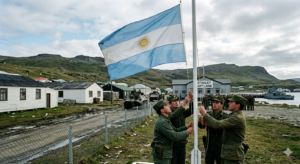
On 2 April 1982, Argentine forces launched their invasion of the Falkland Islands. It was swift and overwhelming. The small detachment of Royal Marines at Moody Brook barracks fought back with remarkable courage against a force many times their size, inflicting casualties before being ordered to surrender. By the end of the day, the islands were under Argentine control. Governor Rex Hunt was flown off the islands. The Argentine flag was raised over Stanley.

The following day, Argentine troops occupied South Georgia — a remote British territory several hundred kilometers to the southeast — completing the initial phase of the operation.
In Buenos Aires, crowds gathered in the Plaza de Mayo to celebrate. For many Argentines, regardless of their feelings about the junta, the taking of the Malvinas felt like the correction of a long historical injustice. The junta had gambled, and in the short term, the gamble seemed to be paying off.
But in London, the reaction was something the generals had not properly accounted for.
Britain Strikes Back: The Task Force Sets Sail
Prime Minister Margaret Thatcher had been in office since 1979. By 1982, her government was unpopular, her economic policies were deeply controversial, and her personal approval ratings were low. The invasion of the Falklands confronted her with a crisis that was also, in political terms, an opportunity — but only if she responded with total resolve.
She did.
Within hours of the invasion, Thatcher convened her War Cabinet. The decision was made quickly: Britain would not accept the occupation. A naval task force would be assembled and dispatched to the South Atlantic to retake the islands by force if necessary. The United Nations was called upon; Resolution 502 was passed demanding an immediate Argentine withdrawal. Diplomatic efforts were launched, particularly through the United States, where Secretary of State Alexander Haig attempted a mediation that ultimately failed.

On 5 April 1982 — just three days after the invasion — a fleet of warships, submarines, aircraft carriers, amphibious assault vessels, and supply ships departed British ports for the South Atlantic. It was one of the largest British military deployments since the Second World War. Requisitioned civilian ships — ocean liners like the QE2 and the Canberra — were rapidly converted to troop carriers. Thousands of soldiers, sailors, and airmen were on their way to a war at the far end of the world.
The sheer audacity of the undertaking was extraordinary. Britain was proposing to mount an amphibious assault on a heavily defended set of islands 13,000 kilometers from home, with a winter approaching in the Southern Hemisphere, against a military that had had weeks to dig in and prepare defenses. Many military analysts were privately sceptical. Some were openly doubtful.
The task force sailed anyway.
War at Sea: HMS Sheffield and the General Belgrano
While the task force made its way south, a maritime exclusion zone was declared around the Falklands. Any Argentine vessel found within it could be attacked. The naval war began in earnest in early May.
The most controversial single event of the entire conflict occurred on 2 May 1982, when the British nuclear submarine HMS Conqueror sank the Argentine cruiser ARA General Belgrano. The attack killed more than 300 Argentine sailors — the single deadliest event of the war. What made it controversial was that the Belgrano was sailing outside the exclusion zone and appeared to be moving away from the islands at the time of the attack. The decision to sink it has been debated ever since, with critics arguing it was unnecessary and supporters insisting it represented a legitimate military threat that could not be left unchecked.
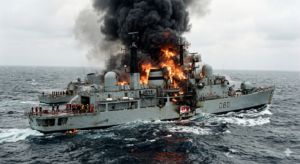
Two days later, Argentina struck back. An Argentine Super Étendard aircraft, flying at low altitude to avoid radar, launched an Exocet AM39 anti-ship missile that struck the British destroyer HMS Sheffield. The missile set the ship on fire; 20 British sailors died, and the vessel was eventually lost. It was a moment that stunned the world. A relatively cheap, precision-guided missile had defeated a modern naval destroyer. Every navy on earth drew the lesson.

The naval campaign demonstrated with brutal clarity that modern warfare at sea was far more dangerous than doctrine had suggested. Anti-ship missiles, electronic warfare, and the vulnerability of surface vessels to low-flying aircraft fundamentally altered how military planners thought about naval combat.
The Air War: Harriers and Heroism
The Falklands War is remembered as much for its air battles as for anything that happened on land or at sea.
Argentine pilots — many of them flying A-4 Skyhawks, Mirage IIIs, and Super Étendards — conducted some of the most daring low-level attack missions in the history of aerial warfare. Flying beneath British radar coverage and releasing their bombs at extremely low altitude to avoid surface-to-air missiles, they pressed home attacks on the British fleet with remarkable courage. Several British ships were hit and sunk or badly damaged. It was later revealed that many Argentine bombs failed to detonate because they were released from such low altitude that they did not have time to arm — had they done so, British losses could have been considerably worse.
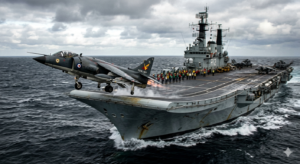
Against them, the British deployed Sea Harrier jump jets, flying from the aircraft carriers HMS Hermes and HMS Invincible. The Sea Harrier’s performance exceeded almost all expectations. Equipped with the advanced AIM-9L Sidewinder missile, it proved highly effective in aerial combat, destroying a significant number of Argentine aircraft without a single loss to enemy fighters. The aircraft became a symbol of the conflict, and its success secured its place in aviation history.

The air campaign demonstrated a truth that has only become more relevant in the decades since: in modern warfare, control of the skies is not simply an advantage. It is a prerequisite for almost everything else.
The Ground War: Fighting Across the Falklands
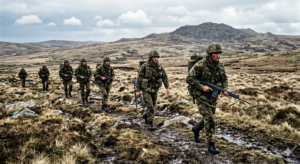
British forces established their main beachhead at San Carlos Water on the western side of East Falkland on 21 May 1982. From there, they began a long, grueling march eastward toward Stanley, fighting across some of the most inhospitable terrain imaginable — boggy moorland, freezing winds, and ridgelines occupied by dug-in Argentine defenders.
The battles that followed were hard and costly on both sides.
At Goose Green, on 28 and 29 May, the 2nd Battalion Parachute Regiment attacked a well-defended Argentine position and won a victory that sent a vital signal — to the British public, to the Argentine command, and to the world — that the land campaign was serious and could succeed. The battalion’s commanding officer, Lieutenant Colonel H. Jones, was killed leading an assault on an Argentine machine gun position; he was posthumously awarded the Victoria Cross.
At Mount Longdon, fought in darkness on the night of 11–12 June, 3 Para fought a brutal, close-quarters battle against defenders who knew the ground and were prepared to hold it. The fighting was ferocious. Casualties on both sides were heavy. One British soldier, Sergeant Ian McKay, also received a posthumous Victoria Cross for his actions that night.
The Battles of Wireless Ridge and Mount Tumbledown followed in quick succession, with British forces slowly but relentlessly tightening the noose around Stanley. Argentine resistance, though often fierce, was finally breaking down. Logistics were failing. Morale was collapsing. Many of the Argentine troops were young conscripts, poorly equipped and inadequately supplied, who had been waiting in freezing foxholes for weeks.

By 13 June, Stanley was surrounded. Argentine forces held the high ground no longer. On 14 June 1982, Brigadier General Mario Menéndez signed the instrument of surrender. The war was over.
The Human Cost
The statistics are relatively modest by the standards of twentieth century conflicts. But behind every number is a person.
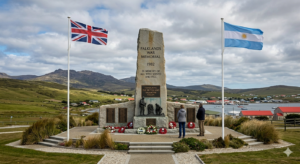
Argentina lost approximately 649 military personnel. The United Kingdom lost 255 service personnel. Three Falkland Islands civilians were also killed. Hundreds more on both sides were wounded. Thousands of Argentine soldiers spent time as prisoners of war before being repatriated. And many veterans on both sides — but particularly the young Argentine conscripts who had been thrust into a war they had not chosen — returned home carrying psychological wounds that took years, or decades, to surface and be acknowledged.
The Argentine government has documented a disturbing statistic in the years since: more Argentine Falklands veterans have died by suicide in the decades following the war than were killed in the conflict itself. It is a reminder that the human cost of war is never fully captured in the casualty figures announced when the fighting ends.
What the War Did to Britain
For Margaret Thatcher and the United Kingdom, the outcome of the Falklands War was transformative. Thatcher’s political fortunes, which had been struggling before the conflict, were dramatically and lastingly reversed by the victory. The “Iron Lady” — a nickname originally coined as an insult by Soviet media — became a genuine expression of how many British people came to see her. Her resolve during the crisis, her refusal to consider anything short of full Argentine withdrawal, and the successful military outcome combined to make her one of the most powerful political figures Britain had seen in a generation.
The victory also reinforced Britain’s sense of itself as a serious military power — a nation that could project force across enormous distances, mount a complex combined-arms operation, and succeed against a professional military opponent. Defence spending increased. A permanent garrison was established on the islands. The Falklands would never again be left lightly defended.
What the War Did to Argentina
The effect on Argentina was almost precisely the reverse.
The junta had staked its political survival on the Falklands gamble. When that gamble failed, there was nothing left to prop the regime up. The loss of the war shattered what little legitimacy the military government still possessed. Protests erupted across the country. The economy continued to deteriorate. The generals, who had ruled Argentina with violence and repression for six years, found themselves unable to command even the basic loyalty of the population they had terrorized.
Within a year of the surrender, the junta had collapsed. Democratic elections were held in October 1983. Raúl Alfonsín won the presidency, and Argentina began the long, painful process of confronting what the military government had done during the Dirty War.
It was a democratic rebirth that emerged, improbably, from the wreckage of military failure. The Falklands War did not create Argentine democracy, but it accelerated its return in a way that years of protest alone had not managed to do.
Historical Significance: Why It Still Matters
More than four decades after the surrender in Stanley, the Falklands War continues to shape both countries and the relationship between them.
Argentina still claims sovereignty over the islands. It remains an article of faith in Argentine politics — one that transcends party lines, economic policies, and generational change — that the Malvinas are Argentine and that the matter remains unresolved. The claim is now pursued through diplomatic channels, through arguments at the United Nations, through bilateral negotiations. But it has not been abandoned.
Britain maintains a strong military presence on the islands and has made clear, repeatedly, that it will defend them. The islanders themselves — who numbered around 3,000 in the most recent census — voted in a 2013 referendum on their political status. The result was 1,513 votes to remain a British Overseas Territory. Three people voted against. The islanders’ own wishes, barely a footnote in 1982, have become central to the contemporary political debate.
The war also left a lasting mark on military thinking worldwide. The performance of anti-ship missiles — particularly the Exocet — changed how navies planned for conflict. The success of the Sea Harrier demonstrated the value of VSTOL aircraft in a way that influenced procurement decisions for decades. The logistics of assembling and deploying a task force across 13,000 kilometers in three weeks became a case study taught in military staff colleges around the world.
And the political lesson — that a military junta’s attempt to use a foreign adventure to shore up domestic popularity can result in the complete destruction of that regime — has been cited in analyses of other conflicts ever since.
Conclusion
The Falklands War was, in the most literal sense, a conflict over a remote group of islands that most people on earth could not have located on a map in April 1982. But it was never really about the islands. It was about pride — Argentine national pride, wounded over 150 years of a sovereignty claim that went unresolved. It was about political survival — a junta’s desperate calculation that a military victory could substitute for democratic legitimacy. And it was about resolve — a British prime minister’s determination to demonstrate that occupation of British territory would not be accepted quietly.
The 74 days of fighting answered those questions, at enormous human cost, in ways that nobody fully predicted. Argentina’s junta fell. Britain’s prime minister was transformed. A generation of soldiers, sailors, and airmen on both sides lived — and in too many cases, died — with the consequences.
More than four decades on, the Falklands War remains one of the most important and most studied conflicts of the modern era. It is a reminder that history’s most consequential moments do not always unfold on the largest stages, and that 74 days can be more than enough time to change the world.
Important Artical on History You Must Read
Read Next: The Thirty Years’ War – Europe’s Most Devastating Religious Conflict
Discover how a conflict that began in the Holy Roman Empire transformed the political and religious landscape of Europe.
Explore: The Story of Cleopatra – Egypt’s Last Powerful Queen
Learn about the life, political alliances, and dramatic downfall of one of history’s most famous rulers.
Read More: Ibn Battuta – The Greatest Traveler of the Medieval World
Follow the extraordinary journeys of Ibn Battuta as he traveled across Africa, Asia, and the Middle East.
Discover: Humayun – The Mughal Emperor Who Lost and Regained an Empire
Explore the challenges, exile, and remarkable comeback of the second Mughal emperor.
External Link Suggestion
Learn More About the Falklands War
Imperial War Museums (IWM) – Falklands War Overview
Imperial War Museums Falklands War Overview
This authoritative resource provides detailed information about the causes, major battles, key events, and legacy of the Falklands War.