
Introduction
In the long, glittering story of the Mughal Empire, Humayun is often the name people skip over. He sits sandwiched between his father Babur — the battle-hardened founder who built an empire from scratch — and his son Akbar, who would go on to become one of the greatest rulers in world history. Between two such giants, Humayun tends to get lost.
That is deeply unfair.
Humayun’s story is not a story of mediocrity. It is a story of a man who was knocked down harder than most kings ever are, who wandered in exile for fifteen years with almost nothing to his name, and who still refused to let his dynasty die. Without his stubbornness, there is no Akbar. Without his suffering in Persian exile, there is no Mughal golden age of art and architecture. Without this imperfect, bookish, generous king simply refusing to quit, the story of India looks entirely different.
This is that story.
A Prince Built for the Throne
Humayun was born on 6 March 1508 in Kabul, the eldest son of Babur and his wife Maham Begum. His full name — Nasir-ud-Din Muhammad Humayun — carried weight and expectation. The word Humayun itself is Persian for “fortunate.” It was a beautiful, optimistic name. Life would spend decades testing whether it was deserved.
From the very beginning, he was shaped for greatness. His education was royal in every sense — Persian, Arabic, Turkish, mathematics, astronomy, literature, and military strategy. Babur did not merely send his son to tutors; he took him on campaigns, stood him close enough to battle to understand what war truly costs, and gave him real administrative responsibilities while he was still a young man. The message was unmistakable: this boy would carry the dynasty forward.
Humayun absorbed it all eagerly. He grew into a man of genuine intelligence and wide curiosity — someone as comfortable with a book of poetry as with a sword. He was kind, thoughtful, and generous by nature. He loved astronomy, was fascinated by the stars, and had a scholar’s instinct for collecting and preserving knowledge. All admirable qualities. And, as it turned out, not quite sufficient armour for the brutal business of holding an empire together.
The Crown at Twenty-Two
Babur died on 26 December 1530, and in a single moment, Humayun went from beloved heir to sole emperor. He was twenty-two years old, inheriting a vast but dangerously unstable domain across northern India. On paper, the empire was magnificent. In reality, it was a map full of enemies.
Afghan chiefs watched the new ruler and measured his resolve. Rajput kings tested his borders. Most dangerously of all, his own brothers — Kamran, Askari, and Hindal — nursed ambitions of their own. Each one was a potential rival. Each one controlled men and territory.
Humayun’s response to this threat revealed the essential tension at the heart of his character. Rather than assert dominance and crush potential rivals before they could grow, he chose generosity. He gave Kamran Kabul and Punjab. He gave Askari important northern territories. He parcelled out provinces to Hindal. It was a peacekeeping gesture, rooted in genuine family feeling.
It was also a catastrophic political miscalculation. He had voluntarily handed away the very sinews of his strength to men who would not always repay that trust. The empire he inherited was already fragile. He had just made it more so.
Victory Without Follow-Through
In the early years, Humayun showed he could fight. In 1532, he defeated Mahmud Lodi, an Afghan challenger who had raised a flag against Mughal authority. In 1535, he swept into Gujarat and beat Sultan Bahadur Shah, capturing significant territories. Real victories, hard-won on real battlefields.
But a pattern kept reasserting itself, and it was a fatal one. Humayun would win — and then hesitate. He would take a territory and fail to consolidate it. He would gain ground, lose focus, and allow what he had earned to quietly slip away. He had the ability to excel in the moment and the tendency to falter in the aftermath. Historians have noted it again and again: brilliant in battle, poor in follow-through.
Meanwhile, in Bihar, a self-made Afghan chieftain named Sher Khan — who history would remember as Sher Shah Suri — was doing everything Humayun was not. He was building roads and organizing revenue systems. He was training armies with methodical discipline and laying administrative foundations of extraordinary sophistication. While Humayun’s attention wandered, Sher Shah grew. By the time Humayun recognized the threat, it was already enormous.
The Two Defeats That Broke an Empire
The reckoning came in two terrible blows.
At the Battle of Chausa in 1539, fought near present-day Bihar, Sher Shah caught the Mughal forces unprepared and crushed them. Humayun narrowly escaped with his life, reportedly crossing the Ganges River by clinging to a water-skin. He survived. His army largely did not. His authority never fully recovered from the shock.
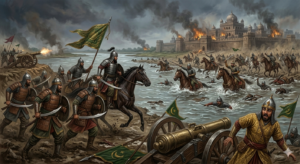
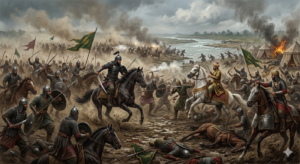
Then came Kannauj, in May 1540. This time Sher Shah was utterly ruthless. He delivered a decisive, annihilating defeat that left no room for recovery. Delhi fell. Agra fell. The empire that Babur had spent years building in blood and brilliance collapsed in a single season. Sher Shah founded the Sur Empire in its place, and Humayun — the Emperor of Hindustan, the son of Babur — became a man without a country, without an army, and without a home.
He was thirty-two years old. His life’s work lay in ruins around him.
Fifteen Years in the Wilderness
What followed is one of the most extraordinary periods of exile in the history of any royal dynasty. For fifteen years, Humayun wandered — through the deserts of Sindh, through hostile territories, through courts that ranged from sympathetic to cold to outright treacherous. His own brother Kamran, the very man he had so generously gifted Kabul and Punjab, refused to help him in his darkest hours. The loneliness of those years — the humiliation of an emperor reduced to begging neighbouring rulers for shelter — is difficult to fully imagine.
And yet the exile gave him things that no throne ever could.
In 1541, wandering through Sindh with few resources and fewer options, Humayun married Hamida Banu Begum, a young woman of remarkable intelligence and quiet inner strength.
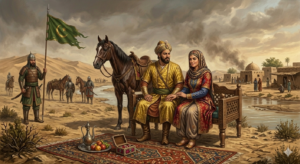
She would become the truest companion of his wandering years and, long after his death, the woman who would build his eternal monument. The following year, in 1542, at a place called Umerkot, their son was born in conditions of near-poverty. They named him Akbar. The child who would one day rule one of the greatest empires in world history arrived with his father owning almost nothing — an emperor in name only, his future balanced on the edge of uncertainty.
The turning point came when Humayun finally reached the court of Shah Tahmasp I of Persia. The Persian ruler received the exiled Mughal with ceremony and offered what he desperately needed: soldiers, financial support, and a genuine path forward. In return, Humayun accepted Persian cultural influence at his future court. Neither man fully grasped what that bargain would eventually mean for India. The Persian painters, poets, calligraphers, and architects who accompanied Humayun back east would quietly transform Mughal civilization. Art, architecture, court traditions, literature — all of it would carry the fingerprints of those lost years in Persia.
The exile that destroyed Humayun’s first reign planted the seeds of everything magnificent about the second.
The Long Road Back
In 1545, fate shifted. Sher Shah Suri died suddenly, killed by an exploding gunpowder store during a siege at Kalinjar. It was an almost absurdly random ending for a man who had been so methodically brilliant. Without its architect, the Sur Empire that had displaced the Mughals began to fracture along internal fault lines. Rivals quarrelled. Authority splintered.
Humayun moved.
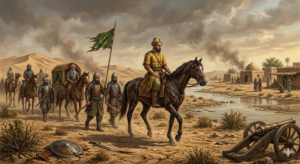
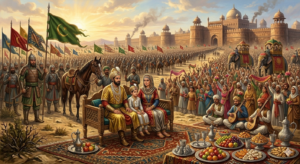
Piece by piece, with patience and precision that his younger self had lacked, he reclaimed what had been taken. Kandahar. Kabul. Punjab. Lahore. The Sur commanders, leaderless and increasingly desperate, could not hold back an opponent who had spent fifteen years learning what it truly meant to fight for survival. In July 1555, Humayun marched into Delhi. The city that had expelled him a decade and a half before opened its gates.
He was not the same man who had fled. Exile had done what no education could — it had stripped away the softness and hesitation that had defined his early reign, replacing them with a harder, more patient resolve. He had learnt to endure. He had learnt to wait. And he had returned carrying something extraordinary: a vision of culture, shaped by Persia and refined by suffering, that would define the Mughal world for centuries to come.
The Final Six Months
Humayun’s second reign lasted barely six months. He set about reorganizing his administration, restoring order to the capital, and beginning to build the stable governance that had eluded him in his first reign. There was a sense of purpose in those months — a man finally given the chance to do what he had always been capable of, if life had only allowed it.
It did not allow it for long.
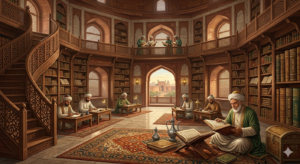
On 24 January 1556, Humayun was descending the stairs of his library in Delhi at dusk when the adhan — the call to evening prayer — rang out across the city. True to his deeply devout nature, he stopped immediately and moved to kneel. His foot caught the edge of a stone step. He fell down the staircase and suffered severe injuries.
Three days later, on 27 January 1556, Nasir-ud-Din Muhammad Humayun was dead. He was forty-seven years old.
His son Akbar, thirteen years old and far away in Punjab, became emperor of the Mughal dynasty.
There is something quietly devastating about how Humayun died — not in battle, not through betrayal, but on the stairs of a library, interrupted mid-prayer. He was felled, in the end, by the very qualities that made him who he was: his love of books and his instinct for devotion.
The Legacy He Left Behind
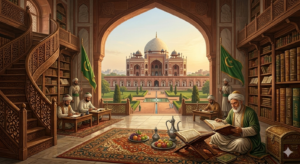
Humayun’s devoted wife Hamida Banu Begum refused to let him dissolve into footnotes. She commissioned a tomb in Delhi that would stop people in their tracks for centuries — a grand garden-tomb of red sandstone and white marble, its great dome rising above a paradise garden of water channels and symmetrical pathways. It was the first major garden-tomb ever built in India, an early masterpiece of Mughal architecture, and the building whose design directly inspired the Taj Mahal. Today it stands as a UNESCO World Heritage Site, visited by millions who may not always pause to fully consider whose memory they are honouring.
But his most significant legacy was not a building. It was a dynasty.
When Humayun handed power to Akbar, he did not leave behind a crumbling ruin. He left a restored, functioning empire with the cultural seeds of something extraordinary already planted deep within it. Akbar took those seeds and grew them into the Mughal golden age — the age of religious tolerance, sublime architecture, flourishing arts, and administrative genius that still shapes how the world imagines Mughal India.
None of that is possible without Humayun’s fifteen years of wandering. None of it is possible without the Persian court, the Persian artists, and the cultural transformation that exile forced upon him. None of it is possible without a man who, by every reasonable measure, should have accepted defeat somewhere in the deserts of Sindh — and simply could not bring himself to do it.
Conclusion: The Man History Almost Forgot
History remembers Babur for founding the Mughal Empire. It remembers Akbar for perfecting it. Humayun sits quietly between them, the imperfect middle chapter in an extraordinary story.
But he was the hinge on which everything turned. He was the man who preserved the dynasty when it had every rational reason to collapse. He carried Mughal civilization through a fifteen-year crucible of exile and returned it transformed — richer, deeper, and more beautiful than it had been before. He placed in his thirteen-year-old son’s hands not merely a throne, but a living culture with centuries of greatness still ahead of it.
He was too kind for his own political good. He was indecisive at the moments that demanded decisiveness most. He stumbled — literally — at the very end of his life. But he never once stopped moving forward. He never accepted that what had been lost could not be recovered. And in the end, that refusal to surrender was the most important thing any Mughal emperor ever did.
Humayun was not the greatest ruler of his dynasty. He was simply the one without whom none of the others would have been possible.
The man named “Fortunate” spent a lifetime earning that name. In the end, it fit.
Important Artical as per History Decoded Hub
1. The Story of Cleopatra: Egypt’s Last Powerful Queen
Anchor Text:
While Humayun struggled to preserve his empire, other rulers such as Cleopatra, Egypt’s Last Powerful Queen, also fought to protect their kingdoms against powerful enemies.
2. The Thirty Years’ War: Europe’s Most Devastating Religious Conflict
Anchor Text:
The political instability faced by Humayun can be compared to the chaos of the Thirty Years’ War, which reshaped the balance of power in Europe.
3. Ibn Battuta: The Greatest Traveler of the Medieval World
Anchor Text:
During his years of exile, Humayun traveled across different regions, much like the journeys described in the story of Ibn Battuta, the Greatest Traveler of the Medieval World.
External Links
1. Encyclopaedia Britannica – Humayun
https://www.britannica.com/biography/Humayun
Learn more about Humayun’s life and reign from Encyclopaedia Britannica.