
Introduction: Why Rolex Is More Than a Watch
There’s a moment every Rolex owner remembers. The first time the clasp clicks shut on their wrist. The quiet, satisfying weight of it. The dial catching the light just so.
It’s not just a watch. It never was.
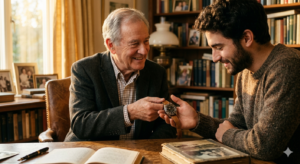
Rolex sits at a rare intersection — part precision instrument, part cultural icon, part heirloom, part obsession. Politicians wear it in press conferences. Explorers strap it to their wrists before descending into the deep ocean. Collectors hunt for it at auctions with the intensity of art dealers chasing a Picasso. And somewhere right now, a grandson is opening a velvet box to find his grandfather’s Submariner, still ticking.
How does a timepiece earn that kind of reverence? The answer starts over a century ago, in the hands of a 24-year-old German with an idea and an extraordinary amount of ambition.
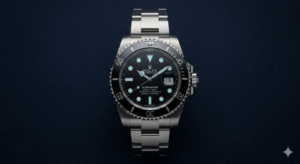
The Birth of Rolex: 1905–1926
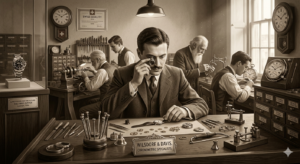
The year was 1905. A young entrepreneur named Hans Wilsdorf arrived in London with a vision that most of the watchmaking world thought was borderline absurd: he wanted to put a precision timepiece on the wrist.
At the time, wristwatches were considered little more than jewellery — delicate, inaccurate, and frankly, a bit feminine. Serious men wore pocket watches. But Wilsdorf saw something others didn’t. The wristwatch, he believed, was the future.
Together with his brother-in-law Alfred Davis, he founded a small watch distribution company called Wilsdorf & Davis. They sourced Swiss movements and fitted them into cases, selling to jewellers across England. The work was unglamorous. The margins were thin. But the vision was clear.
Three years later, in 1908, Wilsdorf registered a name that would one day become the most recognised luxury brand on the planet: Rolex. He chose it deliberately — short, easy to pronounce in any language, elegant on a dial. The name felt like the sound of a watch being wound, he reportedly said.
By 1910, the company had achieved something remarkable: a Rolex wristwatch became the first wristwatch in the world to receive a Swiss Certificate of Chronometric Precision — the kind of official accuracy previously reserved only for marine and observatory clocks.
The scrappy little London firm was making a statement. The world, slowly, began to listen.
The Innovations That Changed Watchmaking Forever
If Rolex’s story were only about beautiful design, it would be a footnote in horological history. What elevated it to legend was a relentless appetite for solving problems nobody else was even trying to solve.
1926 — The Oyster: The World’s First Waterproof Watch
In the 1920s, watches and water were sworn enemies. Dust, humidity, even a rain shower could ruin a movement. Then Rolex changed the equation entirely.
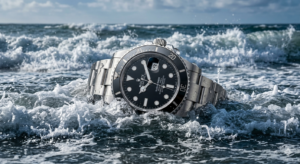
In 1926, Rolex unveiled the Oyster — the world’s first truly waterproof wristwatch. The case screwed shut like, well, an oyster — a hermetically sealed shell protecting the delicate mechanics within. It was an engineering breakthrough disguised as an accessory.
To prove it wasn’t a gimmick, Rolex did something audacious. In 1927, they strapped an Oyster to the wrist of Mercedes Gleitze, a young British woman swimming across the English Channel. After more than ten hours in the cold, open water, she emerged — and the watch was still running perfectly. Rolex took out a full-page advertisement in the Daily Mail the very next day.
Modern marketing was born, and Rolex was leading it.
1931 — The Perpetual: A Watch That Never Needs Winding
Five years later, Rolex solved another frustration that watchmakers had long ignored: the daily ritual of winding your watch.
The Perpetual movement, introduced in 1931, used the natural motion of the wearer’s wrist to automatically wind the mainspring. No battery. No manual winding. Just wear it, and it runs. This self-winding rotor mechanism became the foundation of virtually every automatic watch made since — Rolex’s gift to the entire industry.
1945 — The Datejust: Time, Dated
The end of World War II brought celebration — and a new Rolex. The Datejust, launched in 1945, was the first wristwatch to display the date in a window on the dial, automatically changing at midnight. Elegant, practical, iconic. It became one of the best-selling luxury watches ever made, a title it arguably still holds.
The Story Behind Rolex’s Most Iconic Models
By the 1950s, Rolex had already transformed watchmaking twice. Then it found a new canvas: adventure.
1953 — The Submariner. Built for professional divers, the Submariner was waterproof to depths that would make lesser watches implode. It had a rotating bezel for tracking dive time, luminous markers for visibility in dark water, and a robustness that felt almost military. Today it is the most recognisable dive watch — perhaps the most recognisable watch, full stop — on earth.
1954 — The GMT-Master. Designed in direct collaboration with Pan American World Airways for their transatlantic pilots, the GMT-Master could simultaneously display two time zones. Jet-age glamour on a wrist. It remains the traveller’s watch of choice seven decades later.
1956 — The Day-Date. Reserved for gold and platinum cases only, and sold exclusively through authorised dealers, the Day-Date displayed both the date and the day of the week — spelled out in full, in any of 26 languages. World leaders, heads of state, and presidents wore it so consistently that it earned an unofficial nickname still whispered in watch boutiques today: The President’s Watch.
1963 — The Cosmograph Daytona. Named after the famous Florida racing circuit, the Daytona was built for motorsports — a chronograph capable of measuring average speeds. Paul Newman wore one. He made it immortal. In 2017, his personal Daytona sold at auction for $17.8 million, the highest price ever paid for a wristwatch at the time.
Why Rolex Watches Are So Expensive
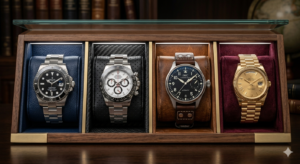
The price of a new Rolex — anywhere from a few thousand to well over fifty thousand dollars — often prompts a raised eyebrow. What exactly are you paying for?
The answer is layered.
Rolex manufactures virtually everything in-house: the movements, the cases, the bracelets, even the gold alloys they use. The tolerances they work to are extraordinary — components measured in microns, assembled by craftspeople who spend years mastering a single skill. Every watch undergoes extensive testing before it leaves Geneva.
But there’s something else at play too. Rolex constrains supply deliberately. The company produces approximately one million watches per year — a number that sounds large until you realise it’s a fraction of global demand. Models like the Submariner and Daytona have waiting lists at authorised dealers that stretch for years. What you cannot easily obtain, you desire more intensely.
Scarcity is as much a part of the product as the steel.
Rolex as a Status Symbol and Cultural Force
Ask someone on the street to name a luxury watch brand. The answer, almost universally, is Rolex.
That brand recognition didn’t happen by accident. For decades, Rolex has embedded itself into the moments and worlds that matter: Wimbledon, Formula 1, deep-sea exploration, golf’s majors, mountaineering expeditions. The association is consistent — Rolex belongs where humans push their limits.
In popular culture, the Rolex has become shorthand for arrival. From hip-hop verses to Hollywood films to boardrooms, wearing a Rolex signals something — success, taste, permanence. Unlike flashy logos or fast fashion, a Rolex says: I intend to keep this.
Rolex in Sports, Exploration, and Adventure
The watch on Sir Edmund Hillary’s wrist when he and Tenzing Norgay first stood atop Everest in 1953? A Rolex. The watch worn by the crew of the Trieste when it made the first descent to the deepest point of the ocean in 1960? A Rolex. The watch on the wrists of countless Formula 1 drivers, golfers at Augusta, and tennis champions at Wimbledon?
You already know the answer.
Rolex doesn’t just sponsor these events — it cultivates genuine relationships with them over generations. The brand’s presence in sport and adventure is less marketing and more mythology, accumulated over a century of showing up where the stakes are highest.

Rolex’s Current Market Position in 2026
After years of extraordinary post-pandemic demand, the luxury watch market has found a more measured pace in 2026. Pre-owned watch prices, which reached dizzying heights in 2021 and 2022, have moderated from their peak. The speculative fever has cooled.
And yet, Rolex remains untouched at the top.
The brand continues to dominate both the new and pre-owned luxury watch markets globally. The Submariner and Daytona still command waiting lists. Resale values for Rolex remain stronger than virtually any other watch brand. Collectors and first-time buyers alike continue to regard a Rolex as the benchmark — the watch you buy when you’re ready to buy the watch.
In an era of financial uncertainty, there is something deeply reassuring about an object that holds its value, tells you the time, and will outlast you.
The Rolex Certified Pre-Owned Program
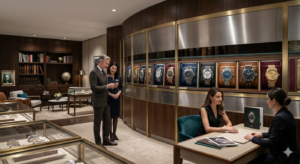
In 2022, Rolex made a move that surprised many observers: it formally entered the pre-owned market with the launch of its Certified Pre-Owned (CPO) program.
The logic was sound. A vast secondary market for Rolex watches had existed for decades, populated by independent dealers of varying trustworthiness. Buyers often had no way to verify authenticity. Fakes were sophisticated. The transaction was stressful.
Rolex’s CPO program changed the equation. Through authorised Rolex retailers only, buyers can now purchase pre-owned Rolex watches that have been:
- Officially authenticated by Rolex-trained professionals
- Fully serviced to factory standards
- Covered by a two-year international guarantee
By 2025, the program had expanded significantly across global markets, signalling a strategic commitment to owning the entire lifecycle of a Rolex — from the first sale to the second, third, and beyond. For buyers who want the security of an official guarantee but prefer a pre-owned model, the CPO program has become a genuine alternative to buying new.
15 Amazing Rolex Facts
1. The name “Rolex” was invented to be short, easy to pronounce in any language, and elegant enough to fit on a watch dial. Wilsdorf is said to have tried hundreds of combinations before landing on it.
2. Rolex is owned not by shareholders or a luxury conglomerate, but by the Hans Wilsdorf Foundation — a private charitable foundation. This means Rolex has no obligation to quarterly earnings reports, no activist investors, and no pressure to sacrifice quality for margin.
3. The Oyster, launched in 1926, was the world’s first waterproof wristwatch — proven by Mercedes Gleitze’s English Channel crossing a year later in a famous early marketing campaign.
4. The Perpetual self-winding movement (1931) is considered one of the most important innovations in watchmaking history. Almost every automatic watch made today owes a debt to Rolex’s rotor mechanism.
5. The Datejust (1945) was the first wristwatch ever to change the date automatically at midnight.
6. The Rolex Submariner is water-resistant to 300 metres (nearly 1,000 feet) — far beyond the depth most recreational divers ever reach.
7. The GMT-Master was developed for Pan American World Airways pilots in 1954, specifically to track two time zones simultaneously during transatlantic flights.
8. The Day-Date has been worn by so many world leaders and presidents that it earned the nickname The President’s Watch long before Rolex made it official lore.
9. Paul Newman’s personal Rolex Daytona sold at auction in 2017 for $17.8 million — making it, at the time, the most expensive wristwatch ever sold at auction.
10. Rolex produces approximately one million watches per year — deliberately constraining supply to maintain exclusivity and demand.
11. Many Rolex models, particularly the Submariner and Daytona, have waiting lists at authorised dealers that can extend for multiple years.
12. A Rolex on the wrist of Sir Edmund Hillary (and Tenzing Norgay) kept accurate time at the summit of Mount Everest in 1953 — the year the Submariner itself launched.
13. Rolex produces its own gold alloys — including a proprietary 18-carat yellow gold called Rolesor — manufactured in-house to control quality at every stage.
14. While many Rolex watches have historically appreciated in resale value, the brand itself cautions that watches should not be treated as guaranteed financial investments. Buy one because you love it.
15. The Certified Pre-Owned program, launched in 2022 and expanded globally by 2025, represents Rolex’s commitment to owning the entire lifecycle of every watch it makes — ensuring quality and authenticity long after the original sale.
Conclusion: Why Rolex Remains the King of Luxury Watches
More than a century after Hans Wilsdorf set up a small watch distribution company in London with his brother-in-law and a belief that the wristwatch was the future, Rolex sits comfortably at the pinnacle of luxury.
The reasons are not accidental. They are the result of a relentless commitment to precision, a genius for innovation, a mastery of branding, and a kind of institutional patience that comes from being answerable to no shareholders — only to a legacy.
Other watch brands are excellent. Some are arguably more complicated mechanically. Some are older. But none have achieved the same alchemy of precision, aspiration, and cultural permanence that Rolex has maintained for over a hundred years.
When you fasten a Rolex to your wrist, you are not just telling the time. You are participating in a story that has crossed oceans, climbed mountains, descended to the seafloor, and wound its way through the wrists of kings, presidents, explorers, and dreamers.
And it’s still ticking.
For official product information and verification, visit rolex.com.
Important Blog You Must Read
- Discover how Queen Victoria helped shape the British Empire during one of the most influential periods in history. Explore her reign, the expansion of British power, and the lasting impact she had on nations around the world. Read our detailed guide on Queen Victoria and the Victorian Era.
- Discover the dramatic story of Louis XVI, the last king of France before the French Revolution. Explore how political unrest, financial crises, and growing public anger led to the fall of the monarchy and changed the course of world history forever. Read our detailed guide on Louis XVI and the French Revolution.