
Introduction: An Empire That Bridged Continents
Imagine standing on the bustling streets of Constantinople in the 16th century. Merchants from Europe bargain with traders from Asia. Soldiers in magnificent uniforms patrol the city gates. Ships carrying spices, silk, and precious goods crowd the harbor. Above it all rise grand mosques whose domes dominate the skyline.
This was the heart of the Ottoman Empire, one of the most powerful and influential empires in human history.
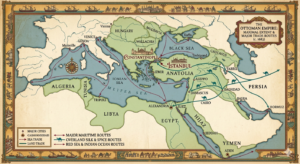
For more than six centuries, from around 1299 to 1922, the Ottoman Empire shaped the political, cultural, religious, and economic landscape of three continents. At its height, it stretched across Southeast Europe, Western Asia, and North Africa, controlling some of the world’s most important trade routes and cities.
Yet the story of the Ottoman Empire is not simply one of conquest and warfare. It is also a story of innovation, diplomacy, architecture, cultural exchange, and survival. Few empires lasted as long or influenced as many people.
Let’s explore the remarkable journey of an empire that changed the course of world history.
1. The Humble Origins of the Ottoman Empire
The Ottoman Empire began in a world of uncertainty.
During the late 13th century, the once-powerful Seljuk Sultanate in Anatolia was weakening. Mongol invasions had destabilized the region, creating opportunities for ambitious leaders to establish their own states.
Among these leaders was Osman I, a tribal chief whose small territory lay in northwestern Anatolia.
At first, Osman ruled only a modest frontier principality. Few could have imagined that his small state would one day become a global empire. Yet Osman possessed qualities that distinguished him from many of his rivals. He was a capable military leader, a skilled diplomat, and a ruler who attracted warriors seeking wealth and glory.
His followers became known as the Ottomans, derived from the Turkish form of his name, Osman.
By the time of his death, the foundations of a future empire had already been laid.
2. The Early Expansion That Changed History
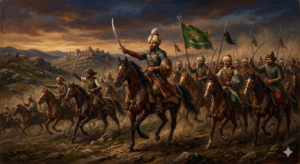
Osman’s successors expanded aggressively.
His son Orhan captured important Byzantine territories and established a more organized government. The Ottomans gradually transformed from a tribal state into a sophisticated political power.
A major turning point came when the Ottomans crossed into Europe during the 14th century.
Many European kingdoms were divided by internal conflicts and rivalries. The Ottomans exploited these divisions skillfully, steadily gaining territory in the Balkans.
Victories against Serbian, Bulgarian, and other regional forces strengthened Ottoman influence.
The empire was no longer a local power. It had become a rising force that both Europe and Asia could no longer ignore.
3. The Fall of Constantinople: A New Era Begins
Few events in history are as dramatic as the fall of Constantinople in 1453.
For over a thousand years, Constantinople had been the capital of the Byzantine Empire. Protected by massive walls, it was considered nearly impossible to conquer.
Then came Sultan Mehmed II.
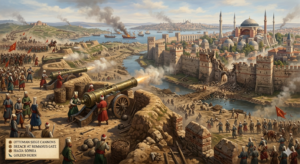
Known later as Mehmed the Conqueror, he was determined to capture the legendary city. He assembled a powerful army and employed massive cannons capable of damaging walls that had stood for centuries.
After a long siege, Constantinople finally fell on May 29, 1453.
The event shocked Europe and transformed global history.
The Byzantine Empire ceased to exist, and Constantinople became the new Ottoman capital. Renamed Istanbul over time, it evolved into one of the world’s greatest cities.
For the Ottomans, this victory symbolized the beginning of a new age of power and prestige.
4. Why the Ottoman Empire Became So Powerful
Many empires rise quickly and collapse just as fast. The Ottoman Empire was different.
Its success rested on several key strengths.
Strong Leadership
The early sultans were talented rulers who combined military skill with political intelligence. They understood how to govern diverse populations and maintain stability.
Strategic Location
The empire controlled territory connecting Europe, Asia, and Africa. This position allowed it to dominate important trade routes and generate enormous wealth.
Military Innovation
The Ottomans were among the first powers to effectively use gunpowder weapons on a large scale. Their armies adapted quickly to changing warfare technologies.
Administrative Efficiency
The empire developed a sophisticated bureaucracy capable of governing millions of people across vast territories.
Together, these advantages created a state that could expand while remaining remarkably stable.
5. Suleiman the Magnificent and the Golden Age
Every great empire experiences a golden age.
For the Ottomans, that era arrived during the reign of Sultan Suleiman I, often called Suleiman the Magnificent.
Ascending the throne in 1520, Suleiman transformed the empire into a global superpower.
Under his rule, Ottoman armies advanced deep into Europe, capturing key territories and threatening Vienna itself. At sea, Ottoman fleets dominated large portions of the Mediterranean.
Yet Suleiman’s achievements extended beyond military victories.
He reformed laws, encouraged education, supported literature, and promoted artistic excellence. Because of his legal reforms, many people referred to him as “The Lawgiver.”
His reign represented the peak of Ottoman political power, cultural achievement, and international influence.
6. Life Inside the Ottoman Empire
One reason the Ottoman Empire endured for centuries was its ability to manage diversity.
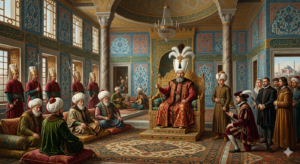
Unlike many empires that attempted to impose a single culture, the Ottomans governed people from numerous ethnic, linguistic, and religious backgrounds.
Muslims, Christians, and Jews often lived within the same cities.
The empire introduced the Millet System, which allowed religious communities to govern certain aspects of their own affairs. This approach helped maintain social stability across vast territories.
Markets flourished with merchants from different cultures.
Cities such as Istanbul, Cairo, Damascus, and Baghdad became centers of learning, commerce, and cultural exchange.
The empire’s diversity became one of its greatest strengths.
7. The Janissaries: The Elite Warriors of the Empire
Among the most famous military forces in history were the Janissaries.
Created as an elite infantry corps, the Janissaries became the backbone of Ottoman military power.
They were highly trained, disciplined, and loyal to the sultan.
For centuries, their battlefield effectiveness gave the Ottomans a significant advantage over many rivals.
The Janissaries also became a symbol of Ottoman strength and prestige. Their distinctive uniforms, military music, and strict discipline impressed both allies and enemies.
However, as time passed, the corps became increasingly resistant to reform, eventually contributing to some of the empire’s later challenges.
8. Architecture, Art, and Cultural Achievements
The Ottoman Empire left behind a rich cultural legacy.
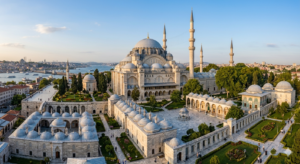
Ottoman architects created some of the world’s most breathtaking structures. The work of architect Mimar Sinan, often compared to Renaissance masters, transformed the skylines of major cities.
Grand mosques featuring elegant domes and towering minarets became symbols of Ottoman architectural excellence.
Ottoman artists excelled in calligraphy, ceramics, textiles, and manuscript illumination.
The empire also played a major role in preserving and transmitting knowledge between East and West.
Its cultural achievements continue to attract millions of visitors and scholars today.
9. The Ottoman Empire and Global Trade
Long before modern globalization, the Ottoman Empire connected distant regions of the world.
Its territory controlled crucial trade routes linking Europe, Asia, and Africa.
Spices from India, silk from China, and goods from Africa passed through Ottoman lands.
This trade generated significant revenue and helped cities prosper.
European powers often depended on Ottoman-controlled routes for access to valuable goods.
Ironically, the desire to bypass these routes contributed to the Age of Exploration, leading European nations to search for alternative paths to Asia.
In this way, the Ottoman Empire indirectly influenced the discovery of new continents and global trade networks.
10. The Beginning of Decline
No empire remains at its peak forever.
By the 17th century, signs of Ottoman decline were becoming visible.
Several factors contributed to this process.
Military rivals in Europe grew stronger and adopted new technologies. Economic changes reduced the importance of traditional trade routes. Internal corruption weakened government institutions.
The empire also struggled with political instability and administrative inefficiencies.
Although the Ottoman Empire remained powerful for centuries afterward, maintaining control over such vast territories became increasingly difficult.
The age of unstoppable expansion had ended.
11. The “Sick Man of Europe”
During the 19th century, European leaders increasingly referred to the Ottoman Empire as the “Sick Man of Europe.”
The phrase reflected growing concerns about the empire’s weakening position.
Nationalist movements emerged throughout the Balkans. Various regions sought independence, reducing Ottoman territorial control.
At the same time, powerful European nations frequently intervened in Ottoman affairs.
Despite these challenges, Ottoman leaders attempted numerous reforms known as the Tanzimat reforms. These efforts aimed to modernize the military, legal system, and government administration.
While some reforms achieved success, they could not fully reverse the empire’s long-term decline.
12. World War I and the Final Collapse
The final chapter of Ottoman history unfolded during World War I.
The empire joined the conflict alongside Germany and Austria-Hungary.
Initially, Ottoman forces achieved several notable successes, including the famous defense of Gallipoli.
However, the war ultimately proved devastating.
Years of fighting exhausted resources and weakened the state.
When the war ended in 1918, the Ottoman Empire faced occupation, territorial losses, and political turmoil.
The centuries-old empire that had once dominated three continents was nearing its end.
13. The Birth of Modern Turkey
Following the war, a new leader emerged: Mustafa Kemal Atatürk.
Determined to protect Turkish sovereignty, he led the Turkish War of Independence.
His movement successfully resisted foreign occupation and established a new republic.
In 1922, the Ottoman Sultanate was officially abolished.
The Ottoman Empire, after more than 600 years, ceased to exist.
The Republic of Turkey was founded in 1923, marking the beginning of a new era.
Although the empire disappeared, its influence continued to shape the modern Middle East, Balkans, and beyond.
14. The Lasting Legacy of the Ottoman Empire
The Ottoman Empire may be gone, but its legacy remains visible everywhere.
Modern borders, political systems, architectural landmarks, culinary traditions, and cultural practices across multiple countries bear the imprint of Ottoman rule.
Millions of people continue to live in regions once governed by the empire.
Historic mosques, palaces, bridges, and markets stand as reminders of a civilization that connected continents and cultures.
The Ottoman story also offers important lessons about leadership, diversity, adaptation, and the challenges of maintaining power across centuries.
Conclusion: An Empire That Shaped the World
The Ottoman Empire was far more than a military power. It was a civilization that influenced politics, trade, religion, architecture, and culture on an extraordinary scale.
From the small frontier state founded by Osman I to the vast empire ruled by Suleiman the Magnificent, and finally to its transformation into modern Turkey, the Ottoman journey is one of history’s most remarkable stories.
For over six hundred years, the Ottomans stood at the crossroads of continents, shaping the destinies of nations and connecting diverse peoples under a single imperial system.
Their empire eventually fell, as all empires do. Yet their influence never truly disappeared.
To understand the history of Europe, the Middle East, North Africa, and even global trade, one must understand the Ottoman Empire—a dynasty whose impact still echoes across the world today.
Important Blog You Must Read
-
Discover the Rise and Fall of the Roman Empire
The Ottoman Empire’s conquest of Constantinople marked the end of the Byzantine Empire, which was the eastern continuation of the Roman Empire. Discover how the Roman Empire shaped ancient civilization and left a legacy that influenced empires for centuries.
👉 Read More: [Roman Empire Blog Link]
-
Explore the Era of Queen Victoria
As the Ottoman Empire struggled to maintain its power during the 19th century, the British Empire expanded across the globe under Queen Victoria. Explore the fascinating story of the monarch who presided over one of history’s largest empires.
👉 Read More: [Queen Victoria Blog Link]
-
Learn More About the Ottoman Empire
Want to explore the Ottoman Empire in greater detail? This trusted historical resource provides additional information about its rise, expansion, culture, and lasting legacy.
👉 External Source: https://www.britannica.com/place/Ottoman-Empire