
Introduction
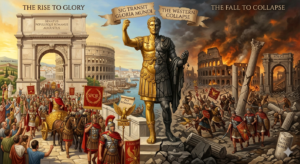
There are civilizations that changed regions, kingdoms that shaped nations, and rulers who altered the course of history. But few powers in human civilization left a legacy as vast and enduring as the Roman Empire.
For centuries, Rome stood at the center of the ancient world. Its armies marched across continents, its laws shaped governments, and its influence reached millions of people from Britain to the deserts of the Middle East. To many, Rome appeared eternal — a civilization too organized, too wealthy, and too powerful to ever collapse.
Yet history often reveals a difficult truth: the greatest empires are not destroyed only by enemies beyond their borders. More often, they begin to weaken from within.
The rise and fall of the Roman Empire is not simply a story about battles and emperors. It is a story about ambition, discipline, political corruption, social division, and the dangerous illusion that power can last forever.
Even today, more than fifteen centuries after its collapse, the story of Rome continues to fascinate historians, leaders, and ordinary people alike because the empire’s successes and failures still feel strangely familiar to the modern world.
1. The Birth of Rome From Struggle and Survival
Long before Rome became the center of a mighty empire, it was merely a small settlement built near the Tiber River in central Italy. The early world surrounding Rome was unstable and violent. Tribes fought constantly for land, influence, and survival.
According to Roman legend, the city was founded in 753 BCE by Romulus, who became its first king after killing his brother Remus during a dispute over the city’s future. Whether entirely true or partly mythical, the story reflected something important about Rome from the very beginning — the civilization was born from conflict.
Unlike wealthy ancient kingdoms such as Egypt or Persia, early Rome possessed no extraordinary riches or natural advantages. Its people survived through discipline, military organization, and an unusual ability to adapt. The Romans respected order above nearly everything else. They believed strength came not only from warriors but from law, loyalty, and collective sacrifice.
Over time, Rome replaced monarchy with a republic. Senators and elected officials shared political authority, at least in theory. This system gave Roman citizens a stronger connection to the state and encouraged loyalty toward the republic itself rather than toward a single ruler.
That political structure became one of the foundations behind the rise of the Roman Empire.
2. The Rise of the Roman Empire Through Military Power
Rome’s expansion did not happen suddenly. It unfolded gradually through centuries of calculated warfare and strategic alliances.
The Roman military became one of the most disciplined fighting forces the ancient world had ever seen. Roman soldiers trained relentlessly, obeyed strict commands, and adapted quickly to unfamiliar enemies. Their organization gave them advantages even against larger armies.
Wherever Roman legions marched, roads, forts, and settlements followed. Rome understood that conquering territory was not enough; maintaining control required infrastructure, administration, and communication. Roman roads eventually connected distant provinces across Europe, North Africa, and parts of Asia, allowing armies and trade to move efficiently throughout the growing republic.
Victory brought enormous wealth into Rome. Gold, slaves, agricultural resources, and trade transformed the city into an expanding center of power. Successful generals returned home as heroes, celebrated by cheering crowds and rewarded with political influence.
But prosperity also introduced dangerous problems.
As Rome became richer, inequality widened between ordinary citizens and powerful elites. Political corruption spread through the republic. Ambitious generals realized that military loyalty could be used to gain personal power.
The republic that once valued balance and civic duty slowly became consumed by competition, greed, and political violence.
3. Julius Caesar and the End of the Roman Republic
Few individuals shaped Roman history more dramatically than Julius Caesar.
Caesar was charismatic, intelligent, and extraordinarily ambitious. His military campaigns in Gaul expanded Roman territory and made him one of the most famous men in the republic. Soldiers admired him deeply because he shared hardships with them and rewarded loyalty generously.
Yet Caesar’s growing popularity terrified many senators in Rome. They feared he intended to overthrow the republic and establish personal rule.
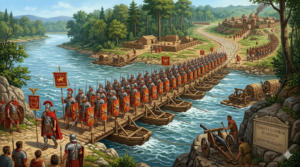
In 49 BCE, Caesar made the decision that changed Roman history forever. He crossed the Rubicon River with his army, openly defying the Senate. By doing so, he triggered civil war.
Caesar’s victories eventually gave him near-total authority over Rome. He introduced reforms, centralized power, and declared himself dictator for life. To some Romans, he represented stability during political chaos. To others, he represented tyranny.
The tension ended violently.
In 44 BCE, Caesar was assassinated by senators who believed they were saving the republic. Instead, his death plunged Rome deeper into instability and conflict.
The republic never truly recovered.
After years of civil war, Caesar’s adopted heir, Octavian — later known as Augustus — emerged victorious and became Rome’s first emperor. Under his rule, the Roman Republic effectively transformed into the Roman Empire.
4. Augustus and the Golden Age of Rome
Augustus understood something many Roman leaders had failed to understand: power survives longer when it appears controlled rather than absolute.
Instead of openly declaring himself king, Augustus carefully maintained the appearance of republican traditions while holding ultimate authority behind the scenes. His leadership brought stability after decades of violence.
Under Augustus, Rome entered one of the most prosperous periods in its history, often called the Pax Romana, or “Roman Peace.”
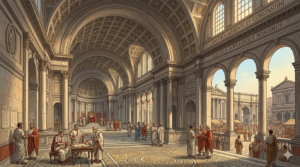
Trade flourished across the empire. Massive engineering projects transformed cities. Aqueducts supplied fresh water, roads connected distant provinces, and grand monuments demonstrated Rome’s confidence and ambition.
The city of Rome itself became one of the largest urban centers in the ancient world. Crowded markets, public baths, temples, theaters, and gladiatorial arenas reflected both the wealth and complexity of Roman society.
For many citizens, the empire appeared unstoppable.
But even during this golden age, problems were quietly growing beneath the surface.
5. The Hidden Weaknesses Within the Empire
The strength of the Roman Empire created an illusion of permanence. Yet the empire’s size eventually became one of its greatest weaknesses.
Managing vast territories required enormous military spending. Taxes increased, placing heavy burdens on ordinary citizens and farmers. Corruption spread through local governments, while wealthy elites continued accumulating power and influence.
At the same time, political instability became increasingly dangerous. Emperors rose and fell rapidly, often through assassination or military rebellion. Loyalty to Rome itself weakened as armies became more loyal to individual generals than to the empire.
Economic difficulties also intensified. Inflation damaged trade, currency lost value, and dependence on slave labor weakened long-term economic development.
Rome’s leadership struggled to address these problems because political survival often mattered more than effective governance.
The empire remained powerful on the outside, but internally it was becoming fragile.
6. Barbarian Invasions and External Threats
As Rome weakened internally, external threats became more serious.
Germanic tribes such as the Visigoths, Vandals, and Ostrogoths increasingly challenged Roman authority along its borders. Some groups sought protection and land within the empire, while others attacked weakened provinces directly.
For centuries, Roman armies had successfully defended the empire’s frontiers. But by the third and fourth centuries CE, maintaining those borders became increasingly difficult.
The empire faced constant military pressure from multiple directions. Resources were stretched thin, and recruiting reliable soldiers became harder.
In an attempt to improve administration, Emperor Diocletian divided the empire into eastern and western halves. While the Eastern Roman Empire remained relatively stable and wealthy, the Western Roman Empire continued declining.
Political chaos, economic weakness, and military exhaustion left Rome vulnerable to repeated invasions.
7. The Fall of the Western Roman Empire
The collapse of the Western Roman Empire was not caused by a single catastrophic event. It happened gradually, through decades of decline.
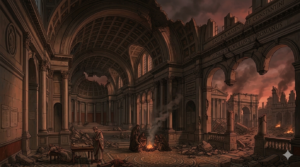
In 410 CE, the Visigoths shocked the ancient world by successfully sacking the city of Rome itself. For centuries, Rome had symbolized invincibility. The attack shattered that illusion.
Additional invasions followed. Provinces were lost, trade networks weakened, and imperial authority continued collapsing.
Finally, in 476 CE, the young emperor Romulus Augustulus was removed from power by the Germanic leader Odoacer. Historians traditionally mark this event as the official fall of the Western Roman Empire.
The empire that once ruled vast territories across continents had disappeared.
Its armies were gone. Its political system had collapsed. Its western cities declined into instability and economic hardship.
The fall of Rome became one of the defining turning points in world history.
8. Why the Roman Empire Still Shapes the Modern World
Although the Western Roman Empire collapsed, Rome’s influence never truly vanished.
Roman law became the foundation for many modern legal systems. Roman architecture inspired government buildings, churches, and monuments across the world. Latin, the language of Rome, evolved into modern languages such as Spanish, French, Italian, and Portuguese.
Military leaders continue studying Roman warfare and strategy. Political thinkers still debate the successes and failures of Roman governance.
Even modern discussions about political corruption, economic inequality, and the decline of powerful nations often reference the fall of the Roman Empire.
Rome’s story continues to matter because it reflects patterns that repeat throughout history.
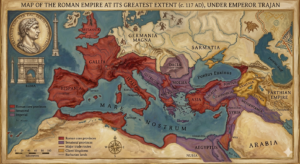
9. Map of the Roman Empire at its greatest extent under Emperor Trajan
The story of Rome is ultimately a deeply human story.
It reveals humanity’s extraordinary ability to build civilizations, create systems of law, organize societies, and achieve greatness through cooperation and ambition. At the same time, it demonstrates how greed, corruption, political division, and the pursuit of unchecked power can slowly destroy even the strongest institutions.
Rome was not defeated solely by invading armies. Long before enemies crossed its borders, the empire had already begun weakening internally.
That lesson remains relevant today.
History does not repeat itself perfectly, but human behavior often follows familiar patterns. The rise and fall of the Roman Empire reminds us that stability should never be taken for granted and that civilizations survive only when they maintain the principles that once made them strong.
Conclusion
The rise and fall of the Roman Empire remains one of the greatest and most complex stories ever recorded in human history.
Rome began as a struggling settlement surrounded by enemies and uncertainty. Through discipline, military strength, and political ambition, it grew into a civilization that dominated much of the known world. Its achievements shaped culture, law, architecture, and government for centuries.
Yet the same empire that conquered nations could not escape its own internal weaknesses.
Political corruption, economic instability, social inequality, and military decline slowly eroded the foundations of Roman power until collapse became unavoidable.
And still, Rome never truly disappeared.
Its legacy survives in modern cities, political systems, languages, and ideas across the world. The empire may have fallen centuries ago, but its story continues to speak to every generation that studies the fragile relationship between power and human nature.
That is why the rise and fall of the Roman Empire is not simply ancient history. It is a timeless reflection of civilization itself.
- History shows that even the strongest rulers can face dramatic downfalls. A similar story unfolded during the French Revolution, as explained in our article on 10 Shocking Facts About Marie Antoinette and Louis XVI During the French Revolution. Tap Here
- Economic strength and strategic planning are crucial for any empire’s survival. A similar lesson can be seen in Why the Dutch Failed in India: The “Businessmen Only” Mistake, which explains how focusing only on trade while neglecting political influence led to failure. Tap Here
- To learn more about the history of the Roman Empire, you can visit the detailed article on Encyclopaedia Britannica’s Roman Empire page.