
Introduction
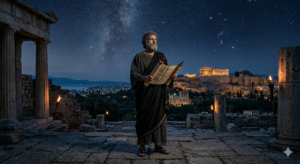
Late at night in ancient Greece, while most people slept peacefully, a young boy sat looking at the sky.
He stared at the stars for hours.
Not because he wanted to admire them.
He wanted to understand them.
Why do they move?
Who controls them?
Why does the world work the way it does?
That boy was Aristotle.
At that moment, nobody could have imagined that his ideas would survive for more than two thousand years.
Kings would disappear.
Empires would fall.
Entire civilizations would turn into dust.
But the thoughts of Aristotle would continue traveling through time.
And it all started with one thing.
Curiosity.
1. The Boy Who Asked Too Many Questions
Aristotle was born in 384 BCE in a small Greek town called Stagira.
His father worked as a royal doctor.
As a child, Aristotle often watched him prepare medicines and treat patients.
 Maybe that is where everything began.
While other children accepted the world as it was, Aristotle kept questioning it.
He wanted to know why people became sick.
Why animals behaved differently.
Why humans fought wars.
Sometimes adults around him probably became tired of his endless questions.
But Aristotle could not help himself.
His mind was always moving.
Always searching.
2. A Childhood Changed by Loss
Then life suddenly became cruel.
Aristotle lost both of his parents when he was still young.
The world must have felt painfully empty after that.
No child understands how to carry such loss easily.
But pain changes people.
Some become silent.
Some become angry.
Aristotle became thoughtful.
Instead of running away from questions, he moved closer to them.
It was almost as if he was trying to understand life itself.
Why do people live?
Why do they die?
What truly matters in the end?
Those questions stayed with him forever.
3. The City That Opened His Mind
At seventeen, Aristotle left his hometown and traveled to Athens.
For a young boy from a small town, Athens must have looked unbelievable.
The streets were full of debates.
Teachers spoke openly about politics, science, and philosophy.
Ideas moved through the city like wind.
And at the center of it all stood Plato.
Plato was already famous.
Students admired him almost like a legend.
When Aristotle entered Plato’s Academy, he was quiet at first.
He listened carefully.
He learned constantly.
But deep inside, something about him was different.
He did not want to simply repeat ideas.
He wanted to test them.
4. The Student Who Refused to Blindly Agree
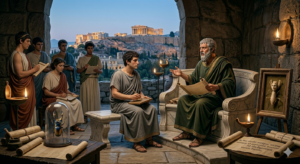
For nearly twenty years, Aristotle studied under Plato.
He respected his teacher deeply.
But respect did not stop him from thinking independently.
Plato believed truth mostly came from deep thought and philosophy.
Aristotle believed humans should also study the real world directly.
He watched animals carefully.
He observed nature.
He studied human behavior.
While others discussed theories endlessly, Aristotle wanted evidence.
That mindset quietly changed history.
Without realizing it, he was planting the seeds of scientific thinking.
5. Meeting the Boy Who Would Conquer the World
Years later, Aristotle received an unusual responsibility.
He was asked to teach a young prince named Alexander the Great.
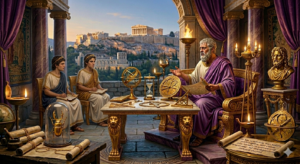
At the time, Alexander was restless and ambitious.
He dreamed of greatness long before the world knew his name.
Aristotle saw something dangerous and powerful inside the young prince.
So he taught him carefully.
Not only about war or leadership.
But about wisdom.
About knowledge.
About the importance of thinking before acting.
Sometimes it is strange to imagine.
One man shaped ideas.
The other conquered nations.
Together, they changed history.
6. A Man Who Wanted to Understand Everything
Most people spend their lives learning one skill.
Aristotle wanted to understand the entire world.
And somehow, he tried.
He studied animals for hours.
He wrote about politics.
He explored ethics and human happiness.
He even thought deeply about storytelling and poetry.
His curiosity had no limits.
People around him probably found him exhausting sometimes.
But that hunger for knowledge made him unforgettable.
Later, he opened his own school in Athens.
There, he taught students while walking through gardens and pathways.
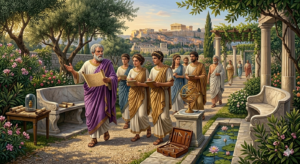
The lessons felt alive.
Not stiff.
Not cold.
Just real conversations between curious minds.
6. The Day Aristotle Realized Knowledge Could Be Dangerous
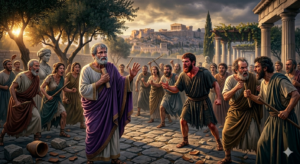
As Aristotle became more famous, not everyone admired him.
Some people loved his ideas.
Others feared them.
Because Aristotle taught people to question everything around them.
And powerful people rarely enjoy difficult questions.
In ancient Greece, questioning traditions could make enemies very quickly.
But Aristotle continued anyway.
He believed truth mattered more than comfort.
7. Aristotle Was Fascinated by Human Behavior
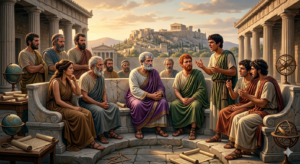
What made Aristotle different was his deep interest in ordinary people.
He watched how humans reacted during arguments.
He noticed how power changed personalities.
He even studied why some people remained calm while others became angry easily.
To Aristotle, understanding humans was just as important as understanding science.
That curiosity made his philosophy feel deeply personal.
8. The Philosopher Who Studied the Ocean
Most philosophers spent their lives discussing ideas inside buildings.
Aristotle often went outside searching for answers.
He became fascinated by sea life.
He observed fish, sea creatures, and marine plants carefully.
Sometimes he spent hours simply watching nature silently.
For him, nature itself was like a giant classroom.
Every living thing had something to teach.

9. Aristotle’s Fear of Ignorance
Aristotle believed ignorance could destroy societies.
That idea stayed in his mind constantly.
He feared people who followed beliefs blindly without thinking for themselves.
Because of this, he encouraged students to debate openly.
He wanted people to challenge ideas instead of accepting everything automatically.
That mindset was extremely rare in the ancient world.
10. The Philosopher Who Believed Happiness Was Simple
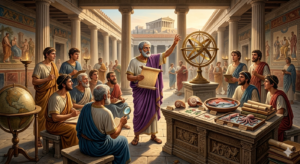
Many people believed happiness came from wealth or power.
Aristotle disagreed.
He believed true happiness came from balance.
Not too much greed.
Not too much pride.
Not too much anger.
He believed a peaceful mind mattered more than luxury.
Even today, his ideas about happiness still feel surprisingly modern.
11. Aristotle and the Silence of the Night
Some stories say Aristotle loved thinking late at night.
When Athens became quiet, he often reflected deeply about life and human nature.
Perhaps those silent nights shaped many of his greatest ideas.
Because sometimes the deepest thoughts arrive when the world finally becomes still.

12. The Legacy Aristotle Never Expected
Aristotle probably never imagined people would still speak his name thousands of years later.
To him, he was simply a man searching for understanding.
Yet his ideas crossed centuries.
They survived wars, collapsing empires, and changing civilizations.
Very few people in history leave behind something that powerful.
But Aristotle did.
Not through armies or wealth.
Through curiosity.
13. The Ideas That Refused to Die
When Aristotle died in 322 BCE, his story should have ended there.
Usually, time erases people.
But not Aristotle.
His ideas survived wars, invasions, collapsing kingdoms, and centuries of change.
Even today, students still study his thoughts.
Scientists still respect his method of observation.
Philosophers still debate his ideas.
That is rare.
Very rare.
Because the world forgets most people.
But it remembers those who change the way humans think.
Conclusion
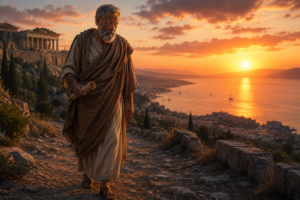
Aristotle never ruled an empire.
He never commanded giant armies.
Yet his influence became greater than many kings.
Why?
Because he taught humanity something powerful.
Never stop asking questions.
That simple habit turned a curious boy from Greece into one of the most important thinkers in human history.
And maybe that is why Aristotle still feels alive today.
Because curiosity never truly dies.