
Introduction
Every single day of our lives is shaped by an invisible system most people never think about.
We wake up at a certain hour. Schools begin at fixed times. Offices follow schedules. Flights, hospitals, markets, television programs, and even international meetings all depend on one simple structure — the 24-hour day.
It feels so natural that it almost seems like part of nature itself.
But it is not.
The Earth gives us day and night through its rotation, but humans decided how to divide that time. A day could have been divided into 10 hours, 20 hours, or even 100 smaller sections. Different civilizations could have created completely different systems.
Yet humanity eventually settled on 24 hours.
What makes this story fascinating is that the origins of the modern clock are not found in laboratories or modern science. They began thousands of years ago in ancient deserts, temples, observatories, and trading cities where people tried to understand the movement of the sky.
The history of the 24-hour day is not simply about clocks. It is a story about astronomy, mathematics, religion, trade, and human curiosity. It connects ancient Egyptian priests, Babylonian mathematicians, Greek astronomers, medieval engineers, and modern civilization in one continuous chain of ideas.
And even today, every digital clock still carries the fingerprints of those ancient worlds.
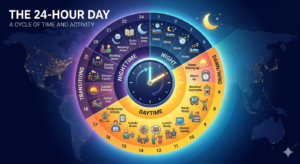
1. Before Time Was Measured
Long before humans invented clocks, life moved according to nature.
People woke up when sunlight appeared and rested after darkness covered the land. Hunters, farmers, and travelers did not think in terms of “hours.” Instead, they understood time through natural events:
- sunrise
- noon
- sunset
- seasons
- moon phases
For early communities, this was enough.
But as villages became cities and civilizations became larger, simple observation no longer worked. Organizing thousands of people required better systems.
Farmers needed to know the right time for planting and harvesting. Priests needed fixed moments for rituals and ceremonies. Traders needed coordination between markets. Kings needed order inside growing empires.
Human civilization was becoming more complex, and complexity demanded structure.
That need slowly pushed humans toward one of the greatest inventions in history: measured time.
2. Ancient Egypt and the First Division of the Day
The earliest roots of the 24-hour day are usually connected to ancient Egypt.
More than 4,000 years ago, Egyptian astronomers and priests closely studied the sky. Unlike modern people surrounded by electric lights, ancient Egyptians experienced a sky filled with thousands of visible stars every night.
The heavens became their calendar, compass, and clock.


They noticed that certain groups of stars appeared in predictable patterns throughout the night. These groups later became known as “decans.” Each decan rose at a particular time, helping observers estimate how much of the night had passed.
By carefully tracking these stars, Egyptians divided darkness into 12 sections.
Daylight was also divided into 12 sections using the movement of the Sun and shadows cast by objects.
Together, this created a 24-part system:
- 12 sections for daytime
- 12 sections for nighttime
This was the foundation of the modern 24-hour day.
However, Egyptian hours were not equal like modern hours.
During summer, daytime hours became longer because the Sun stayed visible for more time. During winter, nighttime hours stretched further. In other words, Egyptian hours changed with the seasons.
To ancient people, this felt completely natural because their understanding of time was still deeply connected to the rhythms of nature.
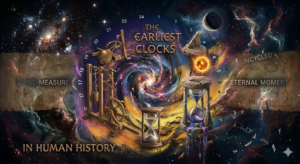
3. The Earliest Clocks in Human History
The Egyptians did more than observe stars. They also invented practical tools for measuring time.
One of the oldest was the sundial.
A sundial worked by tracking shadows created by sunlight. As the Sun moved across the sky, shadows shifted across marked surfaces. People could estimate different periods of the day by observing these movements.
Simple as it sounds today, this invention represented a major breakthrough. Humans were beginning to convert the movement of the heavens into measurable units.
But sundials had a major weakness: they could not function at night or during cloudy weather.
To solve this problem, Egyptians developed water clocks, also called clepsydras.
These devices allowed water to drip slowly from one container into another at a controlled speed. By measuring the flow of water, people could estimate the passing of time even without sunlight.
Water clocks became especially useful in temples, where priests needed precise timing for religious rituals.
These inventions may appear primitive from a modern perspective, but they laid the groundwork for all future timekeeping technologies.
4. Why the Number 12 Became Important
One question still puzzles many historians:
Why did ancient civilizations choose the number 12?
There are several possible reasons.
One explanation involves counting methods. Ancient people often counted finger joints using the thumb. Each finger contains three joints, and four fingers together create the number 12.
Another reason is mathematical convenience.
The number 12 is highly practical because it can be divided evenly by:
- 2
- 3
- 4
- 6
This flexibility made calculations easier in trade, astronomy, and measurement systems.
The influence of the number 12 still exists today:
- 12 months in a year
- 12 inches in a foot
- 12 zodiac signs
- 12-hour clock faces
What began as an ancient counting preference eventually shaped global civilization.
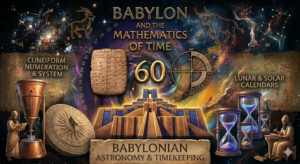
5. Babylon and the Mathematics of Time
While Egypt helped create the structure of the day, ancient Babylon contributed the mathematical system behind modern timekeeping.
Babylonian scholars used a numerical system based on 60 instead of 10. Historians call this the sexagesimal system.
At first glance, this may sound unusual. But mathematically, 60 is extremely useful because it can be divided by many numbers:
- 2
- 3
- 4
- 5
- 6
- 10
- 12
- 15
- 20
- 30
This made calculations much easier for astronomy and geometry.
The Babylonian influence survives everywhere in modern timekeeping:
- 60 seconds in a minute
- 60 minutes in an hour
- 360 degrees in a circle
Even though most people no longer know anything about Babylonian civilization, they unknowingly use Babylonian mathematics every day.
This is one of the most remarkable examples of ancient knowledge surviving into the modern world.
6. Greek Astronomers and Equal Hours
The ancient Greeks inherited astronomical knowledge from both Egypt and Babylon, but they refined it further.
Greek scholars were deeply interested in mathematics, science, and philosophy. They wanted precision and consistency in measurement.
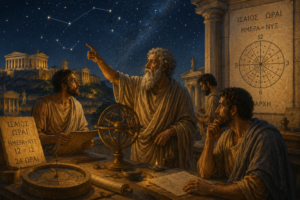
One important figure was Hipparchus, often considered one of the greatest astronomers of the ancient world.
Hipparchus recognized a major problem with the Egyptian system: seasonal hours were inconsistent. Scientific observations became difficult when hour lengths changed throughout the year.
To solve this, Greek astronomers introduced equal hours, known as equinoctial hours.
Unlike Egyptian seasonal hours, these hours remained constant regardless of the season.
This was a turning point in human history.
Time was no longer measured only according to natural experience. It was becoming mathematical and scientific.
The Greek contribution shaped the foundations of modern astronomy, navigation, and eventually modern clocks.
7. Rome Spread Timekeeping Across an Empire
The Roman Empire later adopted many Greek scientific ideas and spread them across Europe, North Africa, and parts of Asia.
Romans used sundials extensively in cities and public spaces. Wealthy households sometimes even owned private timekeeping devices.
However, ordinary people still lived mostly according to natural rhythms. Exact minute-by-minute precision was not yet part of daily life.
Most citizens relied on:
- sunlight
- church bells
- market routines
- public announcements
Still, Roman influence helped normalize the idea that societies should organize themselves according to structured time.
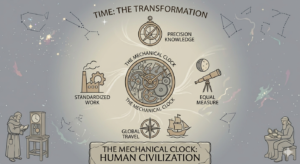
8. The Mechanical Clock Changed Human Civilization
For centuries, timekeeping remained relatively limited.
Then medieval Europe introduced a revolutionary invention: the mechanical clock.
Unlike sundials or water clocks, mechanical clocks could function continuously.
Large clock towers began appearing in churches and city centers. Bells rang across towns to announce:
- prayer times
- working hours
- curfews
- market openings
This changed society dramatically.
Before mechanical clocks, human life followed nature.
After clocks, nature slowly became less important than schedules.
This transformation became even stronger during the Industrial Revolution.
Factories required workers to arrive at exact times. Railways needed synchronized schedules. Businesses depended on punctuality.
The clock became one of the central organizing forces of modern civilization.
9. Railways and the Creation of Standard Time
By the 19th century, the world faced a serious problem.
Different towns used different local times based on the position of the Sun. Noon in one city could differ slightly from noon in another city.
This created confusion for railways and communication systems.
Imagine trying to run train schedules across countries where every town used its own time.
To solve this chaos, nations introduced standardized time zones.
Eventually, international agreements helped establish coordinated global time systems.
The 24-hour structure became increasingly important because it reduced confusion and improved accuracy.
Today, aviation, military systems, hospitals, scientific research, and international communication all rely heavily on the 24-hour clock.
10. The French Revolution and Decimal Time
Interestingly, the modern 24-hour system was not accepted without challenges.
During the French Revolution, revolutionaries attempted to redesign many parts of society using logic and mathematics.
They even tried to redesign time.
The French introduced decimal time:
- 10 hours in a day
- 100 minutes in an hour
- 100 seconds in a minute
On paper, the system appeared efficient and rational.
But ordinary people struggled to adapt. Daily life had already been shaped by the older 24-hour structure for centuries.
The experiment failed quickly.
This failure revealed something important:
timekeeping systems are not just mathematical ideas — they are deeply connected to culture, habit, and human behavior.
11. Why the 24-Hour Day Still Matters Today
Modern technology has transformed almost every aspect of human life, yet the ancient 24-hour structure remains unchanged.
Smartphones, satellites, computers, and atomic clocks all still organize time using the same basic framework created thousands of years ago.
The system works because it balances practicality and tradition.
The 24-hour clock is especially useful in fields where confusion can be dangerous:
- aviation
- healthcare
- military operations
- transportation
- emergency services
For example:
- 2:00 AM becomes 02:00
- 2:00 PM becomes 14:00
This removes misunderstandings between morning and evening times.
Many countries use the 24-hour format officially because it is clearer and more efficient.
12. The Hidden Legacy Inside Every Clock
Most people never think about the history behind their clocks.
Yet every glance at a watch connects modern humanity to ancient civilizations.
When someone checks the time today, they are unknowingly using:
- Egyptian astronomy
- Babylonian mathematics
- Greek scientific precision
- Medieval engineering
- Industrial organization
The 24-hour day is one of the oldest surviving systems still used by nearly all humans on Earth.
Empires disappeared. Languages changed. Religions spread across continents. Technology evolved beyond imagination.
But the structure of the day remained.
That continuity is extraordinary.
Conclusion
The history of the 24-hour day is much more than the history of clocks.
It is the story of humanity trying to understand the universe and create order within daily life.
Ancient Egyptians studied the stars to divide the night. Babylonians developed mathematical systems that simplified calculations. Greek astronomers transformed time into a scientific measurement. Medieval engineers built machines that allowed entire societies to follow precise schedules.
Together, these civilizations created a system so effective that it survived thousands of years of human change.
Today, the modern world runs on an invention born under ancient skies.
And every time a clock moves from one hour to the next, it quietly continues a tradition that began thousands of years ago with people simply looking up at the stars.
Tap here to get a knowledgeable blog about Indus vally Civilization