June 26: The Day the World Chose to Show Up
History does not usually announce its hinge points in advance. Most days pass the way all days do — unremarkable, forgettable, indistinguishable from the ones before and after them. And yet, every so often, a single date on the calendar carries more weight than it has any right to. June 26 is one of those dates.
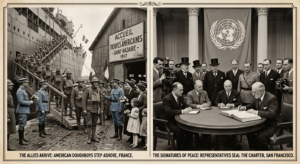
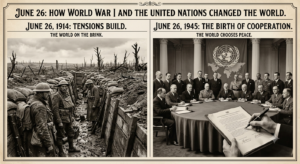
Twice in the twentieth century — once in 1917 and once in 1945 — the world arrived at a threshold on this exact day. The first time, it was an army stepping off a ship onto French soil, carrying with it the promise of reinforcement for a continent bled nearly dry. The second time, it was fifty nations, still standing in the rubble of an even greater catastrophe, signing their names to a document that dared to imagine a future without total war.
These are not two unrelated footnotes that happen to share a date. They are two chapters of the same human story — a story about exhaustion, about the courage it takes to keep trying after everything has gone wrong, and about what it means, in the truest sense, to show up.
A Continent Running Out of Time
To understand why June 26, 1917 mattered, you first have to understand what the world looked like in the years leading up to it — not as a map of borders and alliances, but as a landscape of slow-motion ruin.
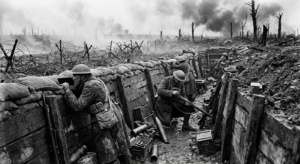
World War I had begun in 1914 with the kind of confidence that only comes before catastrophe — armies marching off behind brass bands and fluttering flags, many believing they would be home by Christmas. Instead, the war dissolved into something almost unrecognizable as warfare in the traditional sense: trenches carved into the earth for hundreds of miles, barbed wire strung across no-man’s-land, poison gas drifting on the wind, and a mechanized brutality so efficient that entire generations of young men — French, British, German — were being consumed by it, year after year, with no end in sight.
On one side stood the Allied Powers: France, Britain, and Russia, bound together by treaty and circumstance. On the other stood the Central Powers: Germany, Austria-Hungary, the Ottoman Empire, and Bulgaria. And for nearly three years, watching this unfold from across an ocean, the United States chose to remain neutral. It was not cowardice. It was policy — and for a long time, popular policy. Americans had little appetite for what looked, from a distance, like an old-world quarrel between empires that had been spoiling for a fight for decades.
But neutrality, it turns out, has a way of eroding once violence begins reaching across oceans.
Germany had committed to a campaign of unrestricted submarine warfare, sinking any vessel — military or civilian — suspected of aiding its enemies. In 1915, a German U-boat torpedoed the British passenger liner RMS Lusitania. Nearly 1,200 people died that day, 128 of them Americans — travelers, not soldiers, drowned in a war they had not chosen to join. It was the kind of loss that does not simply make headlines; it lodges itself in a nation’s conscience.
Then came the Zimmermann Telegram: a secret diplomatic cable, intercepted by British intelligence, in which Germany proposed a military alliance with Mexico — offering to help Mexico reclaim Texas, New Mexico, and Arizona if the United States entered the war. When the telegram’s contents became public, the effect on American public opinion was seismic. The war was no longer a distant European affair. It was, suddenly, a threat standing at America’s own back door.
President Woodrow Wilson — who had campaigned for re-election in 1916 partly on the strength of having kept America out of the war — now stood before Congress and asked for the one thing he had hoped never to ask for: a declaration of war against Germany. Congress granted it. On April 6, 1917, the United States entered World War I.
But a declaration of war is not the same thing as an army ready to fight one. America had no expeditionary force prepared to cross an ocean; it had to build one from nothing — recruit it, train it, equip it, ship it. For nearly three months after the declaration, the exhausted nations of Europe waited to see whether American involvement would amount to anything more than a promise on paper.
The Boots That Landed at Saint-Nazaire
On June 26, 1917, the waiting ended.
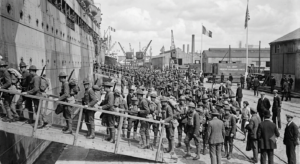
The first troops of the newly formed American Expeditionary Force came ashore at Saint-Nazaire, a port town on France’s Atlantic coast. The AEF had been built specifically for this war, and it was commanded by General John J. Pershing — a man known for his discipline and, just as importantly, for his refusal to let his soldiers be quietly absorbed into French or British units as mere replacement parts in an already exhausted war machine. Pershing insisted that American troops would fight as an American army, under American command. It was a matter of pride, but it was also strategy: a signal that this was not simple reinforcement, but the arrival of a new and distinct force on the battlefield.
What came ashore that day was modest in size — a vanguard, not yet the flood that would follow. But its significance had little to do with numbers and everything to do with meaning.
Consider what the French and British armies had endured by that point: three years of attrition, of friends lost for a few hundred meters of cratered earth, of commanders who had begun to wonder — quietly, privately — whether the war could be won at all, or whether it would simply go on consuming men until both sides collapsed from sheer exhaustion. And now, stepping off ships onto the docks, came soldiers who had not yet seen what trench warfare truly meant, who had not yet learned what mustard gas does to lungs or what a machine-gun nest does to a charging line. None of that mattered yet. What mattered was that they were there. For an exhausted continent, their mere presence was proof that the balance of the war was beginning to shift — that fresh manpower, fresh resolve, and a fresh industrial economy were now flowing toward the Allied cause.
It was also a message aimed squarely at Germany: American commitment was no longer theoretical. It was no longer a diplomatic posture that might fade with time. It was now physical, visible, and standing on French soil.
Over the months that followed, that small vanguard swelled into something enormous. By 1918, more than two million American soldiers had crossed the Atlantic, and roughly a million of them saw direct combat — fighting in engagements that would become etched into military history, among them the Battle of Saint-Mihiel, one of the AEF’s first major independent offensives, and the brutal, sprawling Meuse-Argonne Offensive, fought through dense forest and fortified German lines in the war’s final, desperate weeks.
That infusion of American manpower and industrial capacity did exactly what the Allies had hoped it would. It tipped the balance. Germany, facing a war it could no longer sustain against an opponent with seemingly inexhaustible reinforcements arriving from across the Atlantic, signed an armistice on November 11, 1918. The guns, after four years, finally fell silent.
The road from that quiet June landing at Saint-Nazaire to the railway carriage at Compiègne where the armistice was signed was long, brutal, and paid for in staggering human cost. But it began, in the most literal sense, with an act of arrival — an army that did not yet know how to fight a modern war, stepping off a boat, and announcing, simply by being there, that it intended to learn.
A Different Kind of Arrival, Twenty-Eight Years Later
If June 26, 1917 was about a nation arriving to fight a war, June 26, 1945 was about the world arriving at a decision to prevent the next one.
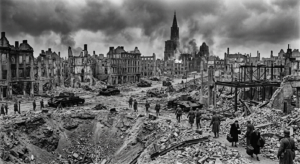
Here lies one of history’s more bitter ironies: the war that ended in 1918 was not, as so many had hoped, “the war to end all wars.” Barely two decades later, the world plunged into something even larger and more destructive — a second global war that, by its end, had claimed more than 60 million lives. Cities across Europe and Asia lay in ruins. The Holocaust had exposed depths of organized cruelty that shattered any remaining illusion that civilization automatically grows more humane with time. National economies across multiple continents had collapsed under the sheer weight of total war.
In the aftermath of devastation on that scale, there is usually one question that surfaces above all others: how do we make sure this never happens again?
It was not the first time the world had asked it. After World War I, an earlier attempt had already been made — the League of Nations, an international body designed to mediate disputes and prevent future wars through diplomacy and collective pressure. It was, in conception, a noble idea. In practice, it was fatally weak. The League possessed no real military power to enforce its decisions, and major nations frequently ignored its rulings whenever they proved inconvenient. It failed to stop German rearmament, Italy’s invasion of Ethiopia, or Japanese aggression across Asia — failures that, in hindsight, read like the slow-motion prologue to the very war that followed.
So when the guns of the second great war finally went quiet, the world’s leaders carried with them a hard-earned and uncomfortable understanding: good intentions, unaccompanied by real structure and enforceable power, were simply not enough. Whatever organization rose from these ashes would need to be built differently — and built to last.
San Francisco, Spring 1945
Even before the fighting in Europe had fully ended, representatives from fifty nations gathered in San Francisco for the United Nations Conference on International Organization. Across April, May, and June of 1945, delegates debated, negotiated, and painstakingly drafted the framework for an institution explicitly designed to avoid the fatal weaknesses that had doomed the League of Nations.
On June 26, 1945, that work reached its culmination. Representatives of those fifty nations signed the United Nations Charter — the founding document that would become the legal and philosophical bedrock of the organization that followed. Among its most influential signatories were the United States, the United Kingdom, the Soviet Union, China, and France: nations that, by virtue of their roles and power in the war just ended, would go on to become the five permanent members of the UN Security Council, each wielding the considerable — and to this day, controversial — power of veto.
The Charter was never meant to be merely ceremonial. It laid out ambitious, specific goals: to maintain international peace by resolving conflicts through diplomacy rather than force; to protect human rights and promote dignity and equality for people everywhere; to encourage international cooperation on shared challenges such as poverty, health, education, and — in a phrase that reads almost prophetically today — climate change; and to help establish a body of international law that could bind nations together under shared rules rather than the law of the strongest.
To carry these goals forward, the United Nations was structured into distinct bodies, each with a defined role. The General Assembly gave every member nation, regardless of size or power, a voice and a vote — a deliberate democratic counterweight to the world’s deep and lasting inequalities. The Security Council was entrusted with the heavier task of maintaining peace and security, holding the authority to act decisively when diplomacy alone proved insufficient. The International Court of Justice was created to settle disputes between nations through law rather than force. The Secretariat became the administrative backbone that keeps the organization’s daily work running. And the Economic and Social Council was tasked with the quieter, less glamorous, but no less essential work of coordinating cooperation on economic and social matters across the globe.
Technically, the Charter’s signing on June 26 was not the precise legal moment the United Nations came into existence — that would come later, on October 24, 1945, once enough nations had ratified the Charter at home. But June 26 remains the symbolic heart of the story: the moment fifty nations — many of which had spent years either fighting one another or watching the world burn — sat together in the same room and agreed, in writing, to attempt something genuinely different.
Two Arrivals, One Enduring Lesson
It would be easy to file these two events away as unrelated historical trivia that happen to share a date. But linger with them a little longer, and a quieter thread begins to emerge.
In 1917, the world learned that sustained, overwhelming violence eventually demands a counterforce large enough to stop it — and that such a counterforce can arrive from unexpected places, announced not by grand declarations but by the simple, physical act of showing up. The soldiers who came ashore at Saint-Nazaire did not end the war on their own. But their arrival marked a genuine turning point: proof that exhaustion was not the final word, that reinforcement remained possible, and that the balance of even the bleakest war could still shift.
In 1945, the world learned something harder, and perhaps more humbling still: that even a complete and justified victory guarantees nothing about the peace that follows, unless something durable is deliberately built to protect it. The signing of the UN Charter was, in its own way, an admission of past failure — the League of Nations’ failure — every bit as much as it was an act of hope. It represented a grieving, battered world attempting to design something sturdier than what had come before: not merely a forum for polite diplomacy, but real structures of accountability and shared responsibility.
Neither story ends cleanly or triumphantly. The American soldiers who landed in the summer of 1917 went on to fight and die in offensives that, even in victory, exacted a devastating human toll. And the United Nations, for all the nobility of its founding charter, has spent the better part of eight decades wrestling with its own limitations — vetoes that paralyze action when it is needed most, conflicts it has failed to prevent, promises of human rights and cooperation that remain, in far too many corners of the world, unfulfilled.
And yet both stories endure in memory, not because they offer perfect solutions, but because they represent genuine attempts — moments when exhausted nations chose to act rather than simply endure what came next. One was an act of military commitment. The other, an act of institutional hope. Both were rooted in the same hard-won recognition: that the world’s gravest problems are too large for any single nation to solve alone, and that showing up — whether on a dock at Saint-Nazaire or in a conference hall in San Francisco — has always been the necessary first step before anything else becomes possible.
History rarely repeats itself in neat, symmetrical patterns. But every so often, the calendar seems to nod quietly toward a pattern worth noticing. June 26 is one of those dates: a reminder, etched twice into the same square of the year, that arrival — in all its forms — has always been one of humanity’s quiet but essential acts of hope.