
Introduction: The story of Bhagat Singh is not just a chapter in history-it is a powerful tale of courage, Sacrifice, and unwavering love for the nation. Born during a time when India was under British rule, he chose the path of revolution at a very young age. While many feared the power of the British Empire, Bhagat Singh stood fearless, raising his voice against injustice. His actions were not driven by anger alone, but by a deep desire to see India free. This is the real story of a young hero whose bravery and sacrifice continue to inspire millions even today.

1. Who was Bhagat Singh?
-
Bhagat Singh was a charismatic Indian revolutionary who played a pivotal role in the Indian independence movement.
-
He is often referred to as Shaheed-e-Azam, meaning “The Great Martyr”.
-
Unlike many contemporaries, his ideology was rooted in social and economic equality, not just political freedom.
-
He was a key member of the Hindustan Socialist Republican Association (HSRA). He believed that “The sword of revolution is sharpened on the whetting-stone of ideas”.
2. Early Life of Bhagat Singh
-
Bhagat Singh was born on September 28, 1907, in the village of Banga.
-
His family, including his father Kishan Singh and uncles Ajit and Swaran Singh, were deeply involved in the anti-British struggle.
-
As a child, he was famously found “planting” guns in his family’s field, hoping they would grow to fight the British.
-
He attended Dayanand Anglo-Vedic (DAV) High School, where he was exposed to nationalist fervor.
-
He spent his youth studying the complex works of Karl Marx, Bakunin, and Leon Trotsky.
3. Why Bhagat Singh Became a Revolutionary
-
The Jallianwala Bagh Massacre (1919): At age 12, Singh collected blood-soaked earth from the site in a bottle as a permanent reminder of British cruelty.
-
The Non-Cooperation Movement (1922): Disillusioned when the movement was called off after the Chauri Chaura incident, he began seeking more direct methods of rebellion.
-
The Death of Lala Lajpat Rai (1928): Witnessing the brutal lathi-charge that killed Rai served as the final catalyst for his shift toward militant action.
4. Major Event in His Life
-
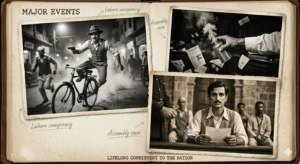
The Saunders Incident: In a case of mistaken identity while trying to kill police chief James Scott, Singh and his comrades shot John P. Saunders.
-
The Assembly Bombing (1929): Singh and Batukeshwar Dutt threw low-intensity smoke bombs into the Central Legislative Assembly to “make the deaf hear”.
-
Voluntary Surrender: He chose to surrender after the bombing to use the courtroom as a platform to spread revolutionary ideas.
-
The Hunger Strike: In jail, he led a 116-day hunger strike to demand better treatment and rights for Indian political prisoners.
5. Role in Indian Freedom Struggle
-
He provided the intellectual backbone to the movement, shifting the focus from individual acts to “Mass Revolution”.
-
Singh advocated for a socialist India where the farmer and laborer were the true owners of the nation’s wealth.
-
His arrest bridged the gap between militant revolutionaries and the common public, making him a household name.
-
His popularity at its peak was acknowledged by Gandhi as rivaling his own.
6. Death and Sacrifice of Bhagat Singh
-
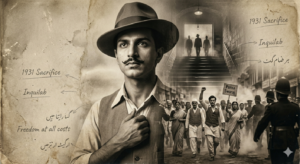
Fearing his influence, the British government executed him on March 23, 1931, eleven hours ahead of the scheduled time.
-
At the gallows in Lahore Jail, Singh remained remarkably calm, kissing the rope before his final breath.
-
He was only 23 years old at the time of his death.
-
British authorities secretly cremated the bodies near the Sutlej River to avoid public riot
7. Lesser-Known Facts About Bhagat Singh
-
Master of Disguise: He famously cut his hair and shaved his beard—a major sacrifice for a Sikh—to escape Lahore undetected.
-
Vast Reader: He finished over 300 books while in prison.
-
Last Request: His final request before execution was to finish the last few pages of a biography of Vladimir Lenin.
-
Prolific Writer: He wrote for newspapers like Akali and Kirti under various pseudonyms like ‘Vidhyarthi’.
-
Jail Diary: He maintained a diary filled with notes on poetry, politics, and philosophy that revealed his high intellect.
8. The Intellectual Legacy: Beyond the Gun
-
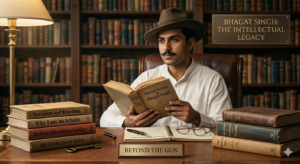
The Power of the Pen: While in prison, Bhagat Singh wrote four books, although the manuscripts were smuggled out and subsequently lost over time.
-
A Prolific Reader: His jail diary contains notes and excerpts from over 108 different authors, showcasing a global intellectual reach that included philosophers from the French and Russian Revolutions.
-
The “Why I am an Atheist” Essay: Written in 1930 while in Lahore Central Jail, this remains one of the most-searched historical documents in India, as it provides a rare look into the logic and rationality of a revolutionary mind.
9. Heritage and Memorials in 2026
-
The National Martyrs Memorial: Located at Hussainiwala, where Singh was secretly cremated, this site has seen a surge in “Heritage Tourism” as part of the 2026 initiative to revive historical landmarks.
-
Digital Archives: New immersive museum exhibitions are now using 3D modeling to recreate the Lahore courtroom where his trial took place, allowing visitors to experience the “Discovery of India” through a revolutionary lens.
-
The Bhagat Singh Archive: Recent efforts by historians have consolidated his letters—written to family and fellow revolutionaries—into digital humanities projects, making his personal thoughts accessible to a global audience.
10. Global Influence
-
International Recognition: Bhagat Singh’s philosophy of universal brotherhood and opposition to imperialism is now being studied in international universities as a key component of early 20th-century anti-colonial thought.
-
A Symbol for Youth: In 2026, he remains the most searched historical figure among Indian youth, particularly regarding his views on social justice and the “Role of the Youth” in nation-building.
Conclusion: The Eternal Legacy of Shaheed Bhagat Singh
The life of Bhagat Singh was a brief but brilliant flash of lightning in the dark sky of colonial India. He was not merely a revolutionary who believed in the power of the bullet, but a profound thinker who believed in the power of the mind. By choosing a path of self-sacrifice, he ensured that his message—a message of equality, dignity, and absolute freedom—would be carried forward by generations of Indians.
Today, as we look back at his journey from the blood-soaked soil of Jallianwala Bagh to the gallows of Lahore, we see a man who lived and died on his own terms. His sacrifice was a calculated spark meant to ignite a national wildfire, proving that while individuals can be crushed, their ideas are immortal. Bhagat Singh remains an enduring symbol of courage, reminding us that the truest form of patriotism lies in the relentless pursuit of justice for all.
Inquilab Zindabad!
*There is a one comparison Blog on Bhagat Singh and Mahatma Gandhi to get a wonderful knowledge about it then visit to my another blog on it.
*If you want a full of Bhagat Singh as per Wikipedia then visit to