1. Introduction
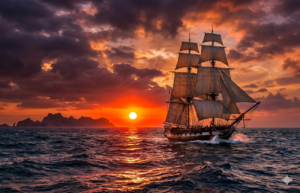
“Some journeys change maps, while some change the way humans think. The story of the HMS Beagle did both. ”History is full of famous ships. Some were built for war, some for trade, and some for discovering new lands. But very few ships ever changed human thinking itself. The HMS Beagle was one of them.
At first, the HMS Beagle looked like an ordinary British naval ship. It was not the biggest vessel in the Royal Navy, nor the most powerful. Yet this small ship became one of the most important vessels in scientific history because it carried a young naturalist named Charles Darwin on a life-changing journey.
The five-year voyage of the HMS Beagle helped Darwin develop the theory of evolution, an idea that completely transformed the way humans understand life on Earth.
2. The Birth of HMS Beagle
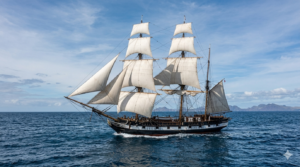
The HMS Beagle was launched in England in 1820. It was originally built for the British Royal Navy as a brig-sloop, a small but strong naval vessel.
The ship was mainly designed for:
- Naval patrol missions
- Coastal surveys
- Mapping dangerous sea routes
Although it was not a huge ship, it was perfect for long exploration journeys because it could travel through difficult coastlines and shallow waters.“At that time, nobody imagined this small ship would one day become part of one of the greatest scientific stories ever told.”
The ship first traveled to South America in the late 1820s for survey work. However, the harsh conditions of sea life caused serious stress among the crew. After the first voyage ended, the ship was repaired and prepared for another expedition that would later become world famous.
3. Captain Robert FitzRoy and Charles Darwin
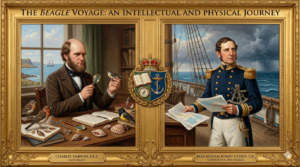
The second voyage of the HMS Beagle was led by Robert FitzRoy, a skilled captain who wanted the expedition to include scientific research.
FitzRoy searched for a naturalist who could study:
- Animals
- Plants
- Rocks and fossils
- Climate and geography
That opportunity went to Charles Darwin, who was only 22 years old at the time. “What makes this story even more interesting is that Darwin himself had no idea how important this journey would become.”
Darwin loved nature and scientific observation, but he was not yet famous. In fact, nobody imagined that this young man would later become one of the most influential scientists in history.
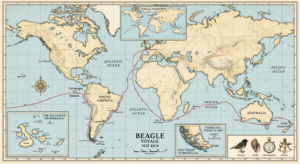
On December 27, 1831, the HMS Beagle sailed from England and began its historic journey.
4. Life Aboard the HMS Beagle
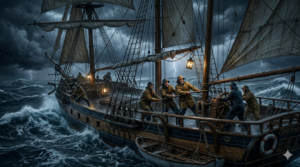
Life on the ship was far from comfortable.
The crew lived in:
- Cramped cabins
- Wet and humid conditions
- Constant movement from ocean waves
Darwin suffered badly from seasickness throughout much of the voyage. His cabin was tiny, and he often had to work among boxes filled with specimens and scientific tools.
Food was limited and repetitive, while storms frequently made travel dangerous. “Sometimes the storms were so violent that sleeping became almost impossible for the crew.”
Despite these hardships, Darwin remained deeply curious about the world around him. Whenever the ship stopped near land, he explored forests, mountains, beaches, and villages with excitement.
5. Exploring South America
South America became one of the most important parts of the journey.
The HMS Beagle visited:
- Brazil
- Argentina
- Chile
- Uruguay
- Peru
In Brazil, Darwin was amazed by tropical rainforests filled with colorful birds, insects, and giant trees.
In Argentina, he discovered fossils of giant extinct animals. Some looked similar to modern sloths and armadillos but were much larger. “These discoveries slowly started filling Darwin’s mind with questions that science couldn’t fully answer at the time.”
These discoveries made Darwin wonder:
Why did extinct creatures resemble living animals from the same region?
This question slowly pushed him toward new ideas about evolution.
6. Earthquakes and Geological Discoveries
Darwin also became interested in geology during the voyage.
While visiting Chile, he experienced a massive earthquake. He saw buildings collapse and noticed changes in the landscape.
Later, while exploring the Andes Mountains, Darwin found marine fossils high above sea level.
This suggested that:
- Mountains had once been underwater
- Earth changed slowly over millions of years
These observations supported the ideas of Charles Lyell, who believed Earth was extremely old and constantly changing.
This understanding later became very important for Darwin’s theory of evolution.
“For Darwin, these moments were proof that Earth was far older and more dynamic than many people believed.”
7. The Galápagos Islands: The Turning Point
The most famous stop of the HMS Beagle journey was the Galápagos Islands.
The islands contained strange and unique animals found nowhere else on Earth.
Darwin carefully studied:
- Finches
- Giant tortoises
- Marine iguanas
- Different plant species
He noticed that finches on different islands had different beak shapes depending on their food sources.
For example:
- Some had thick beaks for seeds
- Others had thin beaks for insects
This observation later helped Darwin und .“It’s surprising to think that a few small birds would later help change the entire field of biology.” erstand that species adapt to their environments over time.
The Galápagos Islands became the most important inspiration behind his theory of evolution.
8. The Theory of Evolution
After returning to England in 1836, Darwin spent years studying his notes and specimens.
Gradually, he developed the theory of evolution through natural selection.
The theory explained that:
- Living organisms vary slightly from one another
- Helpful traits improve survival chances
- Those traits are passed to future generations
- Species slowly change over long periods of time
In 1859, Darwin published On the Origin of Species. “Darwin spent years thinking carefully before sharing his ideas because he knew they would create controversy.”
The book shocked the world because it challenged traditional beliefs about life and creation.
However, over time, scientific evidence strongly supported Darwin’s ideas.
Today, evolution is one of the foundations of modern biology.
9. Scientific Importance of the HMS Beagle
“Over time, people realized this wasn’t just another sea expedition — it was a journey that completely changed science.”
Its impact can be seen in:
- Biology
- Geology
- Zoology
- Ecology
- Navigation and mapping
The journey helped scientists better understand:
- Earth’s history
- Animal adaptation
- Fossils and extinct species
- The diversity of life on Earth
Most importantly, it changed how humans viewed nature itself. “Even today, students, historians, and scientists continue to learn from Darwin’s journey.”

10. The Final Fate of the Ship
After its famous expedition, the HMS Beagle continued serving the British Navy for several more years.
Eventually:
- The ship stopped sailing
- It became a coastguard vessel
- It was later sold for scrap in 1870
Although the physical ship disappeared, its historical importance never faded.
Today, the HMS Beagle is remembered as one of the most influential ships ever built.
11. Why the HMS Beagle Still Inspires People
The story of the HMS Beagle continues to inspire people because it represents:
- Curiosity
- Exploration
- Scientific thinking
- Human determination
Darwin’s discoveries were not made in a laboratory overnight. They came from years of careful observation, travel, and questioning.
The voyage reminds us that great discoveries often begin with simple curiosity about the world around us.
12. Conclusion
The HMS Beagle was much more than just a ship. It became a symbol of discovery and scientific revolution.
What started as a simple survey mission eventually changed humanity’s understanding of life itself. Through fossils, strange animals, earthquakes, and distant islands, Charles Darwin slowly developed ideas that transformed modern science forever.
More than 190 years later, the story of the HMS Beagle still captures the imagination of historians, scientists, and students around the world.
“Personally, I think the HMS Beagle proves that curiosity can sometimes change the world more than power or weapons ever could.”
It proves that sometimes even a small ship can carry ideas powerful enough to change human history forever.